How to Keep the Promise of the Third Billion
A new index of countries links their future prosperity to raising the status of women.
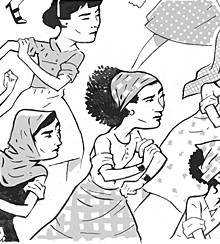
Illustration by Lars Leetaru
As political leaders around the world continue to struggle with economic headwinds, many of them are neglecting one of their most significant opportunities: raising the status of women, especially those in emerging economies. Nearly 1 billion women could enter the global economy in the next decade, moving into roles as employees, executives, and entrepreneurs. So far, many of these individuals have been economically stunted, underleveraged, or held back, to the point where they are invisible to the global economy. By standing in the way of women, countries are letting a valuable resource sit idle.
The Third Billion: Empowering Women, Powering the Global Economy
What will be the impact of nearly 1 billion women entering the global labor force by 2020? Watch this video to understand how global, social, and economic growth will rise with the arrival of the Third Billion.
Who are these women, and why is their status so important? According to data from the International Labour Organization, a United Nations agency that tracks global workforce statistics, roughly 865 million women will be of working age (between the ages of 20 and 65) by 2020, yet will still lack the fundamental prerequisites to contribute to their national economy. Either they don’t have the necessary education and training to work, or—more frequently—they simply can’t work, owing to legal, familial, logistical, and financial constraints. Of these 865 million women, 812 million live in emerging and developing nations.
We call this group the Third Billion, because its economic impact will be just as significant as that of the billion-plus populations of China or India (see “The Third Billion,” by DeAnne Aguirre and Karim Sabbagh, s+b, Summer 2010).
This is a far more complex problem than fostering economic growth in a single country, because women are scattered around the globe and they face a range of obstacles. In both developed and developing economies, women have lower rates of labor-force participation and receive lower pay than men for the same work. The economic gains among this group have often come despite strong societal forces opposing them. Indeed, the factors that keep women out of national economies are so widespread and interconnected that governments and companies seeking to help the Third Billion have hardly known where to start.
Now, however, a new body of quantitative evidence shows, country by country, how best to empower women and leverage this valuable asset. A clear set of policies has emerged that will put more women into the workforce and foster more women-owned businesses, leading to stronger and healthier societies and more competitive national economies.
Policies That Empower
These guidelines were a result of the Third Billion Index, an in-depth research project conducted to assess the performance of more than 100 countries in economically empowering women. To reach these conclusions, our team of Booz & Company researchers started with economic data from the World Economic Forum and the Economist Intelligence Unit, both of which study the workforce gender gap and women’s economic issues.
Each organization publishes a gender parity index that is fairly broad. Between them, they cover all aspects of women’s well-being—including access to healthcare, legal rights, and political participation. However, we excluded those issues from our analysis, in order to focus specifically on the world of work. In doing so, we did not wish to downplay these issues; instead, our goal was to isolate the factors that directly correlate to economic empowerment for women, akin to controlling for certain variables in a laboratory experiment.
Our model looked at the performance of countries based on three specific groups of “inputs,” or policies put in place to bolster women’s economic power. These were equal education opportunities for girls; access-to-work laws; and entrepreneurial support (such as credit, training, and other forms of assistance).
Next we looked at “outputs,” or indications of how well women had been integrated into national economies. Our three output groups were inclusion (female labor force participation); advancement (the number of women among professional workers, business leaders, and company owners); and equal pay for equal jobs in practice.
The central hypothesis of the Third Billion Index was that stronger inputs should correlate with stronger outputs: The stronger the policies for their empowerment, the greater the economic status of women would be. The findings strikingly backed up this hypothesis. Countries that have a solid foundation of inputs—policies aimed at giving women a footing equal to that of men in the workplace and in the national economy—have yielded significantly better results. The linkage is clear, and governments need not experiment or wonder what might work.
Some countries have already put these policies into place and are generating results. For example, Argentina, one of the countries that showed a strong correlation between inputs and outputs, was among the first Latin American nations to enact legislation regulating working conditions for women and children. It has a strong education system, in which more girls complete secondary and tertiary education today than boys. (Although this is true of some other emerging economies, it’s rare in Latin America.) Women have advanced in the political sphere as well: Since 2007, the country has had a female president, Cristina Fernández de Kirchner, and women account for 24 percent of the national parliament—the highest proportion in the world.
Similarly, Japan has a strong legal foundation of support for women. Its constitution mandates gender equality, and the country passed equal opportunity laws back in 1986. Additional policies have followed, such as the 2001 law on men and women’s common social participation, which aims to eliminate discrimination against women. As a result, Japan has a relatively high rate of female participation in the workforce.
More broadly, research on the Third Billion suggests that economically empowering women spurs GDP growth. Our estimates, which are conservative, indicate that if female employment rates were to match male employment rates in the United States, overall GDP would increase by 5 percent. In Spain, such a change could raise GDP by 10 percent. In developing economies, the effect is even more pronounced. The United Arab Emirates would see a boost of 12 percent in GDP, and the Egyptian economy would grow by 34 percent.
Finally, these policy initiatives don’t merely benefit women. Rather, they improve socioeconomic conditions for everyone. In addition to inputs and outputs, we analyzed a third set of data points that we called “outcomes,” such as per capita GDP, literacy rates, and infant mortality. These were independent of the input and output variables, but we hypothesized that countries with strong performance in economically empowering women, as measured by the first two sets of variables, would have stronger performance in these societal measures as well.
Again, the correlation that we had expected to see showed up clearly in the results. Positive steps intended to economically empower women not only contribute to the immediate goals of mobilizing the female workforce, but also appear to lead to more widespread gains for all citizens, such as economic prosperity and improvements in health, early childhood development, security, and freedom.
Relative Progress
The economic advancement of women doesn’t just empower women; it correlates with greater overall prosperity. This idea has been a consistent theme in the literature of women’s issues, but it is typically argued with anecdotal rather than quantitative results. Our findings suggest that economically empowering women is a key to greater societal gains. One reason is that women entering the workforce increase the overall labor force, making countries more productive and increasing GDP.
There is a multiplier effect as well. Women are more likely than men to invest in their children’s education, which can lead to a boost in economic growth, especially as those children grow up and enter the workforce themselves. Moreover, women who are economically active tend to have fewer children, and this often translates to fewer children living in poverty.
“Giving women the chance to become financially independent and make the most of their talents is the key to higher living standards and stronger economies,” says Cherie Blair, founder of the Cherie Blair Foundation for Women, which supports entrepreneurs in Asia, Africa, and the Middle East. “This is more true today than ever before. With the global economy still struggling through a slow and spotty recovery, it is in everyone’s interest to help women make the most of their potential. No real social progress is possible without the economic progress of the Third Billion.”
Before anyone pops open the champagne, we need to emphasize that the notable achievements, in virtually all cases, represent relative progress, not absolute success. Many of the countries that scored highest in our rankings benefited from comparisons against others with poorer track records in empowering women. For example, Germany ranked very high in the equal-pay category, along with other developed nations such as Australia, the Netherlands, Norway, and Sweden. However, women in virtually all of these countries still earn lower salaries than men. In Germany, women on average earn 23 percent less than men earn for similar work.
Some of that disparity stems from structural differences. German women with greater family responsibilities and obligations often choose to avoid demanding careers that require long hours and frequent travel. However, even correcting for these differences and assessing only the salaries of men and women holding similar jobs, with similar tenure and qualifications, there is a salary gap of approximately 8 percent. That’s better than most other countries, and it represents a genuine advance, but it’s still not equal pay for equal work.
Similarly, in the U.S., although women are rising into the ranks of middle management, many are not yet taking the final step into senior positions. In 2011, women held just 16.1 percent of board seats at Fortune 500 companies and 14.1 percent of senior executive positions. Less-developed countries have even worse records: A World Economic Forum survey of Indian employers in 2010 found that women employees held just one in 10 of the senior management positions at responding companies.
Common Challenges
The women who make up the Third Billion are not a homogeneous demographic bloc. They represent a multitude of nationalities, ethnicities, and religions. They live in cities, in small towns, in villages, and on farms. They are young and old, married and single, experienced and inexperienced. Finally, they are products of the places where they live, with the constraints and opportunities unique to those regions, countries, states, and cities. And as such, they require an array of customized solutions to help them reach their potential.
There are many reasons that countries around the world have failed to realize the economic potential of women. Our analysis groups these reasons into two deficiencies: Women are either (1) not prepared or (2) not enabled to join the workforce. “Prepared” refers to having received a sufficient education, usually defined as the completion of secondary school. As women progress through rising education levels, they gain a sense of empowerment that allows them to make more decisions and participate in the labor market. “Enabled” refers to having sufficient social and political support to engage with the labor market. This support spans family, logistical, legal, and financial dimensions.
The precise blend of policy initiatives and private-sector efforts to economically empower women and prepare them to enter the workforce will vary according to local needs. In general, however, most countries will have to address a similar set of challenges.
The burden of care. In rich and poor countries, the responsibility for children, the sick, and the elderly falls almost exclusively on women. Women in the countries of the Organisation for Economic Co-operation and Development (OECD) spend about 2.4 hours more than men on unpaid work (including care work) each day. In less-developed countries, unpaid work also includes household chores that compensate for a lack of infrastructure, such as getting water and finding fuel. One study found that if care work were assigned a monetary value, it would constitute between 10 and 39 percent of GDP.
Many of these practices are grounded in deep cultural norms. In China, for example, eldercare is viewed as a woman’s tianzhi, or heavenly duty. As a result, some 95 percent of Chinese women have eldercare responsibilities, and 58 percent help support their parents financially. In Brazil, education policies add to the burden on women. The standard school day is just four hours in some regions of the country, requiring that women take care of children during the remainder of the day (and leading to lower education outcomes as well).
Governments can intervene to better care for these populations and free women to work if they choose. This intervention need not take the form of state-run facilities. Even policy shifts can spread the responsibility for care. For example, several years ago, Germany began offering a bonus of two months’ pay if fathers took paternity leave; the number of fathers exercising this option doubled in the first year. The private sector can take steps to address this issue as well, through more flexible work schedules and by offering on-site day-care facilities.
Lack of credit. Credit is another universal issue affecting women. Many women’s lending programs thus far have been limited to microcredit—systems based on small loans backed up by community activity. These are better than nothing, but their impact is often limited to small, informal businesses in the service sector, rather than startups in key sectors such as technology. In other cases, lending policies unfairly burden women. In China, for example, many lenders base loan decisions on collateral, rather than cash flow. This particularly affects Chinese women, who have far lower rates of property ownership than men in the country.
Clearly, governments cannot—and should not—simply force banks to lend to a specific business segment, including women-owned businesses. Those kinds of heavy-handed interventionist approaches have the potential to damage the credibility of recipients. Yet regulators can at least ensure that the playing field is level. A recent study in Italy found that women running small businesses were charged higher interest rates than men for overdraft privileges, even though the women had slightly better credit histories than the men. Moreover, for key industries that a country seeks to foster, such as technology, the government can create tax breaks and other incentives to direct capital to areas where it can do the most good.
Insufficient representation in upper management. The glass ceiling persists. Study after study shows that boards of directors and C-suite executives are still overwhelmingly male, even in countries where women now represent a higher percentage of college graduates than men and even more of the overall labor force in many countries. Thus, the European Commission is exploring the use of quotas to promote gender parity on boards. Some countries, including France, Iceland, Italy, Norway, Spain, and Sweden, have adopted such quotas voluntarily. Deutsche Telekom has promised that by 2015, 30 percent of its leadership positions will be held by women.
The use of quotas may seem like a blunt instrument, but it should be seen as a stopgap measure until cultural and business mores have evolved sufficiently and women can take their rightful place on the executive floor. When Norway introduced boardroom quotas nearly 10 years ago, the policy was controversial. Yet it has generated results. In 2003, only 7.3 percent of Norwegian board members were women. By 2006, the number had increased to 21 percent, and today it is nearly half. As with credit, simply leaving this issue up to market forces is not likely to result in a more equitable split between men and women.
Lack of support for entrepreneurs. Finally, female business owners need structured support. The challenges they must overcome to succeed are so widespread and numerous that they cannot make it alone. In developed economies, they need access to energy and technology. In developing markets, they need training in basic business functions.
Networking is another critical aspect of this support, and one that often requires concerted efforts from both the public and private sectors in developing economies. A Booz & Company survey of 175 entrepreneurs in Saudi Arabia found that more than three-quarters of respondents received no encouragement from teachers or mentors to start their companies. Perhaps predictably, among women entrepreneurs, 60 percent of companies were in a handful of sectors where women traditionally launch startups: retail, service, and education. Recent changes in Saudi laws now allow women to invest in higher-growth areas such as real estate and construction, yet if they are to succeed in these fields, they will need access to networks and contacts.
There is no one perfect solution that will boost female entrepreneurship, yet a number of measures can help. Governments can give priorities to women-owned businesses for procurement contracts. Companies can take similar steps to ensure they have a diverse supply chain. Successful women can mentor their younger counterparts, and female investors can provide or lend capital to promising young women with good ideas for new companies.
The women of the Third Billion have the potential to become a tremendous economic force in global markets over the coming decade. The countries and companies that can harness this force and economically empower women—as employees, entrepreneurs, and executives—will gain a clear edge.
If the social benefit of economically empowering women is not sufficient rationale to act, the sheer business opportunity should tip the scales. As Caroline Anstey, managing director of the World Bank, said at a women’s entrepreneurship event in 2011, “Gender equality is good in and of itself, and it is smart economics. But [equality] alone never seems to convince anyone.” The findings of the Third Billion Index provide a set of operating instructions for how to go about economic empowerment: education for girls, policies that give women access to work opportunities if they choose to take them, and support for entrepreneurs. These measures represent investments for the future—not just in women, but in stronger, more prosperous businesses and societies. 
Reprint No. 00137
Author profiles:
- DeAnne Aguirre is a senior partner with Booz & Company based in San Diego. She leads the firm’s work on organizational and talent effectiveness.
- Leila Hoteit is a principal with Booz & Company’s Middle East public-sector practice, where she focuses on human capital development.
- Karim Sabbagh is a senior partner with Booz & Company and the leader of the firm’s communications, media, and technology practice in the Middle East. He is also chairman of the Ideation Center, Booz & Company’s think tank in the Middle East.
- Also contributing to this article were Booz & Company partner Christine Rupp, senior associate Joanne Alam, and senior research analyst Mounira Jamjoum, contributing writer Jeff Garigliano, and former Booz & Company senior editor Melissa Master Cavanaugh.
- The not-for-profit La Pietra Coalition maintains a website on the Third Billion Campaign: www.thethirdbillion.org/.
- For the Booz & Company Third Billion Index, see strategyand.pwc.com/global/home/what_we_think/third_billlion.