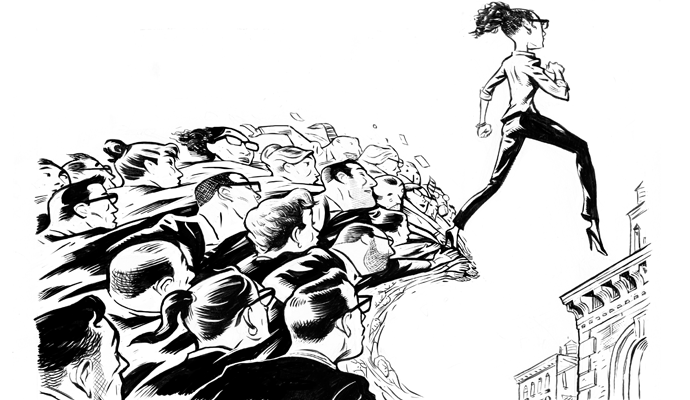
Seven Chapters of Strategic Wisdom
A shortcut to the big themes in the conversation about corporate strategy.
(originally published by Booz & Company)

Photograph by Matthew Septimus
As of October 2009, the Amazon.com category for business strategy featured more than 74,000 books. Confronted with this mass of material, the despairing reader of management literature who just wants the essence of what it takes to compete successfully might well ask how much of the accumulation is really necessary. In fact, most readers of strategy books would probably agree that these tomes would nearly all work better as articles of, say, 3,000 words.
Strategy itself is a distillation; it’s a tight, internally coherent statement of what a company is and wants to be. It may take weeks of data gathering to get the plot points for charting a new corporate direction, and days of managerial deliberation to boil it down to a set of actions, but the statement itself ought to be no longer than a few sentences. An employee woken by flashlight at 2 a.m. and quizzed on the subject should be able to spell it out in a minute or two. If that’s the ideal form, why should anyone require 400 pages to explain what a strategy is or how to create one?
THE STRATEGY+BUSINESS COLLECTION: THE EXECUTIVE GUIDE TO STRATEGY
 This article is featured in the strategy+business compendium “The Executive Guide to Strategy,” designed exclusively for smartphones and tablets. The collection features our best thinking on creating and implementing the right strategy for your organization—with insights from top leaders including Capable Strategist author Ken Favaro, HBS Professor Cynthia Montgomery, strategy expert Ram Charan, and Kellogg School’s Mohanbir Sawhney.
To download, select your device:





In that spirit, what follows is a review of the best writing on strategy: not books, but seven of the best chapters from books related to the topic. None will tell you all you need to know to make great strategic decisions; that’s impossible to summarize, for reasons that a couple of the chapters will explain. But taken together, the seven cover the major themes running through the modern conversation about corporate strategy, a conversation that got started only as recently as the 1960s. The first three chapters (by Alfred D. Chandler Jr., Kenneth Andrews, and Michael E. Porter) and perhaps the last (by Henry Mintzberg) might be considered canonical; any serious history of the discipline would probably include them. All seven serve up insights that every student of strategy, whether practitioner or academic, should keep in mind. Amid all the seriousness are even a few witty surprises.
Structure and Self-definition
Alfred D. Chandler Jr.’s Strategy and Structure: Chapters in the History of the American Industrial Enterprise, originally published by MIT Press in 1962, wasn’t the first book to use the term strategy in connection with business, but it was the first to grapple with the concept in a way that informed much subsequent discussion. The book was a work of history, essentially about how four giant companies — DuPont; General Motors; Standard Oil of New Jersey; and Sears, Roebuck and Company — changed their organizational structures to meet the challenges of the early 20th century. In his introduction, effectively the book’s first chapter, Chandler set out the key concepts that would emerge from his narrative.
The definition of strategy he provides will likely strike today’s readers as massively ho-hum: “the determination of the basic long-term goals and objectives of an enterprise, and the adoption of courses of action and the allocation of resources necessary for carrying out these goals.” You had to be there, in the torpid corporate mind-set of the 1950s and early 1960s, to appreciate what a departure Chandler’s idea represented. Most companies felt themselves largely at the mercy of market forces, with little of the knowledge they would need to truly determine their own future. They might make a few plans, but they didn’t have any framework for plotting the course of their growth using an integrated understanding of costs, customers, and competition.
The corporate histories Chandler recounted caught this note of passivity or, at least, inadvertence in establishing strategic direction. Strategies weren’t the product of heroic, one-time decision making by top management; they grew instead out of a series of smaller, almost ad hoc decisions — decisions to enter a new territory to seek out new customers, or to respond to problems in a particular market by introducing a new product. (See “Professor Chandler’s Revolution,” by Art Kleiner, s+b, Second Quarter 2002.)
Chandler himself was more interested in the organizational aspect of his tale than in the strategic. His main conclusion, and the idea for which his book is principally remembered, is that “structure follows strategy.” The lines of the organization chart, which may seem arbitrarily drawn, actually reflect the path laid out by business decisions. As his four subject companies spread nationwide to serve the American market, for example, they were almost forced to organize themselves into relatively freestanding divisions, in which division heads had profit-and-loss responsibility for operations that integrated functions from production through sales.
In his book’s introduction, Chandler was the first to lay out some of the themes that would later become recurrent, even gospel, as thinking about strategy evolved. A strategy is a response to changes in a business’s environment, he wrote. It concerns itself with the long term, not so much the day-to-day. Responsibility for creating it lies with top management, or what Chandler quaintly called the company’s “general office,” as opposed to division or department headquarters. (Peter Drucker hadn’t yet institutionalized the term management for either the function or the team doing it.) Chandler argued that there is a distinction between making strategy and implementing it, which is a distinction that still bedevils discussions of the subject. The historian also broached more subtle notions whose importance would become clear over time: that innovation is the driving engine for most successful strategies, and that strategy without structural change produces few gains in a company.
Although H. Igor Ansoff published his book Corporate Strategy: An Analytic Approach to Business Policy for Growth and Expansion (McGraw-Hill) in 1965, to my eyes the first work to organize itself entirely around the core idea is The Concept of Corporate Strategy, published in 1971 by Kenneth R. Andrews, a Harvard Business School professor. In its second, central chapter — which bears the same name as the book — Andrews made what we might think of as the grand existential claim for strategy, asserted in the conclusion to his definition of the term: A strategy is “the pattern of major objectives, purposes or goals and essential policies and plans for achieving those goals, stated in such a way as to define what business the company is in or is to be in and the kind of company it is or is to be.” (That will be the last definition quoted in this review, I promise.) By the mid-1970s, thanks in large part to the efforts of the Boston Consulting Group (BCG) — a relentless publicity machine for strategy, which the firm had taken as its specialty — most businesspeople were familiar with the concept and the imperative for creating one, even if they didn’t necessarily agree on what should go into it.
Besides proclaiming the big S as the central act of corporate self-definition, Andrews recited a formidably long list of elements required for the package to be complete. To capture the “present and projected character of the organization,” a strategy should indicate the company’s choice of products, markets to be served, channels to reach those markets, means of financing the operation, and profit objectives — which could be stated in earnings per share or return on investment. His criteria for evaluating a strategy included a few whose good sense is made all the more striking by the degree to which some subsequent practitioners neglected them: Does your company have the resources, including the skills, it will need to carry out the grand scheme? Is the level of risk appropriate? Have you bothered to tell your people what you intend to do? Other criteria will impress financially hyperfocused types, including hard-core Milton Friedmanites, as outrageous: Does the strategy make the “desired level of contribution to society”? And does it fit with the “personal values and aspirations of key managers”?
The Competitive Position
To sensibilities hardened by the corporate wars of the last 30 years, one omission by Andrews and Chandler stands out: They barely mention competition. Ah, for the halcyon days, extending for a couple of decades after the end of the Second World War, when the biggest companies (most of which were American) didn’t have to worry about such annoyances. By the time Michael E. Porter published Competitive Strategy: Techniques for Analyzing Industries and Competitors in 1980, that world was gone. And a message that management consultants had been trying to hammer home for a decade or more had finally begun to penetrate even the most refractory corporate minds: The main point of crafting a strategy was to achieve competitive advantage.
“Generic Competitive Strategies,” the lyrically titled second chapter of Porter’s famous opus (now in its 60th-plus printing) is notable in at least three respects. For starters, as Porter admits, it’s the only chapter in the book that is actually about strategy. The rest all focus on teaching the reader how to analyze industries. And whereas Andrews had resolutely refused to be prescriptive — he declined to lay out examples of particular strategies that might suit companies in particular situations, and indeed didn’t seem to believe that identifiable strategic archetypes even existed — Porter was bracingly clear that you probably had only three alternatives.
First, you could pursue overall cost leadership, essentially aiming to be the low-cost producer in an industry. (As examples Porter cited Briggs & Stratton in small-horsepower electric engines and Lincoln Electric in arc-welding equipment.) This should also mean that you were a market-share leader, your size affording a cost advantage that smaller players were never likely to catch up with. Second, you could seek differentiation, turning out a product or service perceived as unique (Caterpillar Tractor in construction equipment). Third, you could choose to focus, concentrating all your efforts on a particular set of buyers, a geographic territory, or a product segment (Illinois Tool Works in specialty markets for fasteners). And woe betide the company “stuck in the middle,” as Porter put it; if you hadn’t achieved advantage in one of the three ways but persisted in combining a little of each, you would be headed for nothing but trouble.
Despite the fact that it’s a mere 13 pages long, Porter’s Chapter 2 also provides what is in effect a handy recap of some concepts that had sparked interest in strategy over the preceding decade. For example, his cost-leadership option builds on the menacing logic of the experience curve, a construct advanced by BCG. The experience curve posited that any company’s overall costs would decline predictably the more it focused on one particular category of product. With the accumulated experience of turning it out, the capabilities of the company increased. The competitor with the most experience should thus be able to produce the best product at the lowest cost, which advantage it should be able to perpetuate by maintaining the largest market share and continuing to drive down the curve faster than its rivals.
An Emergent Backlash
Only two years after Porter’s book appeared, the modern strategy revolution had been under way long enough to provoke a backlash. In Search of Excellence: Lessons from America’s Best-Run Companies, published in 1982, is chiefly remembered today for its sales — around 6 million copies — a few management lessons (stick to your knitting, stay close to the customer), and the fact that in short order a hefty percentage of the best-run companies featured therein fell off their pedestals. (Where is the Data General, Digital Equipment, or Westinghouse of yesteryear?) But authors Thomas J. Peters and Robert H. Waterman Jr. also offered up one of the first powerful critiques of strategy as an exercise in numbers and charts, one that neglected the human energies and aspirations necessary to make any business go.
Their second chapter, “The Rational Model,” pilloried the prevailing strategic approach for its simple-minded assumptions — that bigger was better, that low cost was a surefire winner, and that a manager’s job was to make decisions. More subtly, it enumerated the often pernicious effects of management’s retreating to what the authors described as “analytic ivory towers,” citadels of executive decision making isolated from the cut-and-thrust of everyday operations. A company that followed the then dominant model of strategy would end up focused almost entirely on costs, to the neglect of quality or value. Experimentation and its handmaiden, mistakes, would be discouraged.
Instead, In Search of Excellence pointed toward a different, more organic view of strategy, one that came to be known as “emergent” — in contrast to the “positionist” school. A positionist such as Porter (and of course we’re oversimplifying here, as any brief intellectual history must) believes that you should conduct a rational analysis, decide on the competitive position you wish to occupy, develop the strategy to get there, then execute.
Fat chance, counter those of the emergent persuasion. Unless you’re a startup, you begin with the hand that you’ve been dealt. You go from there, with all the existing strengths and weaknesses, setting off in a general direction. You run into reality — including markets, products, and competitors that don’t behave the way you expect them to, learn from your mistakes, make corrections, and “execute like hell” (as Jack Welch would later advise). In the process, your strategy emerges.
The 1980s were not kind to positionists. As deregulation and increasingly global competition spread the liberating effects of free markets, companies had greater difficulty holding the strategic ground they thought they had staked out for themselves. To maintain your existing competitive advantage, or, even better, to create a new one, you would have to build into your strategy the capacity to innovate: to make big bets on new products, services, even management processes that gave you an edge over competitors. In Richard N. Foster’s 1986 book, Innovation: The Attacker’s Advantage, this imperative was nicely tied in with one of the enduring intellectual legacies of the positionist school: the notion that behind many successful strategies is an exercise in pattern recognition.
Not experience curves this time, but rather S-curves. In the fourth chapter of his book, “The S-Curve: A New Forecasting Tool,” Foster recounts how the progress of an emerging technology typically begins with a period of slow, grinding performance improvement — the flat bottom of the “S” — then takes off, shooting upward before finally leveling off into maturity. His examples include the rate at which artificial hearts improved and watches became thinner.
What gave Foster’s insight its strategic punch was his observation that such curves typically come in successive waves, with the performance curves of newer technologies starting higher up than the curves of previous technologies. Each new technology grows slowly at first, but eventually improves so rapidly that it puts its older rival technologies out of business. And most companies can’t jump from one curve to the next. Every strategist should have in her or his desk drawer a copy of Foster’s chart (admittedly, you have to go to Chapter 5 to find it) that shows that the list of the top three companies in vacuum tubes (RCA, Sylvania, GE) bears no relation to the list of industry leaders in the next wave, transistors (Hughes, Transitron, Philco), which in turn looks nothing like the list of the companies that came to dominate semiconductors (TI, Motorola, Fairchild).
Paranoia Strikes
You’d better be an attacker, even if it means innovating to supplant your current technology. Just how difficult it is to pull this off, or to make any major change in strategic direction, is wonderfully captured in “Why Not Do It Ourselves?” the fifth chapter in Andrew S. Grove’s Only the Paranoid Survive: How to Exploit the Crisis Points That Challenge Every Company, published in 1996. Grove tells how in 1985 he and Gordon Moore realized that Intel, the company they led, needed to get out of the business on which it was founded, making semiconductor memory chips, to concentrate instead on microprocessors. The reaction they encountered as they navigated their company through this “strategic inflection point” won’t surprise anyone who has tried to effect change in an organization. “How can you even think of doing this?” came the chorus from the heads of the company’s memory-chip operations. “Look at all the nifty stuff we’ve got in the pipeline” (even if we are losing our collective shirt to low-cost Japanese competitors).
Grove and Moore persisted, even though the effort entailed shutting down plants, laying off thousands of employees, and giving up what many thought of as the company’s birthright. Intel’s subsequent success in microprocessors, beginning with its celebrated “386” model, would soon make it the world’s largest semiconductor company. Read over the tale of what it took to get there if, in a delusional moment, you’re ever tempted to think that putting strategy into practice is easy, even a seemingly emergent strategy.
The emergent school did get one huge point exactly right: You can’t predict the future, no matter how many studies you amass or alternative scenarios you gin up. Critics have used this sad fact to bash the whole idea of strategy. Why should companies go to the trouble if the future isn’t going to turn out the way anyone expected? In this they miss a crucial distinction. Figuring out and having a strategy for your company isn’t the same thing as so-called strategic planning, which almost never works.
You need to know who your customers are, who you compete against, and how your costs and capabilities stack up against those of your rivals. (At the beginning of the strategy revolution, a surprising proportion of companies didn’t have much grasp of the last two.) Most important, you have to understand, the more viscerally the better, what your competitive advantage is and how it is to be tended and enlarged. Arriving at such an understanding is not the same as spending weeks each year concocting projections of what toaster sales will be in northwest Brazil three years hence. This is one reason firms such as BCG and Bain & Company vastly prefer to work with the line executive in charge rather than with the corporate planners who labor over such projections. Some pioneers of strategy consulting have told me with great pride that over the course of 30-year careers they never wrote, or helped write, a single strategic plan.
The Evolving Irrationalists
Should you or your company get the urge to write such a plan, merely consult Chapter 5 (“Fundamental Fallacies of Strategic Planning”) of Henry Mintzberg’s The Rise and Fall of Strategic Planning, published in 1994. In it the Canadian scholar — author of half a dozen other books on strategy — recounts and demolishes the reasoning behind three fundamental fallacies of strategic planning. He starts with the fallacy of predetermination, describing why most forecasts are nonsense (they almost inevitably fall prey to unanticipated developments thrown at companies by the real world). He then proceeds to the fallacy of detachment: Why would anyone think that the people making strategy could or should be isolated from the legions charged with carrying it out? Finally, as probably the head druid of the emergent school, Mintzberg beats up on the fallacy of formalization, the idea that any detached analytic process could capture all that needs to go into charting the corporate destiny. No planning drill, however rich, can capture all the intuitions and nuanced judgments of the experienced manager responding to ever-changing business reality. As a bonus, Mintzberg debunks the concept of “marketing myopia” as presented by economist and Harvard Business School professor Theodore Levitt. Thinking of yourself as a “transportation provider” rather than as a railroad company inevitably results in your taking your eye off the ball of what you need to run a good railroad.
For all the fun he has exposing the folly of planning, Mintzberg recognizes that a company must have a strategy, albeit a living, breathing, in-the-heads-of-everybody and ever-ready-to-be-modified version of the thing. How else, he asks, will it be ready to meet all the uncertainties that await it?
Writings on strategy continue to evolve as academics and practitioners seek to cope with new realities. Much of their effort centers on how to make a company’s people — their talents and connections — the basis for its strategy. Other thinkers, fascinated by how Linux grew up to pose a challenge to the likes of Microsoft, are trying to incorporate network analysis into their calculations. Probably the hottest term in discussions these days is adaptive — as in “How can we make sure our strategy continuously, indeed almost automatically, adapts itself to our changing circumstances?” Although it’s too early to know what will be the enduring chapters on these salients, nobody need worry that the great river of literature on strategy will dry up anytime soon. 
Reprint No. 10109
Author profile:
- Walter Kiechel III has served as the managing editor of Fortune and the editorial director of Harvard Business Publishing. His book The Lords of Strategy: The Secret Intellectual History of the New Corporate World is scheduled for publication in March by Harvard Business Press.