

Smart Customization: Profitable Growth Through Tailored Business Streams
As markets atomize, a striking new approach emerges to profitably serve fragmenting demand.
 |
|
Photograph by Frederik Broden |
The challenge for companies is not achieving a single point of focus. It is harmonizing multiple points of focus. No company is immune from the new customer mantra: “I want what I want.” In industry after industry, customers are demanding ever-higher levels of customization — products and services tailored to their needs. And they’re confident that, in an economy characterized by greater and greater information transparency and laden with information technology and operational advances that make customization possible, they stand an excellent chance of getting it — from inside or outside their existing supplier base.
The way a company adapts its business model and its organization to demands for customization can make the difference between performance that leads a sector and performance that lags industry peers. Indeed, companies that more effectively balance the value that customization brings to their customers with the complexity costs it can impose generate organic sales growth and profit margins significantly higher than their industry average, according to a Booz Allen Hamilton study of product and service companies in North America and Europe. The study, which benchmarked business units with sales from $1 billion to more than $20 billion at 50 companies, found striking differences between companies that adapted and aligned their customer strategies and fulfillment operations, and those that constructed more ad hoc responses to customer demands. The research encompassed such industries as consumer goods, chemicals, telecommunications, media, and financial services. The study revealed a two-to-one performance gap between “smart customizers” and “simple customizers.” (See Exhibit 1.)
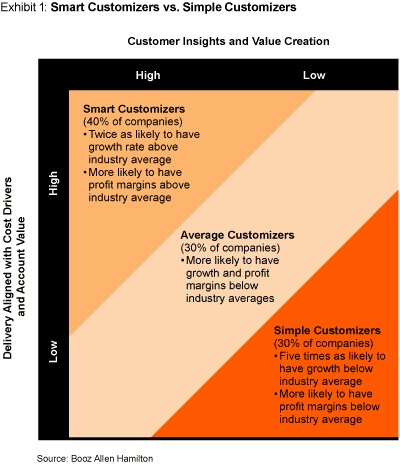
Moreover, the Booz Allen study, conducted over six months and involving such companies as Unilever, Campbell Soup, Rohm & Haas, BP Castrol, Sprint, Ericsson, Time Warner, Hearst Magazines, Fleet, and Sun Trust, among many others, found that higher-performing companies consistently focus simultaneously on the same three best practices. Smart customizers:
-
Understand the sources of value that customization provides their customers.
-
Evolve toward “virtuous variety” — the ever-changing point at which customization adds value to both company and clientele.
-
Tailor their business streams, aligning them to customer need, to provide value at the lowest cost.
Although smart customization seems like common sense, our study shows that comparatively few companies are successfully trading off the value of customization with the cost of complexity. We found that roughly two-thirds of companies with customization programs have failed to increase both their top-line and their bottom-line performance. For the most part, we discovered customization efforts that are shotgun collections of complexity: They take sales and marketing focus from the truly value-added offerings, remove focus from the most profitable customers, and drive disproportionate cost without associated revenue.
Cost of Complexity
Most companies remain stymied by the challenges of optimizing complexity — managing the trade-off between customers’ demands for variety in products and services, and the ballooning costs of meeting those needs.
Firms tend to add complexity to their product or service mix for one of two reasons: to create value for a customer segment, or in response to competitive activity. But because they often don’t refresh their “participation choices” — the decisions about the markets they serve and the ways they serve them — companies can lose sight of the true value of a customer segment and the cost impact of the programs they develop. They don’t target customer needs well enough to provide products and services that either are true “order winners” — offerings that set one company apart from another in the quest for customers — or provide continuing value to existing customers. Just as important, they don’t possess a deep enough understanding of cost drivers and can’t distinguish between easy and difficult forms of customization, which limits their ability to access scale and scope efficiencies.
Consequently, customization programs frequently fuel an “arms race” with competitors that constricts growth and lowers profit margins. When companies provide customization for too many customers without asking the critical question, Is the additional complexity worth the costs incurred?, standardization opportunities or economies of scale are undermined. At the same time, unwarranted customization takes resources away from the highest-priority accounts and limits a company’s ability to invest in more of the “right” opportunities.
Determining the value of customer segments is essential. Companies must align their infrastructures so that the most costly supply-side delivery systems are reserved for the highest-return opportunities, while inexpensive delivery and production systems are geared for the lowest-value needs. A one-size-fits-all business model can’t do that. In most companies, in most situations, some 80 percent of what businesses typically do is basic and stable, and transferable across product or service segments; only 20 percent requires some form of tailoring to customer demand. Yet in an effort to simplify their businesses, most companies try to run all products and services through a single set of operations, which are built — and frequently jury-rigged — to serve the needs of the most complex offerings the firm delivers. In businesses we have studied, this can lead to a tripling of the cost base. (See Exhibit 2.)
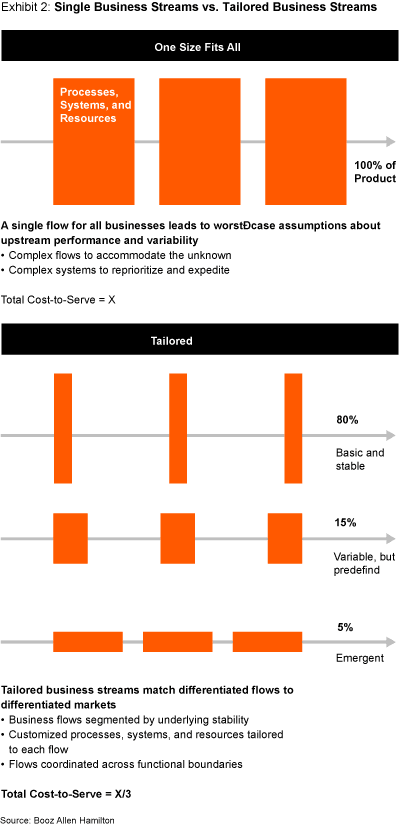
The mobile telecommunications industry provides a clear illustration of the kind of complexity-burdened customization that has resulted in a profit-draining arms race among companies. Most carriers offer consumers and businesses a seemingly infinite number of calling plans. To keep up with their rivals, carriers continually add new programs, with distinctions few customers can understand, while providing a proliferating array of sweeteners to win and retain customers. Consumers are offered free minutes and handset rebates. Business customers are pitched “fleet management” services for hardware distribution, usage tracking services, and wireline-network integration — “solutions” that all too often are offered indiscriminately to highly profitable and marginally profitable customers.
Compounding matters, customers are typically funneled through the same help and sales lines, where high-cost specialists, unversed in the multiple variations on calling plans, service packages, and subscriber issues, cannot handle inquiries effectively. Instead of devising a tiered approach to customer service, where higher-end customers are provided higher-touch service to match the value they represent, carriers have used the most expensive sales and marketing system for all customers — and provided inadequate service to all of them.
This senseless customization competition is eroding industry profitability. Operating margins for a composite of publicly traded wireless carriers in the U.S. fell from an average of 10 percent in 2000 to –13 percent in 2002.
Value of Variety
Companies don’t set out to add valueless variety to their product or service mix. Rather, the gap between smart customizers and most of the companies in our research seems to grow over time, as customer strategies change. (See Exhibit 3.)
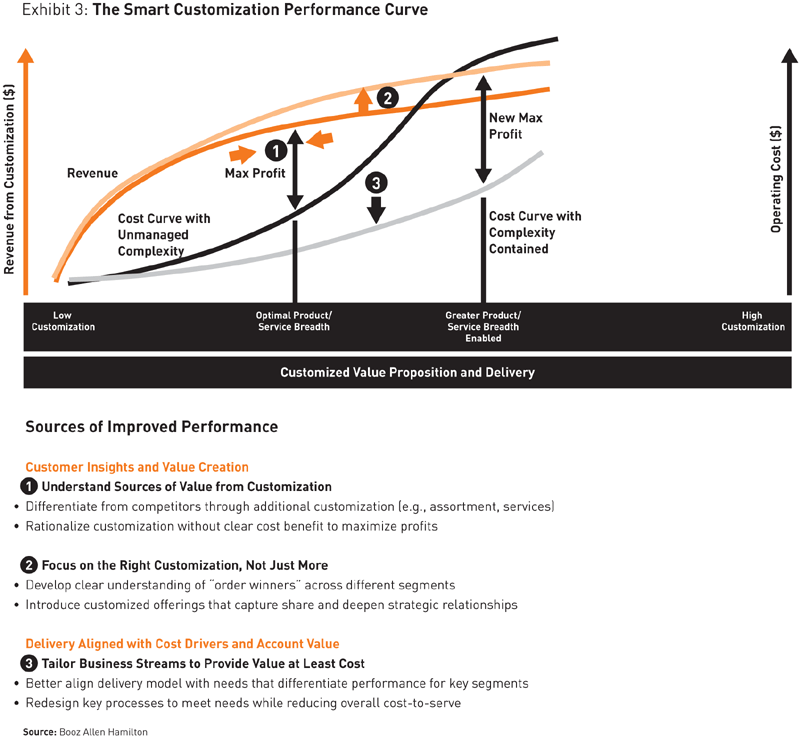
Out-of-control business complexity almost always evolves from the best of intentions. Consider the average startup company as operating in a “state of nature.” It is founded by an individual entrepreneur with a passionate belief that his or her product or service can fill an unmet customer need. Whether it’s a new software company with a tool that can do complex calculations more simply than any other, or a small grocery in a dusty backwater miles from other retailers, such firms are characterized by their utter simplicity: a single product or service for an identifiable customer base, made, marketed, and sold by a focused staff. When customers have no choice — or no knowledge — simplicity serves them as well as it does providers. Thus Henry Ford’s famous offer for his original Model T: “You can get it in any color, so long as it’s black.”
Any number of externalities can alter this one-dimensional business model. A new grocer moves into town. A talented software designer develops a new application. A competitor offers to sell out for an irresistible price. A customer asks for an additional service. For these and myriad other reasons, all but the simplest mom-and-pop operations eventually evolve into more complex companies.
To trump Ford, for example, General Motors’ Alfred Sloan segmented the market socioeconomically, offering inexpensive Chevrolets to lower-income auto buyers, Cadillacs to the highest-end, and Pontiacs, Oldsmobiles, and Buicks in between — “a car for every purse and purpose.” Sloan also created a multidivisional management system that could centrally rationalize the company’s operations, including its inventory, manufacturing, and distribution processes, by identifying and sharing common resources among the organization’s many divisions — an early, pioneering example of smart customization. GM was able to assert control over its marketplaces — external and internal — for three reasons: Its market segmentation was unambiguous (a Cadillac offered a much better driving experience than an Oldsmobile, justifying the price premium); it lacked significant competition after it surpassed Ford; and its customers had little access to the information that would allow them to bargain effectively with the company over products and prices. Sloan’s GM, like other dominant companies through most of the 20th century, controlled its value chain.
U.S. automakers have lost much of that control and become overwhelmed by systemic complexity that derives in part from blunt strategies for responding to their perceptions of customer value. Because they interpreted value as requiring an increasing number of options on automobiles, they multiplied product configurations by the score. Any quality problem, they reasoned, would be dealt with by their extensive dealer networks.
Lacking these networks, Toyota took several steps to limit its exposure to complexity problems. It bundled offerings to reduce the multitude of options configurations and their fixes. It focused on continuous improvement, relentlessly engineering the dealer contribution out of the offering. Furthermore, with a more robust product, Toyota was able to grow its own dealer network more quickly than its competitors. The simpler business model allowed it to penetrate markets far more rapidly than the traditional U.S. automotive model, because it provided customers the options they truly valued without compromising important scale economies.
Even though the Big Three have since adopted similar approaches to bundling, they have yet to match Toyota’s success, which is premised on a holistic business model, not just a backward-looking fix. By aligning its understanding of customer needs with its delivery system, Toyota effectively recaptured value from the dealer network, and engineered itself into a superior position relative to its U.S. competitors. In the second quarter of 2003, its net profit margin was 3.89 percent, more than twice the industry average of 1.67 percent. Its 36-month net income growth of 5.2 percent far outdistanced the –17 percent industry average.
Finding the Fit
Toyota’s success at smart customization aptly illustrates that achieving this…call it a state of grace…can generate value for both customers and providers. To prove this point more rigorously, we sought to measure how fully companies are implementing smart customization and to quantify its value in driving profitable growth.
By synthesizing initial benchmarking findings and Booz Allen’s client experience, we developed 36 best-practice criteria in customization’s two component dimensions: 1) customer value creation; and 2) delivery alignment between cost drivers and account value. We then fine-tuned the weighting of the criteria on the basis of their relative importance in predicting performance. From this, we designed the Booz Allen Smart Customization Index, which provides a composite snapshot of how well a company is doing against the set of best practices we identified. When we add together a company’s scores on both value creation and delivery alignment, a company receives a score between 0 and 100. Those that had total scores above 50 and above-average scores in each of the two dimensions we labeled smart customizers. We then compared all the companies in our cross-industry, 50-company sample to their industry peers, a total universe of 600 companies in 15 sectors. The smart customizers — the companies that focused simultaneously on both value creation strategies and delivery alignment — outperformed industry peers by a two-to-one ratio in revenue growth, and had profit margins 5 to 10 percent above those of their competitors. Simple customizers — companies with index scores of 50 or lower — were five times as likely to grow at rates below their industry average and had lower profit margins. Our statistical analysis found a 99 percent confidence level between a company’s place in the Booz Allen Smart Customization Index and its revenue growth and profit margins compared with industry peers. (See Exhibit 4.)
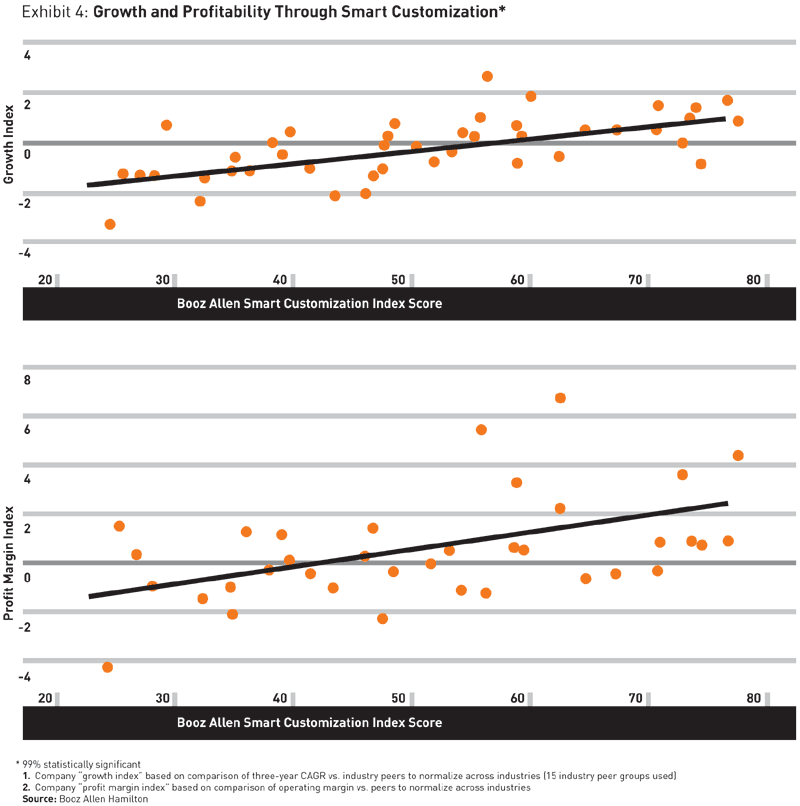
The BOC Group, a United Kingdom–based major supplier of industrial and medical gases, exemplifies the smart customizers we found in our survey.
To improve its performance, BOC embarked in 2001 on a program that was led from its corporate core, but subsequently was extended to its country markets through a series of pilot programs. The company first developed a robust behavior-based segmentation that balanced the distinct requirements of different customer segments with an understanding of how to align its business model to create value and maximize operating performance from serving these needs. The segmentation identified needs along a few primary dimensions, notably the value placed on service and the desire to obtain the lowest price.
BOC first tested its more customized approach in one country market. It identified approximately 20 percent of its customers there as “service buyers”; this segment opted into a volume purchasing commitment. These buyers were to be served at BOC by a modular supply chain that separated the more complex processes associated with serving them from the simpler needs of another important segment, “price traders.” First, the company added a flag to its enterprise resource planning system to identify incoming orders from service buyers. It then redesigned its order fulfillment and delivery processes to give priority in its system to these orders. Through tactical planning, short-term production needs were balanced to ensure in-stock levels, and trucks were optimized to ensure timely deliveries. Finally, customer teams managed execution seamlessly.
This business stream contrasted with the stream developed to serve price traders. To make up for the lower prices that this customer segment pays, BOC rigorously reduced the costs of its sales, marketing, and customer service organizations. Ordering was automated in electronic systems, and broad-based, inexpensive marketing channels were utilized to ensure that price traders would benefit from the cost savings. Performance metrics were created to make sure that the cost-to-serve was monitored directly for this segment.
BOC has received significant benefits from its smart customization pilot. The long-term contracts with service buyers allowed the company to take costs out of its business system, while locking in revenue growth through the volume commitments these customers made. And the simpler, lower-cost relationship with price traders has enabled BOC to serve this more volatile portion of the market more successfully, without subjecting its entire business system to that volatility.
By improving its focus on the specific needs of both segments, BOC has built market share in each, resulting in 10 percent faster growth in the BOC country unit that piloted the program, compared with the rest of the company. Based on the strong initial results, BOC is now tailoring its systems for other customer segments, and has begun extending the lessons to other country markets.
Optimizing Complexity
To fully capture the benefits of smart customization, companies must focus on three sources of improved performance:
1. Understand the sources of value from customization. Companies often attempt to generate additional value through more differentiation and more complicated segmentation. They add assortment, insert new specifications to products, create brand extensions, and design value-added services. Over time, competitors also add more variety, segmenting the market more narrowly, to differentiate themselves and to stimulate additional demand. Typically, the focus is on capturing the next share point without fundamentally changing the production and delivery system. Costs remain under reasonable control, and profits increase.
Problems arise, though, when companies “overshoot” the optimum level of complexity; further customization efforts start to cut into margins. Soon, they reach a tipping point at which the additional complexity drives costs up faster than the incremental revenues from differentiation.
What’s more, when a company is engaged in a customization competition with industry rivals, it’s hard for it to keep an eye on growth and costs simultaneously. Most companies end up driving customization efforts with one foot on the gas and one foot on the brake; they get nowhere fast and wear out their performance engine. Simply striking an appropriate balance between more and less variety can certainly boost growth, but it isn’t enough to generate superior earnings or shareholder returns. What companies really need is a calculation of value that reflects both the opportunities in the segments they choose to serve and the potential for effective delivery.
2. Evolve toward “virtuous variety.” To generate a step-change in performance and positively shift the customization revenue curve (see Exhibit 3, arrow 2), companies must gain a deeper understanding of different segments’ needs, and distinguish the unique requirements of some segments from the needs common to all. This can be accomplished by separating “order qualifiers” from “order winners.”
Order qualifiers are products and services that are required if companies want to stay in the battle with competitors. They’re generally not drivers of growth, though, because they are part of an arms race in which minimum product and service requirements continually escalate, regardless of whether they produce sustainable gains. A company must match the arms race at least possible cost by standardizing as many components of order qualifiers as possible.
Order winners are products and services that meet a customer’s most critical needs. Order winners can vary across segments, although many threshold needs are shared across segments. By developing a clear understanding of what customers’ order winners are, a company can create customized offerings that capture market share and deepen strategic relationships, and still preserve economies of scale and scope.
3. Tailor business streams to provide value at least cost. Smart customizers match their segmentation strategies with delivery mechanisms designed specifically to serve each segment profitably. In our parlance, they “tailor the business streams” to provide the highest value at the lowest cost.
Tailoring business streams (TBS) is a powerful approach for optimizing the complexity that is a natural by-product of an increasingly competitive, transparent, and interdependent economy. Businesses can create and align multiple flows to serve multiple needs, delivering differentiated services and products. The simplest and most predictable products/services flow through the most efficient streams of people, asset management control systems, and processes. Harder, less predictable undertakings flow through a more robust infrastructure. The streams can be kept distinct to prevent costs from rising; easy operations don’t require expensive management and operational infrastructure that more complicated activities need.
At its core, TBS involves segmenting flows to satisfy different customer requirements regarding cost, value, speed, quality, and predictability of demand. These flows aren’t immune to the forces that typically corrupt business models, so it’s also necessary to develop policies and control limits that enable each stream to continually create value for company and customer together. The streams also include guidelines for tuning them as market conditions and costs change over time.
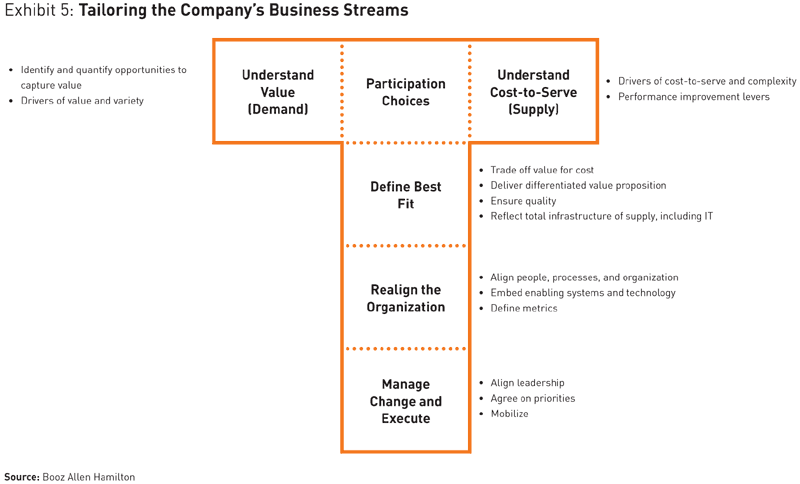
Think of these tailored business streams as separate, mini-operating models. (See Exhibit 5.) They include product development, demand generation, production and scheduling, the supply chain, customer care — the many flows that take value from a company to its customers. Each stream may contain people, processes, and technologies required to deliver parts of the product/service offering. Each stream caters to different expectations for cost, quality, speed, and innovation. Each has the appropriate management tools and processes in place to deliver at the lowest cost with the greatest return. But these streams flow together into a consciously integrated whole that isolates the highly complex and expensive parts of the business from the standardized portions. TBS allows a company to create a high degree of differentiation without constraining scale. In addition, a company gains the ability to continually align its business streams with changes in customer value, providing solutions where merited and more “transactional” approaches where customer needs and economics require them.
Differentiation does not have to compromise scale. By tailoring their business streams and aligning sales, marketing, and operations strategies with customer value, today’s leading companies are able to provide some customers bespoke solutions that truly drive organic growth. Such smart customization is an imperative in current business conditions, not an option. The distance between smart customizers and simple customizers will be measured by accelerating differences in performance. Companies that want to build smart customization need analytical insight to understand the sources of value and drivers of cost, experience in identifying trade-offs and designing solutions, and the change management skills to follow through. We believe the destination justifies the journey.
|
Focus: Smart Customization at Bank of America |
|
Although the advantages of smart customization are perhaps most obvious in manufacturing, because there is a direct and fairly immediate payoff when factory costs are aligned to customer value, services firms can also gain enormously from it. Providing services requires more ad hoc touch points with customers than does manufacturing and requires more flexible systems for delivering products; thus, service businesses are more fraught with complexity risk and more open to opportunity than slower-moving manufacturing businesses. But to succeed, service companies, like manufacturers, must consciously balance the cost of complexity against the value of variety, reconciling the benefits of volume sales growth against the accretion of overhead and indirect cost expenditures. Those trade-offs were bedeviling Bank of America’s Global Treasury Group, a $4 billion business unit that conducts cash management services (wire transfers, lockbox, foreign exchange transactions) for institutional clients, many of them multinational companies with multiple locations and points of contact. Like most financial-services companies, Bank of America (BoA) tended to segment customers by asset size and by how much business they did with the bank. More active customers got more attention from sales and marketing staffs, who tried to up-sell new services to them, than did smaller, less profitable accounts. But service and support provided to customers on a day-to-day basis was the same for transaction-oriented customers and for customers with deeper needs. After signing up a client — whether a large account or a small store — Global Treasury tried to ensure customer loyalty by offering high-touch customized services, through a service-desk environment. The variety of customized service that a customer could expect was endless and so, it seemed, was the cost of providing it. “We tried to be all things to all clients,” says Lisa Margosian, senior vice president for global client services at BoA Global Treasury. “We knew we were underserving some clients, but we couldn’t always identify them. And we knew we were overservicing some, and it was too costly. What we built for the most demanding clients dominated everything we did. Too much energy and resources were offered to all clients indiscriminately. Some clients commented on how costly our service model must be. Yet others told us that routine tasks took 45 days to get done.” Although the division was quite successful, future profitability pressures loomed. Global Treasury was a tight-margin commodity business, and technological advances promised to continue to pressure the margins. Management was convinced that customer service was a fundamental way for the business to distinguish itself from its four large rivals, which each had about the same market share as Bank of America. Getting the equation right was crucial to the division’s continuing competitiveness. Bank of America, together with a Booz Allen team, undertook a comprehensive review of its business streams in Global Treasury. The teams reviewed customer segments, demands, and servicing simultaneously, asking such questions as, “How many different groups are touching this client? Who is furnishing what to whom? How do clients use servicing and implementation?” Ms. Margosian recalls, “We wanted to find simple ways to do the simple tasks, and at the same time cater to clients based on needs. We wanted to look across all functions and channels, and bring this together in a model that allowed us to deliver more to our clients who really needed the highest touch, less to others, yet maintain the best quality standards for all.” Global Treasury created three distinct customer service streams, segmenting clients according to service needs: basic (a quick, mostly self-directed product for accessing account information and conducting transactions); alliance (an ongoing relationship with customer service representatives who help with transaction processing and proactively contact clients when an account issue needs to be addressed); and strategic (consultative services with highly trained bank representatives who offer expertise in managing accounts). Multiple channels were designed to support these service streams. For all clients, Bank of America encouraged migration to self-service for simple tasks. For those with higher-order needs, call centers and service pods were designed. When this process is complete, it’s anticipated that 60 to 80 percent of Bank of America’s customer transactions will flow through the simpler channels — easier and faster for clients, and cheaper for the bank. Global Treasury forecasts that it will eliminate 20 percent of its customer service costs; initial metrics indicate that client satisfaction — driven by the new levels of account management convenience and flexibility — is as high as or higher than before the bank reengineered. The three tailored business streams allow Bank of America to realize full value from its customers while keeping the costs of complexity to a minimum. “This approach is getting us scale where we need it, but allows differentiation where it’s important,” Ms. Margosian says. — Atul Kamra |
|
Research Methodology |
|
We explored approaches companies are taking to segmenting customers and customizing products, services, and processes to market needs, in order to evaluate how more customized approaches create value for customers and for suppliers. Our goals were to find what linkages existed between specific behaviors and improved business performance; determine the limits to which high-performing companies go in customizing their products and services, sales and marketing, operations, and customer service; and identify specific success factors and pitfalls of customization programs. We researched corporate operating units, with sales from $1 billion to $20+ billion, from 50 different companies, split evenly between North America and Europe. Product and service industries were represented; participants included companies in consumer goods; chemicals and gases (e.g., resins, lubricants, industrial gases); commercial banking; media; pharmaceuticals; telecom equipment; telecom carriers (both wireline and wireless); and utilities. Participants filled out a detailed written survey. Topics included: segmentation; approach to customizing products and service levels; approach to aligning operations and the organization; analytical capabilities; IT systems support; performance measurements and incentives; and company data. We then conducted more than 150 in-depth management interviews across all 50 participants, including, for example, the CEO, head of sales, head of marketing, general manager, head of strategy, quality manager, and customer care manager. By synthesizing the interview findings, Booz Allen experience, and a statistical analysis of survey data to identify those behaviors that explain higher growth and profitability, we identified a set of 36 best practices in customization and constructed a "Smart Customization Index" that weighted the criteria to reflect their relative importance in driving higher growth, based on multiple statistical approaches. Using peer groups to normalize for industry differences in growth and profitability, we were able to demonstrate that a higher Smart Customization Index score is 99 percent statistically significant in predicting both growth and profit margins above those of industry peers. |
Reprint No. 04104
Keith Oliver (oliver_keith@bah.com) is a senior vice president in Booz Allen Hamilton’s London office. During more than 35 years in consulting, he has helped senior executives address strategic issues involving the management of the extended enterprise, from suppliers to end-customers.
Leslie H. Moeller (moeller_leslie@bah.com) is a vice president with Booz Allen Hamilton in Cleveland, Ohio, and leads the firm’s Customers, Channels, and Markets service offering.
Bill Lakenan (lakenan_bill@bah.com) is a Booz Allen Hamilton principal based in San Francisco who specializes in operations strategy, manufacturing, and supply chain transformation, primarily for clients in the high-technology and aerospace/defense industries.
Also assisting in the development of this article were Booz Allen Hamilton vice president Edward Frey, vice president Atul Kamra, principal Matthew Egol, and principal Karla Martin.
