
The Four Bases of Organizational DNA
Trait by trait, companies can evolve their own execution cultures.
(originally published by Booz & Company)
 |
|
Illustration by Brian Cairns |
businesses and functions just aren’t working together to get results.”
Welcome to the Era of Execution.
Execution has become the new mantra for this first decade of the new millennium. Larry Bossidy, who led AlliedSignal Inc.’s turnaround and its merger with Honeywell International Inc., wrote a book with Ram Charan, titled Execution: The Discipline of Getting Things Done (Crown Business, 2002), that’s been on the business bestseller lists for more than a year. Former IBM CEO Louis V. Gerstner Jr. put forth the same message in his memoir, Who Says Elephants Can’t Dance? Inside IBM’s Historic Turnaround (HarperBusiness, 2002). In it, he says flatly that the revival of the computer giant wasn’t due to vision. “Fixing IBM,” he wrote, “was all about execution.”
Boards of directors, increasingly impatient with CEOs who don’t deliver, have climbed on the execution bandwagon too. Booz Allen Hamilton’s annual study of CEO succession trends showed that forced turnover of underperforming CEOs at major corporations reached a new high in 2002, rising a staggering 70 percent from 2001 and accounting for 39 percent of all chief executive transitions.
But is execution simply a matter of firing the CEO and bringing in a charismatic leader who can get on with “getting things done”? Not at all. Underlying the quest for an execution-driven enterprise is one central question: How does a company design its organization to execute the strategy — whatever the strategy is — and successfully adapt when circumstances change?
Execution is woven deeply into the warp and woof of organizations. It is embedded in the management processes, relationships, measurements, incentives, and beliefs that collectively define the “rules of the game” for each company. Although we often think of companies as monolithic entities, they’re not. They’re collections of individuals who typically act in their own self-interest. Superior and consistent corporate execution occurs only when the actions of individuals within it are aligned with one another, and with the overall strategic interests and values of the company. Performance is the sum total of the tens of thousands of actions and decisions that, at large companies, thousands of people, at every level, make every day.
Because individual behaviors determine an organization’s success over time, the first step in resolving dysfunctions is to understand how the traits of an organization influence each individual’s behavior and affect his or her performance. We like to use the familiar metaphor of DNA to attempt to codify the idiosyncratic characteristics of a company. Just as the double-stranded DNA molecule is held together by bonds between base pairs of four nucleotides, whose sequence spells out the exact instructions required to create a unique organism, we describe the DNA of a living organization as having four bases that, combined in myriad ways, define an organization’s unique traits. These bases are:
Structure. What does the organizational hierarchy look like? How are the lines and boxes in the organization chart connected? How many layers are in the hierarchy, and how many direct reports does each layer have?
Decision Rights. Who decides what? How many people are involved in a decision process? Where does one person’s decision-making authority end and another’s begin?
Motivators. What objectives, incentives, and career alternatives do people have? How are people rewarded, financially and nonfinancially, for what they achieve? What are they encouraged to care about, by whatever means, explicit or implicit?
Information. What metrics are used to measure performance? How are activities coordinated, and how is knowledge transferred? How are expectations and progress communicated? Who knows what? Who needs to know what? How is information transferred from the people who have it to the people who require it?
Any metaphor can be pushed too far, of course. Although the basic comparison of corporate and human DNA is often invoked in general discussions of institutional culture and conduct, we think it provides a practical framework senior executives can use to diagnose problems, discover hidden strengths, and modify company behavior. With a framework that examines all aspects of a company’s architecture, resources, and relationships, it is much easier to see what is working and what isn’t deep inside a highly complex organization, to understand how it got that way, and to determine how to change it. (See “Focus: Testing Quest Diagnostics’ DNA,” at the end of this article.)
Structure
In principle, companies make structural choices to support a strategy (for example, the decision to organize business units around customers, products, or geography). In practice, however, a company’s organizational structure and strategic intent often are mismatched. The variance can usually be exposed by, in effect, superimposing the organization chart — an efficient communicator of power and status in a firm — over a business unit’s strategic plan.
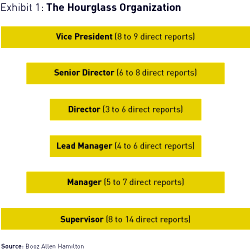 A common structural problem impeding the execution of strategy is the existence of too many management tiers (deep layers), with too many individuals at each tier having too few direct reports (narrow spans). Portrayed graphically, this structure resembles an hourglass. (See Exhibit 1.) Narrower spans in the middle often result from unclear decision rights and the company’s mix of motivators. Generally, a structure shaped this way indicates trouble.
There are many reasons a certain management position may legitimately call for a narrower or wider span than another position’s. Managers in complex jobs that require them to create and maintain multiple information linkages across individual units cannot handle the same number of direct reports as managers with simpler information aggregation roles. But it’s also easy for spans to become too narrow for no legitimate reason.
Consider the spans of control for three senior positions at one consumer goods company with which we have worked. As shown in Exhibit 2, the category/product line manager had five direct reports, compared with seven and 10 reports for senior managers at two best-practice companies. The vice president of sales had six direct reports, versus eight and 10 at the other companies. The manufacturing manager had only seven direct reports; in other companies, similar managers had 11 or more. We have taken this measurement at more than 100 companies, and our data indicates that this company fell well outside the range found at comparable firms.
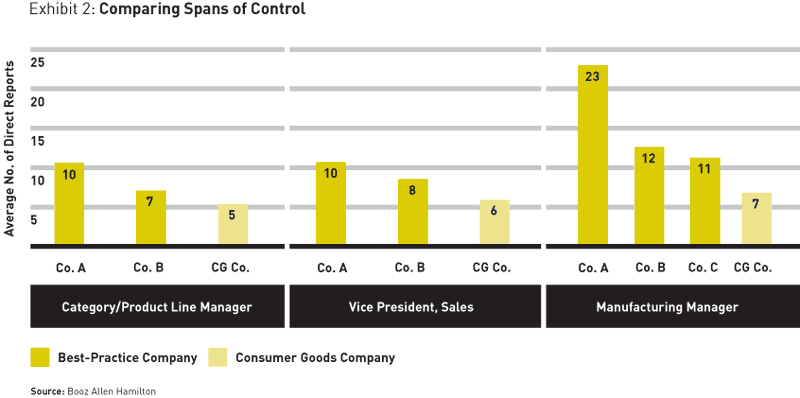
In our experience, numbers this far off the norm provide strong evidence that a company’s spans are narrower than they should be. Often this results in a structure that has too many layers as well. This became evident when we explored how senior managers at the consumer goods company spent their time. About a third of it was devoted to making plans, ensuring target corporate goals were met, and dealing with exceptions and high-impact/high-risk decisions, all appropriate roles for these managers. But they were spending far too much time (roughly 40 percent) justifying and reporting performance to senior executives above them and participating in tactical, operational decisions with their direct reports. In other words, too much of their time was devoted to second-guessing the work of people below them and preparing reports so that superiors could second-guess their work. They should have been giving more of their time to preparing action plans to achieve the strategic and operational objectives of the company.
This structure kept the consumer goods organization from executing to its potential. Among specific dysfunctions we found:
- Because there were no clear standards that allowed basic decisions to be made at lower levels, decisions regarding such matters as authorization for PC purchases and travel were decided too high in the organization.
- Managers and supervisors tended to discourage their staffs from troubleshooting to resolve routine problems on their own.
- Managers rotated rapidly through jobs, reaching senior positions without sufficient experience. Not only did they require close supervision, but they continually struggled to figure out what they needed to know.
- The company seemed to rapidly promote its best and brightest just so it could retain them. This added unnecessary layers to the hierarchy and created more work at lower levels.
- Large cross-departmental meetings filled the workday. The rationale was to have all parties “in one room to resolve the issues.”
All of this activity is costly — these are managers with salaries in the low six figures. Their compensation, plus the actual cost of their activities, pushed the company’s general and administrative costs to a level that was 20 percent higher than the average of our benchmark companies. Because each of its many layers got involved in almost every decision, the company’s speed to market was slowing, and it was losing share to new, more nimble competitors in several categories.
The obvious structural change was to reduce layers and increase spans — that is, to add direct reports to each manager. We recommended a new structure that resulted in a reduction of 10 percent of the positions in the management ranks across all six divisions. Ultimately, with the elimination and repositioning of managers and support staff, about 2,300 management jobs were cut, which saved the company more than $250 million.
Still, simply cutting layers and extending spans would have had little long-term effect if underlying behaviors didn’t change. One way the company could do this was by setting clear standards (e.g., which PC to buy and which airline to fly) so high-level managers would not need to review every transaction and provide approvals. With a monthly report, they could easily track exceptions to the standards. Another solution: Reset promotion expectations to slow the upward movement of managers and encourage more horizontal moves — use promotions not just as a reward, but to develop a manager’s breadth of experience. Long and cumbersome reporting processes designed to satisfy the information preferences of each layer and the tremendous desire for detail also had to go. In their place would be a report on the key lagging and leading measures of critical business activity, a top-down setting of targets, and the monitoring of variances. To further dissolve the reflexive addition of layers, the company also had to do more managerial training and communicate better about the change in promotion principles. Following the restructuring and changes in management, time to market for product introductions shrank by months, enabling the company to regain the first-to-market advantage it had traditionally held.
Decision Rights
Decision rights specify who has the authority to make which decisions. Clarifying these rights puts flesh on an organization chart and makes crystal clear where responsibility lies.
Clear decision rights enable wider spans and fewer layers, which translates into lower costs and speedier execution. Unarticulated decision rights are more than a time sink; they’re a central cause of substandard performance — and even of nonperformance. An employee at a financial-services company expressed this problem quite concretely in a focus group we conducted, saying, “Responsibilities are blurred intentionally around here so everyone has an excuse for not getting involved.”
At one industrial company, we found yet again that senior executives were spending too much time reviewing small projects. It turned out the company had not reassessed managers’ spending-approval limits in more than 10 years. We suggested the authorization process be adjusted so that managers lower in the organization could be accountable for the final approval of more projects. The capital expenditure amount requiring CEO authorization was raised from $5 million to $15 million. The objective was to free up senior management’s time to focus on the longer-term issues associated with market growth and potential acquisitions. Based on historical analysis, it was determined that raising the level at which projects required CEO authorization to $15 million would reduce the number of projects crossing the CEO’s desk by 49 percent. All large projects would still come to the CEO, so the aggregate value of projects approved at the top would decline by only 13 percent.
Decision rights become blurred for many reasons, not all of them intentional. After a large industrial company completed a leveraged buyout, the management of one of its business units became the new entity’s corporate management, charged with reviewing the operating decisions of all business units. That change required every level of management to take on greater decision-making responsibility — an unnatural act for executives accustomed to hands-on involvement in operating unit decisions. Rather than allow their general managers to make basic decisions about product design and resource allocation, the CEO and COO still involved themselves deeply in these activities. Meanwhile, they were neglecting other areas where their attention was expected, notably strategic planning, long-range business portfolio decisions, and the firm’s financial condition.
The solution was to create a process for corporate officers to delegate decisions to the business unit’s general managers. An executive committee was established to review business unit decisions, and several general managers were charged with integrating marketing, product engineering, and manufacturing. These structures and processes made effective delegation possible.
It doesn’t take a leveraged buyout to distort a company’s decision-rights structure. People naturally lean toward the familiar when faced with change. Executives promoted to new positions often cling to their prior responsibilities, burdening themselves with unnecessary tasks and disempowering their subordinates. The press of the urgent at the business unit level drives out the important at the corporate level. The lesser decisions seem concrete and knowable. Forward thinking and big decisions regarding long-term direction seem undefined, amorphous, and tougher to tackle.
Often the process of assigning decision rights is a response to a crisis or a shift in political power. When this happens, decisions can fall between the cracks. Or they can be made twice by different parties. Or they can be reviewed repeatedly, becoming a Sisyphean exercise in backsliding.
It is possible to assign decision rights systematically and rationally. At a global industrial company, we helped create an organizational matrix of functions, products, and geographies. The structure was undergirded by a set of specific organizational and decision-making principles, among them: responsibility does not imply exclusive authority; different units should have joint goals and performance measures; and certain positions need to report upward to multiple managers.
Over several months, we worked with the company to apply these and several other principles to more than 300 critical decisions. Because we undertook this effort explicitly while also changing the structure, the company was able to execute its new strategy faster, and with fewer missteps. The overall change process took two years (one less than had been anticipated). The company returned to profitability, reduced its net debt by the targeted amount, and reached several other critical financial goals a year ahead of schedule.
Making decision rights explicit in companies in which they are not requires management to set rules for the most common business situations — and for each position. In effect, the company is creating a constitution that says who will decide what and under what circumstances.
The decision rights of groups must also be clear. At a consumer goods company, we saw large numbers of executives meeting frequently to resolve conflicts among functional units. It appeared that operations, finance, and marketing were each doing an excellent job of analyzing new factories, new products, and new business opportunities, but they weren’t talking to one another along the way. Operations planned the perfect factory — without guidance from finance on the cost. In marathon meetings, managers from each function brought their independent analyses together. Then they struggled to reach a joint conclusion, because each unit, by that time, was wedded to its own recommendation.
To solve this silo problem, one top executive was made responsible for managing a cross-functional team, so there would always be communication across disciplines. As a result, only a few top executives were needed to make routine decisions, and the company reduced dedicated staff support for these efforts by more than 30 percent.
Motivators
The third of the four bases in a company’s DNA-like makeup involves motivation. Employees generally don’t deliberately act counterproductively; they don’t try to derail a company’s strategy. Rather, they respond quite rationally on the basis of what they see, what they understand, and how they’re rewarded. An exhortation to follow the vision and pursue the strategy is only so much air if the organization’s incentives and information flows make it difficult for employees to understand and do what they’re supposed to do.
An organization can send confusing signals to individuals in many ways. Think about what happens when an appraisal system inflates performance ratings. At a consumer goods company we once worked with, employees were appraised on a 1 to 10 scale. Eighty percent received a rating of 9 or above, and everyone felt good. But superior employees didn’t feel they needed to do any better. Other workers thought their performance was acceptable when it wasn’t. Appraisers were avoiding the unpleasant task of delivering bad performance ratings, and the organization wasn’t giving them any reason to be tough. For every deficient employee who stayed at the company because the organization said he or she was competent, the company’s execution suffered. Because of its unwillingness to differentiate people’s contributions through performance assessments and raises, the company lost the opportunity to send important feedback to employees on what was relevant to executing the strategy — and where their performance was unsatisfactory.
Several years ago we worked with the new CEO of a technology company who had been the head of a business unit and had served for several years on the executive committee that made investment decisions. The new CEO knew from experience that the committee wasn’t tough enough on new investment requests. They were a collegial group; members supported their colleagues’ investment requests with the understanding their own requests would be supported in return.
The new CEO wanted a more discriminating process that would judge investment proposals on their merits. He also knew executive committee members faced little downside from approving unsound investment requests. Future bonuses might suffer if company performance wasn’t good, but that money wasn’t already in their pockets.
So the CEO introduced a new system to change this attitude: Each committee member was required to take out a personal loan of $1 million and invest it in company stock (the loan was guaranteed by the company, so the individuals could borrow at good rates). Unlike an outright stock grant, this scheme ensured that the executives had existing wealth at risk, and that they would lose money, and perhaps the ability to repay the debt, if they permitted poor investment decisions. With this new incentive to scrutinize investment requests, the committee became much tougher and more effective. And after a few sessions, teams began bringing better-researched and smarter investment proposals to the table because they knew if they didn’t, the committee was likely to turn them down.
There are other market mechanisms that can be used to send more accurate signals to managers about the cost and value of certain activities. This approach was used successfully at a large agribusiness company that came to us for help in improving the services of its human resources department. The HR department’s performance had always been judged by how well it stayed on budget. Internal customer satisfaction was rarely measured. Each customer was allocated a share of the HR budget, but these figures didn’t represent the true cost of the services. Meanwhile, customers had little influence on the kind and amount of services they received. Neither HR nor its customers had an incentive to offer or ask for services tailored to the specific needs of a division.
Working with the company, we created a scorecard to measure HR performance on such things as call center response time and payroll errors. Achieving scorecard targets became a significant component of management incentives and rewards. HR’s internal customers were given the right to negotiate service level agreements with HR. The true cost of services was established using outside benchmarks. Once HR’s customers understood what they were paying for and could better manage their costs, they had an incentive to use HR services more wisely. Today, they often decline or reduce some services and request new ones. The market-based measurement and incentive program improved the quality of the company’s HR services and reduced costs by more than 15 percent.
Organizations that are ready to implement multiple profit-and-loss statements and market-based motivational systems will find that these powerful new tools can help them operate effectively with less command-and-control oversight. But not all companies are ready for these systems; it takes strong leadership, persistence, and patience to introduce them and overcome employee resistance to using them.
Information
Underlying a company’s ability to ensure clear decision rights and to measure and motivate people to apply them is one critical matter: information.
Making sure high-quality information is available and flowing where it needs to go throughout a company, all the time, is among the most challenging tasks of the modern corporation, and one of the most underappreciated contributors to high performance and competitive advantage. A 2002 study of the management and financial performance of 113 Fortune 1000 companies over the five-year period 1996 to 2000, conducted by Booz Allen Hamilton and Ranjay Gulati of the Kellogg School of Management at Northwestern University, found that the companies with the highest shareholder returns were more focused on managing and enhancing communication with their customers, suppliers, and employees than other firms in the study.
We have seen this information–performance linkage often in practice. A few years ago, the board of an agricultural grower and processor became concerned about the company’s operating efficiency. Among other problems, farm managers were using equipment without discipline — ordering a machine at will, driving it hard, and returning it with an empty gas tank, all because headquarters was responsible for maintenance and replacement costs. Our benchmark data indicated that this company’s expenses were far higher than those of independent farms. We worked with corporate and farm management to develop a new business model, centered on turning each farm into an independent business. For this to happen, farm managers needed new information — specifically, individual farm P&Ls that reflected, among many other things, the cost of the equipment they used. The redesigned organization executed more efficiently, as reflected in a 48 percent jump in its imputed share price in the first year.
Better information flows did more than keep costs down; they helped allocate scarce resources far more efficiently than before. The company had a silo problem — literally and figuratively. Any field ready for harvest had a peak yield window of about 15 days. But there was only so much mill capacity during the peak window. Coordinating and timing the harvesting and milling activities fell to a hapless employee at headquarters, a central planner who relied on historical data that didn’t reveal much about current conditions.
We showed in a simulation that if farm managers could bid for use of the mill on particular dates, it would strikingly improve the company’s efficiency. If a manager saw that his highest-yielding acreage was ready to harvest and couldn’t wait because rain was predicted, he could bid more for mill time. No longer would someone back at headquarters have to hunker down with a spreadsheet, making educated guesses based on the previous year’s yield data and taking frantic phone calls from farm managers. Market-based pricing of mill time would allocate scarce resources better than a central planner could. And with this new system, decisions would reflect the real-time knowledge of the farmer in the field observing the sky, testing the ripeness of the crop, hour by hour, acre by acre.
Adaptive DNA
Although we have illustrated the four bases of organizational DNA separately to emphasize their distinct characteristics, they clearly are intertwined. Changing structure requires changing decision rights; to make effective decisions, employees need new incentives and different information. At the agricultural grower and processor, the new structure touched each of these elements — the individual farm as a business required new decision authority for farm managers, new metrics by which to measure their performance, and new rewards based on their individual success. This interdependency is evident in all of these company stories.
Considering — and changing — a company’s DNA holistically means weaving intelligence, decision-making capabilities, and a collective focus on common goals widely and deeply into the fabric of the organization so that each person and unit is working smartly — and working together. It’s one thing to achieve well-coordinated intelligence among senior executives. It’s another thing entirely to touch every level of an organization all the way down to the loading dock. What every employee does every day, aggregated across the company, constitutes performance.
The best organizational designs are adaptive, are self-correcting, and become more robust over time. But creating such an organization doesn’t happen quickly; it can take several years to get the basics right, and there is always a need for fine-tuning. This may explain why leaders of companies that are truly ailing — and who need to reassure shareholders as fast as they can — often don’t have the patience for changing decision rights, motivators, and information flows. They’re more likely to cut the structure and see what happens than to take time to ensure that structural changes actually result in sustained productivity improvements and steady gains in shareholder value. But neglecting this hard work may also partly explain why some of these CEOs are no longer in charge.
No company may ever totally master the enigma of execution. But the most resilient and consistently successful ones have discovered that the devil is in the details of organization. For them, organizing to execute has truly become a competitive edge.
|
Focus: Testing Quest Diagnostics’ DNA |
|
DNA testing can be as valuable to corporate health as it has become to human health care. An analysis of a company’s “genetic material” can isolate the underlying causes of and potential solutions to organizational dysfunctions, and even head off problems before they start. Consider the case of the U.S.-based medical laboratory testing company Quest Diagnostics. Originally a division of Corning Incorporated, Quest Diagnostics grew in the 1990s through the acquisition of hundreds of small independent testing laboratories. Spun off from Corning in 1997, the company was losing money and battling fines for billing fraud and other abuses in a number of the laboratories it had bought. Chairman and CEO Ken Freeman, then the newly appointed leader of Quest Diagnostics, recognized that the DNA of an enterprise formed by the union of so many different entities, each born in a different time and place, with many different parents, could readily become a monster. So he was determined to focus his attention on improving organizational DNA across the entire company. Immediately after the spin-off, Mr. Freeman and his top management team took control of key decision rights to ensure that the company’s turnaround effort was coherent and driven hard. When the company acquired SmithKline Beecham Clinical Labs in August 1999, they again deliberately centralized decision rights among a small senior team. A set of integration teams headed by the leaders of both companies methodically worked through the long-term vision and short-term tactics for each area of the new company, again, to ensure consistency across the enterprise. The financial payoff was immediate: Prior to the deal, revenues had typically declined upward of 20 percent following a major acquisition. In this case, Quest Diagnostics not only didn’t lose business, revenues grew at or above industry growth rates during the integration process. This was the first time such postmerger growth occurred in the industry. As Quest Diagnostics’ turnaround progressed, decision rights were decentralized gradually, first by placing supervisors into various units who led change and taught employees new behaviors, and then by empowering frontline staff. Although many parts of the Quest Diagnostics organization are now high performers and largely self-directed, it has taken seven years to get there. Today when Quest Diagnostics acquires a company, Mr. Freeman and his team concentrate on two of the four organizational bases, motivators and information, recognizing their interdependency and combined influence on individual and organizational behavior. Among the first “gene therapies” they perform is to introduce a comprehensive and varied set of metrics that go well beyond the typical financial performance measures that most companies use. There are measures for customer retention, the time it takes to pick up a call in the call center, the time it takes to process a specimen in the labs, employee satisfaction and attrition rates, and more. The system is designed so that all employees know how they can personally influence one or more core performance measures. The only way this information can influence the day-to-day behavior and decisions of employees throughout the organization is if decision makers have the information on hand when they need it. Quest Diagnostics posts various metrics on different timetables depending on the type of management issue: Customer retention metrics are posted at least once a month; specimen turnaround time is posted every morning. Finally, the company ties these metrics to individuals’ bonus payments so that information not only informs, but also motivates productive behavior. Since virtually everyone in the company can affect customer retention in some way, Quest Diagnostics uses the customer retention metric very broadly in its performance-based compensation programs. Ultimately, the bonuses of all 37,000 Quest Diagnostics employees depend in some way on meeting the customer retention target. “If we have a shared goal that says we’re going to reduce customer attrition, that doesn’t mean it is only for people in sales. It impacts people picking up the specimens, people who draw and perform tests on the specimens, and certainly people in billing. If there are lots of complaints, the customer is going to leave. By having shared goals, you get speed and alignment,” says Mr. Freeman. To make the motivators as specific and powerful as possible, customer retention metrics are measured not just organization-wide. They are divided up by region, so that people are paid on the basis of customer retention performance in their own region, where they can have the greatest influence. The aligning and motivating power of bringing information and incentives together is reflected in the firm’s strong financial performance. Since Quest Diagnostics was spun off from Corning in 1997, the company’s stock price has increased 730 percent, compared with a 41 percent increase in the S&P 500 Index during the same period. Having successfully carried out a classic turnaround and taken the — G.N., B.A.P., and D.M. |
Reprint No. 03406
Gary Neilson (neilson_gary@bah.com) is a senior vice president with Booz Allen Hamilton in Chicago. He works on the development of new organizational models and designs, restructuring, and the leadership of major change initiatives for Fortune 500 companies across industries.
Bruce A. Pasternack (pasternack_bruce@bah.com) is a senior vice president with Booz Allen Hamilton in San Francisco. He counsels companies in building strategic agendas, developing organizations, and transforming business models. He has published widely on leadership and organizational issues.
Decio Mendes (mendes_decio@bah.com) is a senior associate with Booz Allen Hamilton based in New York. He works with clients to improve organizational effectiveness and operations efficiency.