
Delay Can Pay
Justin Pettit, coauthor of Merge Ahead: Mastering the Five Enduring Trends of Artful M&A, introduces a new perspective on decision making from Wait: The Art and Science of Delay, by Frank Partnoy.
(originally published by Booz & Company)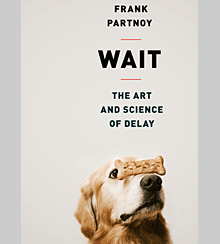
Despite conventional thinking about the benefits of being first and fastest, most of us react too quickly, according to Frank Partnoy, a professor at the University of San Diego. In Partnoy’s new book, Wait: The Art and Science of Delay, a Gladwell-esque compendium that taps research in fields including medicine, finance, psychology, and law, he proposes a contrarian perspective on decision making that suggests that slowing down your response time can yield better results.
In the excerpt that follows, Partnoy applies this maxim to investment decisions. But the book uses case studies of “delay specialists” in realms as varied as stand-up comedy and warfare, extending the implications of postponing responses in order to improve outcomes in every part of our business and personal lives. Procrastinators everywhere will rejoice.
— Justin Pettit
An excerpt from Chapter 11 of Wait: The Art and Science of Delay
Jim Cramer’s Mad Money attracts several hundred thousand viewers nightly during the coveted 6:00 PM Eastern Standard Time slot. During the show, Cramer shouts, gestures frantically, presses buttons that trigger dramatic sound effects, and tosses props, including plastic bulls and bears, as he recommends the purchase and sale of various publicly traded stocks. On a given night, Cramer might feature a “lightning round” of stock picks, a book promotion (often one of his own), some bobblehead dolls (often of himself), or a monkey named Ka-ching. Mad Money has been on the air since 2005 and has been a huge commercial success for the cable network CNBC.
Cramer’s nightly theatrics reverberate in the stock market the next morning. When Cramer recommends a stock, on average it opens for trading the next day 2.4 percent higher than the rest of the market. His average stock recommendation generates an instantaneous gain of $77.1 million. A lot of people are listening to Jim Cramer, and their demand causes prices to go up. If we knew in advance which stocks Cramer was going to recommend, we could make a fortune.
However, we don’t know what Cramer will say in advance, and even if we did, it would be illegal for us to buy based on that knowledge. Instead, the people who follow Cramer’s recommendations buy stock the next day at a higher price. They pay extra, reflecting the optimism Cramer generates among herds of investors about these companies.
According to a detailed analysis published in October 2010, viewers who bought the stocks Cramer recommended the previous night lost money relative to the market overall. Even people who held those stocks for as long as fifty days lost an average of nearly 10 percent relative to the market. For those stocks with the highest overnight returns after Cramer’s recommendations, the fifty-day performance was even worse: negative 29.54 percent for the top quintile. In other words, according to this study, if you watch Mad Money and follow Jim Cramer’s top recommendations, you will lose almost one-third of your money in less than two months. Not very many people can afford to follow that kind of advice.
The study also found that an investment in the stocks Cramer recommended significantly underperformed the market over the longer term. Even if you had insider access to Cramer’s recommendation and engaged in illegal insider trading, buying the stocks before Cramer recommended them, you still would not outperform the market in the long run. Jim Cramer has some interesting and useful things to say about investing in general. But he’d almost certainly be better at picking stocks if he did so less frequently and at a slower speed. The show Mad Money is entertaining, but its recommendations won’t make you rich.
Behavioral finance is a relatively new area of research that combines psychology and conventional economics to try to explain why people make irrational financial decisions. It questions the long-held assumptions by financial economists that investors are rational and act in their self-interest, as well as the mathematical equations that purport to show how markets are largely predictable and efficient. A few economists, such as Eugene Fama, one of the founding fathers of efficient market theory, continue to cling to some of these assumptions. But many financial economists are jumping ship.
A wave of research, spurred on by Daniel Kahneman, Amos Tversky, and Richard Thaler, has demonstrated that investors have systematic biases. Numerous researchers have documented how we make mistakes in our financial decisions. We anchor around certain numbers and concepts, we travel in herds, we overreact, we are overconfident, and we are very, very bad at assessing risk. We trade too frequently. We pay too much for those trades. In short, we are unprofessional.
Much of Wall Street is even less professional. Bankers have their own set of self-control problems, which lead them to place spectacularly bad bets, such as those that nearly brought down the financial system in 2007–2008. Investment advisors take advantage of our mistakes by selling risky and inappropriate investments to us and to the mutual funds, pension funds, and insurance companies we rely on. Many brokers prey on our cognitive mistakes, particularly our overconfidence. Financial advisors are supposed to have our interests in mind when they make recommendations, but we cannot always trust them, especially when their incentives are not aligned with ours, as when they profit from us trading frequently or buying risky securities.
There are still some reliable leaders in the financial business. Although investment banking has been vilified since the financial crisis, some investment banking firms, such as The Needham Group, Inc., have avoided the major losses and scandals that were so common at major Wall Street banks by focusing on the traditional business of advising companies about raising money, mergers, and strategy. Likewise, although most investors have fared poorly in recent years, others have done quite well. There is Warren Buffett, of course. Some investors, such as Wilbur L. Ross Jr. and Ralph Whitworth, have reliably made money by purchasing significant stakes in underperforming companies and turning them around. Several hedge fund managers, such as Bill Ackman and Ray Dalio, have remained successful before, during, and after the recent crisis.
These successful financial professionals are a diverse group, but they share one important characteristic: they are focused on the long term. Their investment horizon extends to years or even decades. They are capable of moving quickly, but understand how to avoid dangerous short-term impulses. They can do what some financial executives call “seeing around corners.” They would never pick stocks during a lightning round. They do not respond to, or even watch, Mad Money.
Warren Buffett says one key to his success as an investor has been delaying decisions. He likens buying stocks to hitting a baseball — except without the strikes: “I call investing the greatest business in the world because you never have to swing. You stand at the plate, the pitcher throws you General Motors at 47! US Steel at 39! And nobody calls a strike on you. There’s no penalty except opportunity lost. All day you wait for the pitch you like; then when the fielders are asleep, you step up and hit it.” As Buffett puts it, “We don’t get paid for activity, just for being right. As to how long we’ll wait, we’ll wait indefinitely.”
Buffett isn’t procrastinating. And although he has written that “lethargy bordering on sloth remains the cornerstone of our investment style,” he certainly isn’t lazy. He works all the time, reading financial statements and reports, preparing for his next big trade. But although Buffett is constantly working, he is not constantly buying and selling. He does not respond to everything he sees. Instead, he delays his reactions as much as possible. His short-term discount rate is low. He is focused on the long haul.
— Frank Partnoy
Reprinted by arrangement with PublicAffairs (www.publicaffairsbooks.com), a member of the Perseus Books Group. Copyright © 2012.