
Japan's Coming Competitive Renaissance
Guided by the ancient philosophy of bushido, a new generation of companies is set to emerge on the global scene.
 |
|
Illustration by Christoph Niemann |
The Japanese system had always had its critics, of course; in their 2000 book Can Japan Compete?, Michael E. Porter, Hirotaka Takeuchi, and Mariko Sakakibara argued that the Japanese economy is made up of two distinct parts, highly productive export industries and an uncompetitive domestic sector. Yet, with performance slipping even in the robust areas during the last decade, many executives, economists, and strategists began to believe that the Japanese were no longer a threat in the global marketplace. The IMD World Competitiveness Yearbook 2003 even ranked Japan 11th in competitiveness, a remarkable decline from its top ranking a decade earlier, and below all other large industrialized economies, including the United States, Canada, and the United Kingdom.
Has Japan really lost its competitive edge?
No. The Japanese have long shown an innate ability to reinvent themselves, in ways that often embrace painful changes. We believe there is compelling evidence that they are in the process of doing that now, leveraging many of the nation’s existing skills and advantages to enable their companies to take on leading roles in the New Economy emerging from the tangle of postindustrialization. While investors and competitors remain riveted by the ongoing travails of such internationally recognized corporate brands as Sony and Daiwa, other large Japanese companies have managed to keep or regain their global stature. Japan is also witnessing the rise of a breed of newer innovators, companies that have bucked the downturn to establish leading positions in their industries. With healthy balance sheets, focused strategies, creativity, speed, and flexibility on their side, these companies — they include the Kao Corporation, Nidec, Hoya, Bandai, and NTT DoCoMo — are spearheading Japan’s new growth and global outreach.
Contrary to the argument that the Japanese have been left far behind in the Internet revolution, these innovative companies are, to a great extent, making use of rapid advances in network, digital, and information technologies. They are building new business models and organizational forms for the 21st century, laying a competitive foundation for the Japanese economy to reassert its former dominance.
In particular, three clusters of Japanese companies — the large multinational kaisha, the keiretsu alliances, and the newer net-batsu — are starting to leverage their strengths and core capabilities to outmaneuver Western competitors and show how certain age-old Japanese practices are readily adaptable to the New Economy and still very relevant to business. (See “Three Clusters for the New Economy," at the end of this article.)
Beneath the Bubble
History readily proves the resilience of the Japanese people. Occupied by the United States from 1945 to 1952, Japan emerged from the devastation of World War II to grow its economy eight times in real terms over the next 18 years. By the end of the 1960s, Japan’s gross national product was the second largest among industrial nations in the free world, after that of the United States. After a brief stall during the energy crises of the early 1970s, Japan spent a decade leading the world in competitiveness, exceeding by far the U.S. and Europe.
By the mid-1980s, however, the export-led Japanese economic juggernaut collided with a U.S. economy overwhelmed by stagnant growth, inflationary pressures, and high interest rates. With protectionist pressure mounting, the Reagan administration engineered an accord among the United States, the United Kingdom, France, West Germany, and Japan to devalue the dollar. To cushion its own economy from the rising yen, the Japanese government adopted an “easy” monetary policy to help companies continue to export. Prices of goods, services, stocks, and property shot up. Japanese speculation was rife, further driving up the value of stocks and property. The Japanese then went on a spending spree in the United States, Western Europe, and Asia, investing in real estate and businesses.
The speculative bubble that followed expanded almost uncontrollably. Between 1985 and 1990, land prices in Japan increased at an average rate of 15 percent per year. Supported by bank loans, large manufacturing companies actively invested in real estate. As land prices rose, so did inflation, prompting foreign companies (as well as many Japanese export companies) to move their offices to Singapore, Hong Kong, and elsewhere. But the worldwide recession dampened office and retail demand, causing supply to exceed demand. On top of it, the government raised property taxes and added a new land value tax.
The bubble burst in 1990. Japan’s real GDP growth dropped from about 4 percent in the 1980s to about 1.25 percent annually between 1991 and 1998, making Japan the country with the lowest growth rate among the major industrial nations. Total asset values suffered a loss of close to $10 trillion during the first half of the 1990s. Japanese banks and their affiliates were saddled with bad loans estimated at more than $1 trillion. Many real estate and small financial companies went bankrupt. Other sectors, including manufacturing, were hurt. All these contributed to a deflation spiral that, in turn, affected other Asian countries, including Thailand, Korea, Indonesia, and Malaysia.
The 1990s have been described as Japan’s “lost decade.” Risutora (restructuring) and layoffs became commonplace. Several economic myths were destroyed: the “land myth” that land prices would continue to rise; the “bank myth” that financial institutions would never fail; the “company myth” that equated corporate life with job security; even the “consumption myth” that Japanese consumer demand would continue to expand. The nation was forced to concede that it was burdened by structural problems that hindered its competitiveness, including high government debt, enormous bank debt, inefficient industrial sectors, high labor costs, poor governance structures, and excessive capacity.
In July 2001, the Koizumi administration received a mandate for a program of economic reform, which included a series of stimulus measures, but avoided painful reforms. Economists, government leaders, and business executives have continued to wonder whether Japan could ever regain its competitive edge.
The Bushido Factor
In Miyamoto Musashi’s classic handbook for Japanese strategists, The Book of Five Rings, the samurai’s way to survival is highly dependent on bushido — a philosophy that teaches patience, frugality, and constant self-improvement. In single combat, the samurai swordsmen stand face-to-face within striking distance of each other, each waiting for his opponent to make the first move. The weaker man, no longer able to bear the strain of waiting, will eventually strike the first blow. But the instant he makes his move, his opponent will also move, not to defend but to attack.
Following this philosophy, Japanese business strategists believe that patience and concentration constitute the highest form of strategy, a kind of discipline that can be acquired only after years of training. Musashi also emphasizes the need for superior intelligence in building strategy, which can be achieved through “knowing whether or not the spirits of the opponents are high or are waning, knowing the psychology of the opponent’s troops, having a grasp of the prevailing conditions of the site of conflict, and observing the conditions of the opponents.”
An intuitive sense of bushido helps explain why Japanese companies — and the government — seemed reluctant to move rapidly to solve the macro and micro problems dogging their economy. Influenced by bushido, many Japanese companies waited through the prolonged recession, taking the time to observe the moves of competitors and to develop their own best strategic moves and new business models.
We believe that Japanese strategists have been inventing new business models for their companies that leverage the strengths of “Japan Inc.,” while incorporating the best ideas from the New Economy. Such business models transcend traditional market definitions and boundaries. There will no longer be a standard business model for each industry; the new business models will actively seek to leap the boundaries of the firm’s established value chain.
Consider the business model underlying the Sony PlayStation 2. Built on a gaming platform, the product has redefined its company’s competitive space, taking it into Microsoft’s arena, computer operating systems, with the potential to become the preferred operating system for television-based interactive multimedia as that field advances. Microsoft has attempted to catch up by lowering the costs and widening the distribution of its Xbox, but Sony’s lead remains commanding; as of September 2003, 60 million PlayStation 2 units had been shipped worldwide since its March 2000 launch in Japan, compared with fewer than 10 million units for the Xbox.
Seven-Eleven is also deploying a boundary-leaping business model to compete well outside its traditional convenience-store space — to do battle, in fact, with Dell and IBM. A simple computer kiosk with a high-speed fiber-optic link located at a local Seven-Eleven store is now offering busy Japanese jet-setters an opportunity to gain Internet access through secure folders housed on the Internet. These executives can now travel from one location to another without the need to carry a laptop computer.
Such “new business modeling” is evident across Japanese industry. Some Japanese companies are developing financial institutions to help subsidize the growth of Japanese firms in the New Economy, similar to the way the Japanese venture company Softbank (a pioneering net-batsu) helped propel scores of U.S. dot-com ventures in the 1990s — and not unlike the way General Electric turned itself into a powerful financial institution during the past two decades through GE Capital. Indeed, Toyota and Sony have offered financial services to their customers since the early 1980s. Sony Bank offers comprehensive personal banking services online, operating with partners like the Sumitomo Mitsui Banking Corporation and J.P. Morgan Chase. Toyota’s financial clout is already so extensive that the company is sometimes referred to as “Toyota Bank.” It provides financing to affiliated sales companies, extends automobile and housing loans, issues credit cards, and performs other bank-related operations.
Sources of Advantage
Although many business and academic gurus have argued that companies need to focus on a single basis of competitive advantage, the Japanese have traditionally been skilled at adopting multiple bases of competitive advantage, a talent they have used in outflanking Western competitors. Their success in the 1980s was premised on superior knowledge, robust competitive intelligence, deep customer relationships, economies of scale and scope, extensive networks of partners, and superior business processes. As the Japanese economy emerges from the decade of decline, we believe the most successful new business models will be built upon four other traditional sources of advantage that are particularly advantageous in the New Economy:
Alliance Expertise. In a competitive environment that is increasingly predicated on network strength and the flexibility to manage rapid change across an extended enterprise, it is vital to remember that Japanese companies have built their success on their alliance capabilities. Relationships, nourished by a vast amount of knowledge and information, serve as a platform for both technical learning and market support, making individuals and their organizations highly informed, effective, and flexible. The Japanese alliance model has inspired some of today’s most successful companies; Cisco Systems’ operational model, for example, is a successful mimicry of the Japanese keiretsu structure. Through a complex network of more than 120 companies, Cisco offers customers an ever-changing array of specifications, computer hardware, and software selections. Competitors now find it difficult to penetrate Cisco’s market segments because of its superior value chain, wide spectrum of alliance partners, and broad product range.
Public Sector–Private Sector Symbiosis. Whereas the American political economy supports public and private sectors that are usually quite distinct, in Japan there is no clear separation among politics, the state, and businesses — including suppliers, customers, and even competitors. Instead, a mutually beneficial relationship exists among the different entities.
In the 1950s, the government single-mindedly guided economic development, creating a long-term credit bank, an export–import bank, a development bank, a bank for small business financing, a foreign-exchange bank, and even a bank for long-term lending to forestry, fishery, and agricultural ventures. These financial institutions apportioned much-needed capital to companies and sectors that were important for postwar economic recovery. The government leveraged its influence within the network to promote specific industries, such as steel, auto manufacturing, and consumer electronics, for exports. Japanese companies could leverage this public sector–private sector symbiosis through their keiretsu, the sogo shosha (the trading conglomerates that led the economic penetration of other countries), and government agencies. These agencies include the Ministry of Finance; the Ministry of Economy, Trade, and Industry (METI, formerly known as MITI); the Japan International Cooperation Agency; and the Japan External Trade Organization (JETRO).
With such extensive government and industry links, Japanese companies were able to syndicate information across a network of affiliated companies long before the advent of the Internet. In a way, the public–private interconnections can be viewed as the bricks-and-mortar equivalent of such information portals as Yahoo, Google, and Amazon.com. Increasingly, the role of the government, in particular METI, will be supplemental rather than interventionist, aimed at removing obstacles from the business highway, in no small part by enhancing the availability of critical business information. JETRO already plays a vital role in intelligence gathering for Japanese companies, through its 80 overseas offices, domestic headquarters in Tokyo and Osaka, and 36 regional offices nationwide. (See “Focus: The Japan External Trade Organization,” at the end of this article.)
Superior Customer Understanding. Japanese companies have an innate ability to make marketing everybody’s business. Customers are considered kamisama (“king” or “god”); engineers and department heads — not just salespeople — routinely visit customers and distributors when they make business trips. Japanese companies’ rapid competitive success in the global market derived from that close attention to customers’ needs, the deep knowledge of customer profiles, the high degree of trust built over the years with their customers, the relentless pursuit of value creation for customers, and the willingness to adopt kaizen (continuous improvement) in their daily practices to achieve such value creation. Combined, these qualities helped guide Japanese firms to design and manufacture products and services suited to customers’ precise and ever-changing needs.
While many Western corporations are still grappling with the fact that information transparency favors the customer and has created a lopsided relationship between companies and customers, this customer orientation is nothing new to the Japanese, and it has helped Japanese companies achieve high levels of customer satisfaction internationally. The consistency in customer service standards is even more apparent in Japan’s service industries, such as retailing. As Kenichi Ohmae has observed, companies that can control the customer interface will ultimately win.
People-Centered IT Systems. Typically, large Japanese firms’ information technology budgets have been 50 percent of those of Western companies. Until the early 1990s, large Japanese companies made investments primarily in human and organizational processes and practices, rather than in information technology (large data and transaction processing systems notwithstanding). But the same operational and organizational processes that helped Japanese firms succeed in the growth years have also helped them manage their IT well and avoid some of the pitfalls that have plagued IT use in Western companies.
Unlike the Western approach, in which IT is adopted primarily to eliminate staff, the Japanese approach to IT emphasizes the virtuous loop from the customer back to the beginning of the supply chain. The aim is not to cut costs per se, but to develop IT tools and systems to serve customers better.
Ben M. Bensaou, professor of technology management and Asian business at INSEAD in France, and Michael Earl of Oxford have identified several organizational characteristics of Japanese firms that have helped them overcome the problems many Western companies have experienced in IT management. The most notable is that Japanese companies typically select technologies that fit their way of doing things, rather than force-fit technology into the organization or compel a successfully designed organization to reconfigure itself for the technology. They concentrate first on independently developing company-specific operational and management processes, and then on the incremental improvement of those processes, introducing IT when needed at the specific request of the front line.
Second, in Japan there is an intrinsic “partnership” between IT systems and their users, facilitated by open offices, where information systems (IS) personnel often share the same space with the users, and work together to diagnose problems and design applications.
The practice of job rotation also helps IS personnel and users build personal networks, which are instrumental in managing operational interdependencies. Job rotation also enables Japanese managers to gain experience in systems analysis, design, and implementation, making them sufficiently knowledgeable to exploit IT, and confident enough to champion IS projects. Finally, a tradition of consensus decision making ensures management and user buy-in for IT investments from the beginning.
Some companies have become quite advantaged from this approach to IT deployment. In 1999, after a decade of flat sales, Mitsubishi Motor Sales of America Inc. embarked on a painstaking shift to a customer focus by investing in CRM and call center systems that enabled it to significantly cut costs, improve service, and do target marketing. Following September 11, 2001, Mitsubishi was able to contact customers in the New York and Washington areas to waive late payment fees and provide additional flexibility on existing financing and leases. Now, Mitsubishi can determine profiles of customers who bought specific models, identify its best customers, target noncustomers for new business, and anticipate customers’ needs. The Kao Corporation’s cosmetics division has been able to lower prices and provide women with makeup suited to their individual body chemistry, thanks to computer systems accessible directly by saleswomen at cosmetics counters, cutting out two layers of middlemen. The company can now instantly track the buying habits of individual women; only a few years ago the best information it could get from distributors was month-old sales data.
Toward Cyber-Japan
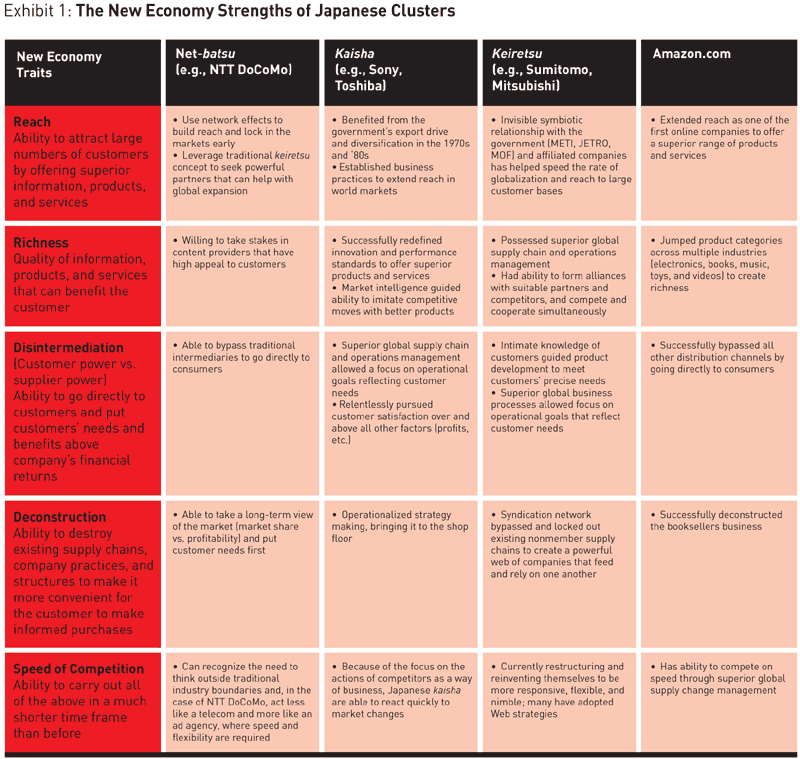
To understand why these existing sources of advantage will benefit Japan as it continues its exit from the stagnant decade, it’s necessary to show their relevance to the five central competitive factors in the New Economy. These are:
-
Reach. The ability to attract a critical mass of customers by offering superior information, products, and services.
-
Richness. The quality of information and the large variety of products and services that can attract the customer.
-
Disintermediation. The ability to go directly to customers, bypassing the supply chain.
-
Deconstruction. The ability to destroy existing supply chains, company practices, and business structures to make it more convenient for the customer to make informed purchases.
-
Speed of Competition. The ability to constantly change, experiment, invent, innovate, and plan in the midst of unpredictability and change.
By overlaying the traditional Japanese sources of advantage against the framework of New Economy competitive dynamics, it’s possible to identify two areas in which Japanese multinational companies could pose a threat to Western companies. First, their historical ability to leverage customer loyalty is enhanced by new technologies that extend reach to the customer and enhance the richness of the customer experience. Second, new technologies allow Japanese companies to extend their robust alliance networks beyond Japan.
Perhaps more important, the Internet and network technologies could potentially deconstruct Japan’s inefficient layers of suppliers, distributors, wholesalers, and retailers, and loosen keiretsu ties as Japanese manufacturers build supply chain management and production networks with companies all over the world, building on the already strong bricks-and-mortar networks of the past few decades.
But it’s even more telling to show how specific companies in the three clusters of Japanese firms have exploited their traditional sources of advantage to develop new business models and new markets. Exhibit 1, while admittedly impressionistic, shows that many Japanese companies, old as well as new, have accomplished many of the same things for which Amazon.com has been celebrated.
Indeed, the decade’s worth of attention to Japan’s ailments has obscured the fact that Japanese firms’ deliberate wait-and-see approach during the Internet boom years is gradually paying off. Companies like Toyota, Canon, and Nissan have already taken hard measures to turn around, with much success. Similarly, many of the net-batsu — companies like Rohm, NTT DoCoMo, and Nidec — also weathered the downturn, and showed significant share price gains over the last decade. On closer examination, we can see that many of these companies used traditional Japanese skill sets to leapfrog into the New Economy.
Consider NTT DoCoMo, a relative newcomer in the global marketplace, which has been able to apply several of the traditional Japanese advantages (including, importantly, a strength in alliances) to help it expand globally in a remarkably brief time.
Although the consumer electronics industry had underpinned Japan’s economy for decades, it missed out on some of the biggest consumer electronics trends of the 1990s, notably the rise of the Internet. The development of portable Web-linked devices provided a rare second chance to get back into the game. The number of Japanese accessing the Internet through car and mobile telephones reached 12.7 million by the end of June 2000, an increase of 250 percent over the previous six months, while the number of dialup Internet users on fixed lines rose by only 25 percent during the same period. METI was determined that Japan’s consumer electronics industry would not miss out on the development of this next generation of mobile communications.
NTT DoCoMo, 62 percent owned by Nippon Telephone & Telegraph, initiated an aggressive attempt to achieve dominance in the burgeoning field. By leveraging its strengths — knowing its customers well, forming extensive alliances, developing high-quality products and services, and then delivering them at competitive prices — it was quicker than any other wireless telecommunications provider in building richness in its content and extending its reach to its target markets. It launched its i-mode mobile multimedia service in February 1999, and by October 2003, had landed 40 million subscribers to its 2G and 3G mobile Internet service in Japan — more than 50 percent of the market for consumers subscribing to mobile telephone services in Japan.
The company has been helped by Japan’s strong tradition of customer-focused manufacturing. Mobile phones are fast becoming a mass-market commodity, in much the same way radios, televisions, and VCRs did in generations past. Staying ahead in an industry in which prices have dropped drastically requires manufacturers to keep abreast of customer trends, and drive product life cycles to match — or even advance — those trends. Close ties with key Japanese electronics manufacturers — which in turn have strong commercial links with component suppliers in the region — have allowed NTT DoCoMo to source large quantities of scarce, important components, such as miniature color liquid-crystal displays (LCDs). This rapid sourcing ability will become increasingly important as handset life cycles continue to fall. (See “A Master Model for Mobile Multimedia.”)
With its success at home, NTT DoCoMo has launched an assertive strategy to turn its i-mode platform into the de facto standard for mobile Web technology worldwide. It has taken the ability to form alliances familiar to generations of Japanese companies and extended it into new forms of strategic partnerships with mobile providers in Greece, the Netherlands, Italy, Spain, France, and North America, and throughout the Asia-Pacific region. It has linked up with such companies as Sony, NEC, and Bandai in Japan, and Disney in the U.S., to jointly develop new products and services. Today, it stands as the premier provider of mobile e-mail, news, and banking services.
Although the company faces big obstacles in its quest for globalization — lack of international experience, a seemingly piecemeal global expansion strategy, and an internal debate over whether it should be a technology- or a marketing-driven company — it nevertheless has great globalization and “network” potential.
Remaining Obstacles
NTT DoCoMo’s hurdles match the three central challenges Japanese companies generally will need to overcome to leapfrog over the lost decade into the 21st century:
Mastering the use of the English language. English is the predominant language of the Internet. Seventy percent of the information on the Internet is stored in English, and 80 percent of Internet communications take place in English. This means that a disproportionate amount of high-tech innovation is first written in English, which further reinforces the link between English and business innovation. Non-English-speaking nations like Japan have a distinct disadvantage. Recognizing this, the Ministry of Education, Culture, Sports, Science, and Technology has formulated a strategy to cultivate “Japanese with English abilities” — a concrete action plan aimed at significantly improving the English facility of the Japanese people.
Managing new customer relationships and service online. The Japanese have traditionally been weak in globalizing service-related businesses — surprisingly, because Japanese society has always had a service orientation. But Japanese companies traditionally relied on their distributors to deliver products and services to the end customers. The challenge now is whether they can learn to deliver services in both the offline and online environments. As network technologies continue to disintermediate complex supply chains, can Japanese firms go online and deliver the same high-quality products and services? Do they know the “cyberconsumers” as well as they do their bricks-and-mortar customers?
Evidence suggests the answer to these questions is yes. The business-to-consumer online marketing site of Toyota, gazoo.com, has become one of Japan’s most popular Internet gateways, peddling items as varied as books, CDs, brake pads, and entire cars. Through online ordering, Toyota can understand and better respond to fast-changing consumer preferences. Toshiba’s business-to-business Web site for dealers, Internet FYI, is similarly successful. Dealers can order photocopiers, fax machines, parts, and supplies, and have the deliveries fulfilled quickly. Toshiba’s primary motivation for launching Internet FYI was to improve service to its dealers.
Building innovation-generation processes. The postwar Japanese business model relied less on innovation than on successfully exploiting the innovations of others. The limits of the “competent copier” model, and of growth through progressive technical innovations centering on process innovations, have been reached. Japan needs to encourage a culture that is conducive to inventing the wheel rather than perfecting it. Japan must maintain and improve its advanced process-innovation capability and manufacturing excellence, while building innovation-generation processes that can continuously generate creative and knowledge-intensive product innovations with high added value. Some leading Japanese firms, including Toyota, have been shaping a new “human-based” business model that stimulates creativity and innovation and supports efforts to achieve agility — the ability to rapidly react to all kinds of change.
These challenges notwithstanding, Japanese firms’ apparent slow start in the New Economy race may have worked for them by giving strategists time to observe the moves of their competitors, craft their transformational strategic moves, and create new business models that will work for the Japan of the 21st century. The traditional Japanese business fundamentals — focus on the customer, global mind-set, a more rounded knowledge, teamwork, strong linkages among Japan’s institutions, and operational efficiency, among others — will set Japanese companies apart from their Western rivals and will be instrumental in transforming the country from Japan Inc. to Cyber-Japan.
A restructured Japan is likely to be an immensely powerful competitor in many sectors, in the domestic market as well as in global markets. If Japan was thought to be mighty in the 1980s, the new Japan could be mightier yet.
|
Three Clusters for the New Economy |
|
Keiretsu are business groups, banded together through reciprocal stock ownership and exclusive, horizontal relationships that link banks, industrial companies, and trading companies (sogo shosha). Keiretsu such as Mitsubishi, Mitsui, and Sumitomo, with their sprawling businesses, once powered the Japanese economy. Keiretsu derived from the powerful pre–World War II zaibatsu, the huge, family-owned conglomerates that were broken up and sold to the public during the U.S. occupation. Today, the keiretsu have jumped onto the restructuring (risutora) bandwagon. Although some large keiretsu have begun to break up, the relationships built over the years by senior company executives provide an underpinning of network strength to many Japanese companies. Kaisha are large multinational corporations with a global presence and brand names attractive to consumers in many parts of the world. Many kaisha, especially the major automakers, belong to vertical production groups linked to a vast network of exclusive distributor and supplier relationships, which tend to do business first with one another. The kaisha include multinational corporations, such as Toshiba, Nissan, and Canon, that are rapidly reinventing themselves and attempting to find new bases to compete globally. Some — including, notably, Nissan, Toyota, and Sony — have begun to radically cut Net-batsu are newer innovators, whose business and operating models have been built consciously on the foundation provided by the Internet. They include Rohm, Nidec, Hoya, Bandai, and Kao. Others, like NTT DoCoMo, Rakuten, and Softbank, blossomed in the high-tech wave of the 1990s. Most derive more than 50 percent of their revenues outside Japan. They tend to be run by entrepreneurial individuals, often the founders. Unlike traditional Japanese companies, which typically favored top-line and market-share growth over profits, net-batsu have focused on efficiency and profit generation, avoiding the maladies of overcapacity, low margins, and bloated work forces that have hurt many Japanese firms. Many net-batsu do not belong to a keiretsu; lacking business and government relationships, they are more exposed to market forces, which compel them to continually sharpen their performance and take greater risks. |
|
Focus: The Japan External Trade Organization |
|
The Japan External Trade Organization (JETRO) has become one of the most powerful enablers of Japan’s renewed global competitiveness. The organization’s role is varied. Through its Region-to-Region Initiatives program, JETRO conducts surveys, engages in economic development missions with other countries, and holds seminars for international regional development activities between Japanese regional economies and overseas regions and businesses. These efforts, coordinated through an extensive network of offices worldwide, bring regions together for investment and technical tie-ups, collaborative research and development, overseas procurement by Japanese firms, and investment in Japan by foreign firms. JETRO also conducts basic and comprehensive studies on economic and related affairs in Asian countries and in developing regions, to promote economic cooperation and the improvement of trade relations between Japan and these regions. Through investment advisors stationed at its Tokyo and Osaka headquarters, JETRO provides information to Japanese firms interested in making overseas investments. JETRO collects a wide variety of information from its worldwide network in its two libraries — the Business Library, located in both Tokyo and Osaka, and the IDE (Institute of Developing Economies) Library. JETRO also regularly feeds companies with information collected through its global network and through publications such as Focus, a monthly newsletter about economic, trade, technology, and industrial trends in Japan. Although many of these reports are available publicly through its library and Web site, JETRO also handles “custom reports” that are available only for Japanese companies. — C.N. and G.S.Y. |
Reprint No. 04105
Cecilia S.V. Ng (cecilia.ng@cantab.net) is the executive director of Think Strategy Consulting, a strategy consulting firm in Singapore. She has held strategy positions with the Japanese retailer Parco and the consumer electronics company Toshiba. Ms. Ng obtained her MBA from the Warwick Business School and conducted research at the Judge Institute of Management Studies, Cambridge University.
George S. Yip (gyip@london.edu) is professor of strategic and international management at London Business School and lead fellow of the U.K.’s Advanced Institute of Management Research. He is the author of Total Global Strategy (Prentice Hall, 1992; revised 2003) and the classic 1989 Sloan Management Review article “Global Strategy in a World of Nations?”