
The Cat That Came Back
How the world's largest heavy equipment manufacturer rebuilt its organizational DNA.
(originally published by Booz & Company)
 |
|
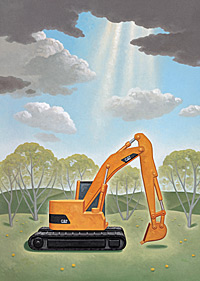
Illustration by Robert Goldstrom |
Decision Rights: the rules and mechanics that govern who makes which decisions — and how.
Information: the metrics that measure performance, and the practices that transfer knowledge.
Motivators: the incentives, objectives, career alternatives, and other elements that drive people’s behavior.
Structure: the overall organizational model, including the “lines and boxes” of reporting relationships and job descriptions.
Just as an individual’s physical and intellectual qualities depend on his or her genetic code, the building blocks of organizational DNA determine how a firm looks and behaves, both internally and externally. These building blocks matter because they deeply influence everyone’s decisions — not just decisions made by people at the top of the hierarchy.
For example, if you work in middle management, which e-mails do you leave unanswered? What determines whether you offer a customer a discount to increase volume or hold the line to protect margins? How do you share information with someone in another business unit or region? These daily decisions, taken together, determine an organization’s ultimate success or failure. And they in turn are deeply affected by the decision rights people hold, the information they receive, the incentives and other motivators that reward them, and the organizational structure of formal positions and reporting relationships.
Fortunately, unlike human DNA, organizational DNA can be modified. The key to improving performance is not to blame individual performers, but to realign those building blocks to support decision making that’s more consistent with the overall strategy and performance objectives of the company.
That is exactly what happened during the late 1980s and early 1990s at Caterpillar Inc., a $30 billion global manufacturer of large construction and earth-moving equipment, engines, and power systems. “Cat,” as people call it, is a company that had enjoyed a long-standing record of profitability and market leadership until 1982, when it was almost put out of business by an unanticipated surge of competition. Caterpillar rebounded reasonably quickly and successfully at that time; it returned from near-bankruptcy to profitability in a few short years. But many companies can do that once. What distinguished Caterpillar was the moves it made afterward: The company reshaped its DNA on all four levels in a way that permanently changed the culture and capabilities of the enterprise.
“This was a revolution that became a renaissance,” says Chairman and CEO James (Jim) Owens, who was a midlevel manager at Caterpillar when the story began. “It was a spectacular transformation of a kind of sluggish company into one that actually has entrepreneurial zeal.”
Complacent to Resilient
Although it operates in many cyclical industries that have been hard-hit by recession over the last several years, Cat has delivered 12 straight years of profit, nearly tripling both its top and bottom lines since 1993. Its global markets reach from Peoria to Pretoria, with innovative products that routinely win quality awards and a dealer network that delivers some of the best customer service in the world. In 2003, its shareholder returns were the second-highest among companies in the Dow Jones Industrial Index, and the Financial Times placed Cat 27th in its list of most respected companies in the world. In 2005, Forbes listed Caterpillar as the best-managed industrial corporation in America.
We have our own term for corporations like Caterpillar: “resilient organizations.” These are highly tuned and capable organizations whose power derives from the fact that all four building blocks are well aligned with one another and with the corporation’s overall strategy. Caterpillar’s employees know the corporate objectives and how to reach them within their groups or functions; they are motivated to act, and they have the authority they need to make things happen. As a result, Cat can move decisively in its markets, establishing positions of leadership in most of them. These traits are undergirded by Cat’s organizational model, which has remained fundamentally unchanged for the last 15 years.
But Cat hasn’t always been so well designed for success. During a 50-year period of uninterrupted profits that began in the 1930s, Cat’s DNA had become so badly misaligned that its very existence was ultimately threatened. Its highly centralized decision-making process, manifested in a hierarchical central bureaucracy, resulted in a slow, inward-focused organization that was increasingly out of touch with the market. The company was organized in strong functional divisions called General Offices, or “G.O.s,” each responsible for a piece of Cat’s overall business process — engineering, manufacturing, pricing, marketing, etc. — and each with its own executive vice president reporting to the company president. Over time, the G.O.s became extremely powerful and made all the important decisions in the company. George Schaefer, the CEO of Caterpillar from 1985 to 1990, referred to the G.O.s in retrospect as “the kingpins of decisions.” Everything revolved around them, and they rarely communicated with one another. “It took a long time to get decisions going up and down the functional silos,” recalls Steve Wunning, then in logistics and currently a group president of Caterpillar. “And they weren’t always good business decisions; they were more functional decisions.”
The General Offices also were not tied together through metrics or motivators to keep them pulling in the same direction. For example, if a sales rep in Botswana wanted to give a discount on a tractor, the decision was made by the pricing G.O. at company headquarters in Peoria, Ill., frequently by relatively low-level staffers who had no accountability for market share or volume. Moreover, Cat had no visibility into its profitability by product or country; like everyone else, the pricing G.O. staff received data only on the profitability of the company as a whole. If the projections for the coming year were too low, they would simply raise prices to try to make up the difference.
Don Fites, Cat chairman and CEO from 1990 to 1999, explains that “those of us who were actually in the marketplace, who were trying to sell against Komatsu when Cat’s prices were already at a 20 percent premium — we knew we weren’t going to sell much. Pricing was always a great frustration.” He recalls the perspective of those who worked in sales: “You spent most of your time trying to get special pricing. There were forms you had to fill out and justify, and sometimes these things took weeks to turn around. And on a big deal, rather than being out there trying to sell the quality of your product, all the marketing and sales people spent a great deal of time trying to get exceptions to list prices. It came to a point where [the centrally controlled pricing] was almost self-defeating.”
This was only one example of Caterpillar’s basic problem. The four building blocks of its DNA — its centralized decision rights, missing or siloed information about such important issues as competitive position and internal profitability, weak incentives that promoted local instead of global success, and its function-dominated organizational structure — reinforced one another’s weaknesses and undermined the company’s competitiveness. But these organizational flaws and frustrations never got much attention within Cat because its product and dealer strength could effectively overwhelm any competitive threat. And, frankly, most people in the organization were pretty comfortable. “It was a lot easier for a lot of people,” says Gérard Vittecoq, then a junior marketing manager and currently a group president of Caterpillar, “because accountability was just doing what Peoria was telling them. No initiative, no risk.”
Then, in the early 1980s, the global recession and runaway inflation combined to turn Cat’s formerly cozy markets into attractive new opportunities for several competitors, key among them Japan’s Komatsu. Caterpillar posted the first annual loss of its 50-year history in 1982.
Cat’s senior management recognized that one of their company’s most important competitive assets was its distribution system, and that whatever happened, that distribution system had to be protected. So they decided to continue selling to dealers at a price that allowed the dealers to make a small profit. Although Caterpillar did not lose a single dealer, the policy was expensive. In 1983 and 1984, Cat lost a million dollars a day, seven days a week. It was “almost like hitting a wall,” recalls Group President Gerry Shaheen, who was an area manager in North America at the time. “New entrants had come into our competitive space and had changed the rules of engagement. The bad news is, it happened. The good news is, it was a wakeup call.”
The crisis brought front-and-center the fact that costs were too high. So Cat launched a massive $1.8 billion manufacturing modernization program called Plant With A Future (PWAF) that dramatically reduced manufacturing costs. In 1985, the same year that Mr. Schaefer became CEO, the rising tide of a recovering global economy lifted a lot of boats, including Caterpillar’s, and the company returned to profitability. By 1988, Cat had surpassed its then-record 1981 profit levels, and much of the organization felt relieved and perhaps a bit smug at having survived the most threatening period in its history. But some in senior management still had nagging concerns: PWAF had done little to solve the problems that made Cat internally focused, slow, and unresponsive to customers.
Upsetting the Applecart
As CEO, George Schaefer was determined that Cat would not be caught flat-footed again, at least not on his watch. He understood that the competitive pressure on Cat was likely to increase, and that others in the company needed to feel more of that pressure directly. He began informally, by inviting a rotating group of middle managers to breakfast once a week. The attendees understood Caterpillar’s weaknesses and were willing to talk about them. By contrast, as in many centralized organizations where authority is held by a small number of very senior executives, Cat’s senior management had too much vested in the current organization to be expected to share their most serious concerns with the chairman.
In 1987, Mr. Schaefer asked each of his senior managers to provide a list of their best and brightest subordinates. When all the lists were combined, “we had about 40 names, but there were one or two that I [added] because they were real renegades — they were clear thinkers, they would ‘upset the applecart.’” In the end, he chose eight young managers to form Caterpillar’s first-ever Strategic Planning Committee, or SPC, to help him chart Caterpillar’s future. Meeting for half a day each week, the SPC was charged with taking everything back to basics, figuring out where the company stood and where it was going. Everything was on the table, and the debate ranged widely for the first few meetings. Glen Barton, who was on the committee, and who would later become chairman and CEO of Caterpillar, credits Mr. Schaefer with being tolerant enough to allow this kind of free-swinging, unguarded discussion. “He wasn’t defensive,” says Mr. Barton. “He didn’t come out and say, ‘Well, you can’t do that’ or ‘That’s not what we’re here for.’ He was more receptive to hearing what people had to say and what their frustrations were than trying to give specific direction as to where we might go.”
Mr. Schaefer announced that he was meeting regularly with a team of “breakthrough thinkers.” The rest of the organization didn’t expect much to come of it, but it became increasingly clear to the SPC that a major reorganization was needed. As Mr. Barton later recalled, Cat was “just not getting the job done in terms of the final customer. We were too long to react, too long to get a price change. And we did not have clear accountability. If we were more optimally organized, we would be more responsive, more effective as an organization, more competitive.”
Seven or eight months into the initiative, Mr. Schaefer concluded it was time to get the SPC’s findings onto senior management’s agenda. But that would be no small feat, given that the findings were not particularly complimentary to senior management, and the recommendations would in large part dismantle the organization Cat’s leaders had spent their careers building. So Mr. Schaefer introduced the ideas gradually, first by inviting Don Fites and Jim Wogsland, who were then president and executive vice president, respectively, to join the SPC. Mr. Schaefer recalls that “the first couple of meetings were really tough, because when [Fites and Wogsland] heard what we were thinking about, they said, ‘You can’t do this!’ But as they got deeper into it, they quickly came aboard. Once I got those two aboard, I knew I had it made because I could bring the rest of them aboard. It was a tough road for a month there. I didn’t want to get them to just tell me they were buying in; they had to buy in.”
And buy in they did. In Mr. Fites’s words, “We just couldn’t live in this [G.O.–dominated] world. Even though we came up through operations, we knew that the frustration level of the company was very high and we had to make these changes.”
Structures for Accountability
Although all four building blocks of Cat’s organization would eventually be overhauled, Mr. Schaefer and Mr. Fites began with structure. They had initially planned to roll out a new organizational “blueprint” gradually, but they (and their fellow senior executives and board members) soon saw that reorganizing all at once, if it was handled well, would force people to wake up and realize that the future held different relationships, a different structure, and a different way of doing business. So they engineered a complete restructuring to take place virtually overnight.
On the day the restructuring was announced — Friday, January 26, 1990 — the functional General Offices were in charge of everything. The following Monday, they simply ceased to exist. Their talent and expertise, including engineering, pricing, and manufacturing, were parceled out to new “accountable” business units that would be judged on divisional profitability. Some of the leaders of the old G.O.s were demoted to division managers in the business units, expected to serve the product and marketing managers upon whom they formerly imposed rules. The old metrics and flowcharts were gone; in their place were profit and loss (P&L) statements through which the new business units reported their performance.
“And then,” laughs George Schaefer today, “I retired!” In 1990, he relinquished the corporate helm to Don Fites, who led the charge of implementing a new, reorganized Caterpillar.
 |
|
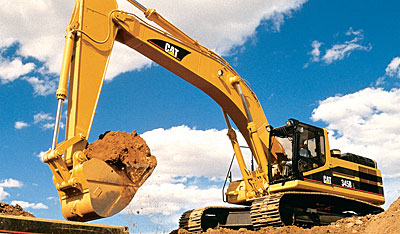
For the 1997 launch of the 345 excavator, Caterpillar retrained its entire sales force. Photographs courtesy of Caterpillar Inc. |
The new organizational structure moved accountability dramatically downward in the organization. Business units could now design their own products, develop their own manufacturing processes and schedules, and set their own prices. They could make their own pricing decisions, develop their own product designs, and create their own manufacturing and marketing plans. They did not need permission from anyone at headquarters.
But the business units were also accountable for how well they used those decision rights. They would be judged on the profitability and return on assets (ROA) in their divisions. If a division could not achieve 15 percent ROA or higher, it could face elimination.
This represented a profound change for nearly everyone at Caterpillar. And the speed and certainty with which it was announced was every bit as surprising as the change itself. Jim Owens, who was a managing director in Indonesia at the time, recalls: “I got a phone call on January 4th, my birthday, while I was on vacation at Squaw Valley. I was told there would be a reorganization, that I would be promoted to [corporate] vice president and president of the solar business unit, and that I should just be in Peoria on January 28th for my first council meeting. At that time everything would be explained to me.
“I asked if I could talk to the guy I was replacing but was told not to talk to anybody. ‘You show up in Peoria, and don’t come early. The meeting is the morning of the 28th. You get here the night of the 27th.’ I showed up on the day of the meeting, and nobody knew who was going to be there from the executive office!”
With headquarters much leaner, its remaining executives focused almost exclusively on setting goals and measuring performance for the business units. Mr. Fites, as the new CEO, held regular meetings with each of his division vice presidents, keeping notes in a spiral-bound notebook on what the managers said they would achieve. At the next meeting, Mr. Fites would produce the notebook and review each manager’s performance against the commitments made in the previous meeting. “It worked very well,” recalls Mr. Fites. “Instead of having all this energy used internally, we focused on the end game: What are the results we want?”
For a business unit manager, the two models produced starkly different behaviors. Before the reorganization, a plant manager in, say, Grenoble, France, would be told by headquarters in Peoria to buy a particular fabrication machine from a certain supplier at a given price and to install it according to a predetermined layout in the factory. The plant manager would fabricate parts according to drawings developed in Peoria, using prescribed manufacturing processes. When the resulting parts were defective, he or she would call Peoria, complaining about the design, the machine, the supplier, or all three. Naturally, he or she would be inclined to assign blame elsewhere, because the onus was on headquarters to fix the problem that they had created with their design, their machine, their supplier.
But after the reorganization, when defective parts came off the line, there was no reason to call Peoria. Instead, the plant manager fixed the problem independently. If the supplier was the problem, the manager’s purchasing group found another. If the drawing was bad, his or her engineers redesigned it. The clear accountability of the new model forced people to focus their attention on finding a solution instead of pointing fingers.
Entrepreneurial Decision Rights
The reorganization — and particularly the shift to an accountable business unit model — dramatically decentralized decision rights. Although centralized, siloed organizations often contain very deep functional talent, they give very few managers the experience of dealing with a broad range of problems. Often, when such organizations move to a more decentralized model, long-hidden talent weaknesses are suddenly exposed.
Cat was no exception. At the time of the reorganization, very few people in the company had any previous experience in running a business. Almost everyone in senior management had grown up inside the old, functional Cat; they knew well how to operate within the silos that had just been obliterated. Now, several of them were being handed the keys to multibillion-dollar business units, with little or no formal training. Some couldn’t manage the transition and the new autonomy and had to be moved to positions with less authority. But many business unit leaders found the new decision rights invigorating and were thrilled to see their first divisional P&L.
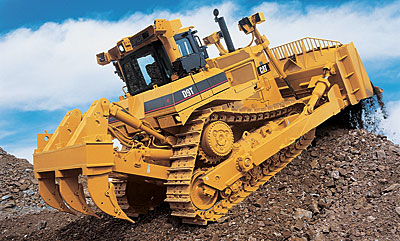 |
| The success of the 1995 D9 tractor prompted Komatsu to withdraw its rival machine. |
“The most spectacular part of the job was that we really didn’t know what they expected us to do,” says Dan Murphy, currently vice president of purchasing, who became global manager of the hydraulic excavator line in the reorganization. “There weren’t a whole lot of guidebooks. We could do what we thought was right. We could make informed decisions, and we got tremendous support. And we were kings.”
A.J. Rassi, who became the general manager of the wheel loader and excavator division in Aurora, Ill., shortly after the reorganization, recalls the first time he saw his divisional P&L: “I was so excited, because I was in a very profitable business unit and I could see that we were making a lot of money for this corporation. We had meetings every month and shared the P&L statements with our top management people in the Aurora group. And, in our plant managers’ meetings, we showed every plant, profit or not. Before, there was nothing.”
Others experienced a rude awakening. When Jim Despain became vice president of the track-type tractor line — the product line on which Caterpillar was founded — he was shocked to learn that “we were losing a lot of money. We had no idea how to fix it. [And this was the] first time we realized it, because the company was profitable, and we had the best product, the original plant, the most seasoned employees.”
But resourceful, empowered managers eventually figured out how to run profitable businesses. The accountability and autonomy of the new model unleashed a vast amount of entrepreneurial energy and managerial discipline from Cat’s considerable talent pool. “People really started intensely looking at how they made money in their division,” recounts John Pfeffer, then a plant manager at Caterpillar, who has since retired. “You’d say, ‘I’ve got to take $20 million, or $50 million, out of my cost structure this year, and the only way is to identify the stuff that clearly I shouldn’t be doing. So why is my assembly and engineering plant cutting steel? I’ll outsource this to Mexico at $4 an hour versus us doing it at $45 an hour.’ That was really the catalyst. People started putting together one-year and three-year plans, and it was almost embarrassing what people could come up with,” compared with their performance in the past.
Information Heroes
At the same time, Caterpillar completely changed the information flows in the organization and the metrics used to measure performance. A high return on assets became the overall goal. ROA was correct, simple, and straightforward to use, which was particularly important for the pragmatic engineers who were mostly now running Cat’s businesses.
Only a few of Caterpillar’s divisions sold to outside customers; the rest lacked any natural measure of revenue to use as the top line of their P&L. For the profit-center model to work, Cat needed to create a measure of internal revenues. This was provided through transfer prices, at which Caterpillar divisions “bought” and “sold” intermediate goods from each other. It is easy to underestimate the importance of transfer prices. After all, they are tantamount to “trading wooden nickels,” since they only move money from one division in the organization to another. However, because transfer prices enable organizations to re-create supply and demand economies inside their boundaries, they are the often-overlooked linchpins that hold decentralized organizations like Cat’s accountable model together.
Using market-based benchmarks, divisions would negotiate with each other to determine transfer prices. These negotiations were often contentious and protracted, and consumed a lot of management time and attention. But they were essential to making the new organization work properly.
Jim Owens recalls a meeting of the administrative council two years after the reorganization in which “a large group of vice presidents from materials purchasing and the plants gave a little presentation about all the time they spent doing commercial negotiations over transfer prices. ‘We’re too inward looking; we’re wasting our time.’ And Fites got up and said, ‘You don’t understand. Half your cost is purchases from outside suppliers. U.S. Steel didn’t have any trouble whatsoever establishing those prices. So that’s the way we’re going to run the railroad. If you can’t work that way, you can get another job.’ That ended the debate rather succinctly.”
As a Ph.D. economist and new CFO at the time, Dr. Owens recognized that the business unit structure could uncover cost problems only if transfer prices were negotiated from market benchmarks, “so the losses showed up where the cost problems were. And if you lose that discipline, you’ve lost it. I was thrilled that [Fites] took that very staunch position.”
It was no small feat to create reliable metrics that would give every division its own balance sheet and P&L. In June 1990, Mr. Fites went to the “unsung information heroes” (as one observer later called them) of the accounting division and asked how long it would take. They said they thought they could do it in three years. “I told them, ‘I want every one of these divisions to budget next year on the basis of their new balance sheets and come up with a P&L,’” Mr. Fites recalls. “And Bob Gallagher, who was our comptroller — the blood drained from his face. I thought he was going to faint right on the spot! But you know what? They did it. And they did it well. We hardly ever had to make any changes in the balance sheets or the P&Ls. That six months was probably one of the most incredible transitions that ever took place around here.”
Motivators on Target
“The great motivator,” says Don Fites, “was survival — survival of the company, your personal survival as an important player, survival of this product that you love and that you designed, the survival of your plant.” Nevertheless, Cat’s reorganization also involved an overhaul of the compensation plan. Before the reorganization, individual bonuses were based on overall corporate performance rather than business unit objectives. After the reorganization, an employee could make anywhere from 7 to 45 percent additional salary per year based on meeting business plan targets.
These incentives cascaded through the organization and helped the business units focus on tangible, measurable outcomes that line employees could affect. For example, John Pfeffer recalls a new concetration on meeting delivery commitments: “We supplied all these little components, and prime product plants just go berserk when you shut them down because you missed a shipping date. So our incentive plans were heavily skewed [toward meeting the shipping dates]. And what happened was, we started meeting [those shipping dates without] expediting stuff all the time.”
Mr. Schaefer (who remained on the Caterpillar board for several years after retiring) credits the compensation plan with generating buy-in for the change deep down in the organization. “We had a lot of trouble in the middle and lower ranks buying into these many changes. But when we told them, ‘If you get your revenue up by 10 percent, and you get your profit up by 20 percent, here’s the amount of bonus you earn,’ they bought into that in a hurry!”
The compensation committee of Caterpillar’s board set up a long-term incentive plan for top management, and short-term incentive plans for individual units. Under the short-term plans, managers in business units who outperform their ROA targets receive bonuses even if the company does not meet an overall target. But by far the larger incentive is provided by the long-term plan, under which Cat executives can earn bonuses when the company outperforms a peer group of about 15 other companies on ROA and profitability growth targets. Glen Barton believes that the incentive plan has “caused people to work together.”
 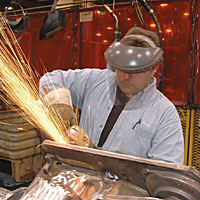 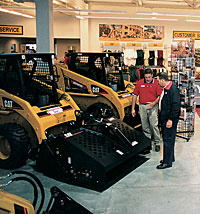 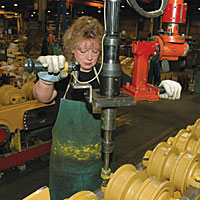 |
| Clockwise from top-left: Caterpillar's assembly plant in Mexico, mentioned in this article for its innovative resale of scrap steel; two views of the East Peoria, Ill., plant; Cat's hometown retail store in Peoria. |
Sustainable Resilience
Cat’s timing was fortuitous. In 1993–94, the effects of the reorganization began to kick in at the same time as the economy started to recover. “The world started getting good,” recalls Mr. Pfeffer. “People started making their business plans, started getting a lot of incentive compensation, and they stopped fighting the change. They said, ‘We did the right thing, I’m happy we’re doing this.’”
The turnaround in Caterpillar’s financial performance was spectacular — and sustained. After posting a $2.4 billion loss in 1992, the company returned to profitability in 1993, and has increased its earnings ever since, reaching a record $2 billion in profits in 2004. Cat’s revenues have nearly tripled since 1992, from $10.2 billion to $30.3 billion in 2004. The results also appear in operational indicators, including dramatic increases in productivity. Cat reduced its product development cycle to roughly 36 months (from 48 to 72 months before the reorganization). Because assets were tied back to product profitability, the businesses no longer sought massive capital investments to renew manufacturing operations for every product upgrade, so capital requirements fell as well.
At the same time, everyday behavior changed focus from internal process and budget to customer satisfaction and profitability. For example, Cat started developing products more in sync with what dealers and end customers wanted. Because each product business unit now had a full complement of functional talent in its new product introduction teams, and those teams were empowered to make all product development decisions without requiring approval from any other source, they could act more quickly and responsively with more complete information. In 1995, Caterpillar introduced an updated version of its D9 tractor after just three years of development. The model was so successful in North America that in only two years, Komatsu withdrew from the market completely in that category.
Another example of Cat’s responsiveness occurred in the early 1990s, when the company bid to supply 800 pieces of road maintenance equipment to the county governments in Vancouver, Canada. John Deere, one of Cat’s main competitors, had offered a big discount and appeared to be the favorite. But Caterpillar quickly assembled an attractive lease program, creating a better deal than Deere’s, and won the entire order.
Group President Stuart Levenick, who was the district manager in Vancouver at the time, remembers that such an approach would never have been possible in the old organization. “First of all, to do that, we had to do all kinds of creative marketing and merchandising programs, and bring in Cat Finance. It was a very comprehensive approach. Second, we had to be able to ship all that stuff in two months, so we essentially took the entire production capacity of the Decatur plant for two months and devoted it to this customer. That would never, ever have happened before the reorganization. Nobody at that level would have ever had the authority to do something like that. Even to propose it would have taken a year to work through the old pricing G.O., and then to get the capacity allocated to do something that was so strategic was impossible.”
There are other examples of formerly impossible feats. In 1997, Caterpillar launched a 40-ton excavator, the 345, with an unprecedented marketing campaign that involved retraining its entire sales force — and the company nearly doubled its percentage of industry sales within two years. A Cat plant in Mexico took excess steel that was formerly sold as scrap and cut it into two-inch-square blocks that could be used for parts in heavy machinery, and then sold those blocks to other Cat plants at half the regular price. In a tractor plant in East Peoria, a team of hourly welders on the production line figured out a way to produce welding lenses for nearby robots. These parts needed frequent replacement because sparks and molten pellets would bombard them; in-house fabrication cut the cost from $62 per lens to six cents.
On a different occasion, when Division Vice President Jim Despain was visiting the East Peoria plant, another welder showed him a striking innovation he had developed. Mr. Despain, impressed, said he wanted to show the innovation to a couple of group vice presidents the following Friday. The welder demurred. “I’m going to Cleveland Friday,” he said. “I read in a welding magazine that they’ve got something they’re trying out there and I want to go take a look at it to see if it would fit here.”
Even more impressed, Mr. Despain said he would mention to the supervisor that he appreciated the support he gave for this kind of innovation. “Oh, I haven’t told him yet,” said the welder. Here, thought Mr. Despain to himself, was a truly empowered person.
Mr. Despain’s division went from heavy losses in 1990 to significant profitability by 1995 and cut head count from 4,500 to 2,000. “We never invested a dime in more technology, never did any outsourcing,” he recalls. “We just changed the way people worked together. They were putting their own creativity into the opportunities they were provided. They forgot about themselves and started looking at the bigger picture.”
Caterpillar today looks somewhat different from when it was first reorganized, but the original principles of the reorganization are still intact: decentralization, profitability, market-based transfer prices, and accountability. There are more and different business divisions now. Some have been eliminated because they couldn’t perform (e.g., agriculture, lift trucks), and some have been split into multiple divisions (e.g., engines). But the fact that Cat has operated and thrived using essentially the same organizational model it established 15 years ago is a testament to its resilience. Cat does not reorganize every few years, as many companies do, just to “shake things up.” Such a concept would be anathema at Caterpillar.
As do all resilient companies, Cat periodically moves the goalposts to keep stretching the boundaries of what it can achieve. For example, Cat showed a profit of more than $800 million in 2001 at the bottom of the recession, and then raised the bar: The next goal was to be “attractively profitable” at the top of the business cycle, which it achieved in 2004. The next objective is to be increasingly profitable at the bottom of each successive trough.
Cat’s reorganization was deliberately designed to encourage “horizontal” thinking across silos, another trait of resilient organizations. Cat continues to build upon that horizontal emphasis when it develops its management talent, consciously moving leaders across business units, functional areas, and geographies through the course of their careers. After several years with the company, almost every manager at Cat has experience in two or three different business units. As a result, Cat has developed one of the deepest management benches in its industry. In fact, Cat’s organizational structure, with many more-or-less-complete businesses being run by essentially autonomous general managers, has “allowed us to identify people who are business leaders whom we would probably not have uncovered as quickly before,” says Glen Barton. “People have emerged from this process very capable of leading a business, and becoming a lot more than they probably could have ever realized in the old bureaucratic organization.”
Are resilient organizations problem-free? Can they be managed on autopilot? No. Resilience is not an end state. It’s a never-ending journey. But as Caterpillar’s experience (in contrast to the plight of many other motor vehicle and heavy machinery manufacturers today) shows, it is far better to navigate that journey in a craft whose parts fit together well and make up a seamless whole.
|
Top 10 Traits of Resilient Organizations |
|
1. They entertain the inconceivable, benchmarking themselves not against competitors, but against industries or categories that may not yet exist. 2. They build a culture of commitment and accountability, expecting and rewarding no less than the best from their people. 3. They move the goalposts, typically every three years, embarking on ambitious new objectives whether or not they feel the hot breath of competitors on their necks. 4. They show the courage of their convictions, charting a course based not on business fads or Wall Street fancy, but on their best instincts and judgment. 5. They bounce back from adversity, detecting setbacks early and mobilizing responses quickly. 6. They think horizontal, flattening their organizations, breaking down silos, transferring best practices, collaborating cross-functionally, and promoting laterally. 7. They self-correct, developing and institutionalizing internal mechanisms for correcting problems before they reach profit-warning proportions. 8. They listen to the complainers, using mechanisms and processes for surfacing and addressing dissatisfaction among customers and employees. 9. They put their motivators where their mouths are, designing financial incentives (raises, bonuses, benefits) and nonfinancial incentives (promotions, transfers, exposure) to pull in the same direction and clearly point toward what is valued. 10. They refuse to rest on their laurels, resisting or even shunning media praise and hype while pursuing tangible results. These traits are distinctive because they’re difficult to master, and resilient organizations do not necessarily pursue them directly. Rather, the traits are a natural consequence for any organization that aligns its “DNA” building blocks effectively to strategic goals. |
|
Inside the Transformation | ||||||||
|
Caterpillar Inc. is one of the few companies anywhere that has successfully completed a revolutionary transformation. We believe that Caterpillar achieved this success because of its deliberate focus on a set of organizational guiding principles. Those principles enabled Cat’s dramatic, wholesale transformation in the early 1990s, and they continue to guide Cat’s response to changes in its competitive environment today.
• Make businesses accountable for their bottom line. Cat’s stronger product lines no longer subsidize weak ones; business unit managers are held personally accountable for results. • Use market-based transfer prices for the (many) transactions among business units. Transfer prices based on external markets are negotiated between businesses, so that performance issues show up in the business units that are uncompetitive, rather than farther downstream. • Establish a “single-counted” bottom line. Accrue full costs to each business unit and give business unit managers access to the metrics needed to boost productivity and manage performance. Such cost accounting combined with transfer prices provides each business unit with a P&L for which its managers can be held accountable. The sum of all business unit P&Ls adds up to the P&L for Caterpillar as a whole. • Expect business unit managers to maintain an enterprise-wide view of Cat as well as see to the strategic, operational, and financial performance of their particular business. • Hold no business sacred. Product lines that persistently fail to deliver are sold.
All four of Caterpillar’s CEOs since the reorganization have told us that it was the most significant event in the company’s history — and in their own professional lives. They each played an important role. George Schaefer instigated it. Don Fites carried it out, not opening the change up for debate, since he knew that would allow people to hold back and stall it out. Glen Barton and Jim Owens continued to institutionalize it, resisting any temptation they may have felt to change course just to show they were in charge. Their steadfastness means that Caterpillar has held to its fundamental principles through four generations of CEOs — a remarkable accomplishment that only a few great companies achieve.
Many companies would respond to such challenges with wholesale change, throwing out their principles and downplaying their existing relationships. At Caterpillar, the choice of exactly how to adapt is likely to be made by the next generation of senior executives, who will be the first group running Cat without direct experience of the Schaefer and Fites era. They are, however, already operating on a global basis, and eager to keep the freedom and accountability that the principles have provided for more than a decade. We suspect that these new leaders are up to the challenge of adapting the organization within the framework of the original guiding principles, and when they succeed it will represent the continued natural evolution of Caterpillar’s transformation. — Paul Branstad and Jan Miecznikowski Paul Branstad is a senior vice president and Jan Miecznikowski is a vice president in Booz Allen Hamilton’s Chicago office. |



Reprint No. 05304
Gary L. Neilson (neilson_gary@bah.com) is a senior vice president with Booz Allen Hamilton in Chicago. He leads the global Booz Allen team that developed the organizational DNA concept and that deploys the related “Organizing for Results” service offering, helping companies diagnose and solve problems associated with ineffective organization and strategy implementation.
Bruce A. Pasternack (pasternack_bruce@bah.com) is president and CEO of Special Olympics. Before joining Special Olympics, he was a senior vice president and managing partner of Booz Allen Hamilton in San Francisco, where he specialized in building strategic agendas, developing organizations, and transforming business models.
This article is adapted with permission from Results: Keep What’s Good, Fix What’s Wrong, and Unlock Great Performance, by Gary L. Neilson and Bruce A. Pasternack, copyright © 2005 by Booz Allen Hamilton Inc. Published by Crown Business, a division of Random House Inc. Click here.
The authors wish to thank Booz Allen Hamilton Senior Vice President Paul Branstad and Vice President Jan Miecznikowski for their assistance with the research on Caterpillar, and Booz Allen Principal Karen Van Nuys for her assistance with the development of this article.