

Format Invasions: Surviving Business’s Least Understood Competitive Upheavals
Surviving business's least understood competitive upheavals.
 |
|
Illustrations by Elwood Smith |
But these standard explanations are misleading. In the 1990s, incumbents like GM, Ford, United, and US Air (now US Airways) were already losing market share and money whenever they faced the intruders directly. Only rising markets elsewhere kept them profitable. Today, even if their employment costs were equalized, their pension obligations were lifted, and crude oil prices returned to $28 per barrel, they would still have higher costs and lower quality than their new competitors.
The real explanation is format invasion. Every business has a format — its own distinctive way of organizing the many activities involved in delivering its product or service. Incumbents suffer (as GM, Ford, United, and US Airways have suffered) when intruders enter their markets wielding new types of business formats. These new ways of assembling commonplace assets deliver familiar goods and services at massively lower cost, often 20 to 40 percent lower, while maintaining or improving quality. The traditional market leaders fail to recognize the power and potential of their competitors’ new formats. They cling instead to their old familiar formats, and gradually but inevitably lose ground to the new ones.
Some business observers credit technological innovation as being the most critical factor in transforming an industry. But successful new formats do not rely on new or proprietary technology. Indeed, incumbents often have broader and deeper technological capabilities than intruders. Instead, new formats achieve their massive cost advantage by changing several of the business’s main functions at once, often reaching backward to include suppliers or forward to include distributors. These changes are tightly interlinked: The new format “works” only when it’s adopted as a whole, which makes the transition to a new format daunting for incumbents.
Other observers equate market development and growth with a “killer app” — a new feature or hit product, like the Chrysler minivan, the Apple iPod, or Pfizer’s Viagra. Hence the frenetic chase for the new feature or hit product that will open the wallets of an existing market segment or galvanize a new one. But a new business format has little to do with innovative features or technological novelty. Rather, massively lower cost is the killer app in many markets — as companies as diverse as Dell, Inditex (Zara) apparel, Countrywide Financial, Nucor, Wal-Mart, and Charles Schwab, as well as Toyota and Southwest Airlines, have shown. Toyota’s lean manufacturing methods, which ruthlessly eliminated the waste in its production systems, led to costs far below those of the Big Three Detroit automakers. Southwest’s point-to-point format for air travel vastly reduced the ground and flight costs inherent in the “hub-and-spoke” format of the airline industry’s established leaders. In recent decades, intruders wielding new business formats have trounced traditional incumbents across a wide range of industries: personal-computer manufacturing, car care, mortgage lending, stockbrokerage, steel, and many varieties of retailing, from groceries to books to gasoline.
An effective format invasion throws open for question the prevailing operating assumptions of an industry. Consider, for example, two recent format invasions in the European gasoline retail sector. The predominant format for the past several decades was the large, self-service gas station combined with a convenience store, which had supplanted the older format of small, full-service gas stations with repair bays. Jet, now a subsidiary of ConocoPhillips, has entered the Scandinavian market with a wholly new format: a completely unattended gas station. Effectively, it is a giant vending machine. By eliminating the station manager, cashiers, and other support costs, the new stations require only half as much margin per liter of gas to earn an attractive return. They can offer an almost unbeatable combination of low prices and convenient locations.
Meanwhile, in the United Kingdom and France, grocery chains have initiated a different kind of format invasion in the same sector, moving aggressively into gasoline, leveraging their existing stores and infrastructure to sell gasoline at much lower costs and prices. Gasoline is just one more product for a grocery chain, whose entire motor fuel department need be only a handful of people, compared with the hundreds employed by the old-format oil companies to support similar market share levels.
Both new formats are coming to the United States. Grocers, general merchandisers, and warehouse clubs have all begun offering gasoline, many of them using unattended operations like Jet’s. They now serve about 10 percent of the U.S. national gasoline market, and much more in some markets, notably Texas. It remains unclear which variant of these new formats will win, with the answer likely varying by local market. But one thing seems clear: The traditional format is losing, and will continue to lose.
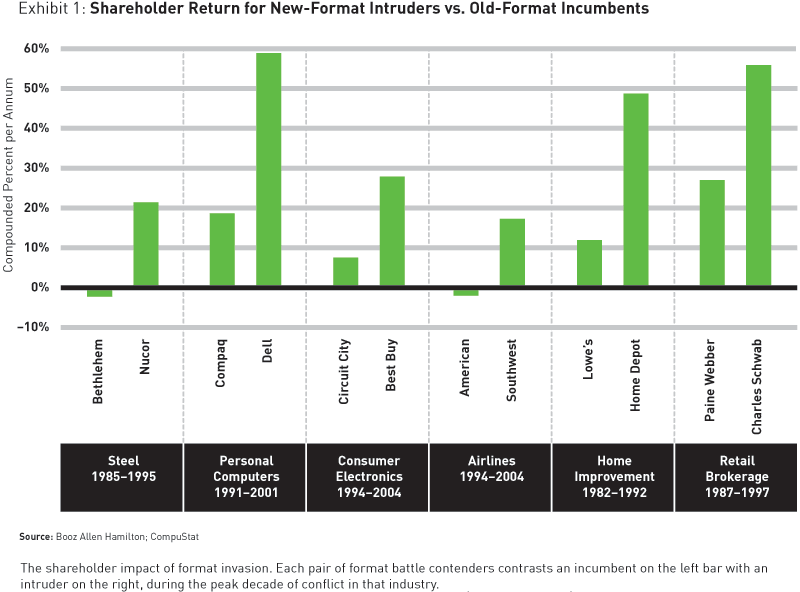
It may seem remarkable that this pattern recurs so often. Yet that’s the reality of format invasions. Highly sophisticated incumbent companies, with years of experience and strong market positions, ignore and resist a new format’s opportunities to reduce cost, while upstart new entrants embrace and exploit them. Intruders wielding new business formats in just this way have shattered traditional competitors across a wide swath of industries, in countries ranging from the United States to France to Japan. As a result, companies championing new business formats are among the largest creators of shareholder value. Conversely, incumbent companies’ failure to respond effectively accounts for a great deal of shareholder value destruction. (See Exhibit 1.)
The pattern continues. New format invasions seem to be occurring now in industries as diverse as fashion apparel, commercial aircraft, and wireless communications. And (investors, take note) we see many established companies responding to format invasions with the same tactics that have failed other incumbents before.
But there is good news for executives of established companies. Format invasions are not overnight successes; there is time to respond. And incumbents need not be losers. Established companies in large industries — armed as they are with substantial assets, intellectual capital, and customer relationships — can defeat the invasions and emerge as winners, if they recognize:
-
Where new formats come from
-
How new formats take over a market
-
Why incumbent companies so often fail to respond to new formats
-
How to take advantage of a new format.
Birth: Reconceiving Costs
Over time, an industry’s prevailing format becomes a victim of its own accomplishments. The quest within one company to earn a premium or bring down costs in targeted activities succeeds — and is then copied across the industry. Competitors may become less distinct, in both features and performance, and the category commoditizes. Growth may slow, but the industry can carry on in a state of equilibrium for quite a long time.
Then an innovative new format appears. One day, somebody reexamines the activities common across the industry and discovers or develops a completely new way of performing them. Quite often, this new pattern involves a focus on activities that the industry’s leading companies had not noticed, much less singled out for attention. But by focusing on these overlooked factors, the innovator finds ways to configure or reconfigure the company’s assets, people, and processes to greatly reduce the activities’ costs.
Southwest Airlines provides a famous contemporary example. Once in the air, Southwest is no more efficient than its traditional competitors. But Southwest was the first airline to focus its institutional attention on the least interesting part of aviation: the time an airplane sits at the gate. By dramatically reducing that turnaround time and ruthlessly applying the same logic to all its operations, Southwest developed a 40 percent or greater cost advantage that its old-format competitors seem helpless to meet. (See “Airline Invasions: ‘Barbarians’ at the Gates,” below.)
|
Airline Invasions: “Barbarians” at the Gates |
|
One of today’s harshest format invasions is roiling the airline business. An alternative business format — low-cost carriers with a point-to-point production model, exemplified by Southwest, Ryanair, and JetBlue — is challenging the traditional “hub-and-spoke” format of incumbents. The challengers have designed their operations around the relatively simple requirements of moving passengers directly from one city to another. The hub-and-spoke incumbents, in contrast, are configured to provide effective passenger connections and to maximize revenue from their networks. The challengers build volume through price-led market stimulation of their point-to-point routes, creating passenger connections as a by-product. The incumbents build volume by offering synchronized services “from anywhere to everywhere.” The cost differences are huge: The challengers have a 40 to 50 percent cost advantage, a result of 20 to 30 percent higher utilization of aircraft and crew, more than twice the ground personnel productivity, and less than half the overhead cost per enplaned passenger. Critically, this is not the result of unionization or differences in pay scales. Southwest Airlines, for example, is unionized; with stock options and benefits factored in, it pays its employees more than many of the U.S. hub-and-spoke carriers. Neither can the cost differences be attributed to bare-bones and low-quality service. Although challengers like Southwest and Ryanair began by attracting price-sensitive customers traveling short distances, they have steadily extended their service offerings. They now feature longer flights, connections for passengers and baggage, and better on-board services (JetBlue has 24-channel TV screens for each passenger). As a result, challengers have doubled their share of U.S. domestic passengers, to 30 percent today from 15 percent in 1992. (European discounters are rapidly moving along the same path.) In his book Seeing What’s Next: Using the Theories of Innovation to Predict Industry Change (Harvard Business School Press, 2004), Clayton Christensen questions the ability of these new-format airlines to replace the hub-and-spoke incumbents. While conceding that low barriers to entry make them a continual threat to incumbents’ profitability, he adds, “Because there is not asymmetric motivation, disruptive discounters are unlikely to transform the industry.” But we see a different pattern emerging. Having capitalized on the recent cyclical downturn in airline travel to gain market share, the challengers are permanently changing the pricing level in the industry, and are poised to become the dominant format. Today, some 80 percent of U.S. domestic passenger trips occur between cities that can comfortably support nonstop service. For the traditional hub-and-spoke airlines, there is no place left to hide. The incumbents have responded by cutting costs, increasing efficiency, and adapting selected elements of the low-cost carrier model, such as “smoothing out” (more effectively scheduling arrivals and departures) at hubs. They have also created smaller “airlines within airlines,” such as Shuttle-by-United (and, recently, Ted), Continental’s CalLite, and US Airways’ MetroJet. However, their costs are too high to allow them to compete in the low-fare market, because they retain significant elements of the hub-and-spoke business format. Overall, the incumbents’ countermeasures have had little effect, because their basic business format — the fundamental cause of their cost disadvantage — remains largely unchanged. The only viable strategy for the major hub-and-spoke airlines is to adopt the essential elements of the point-to-point production model as quickly as possible. This does not mean eliminating first-class service, on-board food, frequent-flyer lounges, or even connections. In fact, reducing service levels might well be counterproductive, as the challengers will gradually add these service features without losing their fundamental cost advantage. Instead, it means adopting the challengers’ scheduling approaches and ground-operations concepts, and simplifying overhead structures accordingly, reflecting the fact that the vast majority of passengers really only want to travel between points A and B. This will involve massive transformation programs — completely redesigning how operations are carried out and displacing tens of thousand of workers. The new format, however, could save the larger incumbents billions per year in costs and allow them to compete effectively in the new equilibrium that will emerge as the new business format replaces the old one. —B.S., T.H., N.H. |
For a not-so-famous example, take Inditex, the European apparel maker best known for its major brand, Zara. In the mid-1990s, European fashion apparel was dominated by specialty brands that put out new lines of clothing each season, hoping to catch the eye of trend-conscious consumers. These firms were on a relentless treadmill, designing, sourcing, and distributing product for each season on an eight- to 12-month cycle. Although this was highly profitable if a firm’s seasonal offering “hit the market” — selling a good proportion of product at full retail price — such good seasons were invariably interspersed with weaker ones, when much of the product sold only at heavy markdowns. Since all players had essentially identical business formats, they competed to reduce manufacturing costs by sourcing from China, India, and other low-cost locales.
Zara took a wholly different approach. Management realized that the biggest cost in fashion apparel is not in production and distribution (fabric, cutting, stitching, shipping, etc.) but in the margin forgone in marked-down sales of unpopular product. As a result, Zara created a business format capable of delivering a design from sketch to shelf in six weeks or less, allowing its designers and merchants to observe trends and respond rapidly, rather than making educated guesses about what customers might want eight months in the future. This approach has its costs: Zara’s manufacturing facilities are located in relatively high-cost Spain. However, Zara sells around 80 percent of its product at full price, twice the percentage most competitors achieve. Confident that its product portfolio is mostly “hits,” Zara can price its product profitably at about 25 percent less than competing brands. The resulting extraordinary sales volumes have generated very attractive returns, fueling rapid expansion.
New formats often migrate; they jump across categories, customer segments, and geographies. Sam Walton borrowed Wal-Mart’s supercenter concept — general merchandise plus food — from France’s hypermarkets. Toys “R” Us transported the self-serve supermarket from groceries to toys. Southwest Airlines started in 1971 as an intrastate airline in Texas. Only in the last 10 to 15 years did Southwest break out from being a short-haul regional player to become a national force — and only within the past five to 10 years have airlines such as Ryanair and JetBlue successfully carried the Southwest format into markets without a similar point-to-point competitor.
Takeover: Capturing Demand
Time and time again, intruders in a wide variety of industries around the world have used the same tactics successfully to invade and take over existing markets. Invasions typically occur in four stages:
Stage I — Equilibrium. At the outset, incumbent-format firms serve their entire market. These firms play by variations on the same business rules, using largely the same approaches to product design, production, and marketing. Of course, each has its own slight distinctions in features, amenities, and pricing, and one or another company may tweak those to gain a temporary advantage. But these aren’t decisive, since each player quickly imitates the others’ worthwhile improvements.
This period can last for decades. U.S. supermarkets replaced neighborhood stores as the main purveyors of groceries in the 1950s. They lived in quiet equilibrium until Wal-Mart and the warehouse clubs finally invaded their markets with new formats in the 1990s.
Stage II — Intrusion. Most markets have a considerable amount of price-sensitive demand hanging around — both customers willing to change suppliers for a discount (“penny switchers”) and noncustomers willing to start buying if prices fall low enough. For a new-format intruder, these customers represent a very attractive startup market. They don’t value “frills”; they prefer a bare-bones offering at a lower price, and they don’t have much loyalty to incumbent brands. So the intruder tailors its initial offering to their preferences, stripping out amenities that the new format could otherwise provide, to reduce costs still further.
 Capturing these customers requires a careful pricing strategy. They don’t look just for a good price, but for the absolute best price, gravitating elsewhere if the price goes even modestly higher. A successful intruder exploits this pattern, translating its cost advantage into prices at the very bottom of the market. These prices attract customers in extraordinary volume that more than compensates for the margin lost in the discount. Thus, a relatively low price, near the market bottom, is not as profitable as the lowest price at the market bottom. In the early stages of invasion, this phenomenon works to the advantage of the lowest-cost intruders.
At the same time, even price-sensitive customers know the difference between “bare bones” and “shoddy.” They’re naturally suspicious that a below-market price reflects inferior product quality or poor service. So a typical successful intruder works hard to build and maintain a reputation for candor, no-frills quality, reliability, and excellent customer service. It secures its relationship with customers through the openness of its menu and the clarity of its choices. The tendency of a new format to improve its product’s quality and consistency helps establish that reputation.
Stage III — Expansion. The extraordinary profits that flow from the new format’s huge cost advantage nurture rapid expansion: double-digit growth at margins hitherto unheard of in the industry. Format innovations aren’t usually patentable technologies, so additional entrants soon emerge, imitating the new format. They would naturally prefer to compete against the old-format players than to compete against one another, so these imitators target market segments — customers, products, or geographies — into which the new format hasn’t yet penetrated. A free-for-all ensues, as the new-format intruders race to occupy as much market “space” as they can.
Old-format incumbents may try to meet the intruders’ low prices. But that seldom lasts long, since the incumbents labor under two disadvantages: the significantly higher costs inherent in the old format, and the broader amenity set they have customarily offered. So they typically redefine their target market upward, forsaking the price-driven customers now flocking to the intruders. There is a tempting but ultimately shortsighted rationale for abandoning these customers: Many of them are new to the category, “so we never actually lost them.”
Retreating up-market relieves the incumbents’ immediate pressures, but only postpones the problem. As the new format proliferates, it further erodes the old-format players’ business, draining away their volume and depressing their prices. Their financial returns deteriorate, and investment in the old format gradually ceases.
The recent flurry of activity among European airlines nicely illustrates this expansion phase. Ryanair, easyJet, and a plethora of other new-format competitors have piled into the European air-travel market. They expanded far more rapidly than their acknowledged model, Southwest, did in the U.S., precisely because the U.S. example demonstrated how much potential the new format has.
The intensifying financial pressures on old-format European carriers already have eliminated some (Swissair, Sabena) and encouraged others to merge (KLM with Air France). Yet some of these incumbents remain convinced that the new-format upstarts are “for backpackers, not for businesspeople” and “cannot extend into long-haul markets” — as one executive at a traditional European airline told us quite recently.
Stage IV — Consolidation. The new-format players continue to expand, broadening their target market beyond price-sensitive customers. Adding amenities without giving up the new format’s cost advantages becomes their next challenge; if they surmount it, they become very attractive to mainstream customers.
As the mainstream fills up with new-format players, competition among them pushes prices down toward the new format’s long-run level, reducing their margins to more “normal” levels. At that point, the remaining traditional-format players must crumble, or retreat into minor niches. Meanwhile, the toughening environment gradually forces the new-format players to switch their attention from expansion to grinding competition among themselves — through incremental efficiencies, differentiated amenities, or intensified sales campaigns — with better performers acquiring weaker ones. Eventually, equilibrium is reestablished and the new business format dominates the market.
Incumbents: Misperceiving the Threat
We have found no cases in which an incumbent responded to a new business format successfully without essentially adopting it. It’s true that many incumbents survive for quite some time in the face of a format invasion; they prune product lines, retrench operations, and scale back investment (if only because the business is generating less cash than it previously did). But none prosper over the long run unless they adopt the new format. No economically sound alternative seems to exist. Why do incumbents so consistently fail to recognize this, and let the intruders take away their markets?
Two classic misperceptions lie behind this common development. First, incumbents often mistakenly ascribe the new format’s cost advantage to better factor prices, such as lower wages and benefits for employees or lower prices paid to suppliers. That explanation, despite being attractively straightforward, misses the central point — that the new format uses fewer resources, rather than merely paying less for those it uses.
This misperception sets incumbents on a path of fruitless confrontation with unions and suppliers. They reason that if their competitors got better factor prices, it was because they themselves hadn’t been “tough” enough. Automakers, supermarkets (under pressure from Wal-Mart), and traditional airlines provide ready examples of old-format players distracted by these confrontations.
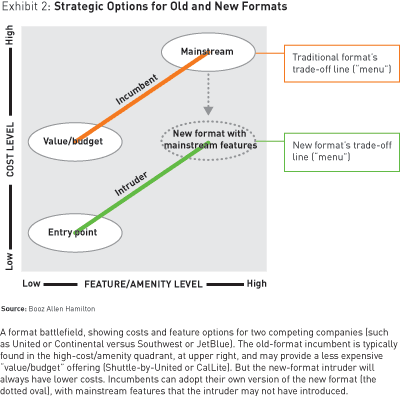
Second, incumbents often confuse the intruders with “value” or “budget” companies. In their view, the “value” company is making a niche play, appealing to the most price-conscious customers in its market. A “value” make of automobile is smaller, with a less-powerful engine and fewer extra features than a mainstream car, and thus carries a lower price tag. Similarly, a “value” department store offers no-frills products and fewer services and amenities than a mainstream store in the same market, at a lower price point. But these “value” companies rely on the same traditional business format as their mainstream competitors: They all face the same menu of trade-offs between amenities and price. The “value” companies just make different choices from that menu — choices attuned to the price-conscious customers they’ve targeted. These traditional-format “value” competitors don’t threaten the market’s mainstream traditional companies.
In contrast, new-format companies create a different and better menu for themselves by operating in strikingly new ways that slice out slabs of cost. (See Exhibit 2.) The new format can deliver either a high or low level of features and amenities less expensively than the old format. Format invaders thus represent a long-term threat to the mainstream traditional companies in the sector, unlike other companies that merely pitch their offerings at the “value” end of the market.
This misperception fatally weakens the incumbents’ efforts to counter the new-format intruders at each stage in the cycle. Early on, seeing the intruders as simple “value” companies, the incumbents may try competing head-to-head against them with a “value” offering of their own, providing lower features and amenities at a lower price, but still based on the old format. Examples include General Motors’ Vega, an early (1970s) response to low-end import cars, and the lower-priced “value” subsidiaries of mainstream airlines.
Of course, the incumbents’ “value” offerings can’t truly meet the intruders’ pricing head-to-head: Their cost disadvantage forces them to seek some premium above the intruders’ price. But that misses the central point of the intruders’ entry tactics — that price-sensitive customers respond to prices at the market bottom, not near it. Near-bottom pricing causes the incumbents to give up margin without commanding much volume. So the incumbents’ “value” offerings quickly fail.
Later, the same misperception leads incumbents to believe they can retreat up-market safely, since they believe the new-format intruders can’t follow. But in fact, the intruders have no such limitation — their new format can combine high features or amenities with low costs. Toyota’s lean business format produces the top-of-the-line Lexus as well as the entry-level Corolla. Similarly, Target and Wal-Mart use the same extraordinarily efficient business format; Target has merely chosen to focus it on customers and merchandise that are farther upscale than Wal-Mart’s.
Conversely, incumbents often reject the notion of adopting the new format on the grounds that doing so would require abandoning their up-market feature and amenity offering, and thus cause an unthinkable revenue loss. They fail to see a major opportunity: that the company can combine high features and amenities with the new format’s low costs. There is a realistic opportunity, for instance, for a traditional airline to continue providing high levels of service while adopting Southwest’s more efficient production model. (In Exhibit 2, the traditional airline could move down the dotted line to the new format with mainstream features.)
This confusion also seems to underlie Harvard Business School Professor Clayton Christensen’s well-known views on format competition. Professor Christensen argues that innovative products and business formats (or “value networks,” as he calls them) begin life underperforming the requirements of a market’s core customers. Later, as the intruder’s performance improves, it gains the ability to enter the incumbents’ core markets. Whatever the merits of this view with respect to technological innovations such as improved disk drives, it does not apply to new business formats. The choice of business format and the choice of amenity level are largely independent of each other. Most format innovations indeed appear at the low end of the market, but this is only because that represents the simplest and most expedient route for the intruder to monetize its innovation.
 When a new-format intruder offers more features and amenities than its traditional competitors do, they will not necessarily be the same mix. The new format makes some amenities easier and some harder to provide, so the intruders do what any seller would do: accentuate their advantages. Airline passengers, for example, may wait a bit longer for connecting flights on Southwest, but they get nonstop flights more frequently. Retail customers may drive a bit farther to shop at a “big box” store, but they can choose from a broader variety of goods. In any case, these differences tend to be modest; the new format’s lower costs and prices swamp any differences in its amenity mix.
Late in the cycle, as new-format intruders take ever more market share, the increasingly strapped incumbents often start to merge. From one perspective, these mergers appear inevitable and beneficial: Old-format companies face a contracting market, which simply cannot support as many of them as it did before (even if the overall market remains robust). However, the traditional companies often expect more from this kind of industry consolidation than it can provide. Too often, they view consolidation as a real fix, rather than seeing it correctly as another step in their decline. This is because they view their collective overcapacity as the problem, rather than recognizing it as a symptom of the format invasion.
The Incumbent’s Opportunity
Some incumbents have responded successfully to a format invasion. When they do, the results are extraordinarily profitable. We’ve looked at several companies that took on a format invasion successfully, and at several others that more or less tried but failed. Nothing we’ve seen indicates that the companies that made a successful transition to a new format had any greater depth of technical, financial, or operational resources than the peers they left behind. Nor did we find that they had “less to lose” by giving up the old format. But the winners adhered to a few basic principles, while avoiding some clear pitfalls.
The experience of Best Buy and Circuit City over the past decade comes close to being a controlled experiment on this point. At the outset, nothing about Best Buy’s market position or format distinguished it from Circuit City. If anything, Circuit City had more resources with which to innovate. But Best Buy identified and acted upon an opportunity where Circuit City did not.
In 1980, Circuit City was a rapidly growing electronics retailer, with a better format than traditional TV dealers. Customers viewed floor samples, made their selection — usually with help from a commissioned salesperson — and paid for the merchandise. They then took their receipt to a separate pick-up window, near the store exit, to collect their purchases. Many other retailers copied this format, including a small but successful electronics chain named Sound of Music, based near Minneapolis.
Then, in 1981, a Sound of Music store in Roseville, Minn., was hit by a tornado, forcing managers to hold a clearance sale with the inventory stacked on the sales floor. It was an unexpectedly wild success. Through this random event, company founder Richard Schulze discovered that a discount, no-frills, self-serve value proposition could be both very attractive to customers and very profitable for the company. After a couple of years of experimentation, Mr. Schulze opened his first warehouse-style, truly self-serve superstore in 1983, changing the company’s name to Best Buy at the same time. The following year Mr. Schulze, sensing his new format’s cost advantage over the incumbent leader, Circuit City (still thriving at that time), committed his company to a “won’t be undersold” pricing policy. Mr. Schulze continued to adjust the new format during the next few years; in 1989, he launched a “grab and go” store, with salaried rather than commissioned salespeople.
Between 1994 and 2004, Best Buy gradually eclipsed Circuit City — earning a compound total shareholder return of 28 percent per year while Circuit City managed just 8 percent (despite a rapidly expanding market for consumer electronics). Circuit City lost market leadership in the sector beginning in 1997, but continues to follow its old format strategy. By now, it’s a troubled company.
Companies that successfully survive a format invasion seem to have four common attributes:
1. Successful incumbents start with a clear and accurate vision of how the new format works for their competitors — how it serves customers adequately at much lower cost. Undeniably, that’s hard work. A new format focuses on unfamiliar aspects of the business; an accurate vision must grasp what that new focus is. But the new format differs from the traditional format in so many ways — spread across so many parts of the business yet knitted so closely together — that it’s hard to see. The successful companies don’t just assemble a factual, detailed view of the new format; they fit those details into a realistic overall picture.
2. Successful incumbents undertake the new format as an integrated whole, recognizing its tightly interlinked nature. Too often, incumbents experiment halfheartedly with imitating a new format, layering bits and pieces of it onto their existing business. They modify just one element of their traditional business at a time, or they make a modification but don’t pursue its implications through the rest of the business. Few companies have an appetite for making a flying leap to a whole new operating model — which is another way of explaining why so few incumbents make the transition to a new format. But the alternative — piecemeal adoption — just won’t produce results.
3. Successful incumbents adapt the new format in ways that don’t compromise its cost advantages. They provide a basic-level offer that meets the intruders’ bottom-level prices profitably at the basic amenity level. This reclaims the bottom-of-market volume that they would otherwise forfeit to the new-format competitor. To this, they may add products or services with more features or amenities than the intruder has yet offered. They resist the temptation to blend the new format with the traditional format — an approach usually justified as “we’re doing it, but our way.” That approach rarely succeeds. After all, the new format moved away from the old to achieve some specific objectives; it’s hard to move back without compromising them. These blends often fritter away much of the new format’s cost advantage without any decisive offsetting gain in customer appeal.
4. Successful incumbents make the new format their core business, not a side offering. Assuming that a competitor’s new format has already proved itself in the marketplace, execution is needed. Launching a side experiment signals that management sees the new format as a niche offering, with no bridge to changing the core business. It’s easy for an organization to get excited at the outset about an experiment and invest a lot of energy in it (“Finally, we are actually doing something about the new format threat”), but it’s ultimately ineffectual.
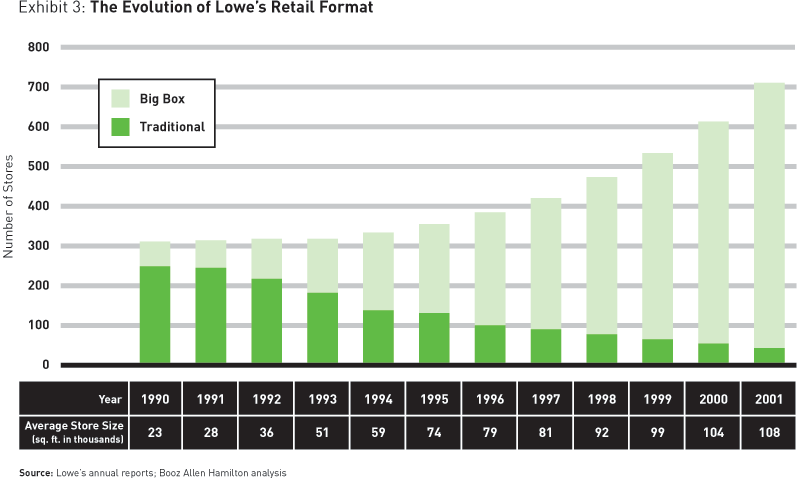
The story of the Home Depot format invasion of the 1980s, and the response by Lowe’s Companies Inc. in the 1990s, shows how an incumbent company can come successfully to terms with a new format. Traditionally, Lowe’s sold construction materials, mainly to professional homebuilders, through an extensive chain of small full-service outlets. In 1982, Home Depot introduced “big box” retailing in a “home improvement center” format: a much larger store (90,000 square feet versus 15,000 for a Lowe’s outlet) with dramatically lower unit operating costs, due mainly to the labor savings from scale and self-service. The new format spread rapidly and profitably, displacing traditional-format competitors — largely hardware and building supply stores.
Throughout the 1980s, Lowe’s struggled to respond, trying to blend its traditional format with the new home improvement center. The company built larger stores (25,000 square feet) and modified its offerings and layout to accommodate both professionals and consumers. It didn’t work. By 1988, Lowe’s had fallen behind Home Depot in size, profitability, and shareholder returns. (See Exhibit 1, above.)
At that point, almost a full decade after the birth of Home Depot’s format, Lowe’s finally recognized the new format’s power. In 1989, the company built an experimental home improvement center. In 1992, management committed to the format and started converting to new stores rapidly. (See Exhibit 3.) Since then, the profitability, growth, and shareholder returns of Lowe’s have exceeded those of Home Depot.
Strategy for Survival
Format invasions seem almost certain to continue, probably with increasing frequency, as ideas for new formats flow ever more easily across industry and regional boundaries. The lessons for established companies in those markets seem clear.
• Scan your markets regularly for format invaders. Whenever a competitor — especially a new entrant — starts gaining market share by offering familiar products at below-market prices, suspect the possibility of a format invasion. If the new format continues growing, what will you do? Look askance at assumptions that the new format will apply only to some “value” niche. In particular, question any plans or actions that would forfeit down-market segments.
• Understand the competitor’s new format thoroughly, including the full potential of its cost and quality advantages. Recognize that its “logic” will likely be unfamiliar, so aim to see it on its own terms. In particular, resist the temptation to assume that the intruder’s success depends simply on lower factor prices, selling below costs, or other measures you could never emulate (even if these elements are truly in the picture somewhere). Then, translate that understanding into a forecast of the new format’s likely success over the next five to 10 years. Caution: Incumbents often unconsciously water down these forecasts on grounds of “realism.” With a new format, forecasting extraordinary growth is realism.
• Approach the new format as an opportunity. At this point, you’re likely well ahead of most incumbents facing a successful new-format competitor. So you now have a significant opportunity to grow and profit at your traditional competitors’ expense. In a mature market, the new format may well be the best opportunity available to your company. Make an assessment of its potential; then (if warranted) focus the company on seizing it.
• Design your moves from the market back. A practical plan for exploiting the new format does not start from your company’s current position. Rather, it starts by asking, How could we imitate our most successful new-format competitor, with parity offerings, parity costs, and parity prices leading to growth and profits equalling theirs? (You won’t necessarily implement this parity plan, but it forces your company’s thinking away from its traditional format and toward the new one.)
• Be cautious in adding features and amenities. They may well be justified to build market share by appealing to mainstream customers, but that will happen only if they reinforce the new format’s core advantages. (That’s one reason why understanding the new format thoroughly is important.) A test: Does your new plan include a bare-bones offering that profitably matches your new-format competitors head-to-head on price and features? (If it doesn’t, then your design has probably slipped away toward a less profitable “blended” format.)
• Make the new format your mainstream business. It’s natural to field-test a new business format before committing to it wholeheartedly. But experimentation and niche marketing can become ends in themselves. Any plan for a test should define a successful outcome and the rollout plan that will follow, carrying the new format into the heart of your business.
• Don’t get distracted by merger possibilities. Against the backdrop of a format invasion, combinations among traditional competitors present the illusion of progress. Unfortunately, because the combined incumbent remains fundamentally disadvantaged, the merged company’s greater scale seldom provides enough benefits to offset the burdens of an old format. (However, a company that has adopted the new format successfully may find it worthwhile to acquire other old-format companies and bring them through the same transition.)
As for the two biggest format invasions going on right now, we don’t know whether the incumbent automakers or airlines will survive or succumb. Some may well retain industry leadership, growing their businesses and delivering attractive shareholder returns over the long term. If so, they will do it by finally adopting and adapting the superior new formats that have overtaken them — the formats that enabled the Southwest Airlines and Toyotas of the world to succeed and prosper in the same economic and market conditions in which the old formats proved to be uncompetitive.
Reprint No. 05305
Bertrand Shelton (shelton_bert@bah.com) is a vice president in Booz Allen Hamilton’s San Francisco office. He has advised leading petroleum, financial-services, aerospace, and consumer goods companies in North America, Europe, and Japan. He focuses on helping companies facing market discontinuities, such as format invasions, technology shifts, and deregulation.
Thomas Hansson (hansson_tom@bah.com) is a vice president in Booz Allen Hamilton’s Los Angeles office. He focuses on new business development, growth, mergers and acquisitions, and pricing issues for a variety of corporate sectors, and has written extensively on new operating models and business formats in the global airline industry.
Nicholas Hodson (hodson_nicholas@bah.com) is a vice president with Booz Allen Hamilton in San Francisco. He has advised companies in Europe and the United States in the retailing, fashion apparel, petroleum, wireless, and aerospace industries on issues including organization design, strategy-based transformation, and new format development.
The authors wish to thank Booz Allen Hamilton Vice President Mark Moran and strategy+business contributing editor Rob Norton for their assistance in developing this article.
