
The Beatles Principles
Lessons about teamwork and creativity from the most successful band in history.
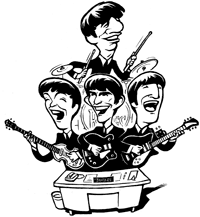 |
|
Illustration by Lars Leetaru |
Too many people in business feel that way. And the more they lose sight of the fun and camaraderie in their business, the harder it is to deliver performance.
But there is an example of a team that learned to deliver the highest level of performance while having fun on a legendary scale. Not coincidentally, it’s the most successful team of our time: the Beatles. Richard Branson has fun, but his outsized personality and high-stakes gambles make it hard to follow his example. The Beatles were great artists and entertainers, but in many respects they were four ordinary guys who, as a team, found a way to achieve extraordinary artistic and financial success and have a great time together while doing it. Every business team can learn from their story.
If we want to understand the Beatles’ relevance to management teams, the place to start is February 9, 1964. On that night, the group made its American debut on The Ed Sullivan Show in front of what was then the largest television audience in history. The black-and-white clip of that performance is now a pop-culture classic. Before a theater full of screaming teenagers, the four young musicians — John Lennon, Paul McCartney, George Harrison, and Ringo Starr — are relaxed and confident as they kick into “All My Loving.” Ringo’s drum kit is elevated above the stage — then an unusual arrangement — so that he is as much the center of attention as the other three Beatles. It’s an ensemble of four equal players, not a flamboyant lead singer with his backing musicians. They’re all smiling. They’re having the time of their lives. If ever there was an antidote to the malaise of “grinding it out mechanically,” it was visible on the stage that night.
The Beatles are a noteworthy example because the whole of their accomplishment was so much greater than the sum of its parts. The reasons are evident in the way they worked together as a team; how they collaborated to write their songs; the techniques they used to enhance their innate creativity; and the approaches they used, for most of their time together, to defuse the inevitable tensions that arose among them.
The magic was far more than just the music. There are, in fact, specific strategies — I call them “the Beatles Principles” — that you can use to re-create a bit of the Fab Four’s juju. If you have to field teams of high-performing professionals, or if you’re trying to improve your organization’s teamwork, creativity, and capacity to connect with customers, here are four principles to work and play by.
“Eight Days a Week”
When the young Beatles first hit the top of the U.K. charts in 1963, with “Please Please Me,” they seemed like an overnight sensation, but they weren’t. Behind their seemingly effortless playing were thousands of hours logged performing together in the clubs of Liverpool and Hamburg. This face time forged the individual Beatles into a cohesive, tightly knit team that Rolling Stones singer Mick Jagger called, enviously, “the four-headed hydra.”
Today, we have almost forgotten about the importance of face time in building familiarity and mutual trust — the requisites for teaming seamlessly under pressure. Some companies have gone so far as to promote the concept of “virtual teams,” whose members have never met one another, and never will. This approach can work for engineering and other technical projects, but if you have to perform for clients and customers, forget it. As the CFO of a Fortune 500 company told me recently, “All of the big banks and professional firms tell you they are ‘global.’ But most of them cannot field a team of people, drawn from these far-flung operations, who know and trust each other and who have worked together before. You really notice when the individuals on the team are relaxed, communicating, and having fun together — or, as the case may be, introducing themselves to each other for the first time outside your office door.”
That behavior is a tip-off, says the CFO: “I notice how they are getting on with each other because this tells me what a long-term relationship with me and my organization might look like.”
The Beatles demonstrated that true esprit de corps comes from intense, shared experiences.
Beatles Principle Number 1: Invest in and build face time between team members long before they are required to appear together.
“Getting Better”
Most rock groups produce essentially the same types of songs, over and over again. The Beatles’ secret to retaining and growing their audience over time was the breathtaking and continual evolution of their music, from album to album, along many dimensions. Their musical explorations took them into new and unfamiliar themes, musical styles, arrangements, instruments, and recording techniques. With songs as varied as “Yesterday” and “Revolution,” they sold more than 1 billion records in not much more than a decade.
Like many eclectic innovators, the Beatles borrowed extensively from other genres and combined these ideas into something new. Starting from a base of rock and roll, they added touches of Indian music, country and western, rhythm and blues, classical, music hall pop, acoustic folk, and jazz. They turned record covers into works of art (Revolver, Sgt. Pepper’s Lonely Hearts Club Band) and virtually created the rock video. The Beatles did not actually invent most of these musical ideas, but they reached out and dared to combine them in new ways that vastly expanded the vocabulary of rock and roll.
No subject was too mundane or outlandish. A newspaper article about the death of a Guinness brewing heir spurred John Lennon to compose “A Day in the Life.” A parking ticket became “Lovely Rita.” Paul McCartney’s sheepdog inspired “Martha My Dear,” and an offhand comment from an overworked chauffeur turned into “Eight Days a Week.” The Beatles had profound powers of observation. They absorbed the world around them, framed it musically, and gave it back to us.
Complacency — being content to sing “I Want to Hold Your Hand” over and over again — is the enemy of sustainable success. The way to keep clients and customers for life is to evolve your songs with them — to constantly expand your repertoire. Amazon has done this by slowly adding merchandise categories to its original core of books, Porsche through its successful Boxster sports car and Cayenne SUV lines, and Apple Computer with its popular lineup of iPod music players and related software.
Beatles Principle Number 2: Evolve your “songs” and bring the same level of ideas, new perspectives, excitement, and enthusiasm to your hundredth meeting with a client that you brought to the first.
“With a Little Help from My Friends”
The Beatles’ early success was driven mostly by Lennon and McCartney’s songwriting prowess, but the pair quickly had to accommodate what turned out to be four star personalities in their own right. The band used a number of strategies to manage these tensions. For example, drummers always feel underappreciated in rock groups, and Ringo Starr was no exception. So Lennon and McCartney would write a song for him to sing on almost every album (e.g., “With a Little Help from My Friends” on Sgt. Pepper), giving him a special platform with the public. As George Harrison’s compositional talents developed, the other members of the group began ceding song tracks to him. Famous Harrison songs include “Here Comes the Sun” and “Something” on the Abbey Road album.
As the Beatles matured as a team, they worked even harder to recognize and embrace each player. It worked: The individual Beatles became brands within the brand.
Keeping stars together is not easy, and younger professionals, especially, often feel underappreciated on teams. It’s great to feel part of a whole, but in the end everyone needs a sense of personal importance as well. Why not give team members a project that makes them look good in their own right?
Beatles Principle Number 3: Help team members become brands-within-a-brand by giving them a song — an idea or proposal — that will help them to shine.
“I Need You”
Research shows that most managers hire individuals who are like themselves, in effect assembling homogeneous teams in their own image. The most successful songwriting duo in history, in contrast, was composed of two individuals — John Lennon and Paul McCartney — who were dissimilar in almost every respect. When they first met, in July 1957, Lennon was a cynical, angry, sarcastic young man of 16 who was constantly getting into trouble. Ultimately, he came to loathe the Beatles’ fame. McCartney, on the other hand, was optimistic and hardworking. He liked to please, and would later adore celebrity. Despite their differences, they were drawn together by a shared love of American rock and roll and their powerful musical ambitions.
As McCartney would sing, “I’ve got to admit it’s getting better,” Lennon would chime in with a dour counterpoint, “Can’t get much worse.” They complemented each other’s musical ideas, and pushed each other to come up with better songs. They balanced each other’s temperaments, and each curtailed the other’s excesses. Lennon’s lyrics made you think, while McCartney’s haunting melodies could send a tingle up your spine.
The Beatles showed that differences and friendly competition fuel team creativity. So does a blend of specialist and generalist abilities. McCartney and Lennon were the deep generalists of the band. Each had broad musical and artistic talents — both could play a range of instruments, compose music, and write varied lyrics — and this breadth fueled many of the Beatles’ innovations. George Harrison and Ringo Starr, in contrast, were the branded experts. Harrison played lead guitar and Starr played drums, and they stuck to their knitting. As a result, the lead guitar solos grew ever more inventive, melodic, and moving. Starr developed a highly idiosyncratic and recognizable drumming style.
The art of creating effective teams lies in how you blend together branded experts and deep generalists. Unfortunately, many corporate teams are overloaded with specialists who fail to put their products and services into the broader business context of their customer’s or client’s needs — they save the leg but let the patient die. The harder person to develop is the deep generalist. That takes a mix of careful hiring, creative career management, and broad-based skill development. Sprinkle your teams of branded experts with a few deep generalists, and the result will be powerful.
Beatles Principle Number 4: Put exceedingly diverse professionals on the same team, mix specialists with generalists, and foster friendly competition to produce the best ideas.
“And in the End”
The Beatles’ breakup in 1970 raises a big question: How do you keep a superstar team together after it has reached the top? How do you keep the creativity, drive, and motivation going once you’ve vanquished all enemies? Bill Gates, no doubt, has had a few sleepless nights thinking about that one.
At the core of the Beatles was their great music — but they had more than that. We cannot imitate the Beatles’ native genius as songwriters and musicians, but we can borrow from the other parts of their success and apply what we’ve learned. The Beatles remind us that the essence of any successful organization is small teams of individuals who do things they love, have fun together, and feel part of a greater whole while maintaining their individual identities.
The cure for “grinding it out” is available; the principles are there for the taking. Put on Sgt. Pepper or Abbey Road, sit back, listen, and relax. Watch a few of those old clips of the Beatles’ raucous press conferences, or their exultant performances on The Ed Sullivan Show. I’m betting you’ll see what I mean.
Reprint No. 06104
Andrew Sobel (andrew@andrewsobel.com) is the author of Making Rain (John Wiley & Sons, 2003) and coauthor, with Jagdish Sheth, of Clients for Life (Simon & Schuster, 2000). As president of Andrew Sobel Advisors, an international consulting firm, he focuses on building high-performing professional services teams. A guitarist, Mr. Sobel is the founding board member of the Santa Fe Jazz and International Music Festival.