
Manufacturing Myopia
Instead of drifting into decline and irrelevance, producers of goods have a chance to seize the future.
 |
|
Illustration by Peter Krämer |
Consider, for example, the bad news from the Middle East that hit Household GmbH, a Europe-based consumer goods manufacturer, in 2003. (The company name is changed, but the details are accurate.) Household’s market share in hygiene products, one of its flagship divisions, had recently tumbled in such cities as Cairo and Abu Dhabi. When Household’s regional managers investigated, they discovered that a private-label producer based in Egypt had begun to aggressively undercut the shelf price of Household’s products.
At first glance, it seemed as if Household could easily win a price war with any local private label. After all, Household’s Middle Eastern manufacturing sites were running at higher capacity than the competition’s sites, with advanced proprietary technology and a highly productive, well-trained staff. But the private-label manufacturer refused to go away, and its prices remained low while its market share kept rising.
Household’s managers had assumed that their competitor was selling under cost. But gradually it became clear that, despite Household’s scale and technological edge, the competitor spent less to make most hygiene products, without any sacrifice in quality — at least as perceived by customers. In short, Household’s ostensible manufacturing advantage — its distinctive technology — had become its biggest disadvantage. To make matters worse, Household had nearly completed a new factory in Ukraine, which had been intended, in part, to add capacity to serve the Mideast, but which now would simply add to Household’s manufacturing costs.
There are many such stories in manufacturing today. Executives do all the right things to improve operations, but somehow get outperformed on cost, quality, or delivery. They may turn to benchmarking exercises, but those are rarely meaningful. Low-cost competitors appear with prices that can’t be completely explained by lower wages. Rising warranty costs or dramatic product recall levels indicate the ongoing erosion of quality.
As a last resort, companies outsource production, and thus erode their own company’s competence in it. Gradually, manufacturing is treated more and more as an outcast, and plant communities become disenfranchised.
We call this condition “manufacturing myopia.” It is akin to the “marketing myopia” that Harvard Business School lecturer Theodore Levitt identified in the 1960s. Professor Levitt argued that companies made themselves vulnerable when they defined their brands too narrowly. Railroads are not in the passenger-train business, he argued; they’re in transportation. Every business should define itself through the interests of its market, not its own production priorities.
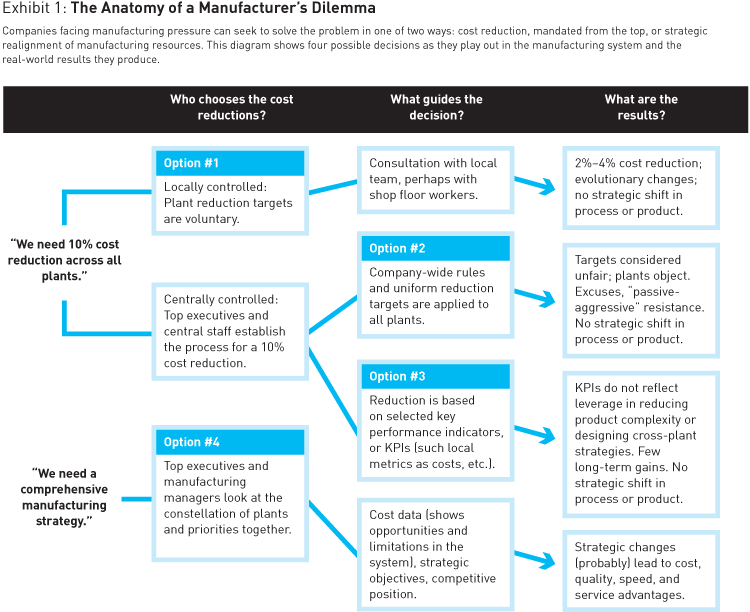
Today, myopia is even more prevalent and dangerous in manufacturing than it was in marketing four decades ago. Like marketing myopia, manufacturing myopia is caused by isolation; it is the inevitable outcome of keeping manufacturing strategies contained to the functional or even plant level, with little or no connection to enterprise-wide strategies. As the factories and supply chain oversight functions are cut off from the rest of the executive decision makers, the manufacturing focus grows narrower, and overall competence can atrophy. This compels companies to cut costs even more blindly and irresponsibly, often by setting company-wide targets determined by financial fiat rather than by competitive or customer insights. (See Exhibit 1.)
Building Awareness
Surprisingly few major multinational or large-scale manufacturing companies have been able to break free of this trap. Household GmbH was one of them. The Middle East episode prodded its senior executives into a multiyear, systematic endeavor to rethink the company’s operations and to glean and use better information about its manufacturing costs. Today, rather than a few state-of-the-art plants, Household operates a variety of plants that are designed for flexibility and can be moved or revamped as customer needs and the competitive climate change.
The cure for manufacturing myopia is 20/20 vision — that is, the cultivation of awareness about manufacturing costs and means. Companies can sharpen their own ability, as Household did, to see their operations more clearly and redesign them more flexibly. For companies that achieve this kind of manufacturing prowess, the manufacturing function is no longer seen primarily as a cost center, ripe for cutbacks or outsourcing. Instead, the ability to produce higher-quality goods at lower prices in a more flexible manner is a key component of their long-term competitive strategy and a central, dependable part of their identity.
This involves two major commitments: first, dedication of resources to building awareness. Leaders can peel back the layers of their own manufacturing operations and those of their competitors so that processes, advantages, and disadvantages can be viewed more clearly. This means becoming more aware of a company’s unique technological capabilities, the unfulfilled potentials of each plant (for reaching the appropriate markets), and the specific drivers responsible for their costs. Many manufacturers look at cost data primarily as justification and leverage for continually trimming expenses, rather than as a source of insights about scale, capital spending, labor deployment, technology, logistics, and supply chain efficiency — all critical factors in measuring how well a company’s manufacturing processes stack up against the competition. Toyota’s much-admired manufacturing competence stems, in large part, from the company’s insistence on building fine-grained awareness of every facet of production, at all levels of the company.
The second commitment is patience, demonstrated by investing the time and resources to address manufacturing productivity as a long-term, organization-wide strategic imperative and not as an isolated operational or functional issue. Plant managers are often expected to show the same fast pace of change as marketing, finance, and procurement, where six- to 18-month transformations are feasible. But those metrics don’t apply to manufacturing efforts, where improving results requires a very different set of time frames. A new manufacturing program frequently involves motivating, as well as hiring or moving, thousands of employees; new construction; new technology deployment; and perhaps the closing of a plant or two, which takes years rather than months. That time is well invested if it is used to develop an effective, flexible manufacturing capability, unique to the business and its customers, as a platform for more rapid change once it is established.
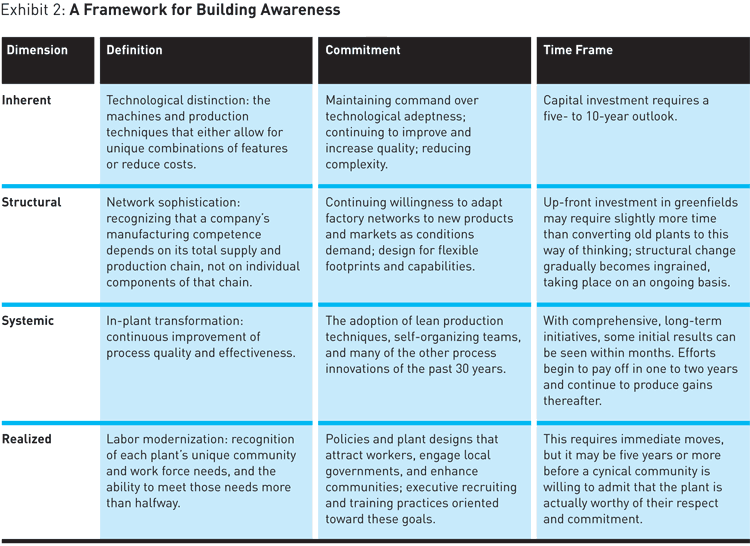
How does one go about building this kind of awareness? At most companies, there are four dimensions of manufacturing in which highly visible data and analysis, projected farther into the future, can yield both short-term gains and long-term advantage: technological distinctiveness, network sophistication, in-plant transformation, and labor modernization.
Technological Distinctiveness
One of the first places to eliminate myopia is in the design, engineering, or purchasing of manufacturing technology. (We call this the “inherent” dimension of manufacturing, because it involves the physical nature of the products and the processes that create them.) There is a staggering level of underinvestment in business process innovation as compared with product innovation. In 2004, according to Booz Allen Hamilton analysis, only 10.2 percent of the R&D budgets at the top 500 industrial companies was set aside for process innovation, down from 15 percent in 1980. Because they’ve neglected this essential activity, manufacturers tend to rely on machine builders and other vendors to fill in the gap. In most cases, this is counterproductive. Equipment manufacturers do not generally have a strong track record for innovation, particularly for the kinds of creative and customized solutions that would enable individual companies to overcome their manufacturing shortcomings. And even when equipment providers are innovators, their technology is unlikely to give manufacturers a competitive edge, because it generally can be freely purchased by any of their rivals.
Moreover, in many organizations, there is little patience for process innovation, which in manufacturing is by its very nature a long-term event. After the production technology is replaced, it could take two to three years before the capital investment bears fruit in the semiconductor sector, five years in major manufacturing, and as much as 20 years in process industries, such as petrochemicals and electricity production. Additionally, to improve processes, companies have to train entire plant communities in dozens of different tools and techniques and completely different ways of working. All of that consumes time and resources.
Some extremely successful manufacturers, such as packaging giant Tetra Pak, Procter & Gamble, and Toyota, have bucked the trend and used in-house machine development and internal process innovation to protect their competitive advantages. P&G has long been a pioneer of novel factory floor environments; for example, letting shop floor employees not just lay out the flow of machinery but design the machines themselves. This approach began at P&G in the early 1960s and has developed in scope, efficiency, and sophistication ever since. In one celebrated example at a P&G plant in Lima, Ohio, a team of shop floor “technicians,” as hourly workers were called, designed a machine for placing detergent bottles into position on the assembly line — a mechanical feat that P&G’s professional engineers had said was impossible. The team commissioned a machine-tool supplier to produce the device, and put it successfully into operation.
But for every P&G, there are dozens of companies faced with an equivalent to Household’s dilemma in the Middle East: Their state-of-the-art factories, more capable than those of competitors on a worldwide basis, are not flexible enough to respond to local conditions.
Sometimes, a promising process innovation effort is disbanded because top management changes or because the sponsoring executives lose interest, even though they have known all along about the nature of the investment they’ve been making. As a result, outmoded technological principles may endure for 30 or 40 years while the company cycles through a series of half-realized quality-improvement or plant-restructuring initiatives. Other times, process innovation is consigned to the plant level only. When approached in this way, companies become little more than multiple small organizations with no scale, unable to harness process technology as a competitive advantage.
Myopia also afflicts efforts to modify existing manufacturing processes. For example, there has been a lot of excitement in the last 15 years about design for manufacturing (DFM), an approach by which companies engineer products not just for their intrinsic qualities but also for how efficiently they can be manufactured. But despite the allure of DFM, the relationship between engineering and manufacturing groups at most companies is chilly or nonexistent. The shop floor community is often excluded from direct communication about the manufacturability of products with the engineering/design function. Even if the two groups are allowed to communicate, manufacturing companies may not have the budget to cover the engineers’ internal rates and therefore may lose contact.
Network Sophistication
Most companies organize their production and supply operations on a project-by-project basis. As market
conditions change, they move plants from Detroit to Mexico, and a few years later they shift subassembly to Asia. They do not envision their manufacturing system for what it must be: A global, flexible supply chain network that can be reconfigured anywhere in the world as market conditions change. (We think of this dimension as “structural,” because it involves such infrastructure-oriented features as the location and size of plants and the supply chain flow among them.)
Companies that realize this and design their plants accordingly gain a tremendous time advantage. It can take two years to close down a factory — and that’s typically after several years of wavering over the decision to shutter it in the first place. It is far better to design the configuration of individual plants so that it is easy to enlarge, shrink, or reconfigure them based on the business landscape. Then fewer factories ever have to be abandoned and the manufacturing network needn’t be completely overhauled. There’s also an expense advantage as the one-time cost penalty of moving plants from one place to another is reduced.
This approach, known as flexible footprints, is practiced with great success by a few dozen large organizations. Among them: the U.S. Army, which constantly and proactively reassigns military bases to fresh uses. In an extremely novel implementation, a European manufacturer of specialized air conditioning supplies built its factories on large freighter ships that can be moved from port to port as the seasonal marketplace changes. The company chooses not to broadcast this manufacturing innovation publicly, perceiving it as a competitive advantage. A Qatari company, Cement International, has recently begun similar operations, putting a cement factory on board a ship that docks in ports around the Persian Gulf, wherever building materials are needed.
Unfortunately, we observe that there is little cooperation among companies within a supply chain to jointly optimize plant networks, another potentially lucrative example of flexible footprints. In the outdoor equipment industry and in basic chemicals, some companies have shared parts of their production capacity, sometimes spinning off manufacturing. But capacity pooling is a rarity outside those two industries.
In-Plant Transformation
It is now more than 30 years since the notion of manufacturing excellence — variously attributed to the Toyota production system, socio-technical systems, quality management, lean manufacturing, and high-performance systems — became widely known in Europe and the United States. By now, practically every manufacturing manager can tell you about pokeyoke, kanban, or self-steering teams. But plants that have successfully implemented the manufacturing practices that produce efficient and optimal operations are few and far between. And most of these are greenfield sites: previously undeveloped locations where elite processes could be designed into the factory from the beginning. The competitive advantage of process optimization remains high, in part, because of the woefully poor record of the manufacturing industry in general.
We think of in-plant transformation as “systemic,” because it takes place when people see the processes on the shop floor as interrelated parts of a whole system. Why has this kind of in-plant transformation lagged so badly, even though its successes are so visible? Manufacturing myopia is the primary reason. Typically, process improvement is seen by company executives as a “go ahead, just do it” manufacturing issue managed solely by the plants.
This isolation contributes to the lack of patience among decision makers, who feel pressured to show results before the systemic change is ready. By contrast, a well-designed manufacturing change initiative is deliberately set up like a developmental path, with a menu of results expected in the short term, medium term, and long term. Some systemic drivers can have an effect on costs almost instantly (e.g., changing maintenance contractor purchasing procedures); some take a bit longer (e.g., installing “pull” systems, in which the production line sets its own pace, to replace the top-down controls of a manufacturing resource planning approach). Even in full-scale manufacturing transformation initiatives, it should not take more than two years for the first visible effects to appear. The leaders of many manufacturing projects stop paying attention after that. But in a well-designed initiative, those first results become a base for continuous improvement.
In a so-called brownfield site (an established factory with a long-standing work force), one may often find high fixed costs or blatant overstaffing. Installing “intelligent tools,” “lean solutions,” or “high-performance systems” will not solve these problems. If there are already more workers than work to do, improving production speed or throughput will not lead to higher levels of productivity, in part because overcapacity breeds “process creep,” in which workers and managers merely overlay the new work rules and practices on top of their old routines. Despite knowing this, all too often, manufacturers myopically push a “lean” program through plants that are overstaffed and have a high share of non-value-added work. We call this the fat ballerina syndrome: Only slimmed-down organizations stand a chance of performing smart moves.
Companies also are often greedy or formulaic when it comes to assigning improvement objectives to plants. It’s not atypical for a factory manager to be told to save 10 percent of fixed costs, while improving output and quality by 20 percent. Often a basic analysis will reveal that enhancing a plant’s productivity dwarfs the value of firing a group of maintenance technicians and engineers, and more importantly that increasing productivity and cutting personnel are not mutually compatible objectives. For one thing, plant communities often resist cooperating with management to alter their work methods and increase output while their colleagues are being let go.
Labor Modernization
Let’s face it: In most plants, industrial relations and treatment of the work force are reminiscent of the 19th century. This statistic illustrates the point: From 1999 to 2004, there were more strikes in most Western European countries than occurred between 1950 and 1975. In one German aerospace plant, where three generations have worked on the shop floor, absenteeism and illness rates have risen a steady 3 percent per generation. Overall, Western companies made few strides in aligning factory workers more closely to the companies that employ them. Only 20 percent of production workers in Western Europe and the U.S. receive compensation linked to performance, and more than 75 percent work under a compensation system that is so rigid it unintentionally drives people to take overtime.
We use the term realized because the modernization of a labor force takes place only in the real-world dimension of the community around each manufacturing location. The principles of effective work force management are universal: The improvement of labor practices and customization of human resource policies are essential to developing creative, innovative, and motivated employees. But the most appropriate methods for accomplishing those things are decidedly local. Labor issues vary significantly from one place to another. Work forces in different locales have their own particular cultures, holidays, workdays, family structures, community resources, demographics, education levels, and assumptions about the type of work they will do. Productivity can also deviate dramatically among regions.
Over the years, effective manufacturers have experimented with a wide variety of means for engaging shop floor employees. Some companies establish worker-focused principles. At one Dutch chemical company, the budget line for work space and plant maintenance and modernization was sacrosanct and could not be cut. This was important because workers perceived the company as a reliable protector of their safety. A cosmetics manufacturer demonstrated the same kind of commitment by installing an on-site health spa, free to employees. We have seen plants in which windows and skylights are carefully placed to make the most of natural light, the architecture fits local styles, and social spaces reflect the way employees naturally interact.
These types of factories, which fit their social and physical environment so well, are usually owned by companies that realize the value of an inspired work force to the finished product. Such companies often make concerted efforts to link employees with more in-depth knowledge of the company and the product. Danone, Procter & Gamble, Harley-Davidson, and Mercedes-Benz are all known for plant communities that take part in word-of-mouth and face-to-face sales campaigns and provide testimonials for marketing and public relations programs. Mercedes, for example, encourages customer-to-factory interaction by suggesting that car buyers pick up their new vehicles at, say, the Sindelfingen plant, where they can talk to plant workers about quality and other issues pertaining to the making of their automobiles. Very successful companies create products that command an emotional premium, and they make certain that their manufacturing employees are among the first to emotionally promote them. Ultimately, how can your product be loved by your customers if thousands of your own employees who make the product don’t love producing it?
In a brownfield site, labor modernization often represents a daunting challenge. Managers may believe that they can employ greenfield policies (those applicable to a new factory) in a brownfield plant, but this assumption is flawed. The brownfield work force is generally older; they may have already lived through shutdowns, layoffs, and closures. Moreover, unions don’t usually forget the bitter relations they had with the prior plant management and are less willing to forge alliances with the new factory team. In some locations, sophisticated lean production concepts, implemented in a one-size-fits-all pattern, have been viewed by the cynical, dispirited work force as micromanagement and paternalism.
For a brownfield renewal to succeed, the surrounding community has to be fundamentally remotivated and more closely tied to the enterprise through new compensation systems and governance roles. The German agricultural equipment maker Claas demonstrated the value that can be unlocked if the right formula is found. In the midst of substantial growth and as part of a constant drive to improve flexibility, Claas spun off a large part of the factory through a management buyout and made the newly independent plant a primary supplier. The newly formed business unit was able to secure quality standards and to better balance its capacity, signing up additional customers besides Claas. Meanwhile, employee motivation improved in the factory as managers used the space they had reclaimed to fundamentally reengineer activities, aiming at a one-piece-flow philosophy. The plant’s positive development defied the long slump in commodity machining and metalworking factories in the region.
Manifesto for Manufacturers
A company seeking to overcome its manufacturing myopia may find the task daunting at first, but easier over time. The goal is not to “fix” manufacturing, but to build the capacity for long-term and medium-term manufacturing management among engineers, suppliers, and staff (including unionized staff), and to redesign the technology to take advantage of these capabilities and augment them.
There are no universal rules for doing this because each manufacturer has a unique combination of in-house capabilities, labor histories, supply chain relationships, market demands, and technological innovations. A holistic manufacturing strategy emerges only from an analysis that assesses the critical operational data buried in the four dimensions of manufacturing design: inherent, structural, systemic, and realized. (See Exhibit 2.)
Consider the recent case of a European auto manufacturer. The company was desperate for a way to cut costs per car, which had risen to almost 30 percent above those of its nearest competitor. The carmaker’s initial inclination was to close plants and implement flexible manufacturing lines that could produce multiple models in remaining factories. Pressure from unhappy unions convinced the company to think twice about this plan.
Analysis of the automaker’s cost drivers found that the gains from minimizing inherent costs (by increasing plant flexibility) and structural-level costs (by eliminating plants) would do little to close the gap between its manufacturing costs and those of its closest competitor. In fact, the only way that the company could catch up to its rival was by systemic improvements (adopting lean processes), a category that accounted for 65 percent of the cost gap. The automaker would never have learned this had it relied only on traditional analyses and not exposed the interconnections among all of the critical components of its manufacturing operations. To address its shortcomings, the company appointed experienced managers from outside the region to critical posts in its European plants, retooled its production system, and began to implement those lean manufacturing processes.
By separating manufacturing operations into their four dimensions and exploring the way they are interrelated, management can accurately measure manufacturing costs and perfect “what if?”–style decision making. This is not possible with a conventional cost accounting approach. Even the most advanced cost accounting systems are usually designed for only two tasks: calculating product costs to provide marketing with a basis for pricing, and tracking actual and forecasted results in individual cost centers.
In addition, accountants at most companies do not have the experience in operations to spell out the financial consequences of manufacturing decisions. For example, they cannot estimate the overall cost position of a plant that would result if more automated equipment were installed, specific processes were farmed out to a low-cost nation, the demand for a product doubled, the number of SKUs were reduced, or the competition opened two new plants in Eastern Europe using the latest manufacturing technology.
Even in the best of circumstances, it is tricky to distinguish the effects of individual manufacturing drivers. For instance, how much advantage does a competitor gain from operating continuous instead of batch processes, and how does that balance out the disadvantage it has maintaining smaller plants with greater indirect and overhead requirements? Manufacturing, finance, and research and development executives can’t answer such questions in isolation from one another; they need regular opportunities to think and strategize together.
Companies that are willing to invest in a long-term change cycle discover that the learning curve in manufacturing is nonlinear. Even though the investment may be steady, measurable improvement is typically slow at first and accelerates over time. It may take five years to cross the initial threshold of a new production system, but after that first experience, the capacity for changing technology grows rapidly — in part because the technologies themselves become more flexible, and in part because employees develop the skills and knowledge to deploy new production machines more efficiently.
Cadbury Trebor Bassett, the candy and chocolate manufacturer based in Birmingham, England, grasped this particularly well. When the company installed a new production system, it assumed it would take up to five years for the plant to reach maturity. Cadbury measured this evolution by how well employees responded to the new system. As the plant matured and its capabilities grew, productivity was expected to increase. Management assumed that either head count would decrease or production quality would increase during the first five years, depending on the level of sales and scope of the plant’s market. Indeed, as employees became more familiar with the processes, the cost of production dropped and quality stayed high.
This type of approach represents an alternative to the prevailing despondent mood at many manufacturing companies. Indeed, perhaps the most tragic result of manufacturing myopia, for many companies, is the lost opportunity for manufacturing leadership. Computer technology, materials science, and energy innovation have progressed dramatically over the past 20 years. There are many futuristic manufacturing options available. They include “instant” and “inkjet” manufacturing, where computer-based molding machines turn out individually customized plastic components with the speed of mass fabrication; biomimicry, in which industrial processes reproduce the cell-by-cell process by which, for example, a seashell is formed; and environmentally friendly fermentation-based fabrication methods that eschew toxic chemicals and reuse waste more effectively. In many industries, there exists great unfulfilled potential for moving beyond commoditization by rethinking manufacturing prowess as part of the company’s identity. Few companies today are trying to realize that potential; there are few 21st-century equivalents to the original Ford Motor Company, with its breakthroughs in assembly-line manufacturing, or even to the 1990s-era Intel. We believe that manufacturing myopia helps explain why.
Over the past 20 years, manufacturing managers have learned that even the most effective supply chain management will not lead to results unless these capabilities are implemented — not just within the function, but at the level of the executive suite. In a confrontational competitive environment, the choice is engaging in manufacturing competence as the core of your corporate identity — or continuing to pay the price of myopia.
|
The Roots of Myopia |
|
How did manufacturing myopia become so prevalent? There are several roots. Probably most pernicious was the separation of manufacturing, marketing, and finance in corporate structures that date back to the mid-20th century. “Turf wars” often unconsciously reinforce those divisions, Here’s one typical story we recently encountered in a consumer products company: The vice president of manufacturing stated at a meeting that his factories could deliver at lower costs, “but only if R&D can come up with a better factory blueprint and reduce the number of product parts.” Also, he said, it would help if sales provided reliable forecasts “and didn’t ask us for last-minute changes for important clients.” And finance would be less of a hindrance if the CFO would finally approve funding for new machines to simplify operational bottlenecks. The company’s vice president of sales responded that manufacturing needed to eliminate its oversized work force and sharply curtail labor costs by shifting more of the production to low-cost countries. Only then could his team sell significantly more. The vice president of R&D expressed the opinion that manufacturing still had not managed to sufficiently operate the existing production technology. “We’re simply not up to world-class standards,” he said. Later, the CEO said privately that he was fed up with all these points of view. None of them had much to do with the problem as he saw it: an unsustainable status quo of rising fixed costs and a widening gap between projected and actual profits. Manufacturing companies are usually not set up with the kinds of incentives and decision rights that would encourage executives to review plant operations with a full understanding of the company’s competitive cost drivers. Consequently, a narrow, self-interested view of plant performance tends to prevail, even when everyone involved has the best interests of the whole company at heart. Business education reinforces the division. Students interested in manufacturing are tracked into a “ghetto” in many business schools; they don’t share many classes or associate much with their counterparts in finance and strategy. Nor do they expect to cross over to other positions when they enter the working world. “Once a plant manager, always a plant manager,” people say. Manufacturing functions consequently suffer in the “war for talent”; they recruit from a smaller pool. The result is often an unnecessary tension between manufacturing and finance; manufacturing executives may have far more contact with, and feel more loyalty to, employees than shareholders. And finance executives may not appreciate the strategic importance of manufacturing talent, particularly on the shop floor. This tendency was exacerbated during the service boom of the 1990s, when it became fashionable to assert that mere manufacturing was not strategically important. Some companies followed cost-cutting strategies that downplayed the importance of their long-standing manufacturing knowledge, and then found themselves needing to rebuild it. This was one of the key components of the decline of the American manufacturer Sunbeam. After being acquired by Allegheny International in the early 1980s, the company’s manufacturing division was “starved of capital to update its factories and refresh its product line,” as management writer John Byrne put it. This ultimately led the shareholders to appoint cost- cutting turnaround artist Al Dunlap as CEO in 1996; manufacturing capacity suffered even more erosion during Mr. Dunlap’s time as CEO. In his book Chainsaw: The Notorious Career of Al Dunlap in the Era of Profit-at-Any-Price (HarperBusiness, 1999), Mr. Byrne describes how Sunbeam shut down a high-quality, efficient hair-clipper plant in McMinnville, Tenn., and moved production to a chaotic, money-losing, poorly managed new facility near Mexico City. To counterbalance all these trends, some companies now make deliberate efforts to integrate manufacturing with the rest of the enterprise. Toyota sends manufacturing employees and managers on sales calls — to areas including those where their products have low penetration. ASML, a Dutch company that is a leading producer of lithography and semiconductor manufacturing equipment, went from a 10 percent to a 70 percent market share in its product categories, in part by bridging this gap. ASML’s head of manufacturing started as an accountant, then led a finance function, and only then moved into production. This perspective recently helped the company reduce lead times and generally improve the integration of manufacturing with other functions. —K.G., C.W., P.V.H. |
Reprint No. 06105
Kaj Grichnik (grichnik_kaj@bah.com) is a principal of Booz Allen Hamilton based in Munich. As a leader of research and practice in manufacturing, he has visited more than 350 plants in the past 10 years. He focuses on the pharmaceuticals, food, aerospace, and automotive industries.
Conrad Winkler (winkler_conrad@bah.com) is a vice president of Booz Allen Hamilton based in Chicago. He advises companies across industries on supply chain management improvement and manufacturing strategies, with a focus on the automotive and aerospace sectors.
Peter von Hochberg (von_hochberg_peter@bah.com) is a vice president of Booz Allen Hamilton based in Düsseldorf. He has extensive experience in consulting with clients on manufacturing and lean production, focusing on automotive OEMs and suppliers, and industrial goods manufacturers.
Also contributing to this article were John Potter, a Booz Allen Hamilton vice president based in London, and Georgina Grenon, a Booz Allen senior associate based in Paris.