
Love Your “Dogs”
Behavioral economics can reveal the hidden value in the poor performers of a business unit portfolio.
 |
|
Illustration by Marco Ventura
|
In the course of maximizing shareholder value, senior executives routinely face decisions about which of their companies’ businesses should be nurtured, which should be starved, and which should be sold. The typical strategy is to invest more heavily in the “stars” that are earning superior returns on capital, while starving or selling the underperforming “dogs.” This is the conventional approach in corporate finance and has become so ingrained in management practice that it is almost impossible to question it. But what if it is wrong? What if corporations would be better off shortchanging their stars and nurturing their dogs? What different decisions would managers make then?
There is, in fact, reason to believe that the conventional wisdom is wrong. Corporate managers often rely on accounting metrics to make business decisions. However, these metrics are based on past performance; the market is interested only in the future. And past performance is generally a poor predictor of the future. Thus, when performance is assessed over time, greater shareholder value can be created by improving the operations of the company’s worst-performing businesses. The way to thrive is to love your dogs.
Just as some fund managers earn superior returns by identifying and buying undervalued “market dogs” — better known as value stocks — corporate leadership can learn to identify “value assets,” hold and nurture them, and produce superior performance. This in turn will ultimately lead to an increase in shareholder value.
From a recent analysis that we conducted of 25 years of U.S. stock-price performance, three messages for corporate leaders became clear:
• Fixing your dogs can yield unexpected levels of shareholder value, even when their key financial indicators lag behind those of other business units. Business unit returns are not tracked like stock prices. But experience suggests that turning around an undervalued business unit can be analogous to turning around an undervalued company. In 1992, the Lowe’s home improvement retail chain was considered a “dog,” after five years of lackluster revenues. But then the chain’s executives conducted an operations turnaround — leading to total shareholder returns (TSR) of 37 percent annually over the next five years. During that time, Home Depot outpaced Lowe’s in revenue growth. However, a dollar invested in Lowe’s in 1992 would have yielded returns of $4.83 in 1997, compared with $2.93 if invested in its “star” rival. The same dynamic can be found in any number of business unit examples, from a specialized product in a manufacturing company to a moribund brand in a retail chain.
• Improving operations is an important management lever for adding shareholder value. Starving dogs is not a strategy for creating shareholder value; in aggregate, there is more potential value in helping the dogs thrive. Focus on fixing the business — in both sales and operations — in ways that allow business units to realize their potential. This may primarily involve investing time and attention, rather than more money.
• Buying and fixing someone else’s dogs will produce more shareholder value than buying stars. Adding value to an overvalued business is a tall feat, especially on top of the premium that acquirers typically pay for a controlling interest in an enterprise. It is no wonder that two-thirds of acquisitions fail to add value for the acquiring shareholder. The right dogs, on the other hand, could offer a company focused on operations wonderful acquisition opportunities.
Far too often, senior executives attempt to diversify out of their core businesses, selling underperforming business units and buying their way into businesses that appear to be more attractive. The beneficiaries tend to be the private equity firms that are usually the buyers of these “unattractive” businesses. Those companies that have done the opposite — concentrated on their underperforming core business units — have tended to perform much better.
Why Markets Miss
Are we really suggesting that a company should abandon its stars and focus on its dogs? We don’t rule out the possibility, especially if the dogs can be rehabilitated in line with the company’s core strategy. Superior value creation comes from changes in future performance. What if the markets have inherent biases in predicting performance?
The strategy of loving your dogs may be intuitively difficult to swallow for many, but it is supported by an economic field of study — behavioral finance — that has come into vogue over the last decade. Behavioral finance is founded on the precept, as economist James Montier puts it, that “not only do investors make mistakes, but they do so in a predictable fashion.” Day traders, for example, routinely display overconfidence; they trade with high turnover but low returns. And as Nobel Prize–winning economists Amos Tversky and Daniel Kahneman articulated in their “law of small numbers,” people are likely to overestimate the similarities between a small group they know and the larger population — an error that leads to faulty predictions of the behavior of markets and prices. Irrationality occurs even with highly trained specialists, such as professional investors, or, as Dr. Kahneman puts it, when “people who are explicitly trained to bring [rational] thinking to problems don’t do so, even when they know they should.”
Guided by these types of insights, behavioral economists have developed a robust set of models of market behavior. These models represent an alternative to conventional economic models, which are logically consistent but fail to account for the real behavior of capital markets because they assume that all markets are efficient, all investors are rational, and all relevant information about securities is reflected in their prices. Because behavioral finance explains the gaps between ideal valuations and actual prices, investors have begun to use this theory to exploit these mismatches and thus capture additional value. (See “Derivative Wisdom,” by Rob Norton.)
Although behavioral finance is used by a growing number of fund managers to guide their purchases, another potential application has largely gone unnoticed: its use as a guide to corporate strategy decisions. The same kind of behavioral analysis can help corporate executives better understand and manage their own “portfolios” — the businesses or business units that make up their companies. Executives who understand behavioral finance will capture more shareholder value from businesses that have previously been regarded as unworthy of much attention.
Consider, for example, how behavioral analysis can explain the poor track records of capital markets as predictors of the true value of businesses. Investors don’t make their choices through purely rational processes or with complete information; they allow emotions to affect their decisions, they misinterpret data, and they are shortsighted in estimating the long-term viability of an enterprise. All of this can lead to a misunderstanding of the future potential of a security (or other asset).
These “flaws” are pervasive enough to be systematic in a population of investors. Enough people make decisions with enough irrationality that individual mistakes, however minor, combine to lead to routine mispricing of securities and other capital assets. Investors overvalue “glamour stocks,” those in vogue as evidenced by their high market-to-book value ratios or high price-to-cash-flow ratios. And they undervalue “value stocks” — identified by such measures as low market-to-book value ratios or low price-to-cash-flow ratios — even though a vast amount of research conducted over the past few years has shown conclusively that a portfolio of “value” stocks will consistently outperform their more popular “glamorous” counterparts.
Research shows that this pattern exists both over time and in all major capital markets. While academics continue to investigate the rationale for this dynamic, a consensus has emerged about its relationship to two phenomena. First, investors are people, not rational machines, and therefore display “expectation biases” about future performance. If they can recall that a stock has done well in the past, they are more likely to expect it to do well in the future, and they invest accordingly.
Second, professional money managers as a group are limited in their ability to compensate for this type of bias. Technically, they have the ability to eliminate the gap between erroneous expectations and true value via arbitrage (transaction strategies designed to profit from fluctuations in market value). But in practice, the use of arbitrage by professional managers is constrained by what economists call agency issues: investment styles, concerns about deviations from benchmark performance, and institutional practices.
To be sure, the distortion of any one company’s share price diminishes over time; perception eventually catches up with reality. But the transition can take years. Behavioral finance has recently gained increased legitimacy because it has helped investors realize significant returns by exploiting the gap between the irrationally perceived value of shares and their actual potential value.
Past Dogs, Future Performers
Perhaps the most common misperception that leads investors and corporate decision makers to prefer glamour over value assets is the simple effect of hindsight. We saw this in our study of U.S. stock market performance. We employed a common research methodology: sorting stocks into monthly portfolios, which were then sorted into deciles as measured by market-to-book value, looking at the years 1975 through 2004. (See "Methodology.") We then calculated the returns to investors over a five-year horizon for each decile. The decile results were aggregated for each of the monthly portfolios. We characterized the top decile as “market stars” (our own name for glamour stocks) and the bottom decile as “market dogs” (equivalent to value stocks).
|
Methodology |
|
The sample includes all U.S. stocks that had publicly traded equity between 1975 and 2004 (for all or part of the time This process was repeated each month from January 1975 to December 1999, and the statistics presented in the exhibits are time-series averages of the monthly portfolio returns over the sample period. Balance sheet and operating income data is matched with stock price data to reflect publicly available information at the time of portfolio formation. The source for all data is the Compustat database from Standard & Poor’s. |
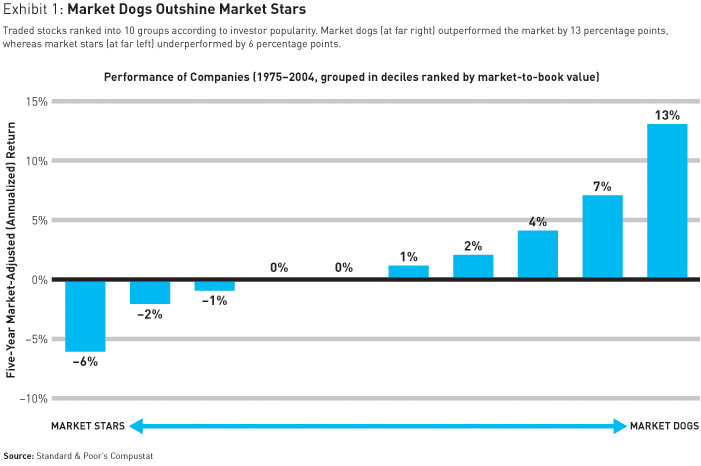
Just as behavioral economists might predict, the market dogs consistently and substantially outperformed the market stars in shareholder value creation. Indeed, over the period of our research, the dogs outperformed the stars by an average of nearly 20 percent annually. Market dogs exceeded the market returns by 13 percent annually. (See Exhibit 1.) Other researchers have found results consistent with our data for nearly all equity markets in Europe and Asia.
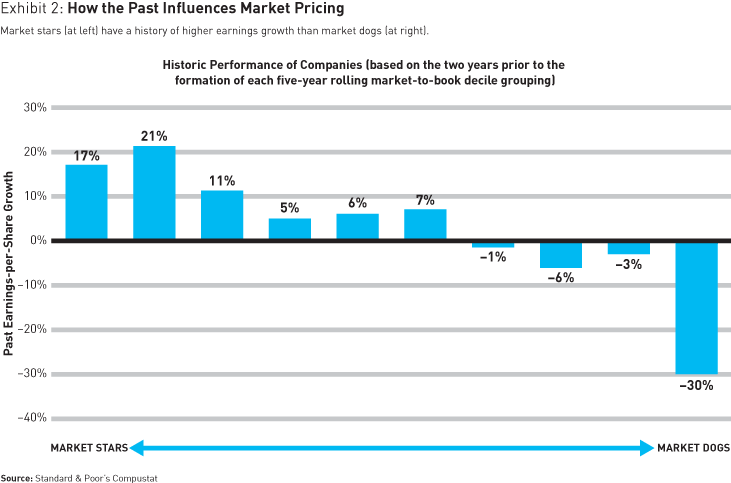
We investigated the data set to determine what operating factors investors could have used to distinguish market dogs from market stars. One factor provides a clear correlation. As Exhibit 2 shows, investors use past operating performance to characterize companies.
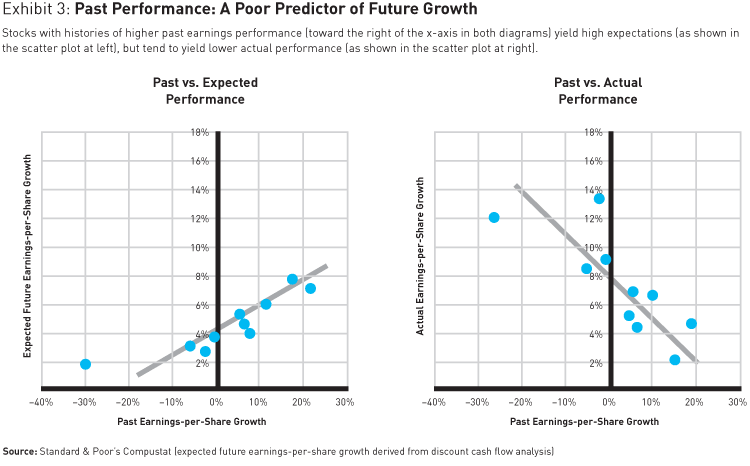
We then compared actual past operating performance with the future expectations required to justify the current stock price. As expected, there is high positive correlation between past performance and future expectations. However, past performance is negatively correlated with actual performance. (See Exhibit 3.) Established valuation methodology prescribes that stocks be valued on future (not past) earning streams. Yet, many investors simply — and erroneously — assume that a company growing earnings at 10 percent per year will continue to do so. This extrapolation, unsupported by actual market history, is the primary driver of the difference in returns between the market dogs and the market stars.
Letting the “Dogs” Out
How similar are the “market dogs” and “market stars” of stock analysis to the “dog” and “star” categories that corporate management might use in discussing business unit performance? Our experience and research suggest that they are similar enough that business decision makers can benefit from the analogy.
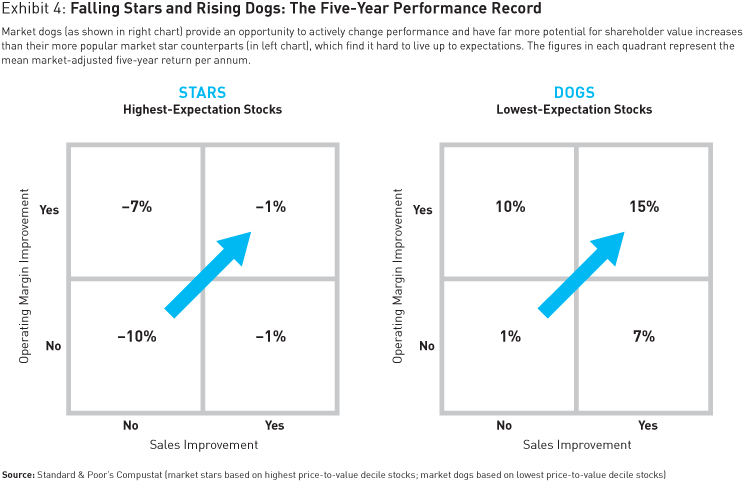
In our study of the stock market, for example, we looked at the average returns for market stars and dogs across two dimensions: whether the companies’ operating margins had improved, and whether their sales had increased. These happen to be the two main levers that corporate decision makers use to try to improve their business units’ valuations. The results are presented in Exhibit 4: Improvements in both categories can increase the annualized mean shareholder returns by only 9 percent for stars, compared with 15 percent for dogs.
To embrace this precept and use its insights effectively, management needs to rethink the potential for future shareholder value creation in the company’s business units in a four-step process:
-
Mark each of the individual businesses to market (calculate a reasonable market value for it) using the market value of comparable enterprises. Evaluate their earnings performance on this market-value basis. Return on market value provides a better handicap for future value creation than backward-looking accounting measures because it incorporates the current mispricing into its calculation of true value.
-
Using the calculation of market-to-book as a basis, assign each business unit to a decile in the star-to-dog spectrum (as shown in Exhibit 1). This will provide an estimate of the expected market returns that will accrue to this business unit. Use this to assess the degree to which each business is currently mispriced.
-
Since future shareholder returns are based on changes in expectations of performance, assess the potential improvement for each business (as shown in Exhibit 4).
-
Estimate the future shareholder value creation of each business by evaluating both the degree to which it is currently mispriced and the opportunity to transform the business. Although it is easier said than done, the effort yields important insights.
Viewing a company’s businesses through a behavioral finance “lens” will ensure that management is making portfolio decisions that offer the greatest potential for long-term shareholder value creation. Automatically directing resources to businesses with the highest accounting returns, for example, may not be the best strategy. Selling your dogs may be counterproductive. Instead, resources should be allocated to those businesses that offer the greatest future increase in shareholder value.
There is thus large shareholder value creation potential for corporate management in exploiting the capital-market anomalies that the behavioral finance literature and our research have identified. When portfolio managers and other outside investors evaluate a company’s stock, they are making implicit judgments about the value of the company’s business units. Corporate management teams have better information than outsiders about both their own enterprise and their own industry. In addition, they have a longer time frame than most professional investors. Above all, senior executives have the ability to intervene and change the performance of their businesses. For executives willing to challenge the conventional corporate finance wisdom, behavioral finance can provide a more sophisticated framework for setting corporate strategy, a framework that will ultimately lead to higher share prices.
Reprint No. 06107
Harry Quarls (quarls_harry@bah.com) is a senior vice president in Booz Allen Hamilton’s Dallas office. He specializes in strategy, corporate finance, and merger and acquisition issues for global companies across a variety of industries, particularly in the energy and utilities sectors. He has served as a member of Booz Allen Hamilton’s Board of Directors.
Thomas Pernsteiner (pernsteiner_thomas@bah.com) is a vice president of Booz Allen Hamilton based in Cleveland. He has advised Fortune 500 clients in North America and Europe, assisting management in evaluating corporate portfolio and finance strategies, redesigning organizational models and processes, and restoring lagging businesses to profitability.
Kasturi Rangan (rangan_kasturi@bah.com) is an associate in Booz Allen Hamilton’s Cleveland office. He specializes in corporate finance and valuation issues. He has a Ph.D. in finance from the University of Florida and has published several academic articles on capital structure, regulation, and market structure.