Five-Star Hospitals
Treating patients like customers is not only good medicine; it’s good business.
 |
|
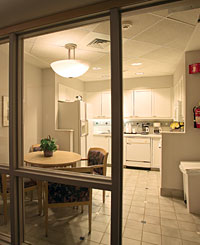
Griffin Hospital in Derby, Conn., provides patients and their visitors with private kitchens.
Photographs by Peter Gregoire and Vern Evans |
But the hospital did not close. Two decades later, Griffin is financially successful, steadily expanding its programs, its buildings, and — a key metric for hospitals — its market share. It is the only hospital named by Fortune magazine as one of the “100 Best Companies to Work For” in America for seven consecutive years, ranking No. 4 in 2006. And Griffin has become such a model for other institutions that it conducts a side business charging health-care executives thousands of dollars for “benchmarking” tours. How did such a striking change occur? Through a single-minded devotion to customer service — one that many in health care regard as quixotic, superfluous, or even downright fanatical.
Griffin is typical of a worldwide subculture of hospitals and other health-care facilities that in the past 20 years have taken the idea of customer service to heart and transformed themselves. In the process, they are demonstrating that service-minded health-care institutions can thrive financially even amid escalating costs and competitive pressure. This movement goes by a number of names — people-centered health care, health-care improvement, medical quality, and consumer-driven health care. It is led by a host of advocacy and research organizations that include an international nonprofit managed by Griffin Hospital: Planetree, an association of 100 hospitals aimed at improving the patient experience. Other leading organizations include the Institute for Healthcare Improvement (known for its crusading founder, Dr. Donald Berwick, and its “100,000 Lives” campaign) and the Center for Health Design, which promotes “evidence-based building design” to construct hospitals that work better for patients. The place to see the people-centered movement in action is in Griffin Hospital and some counterparts around the world. Three health-care centers in the U.S. — Griffin, North Hawaii Community Hospital, and the Fresno Surgery Center in California — show how even hidebound organizations like hospitals can remake themselves and the way they do business.
While new payment schemes, clearer pricing, and increasing competition are driving most hospitals to hack and trim in desperate efforts to survive, the executives at Griffin and other “five-star hospitals” have taken a different tack. They’re attempting to build health-care centers with the customer-friendliness of Nordstrom, the reliability of FedEx, and the transactional accuracy and simplicity of American Express. They believe that making hospital stays more pleasant will pump up market share and revenues, boost the quality of clinical care, create less stress for the staff, and generally turn their business around. They are transforming themselves to better serve the consumer.
The Tough Business of Caring
Visibly, vividly, most of today’s hospitals do not work for the customer. Rik Elswit, the legendary guitarist for the rock band Dr. Hook and the Medicine Show, struggled with several forms of cancer for years. Ask him about the treatment and cure and he lights up, overflowing with praise for the miracles of modern medicine and the skill of its practitioners. Ask about his experiences as a patient, though, and his face changes completely. “I don’t see why, just because I was sick, they had to treat me like a prisoner,” he says.
Most physicians and health professionals agree that Mr. Elswit’s perception is typical: Sick people are treated in effect like prisoners in many health-care settings. The people-centered health-care movement responds to this chronic neglect of the patient experience by proclaiming a call to arms. Hospitals, say leaders of this movement, should never add to the pain and trauma of being sick or injured.
There is no shortage of low-cost opportunities to build a better patient relationship. Some people-centered practices are clinical, including the enforcement of such fundamental (but too often forgotten) measures as having doctors and nurses wash their hands between treatments, installing better ventilation in hospitals, and responding reliably to the call button. (In a 2004 study of hospital accidents, the Center for Health Design found that a major cause was patients struggling out of bed, alone, to go to the bathroom because no one showed up to help them.) Other innovations provide simple dignity: giving patients hospital gowns with Velcro closure tabs or straps, for modesty; or training staff to answer telephones by the third ring, to knock before entering a patient’s room, and to introduce themselves and explain what they’re there to do.
One reason that people-centered health care has been slow to take hold in many hospitals is the underlying reality: The customer, at least in the sense of the person who pays the bills, is usually not the patient. Employers, insurers, and governments (in the form of national health services, or in the U.S. through Medicare and Medicaid) are collectively known in the business as “payers.” Physicians are also important customers. Everything a hospital sells, from an aspirin to the use of an operating room for a heart bypass, is ordered not by the patient or the payer but by the physician. And it is the physician, traditionally, who decides which hospital to send a patient to.
The regulations on the cost structure of health care also play a role. In the U.S., ever-rising prices drove the federal government in 1983 to impose a watershed accounting change for Medicare. It established categories called diagnosis-related groups (DRGs) for inpatient services and set prices for each one — one price for an uncomplicated birth, another for a gallbladder removal, and another for an acute myocardial infarction (a heart attack). Other payers soon adopted the approach, each setting their own prices. DRGs and similar schemes for outpatient treatments and other types of treatments have since become the core code sets of the industry’s finances, and the subject of constant and brutal negotiations. All payers demand steep reductions in the prices that hospitals set, and the government imposes the discounts. These negotiations are complicated by two facts: Hospitals have great difficulty discovering, let alone proving, what a given operation or procedure really costs them; and nongovernment payers, as a normal course of business, refuse to pay a certain percentage of hospitals’ claims. Health-care bureaucrats are like camel traders in a souk. Everything is negotiated all the time, repeatedly, forever.
In such a system, clinical quality is consistently undervalued. (That, at least, is the conclusion of numerous studies, including one by the RAND Corporation published in the New England Journal of Medicine in June 2003.) This contributes, in turn, to many of the chronic abuses documented in health care, such as the high number of medical errors. Exacerbating that situation, the insurance market in the 1990s came to be dominated by huge for-profit companies, forcing providers to compete on price alone rather than the price/quality trade-off that drives most consumer markets. It was as if your “car maintenance organization” declared that you could buy any car you wanted, as long as it cost no more than a Yugo.
In the U.S., the Balanced Budget Act of 1997 (later amended) cut federal hospital reimbursements by 10 percent. In the years immediately after the act went into effect, many of the nation’s hospitals were operating in the red, including 35 percent of the teaching hospitals (according to a 2004 study in the Annals of Family Medicine). Even now, as health-care costs continue to shoot up, hospitals get the slimmest part of the increases. Operating a hospital is often a matter of hair-thin margins (rarely hitting 3 percent) and desperation measures (such as cutting ambulance services and hospice care).
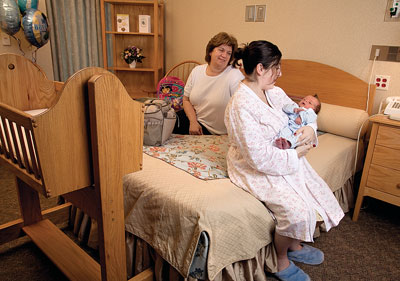
A room in Griffin Hospital’s birthing center
Turning Patients into Customers
Griffin Hospital long ago decided that, as Griffin’s vice president for support services, Bill Powanda, put it, “we could not cut our way to prosperity.” Two things prodded Griffin to turn itself around. The first was a wholesale demographic shift in the Naugatuck Valley. In the early 1980s, the region lost thousands of manufacturing jobs. At the same time, a new north–south highway brought in thousands of white-collar commuters who worked at GE Capital, Xerox, Union Carbide, UBS AG, and the other corporations that were then moving into southern Connecticut. In this grow-or-die moment, when Griffin was losing its business to the half-dozen other hospitals that were now easily accessible via the new road, Lorraine Scarpa — a board member with a marketing background — had a brainstorm: Griffin had to figure out how to sell itself. She proposed devising a marketing strategy using the same tools — focus groups and surveys — that the corporate world used. With sinking market share, dismal rankings, and a crumbling physical plant, the board came to a consensus: Do it.
They started in 1982 by surveying residents of the six towns in the Naugatuck Valley and were stunned to learn how dismissive the area’s residents were of Griffin.
By 1985, management was taking 100 of the 1,200 employees each month for a daylong off-site session, the morning given to education about changing area demographics and new payment systems, and the afternoon devoted to discussing one question: “If you were a patient or the family member of a patient admitted to Griffin Hospital, what would you want the hospital experience to be?” The employees’ answers were dramatically different from the experience that their own hospital was providing. They wanted service: an institution more focused on them and their families, with a friendlier staff and longer visiting hours.
At the same time, Griffin hired consultants to conduct “visioning exercises” with all the hospital’s stakeholders — physicians, nurses, board members, and citizens of the valley — to shape clear and detailed images of what people might want from a hospital experience.
The testing ground was the maternity ward. Griffin’s CEO at the time, John Bustelos, put a 28-year-old assistant administrator named Patrick Charmel in charge of the effort to transform its maternity service into a modern birthing center. Pat Charmel and his team visited the best birthing centers across the country. His wife stuffed a pillow under her dress for “mystery shopper” visits to rival area hospitals. Using intelligence gained from his reconnaissance missions and from the marketing surveys, Mr. Charmel planned a birthing center with such then-unusual features as a separate entrance, private rooms with bathrooms and showers, a greater variety of anesthesia choices, the option to have fathers and siblings attend the birth, and more female obstetricians and midwives. It also included innovations that are still rare in hospitals today: double birthing beds so that fathers could comfort mothers in labor, whirlpool baths, family waiting areas with kitchens and special play areas for children, unrestricted visiting hours, celebration dinners, and classes for grandparents.
At first, Griffin’s blueprint was stymied by what Mr. Powanda now calls “a high giggle factor.” The state’s Certificate of Need Commission, which controls health-care spending by approving capital projects, laughed at Mr. Charmel’s presentation. One commissioner said, “This isn’t San Francisco. That won’t fly here.” When Griffin executives promised that the newfangled birthing center would cost no more than the traditional model, however, the commission gave the plan the go-ahead. But that wasn’t the last hitch in the transformation. When Mr. Charmel tried to order 14 double birthing beds, for example, he discovered that no supplier had heard of such a thing. The beds had to be custom made.
The childbirth center opened in 1987. Griffin’s maternity business — a profit center for any hospital — doubled in just four years from fewer than 500 births per year to more than 1,000. An extraordinary one-third of its “customers” came from outside the Naugatuck Valley. Patient and staff satisfaction surveys resulted in perfect scores.
Having enjoyed such success with its maternity experiment, Griffin began to rebuild its whole facility using the same customer-oriented approach. In 1990, Mr. Charmel — who had become the hospital’s chief operating officer — was charged with renovating its 56-bed medical/surgical unit. He replaced the harsh fluorescent lights with indirect incandescent lamps, installed carpeting to absorb sound, and constructed family rooms and kitchens stocked with snacks. Volunteers came in to bake muffins and cookies for patients and staff, filling the corridors with comforting, homey smells. Musicians were brought in to play live music, and visiting hour restrictions were eliminated. “We found that friends and families were far more respectful of patients’ need to rest than staff traditionally are,” says Mr. Powanda.
But the changes went beyond the level of physical comfort. Mr. Charmel brought a heretofore-unknown level of transparency to the business. Medical records were made available to patients, who could have them explained and even write in their own comments. Of the doctors who at first resisted the change, some were unconvinced that it would lead to better results and others were worried that the information could be used against them. Most were won over when they realized that open records led to fewer, not more, malpractice claims. Griffin’s records show claims against the hospital dropped more than 43 percent, from 32 in 1996 to 18 in 2005, even as discharges rose 40 percent (from less than 9,000 to more than 12,000) during the same period.
Griffin got the idea for this innovation from the Planetree Health Resource Center, a San Francisco nonprofit membership organization dedicated to improving patients’ experience in health care. In 1977, Angelica Thieriot, the wife of the San Francisco Chronicle publisher, had been hospitalized with a mysterious viral fever. Her medical care was of the highest quality, but her experience nonetheless left her traumatized. The hospital was “terribly cold, impersonal, and lonely,” she recalls. She founded Planetree in 1978 to push for change by publishing information about disease, treatments, and medical self-care, and by promoting the development of hospital environments designed to post nurses closer to the patients, ease access for family members, and involve the patients in their own care.
In 1993, Griffin became Planetree’s first affiliate hospital, and that alliance led to Griffin’s boldest move yet. In 1994, it broke ground on a new north wing, the first hospital building designed from the ground up around Planetree principles. Once again, Mr. Charmel oversaw the design, escorting more than 400 staff and potential patients through room mockups in a local warehouse. The wing features decentralized nursing stations, one for every four beds, constructed without barriers to foster communication among patients, their families, and the medical staff. For visitors there are “quiet rooms,” family rooms, and kitchens where they can prepare meals for themselves and patients. The surroundings are designed to comfort, with gentle colors, natural lighting, and large aquariums. Other amenities include valet parking, concierges, and escorts to accompany patients as they check in. Each unit has a patient resource center with books, videos, and Internet connections.
Planetree, meanwhile, though visionary and widely admired, lost its financial footing. In 1997, Griffin saw an opportunity to capitalize on the approach that had brought it such success and purchased Planetree. Griffin paid off Planetree’s debt, transferred its operations to the Naugatuck Valley campus, and proceeded to grow it into an international association with more than 100 affiliated hospitals.
Griffin, meanwhile, continues to tap the market for insights into improving its operations. Every Griffin patient gets a phone call 15 days after discharge to check in on his or her experience at the hospital. Griffin executives can see the results, including narrative comments, by the 10th of the following month, allowing them to track the impact of even tiny changes such as resurfacing the parking lot or changing food vendors. Every two years, Griffin conducts a large-scale customer perception survey that recalls the first one in 1982. This level of market awareness is unusual in the industry. “While a majority of U.S. hospitals do some degree of patient-satisfaction surveying, few do it as assiduously as Griffin,” says Rick Wade, senior vice president of communications for the American Hospital Association.
Griffin’s efforts are paying off. In recent years, inpatient admissions have leaped 25 percent (from 5,866 in 1997 to 7,349 in 2004), and its outpatient services have grown even faster (from 94,567 in 1997 to 160,427 in 2004, an increase of 70 percent). This is three times the average growth rate for the state. “Every one of those patients is connected to a doctor,” notes Mr. Charmel, who has ascended to CEO. “Many of our doctors have been able to expand their practices, bringing in other doctors.” At the same time, Griffin’s work-force turnover has dropped. “We undercompensate our employees,” Mr. Charmel admits, “and we probably work them harder [than do other hospitals]. But they become much prouder of what they do.” Griffin has also become a model for other institutions. More than 500 medical centers — 10 percent of the hospitals in the U.S. — have sought out Griffin for benchmarking tours. Griffin is no longer everyone’s last choice in health care. According to Mr. Powanda, it is now the market leader in the area.
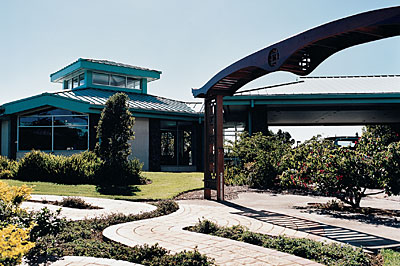
The grounds of North Hawaii Community Hospital
Treating the Spirit
As Griffin was refashioning itself, a more extreme example of the people-centered health-care movement was coming together independently five time zones away, on Hawaii’s Big Island. In the mid-1980s, local doctors and civic leaders set out to build a new hospital in an area that badly needed one — on the island’s ragged northern slopes, halfway between Kona and Hilo. The organizing committee took as its slogan “Not Just Another Hospital.” Several committee members were fans of health-care visionary Leland Kaiser, a former hospital administrator and currently a professor of health administration at the University of Colorado who had long preached an alternative future for health care in which hospitals would build healthier communities and serve not just the body, but the mind and spirit too. Dr. Kaiser led them to Patrick Linton, CEO of Yavapai Regional Medical Center, in Prescott, Ariz., who had pioneered the use of consumer-friendly health-care management techniques. The committee called on Mr. Linton to consult on the design of the new North Hawaii Community Hospital, and eventually hired him as its founding CEO.
Earl Bakken, inventor of the first wearable, battery-powered cardiac pacemaker and founder of the medical technology giant Medtronic, became a third powerful influence when he retired to the Big Island in 1990. Mr. Bakken, another champion of people-centered health, traveled widely to evangelize his vision, which he described as “high-quality diagnostics and treatment, combined with the human touch, the caring, the loving, the healing arts, the energy arts, massage, acupuncture, a healing environment — high tech and high touch. Call it ‘blended medicine.’” Now this small, ambitious group of social entrepreneurs was offering him a rare opportunity to build a hospital accordingly. Mr. Bakken became chairman of the hospital’s first board.
The full-service, 41-bed hospital, which opened in 1996, is a feast for the senses. Research studies (such as those conducted by the Center for Health Design) show that patients who have access to nature, natural light, and art have less stress and better outcomes. So every room opens out to a flower garden with running water. Interior hallways have clerestories and skylights. Even operating rooms and the intensive care unit have windows, set high in the wall for privacy. The artificial light is full-spectrum, like sunlight. Colorful prints fill the walls. The ventilation system has three times the usual airflow capacity, and janitors are trained in aromatherapy to ensure that North Hawaii has no “hospital smell.” Acoustics are designed to reduce noise, especially loud “startle” sounds. And such services as massage therapy and visits from Kahunas (traditional Hawaiian priests) are available to both patients and staff.
“All hospitals are stressful places to work,” says Director of Healing Services Ann Warren. “Employees can’t give anything to the patients, the customers, unless they are feeling good about what they do.”
That attitude more than pays for itself. Whereas the American Association of Colleges of Nursing has documented a nationwide nursing shortage in the U.S., and other hospitals on the Big Island have to resort to expensive itinerant nurses, North Hawaii Community Hospital is fully staffed. Vice President for Patient Care Services Laura Boehm says, “We usually have more applications than positions, and our turnover rates are lower than other Hawaii hospitals.” CEO Stan Berry concurs: “Nurses like working here because of the environment, the whole-person care, and the good relationships with physicians.”
For North Hawaii’s patients, customer care doesn’t stop when they leave the hospital. Laurien Hamilton, director of patient financial services, notes that every hospital bill comes with a handwritten note explaining each entry in detail, along with the direct phone number of the person who wrote the note. Despite that kind of individualized attention, the hospital’s finances are healthy. In Hawaii, where almost all hospitals are state supported, North Hawaii Community is an exception. Its operations generate a positive cash flow of approximately $2 million each year, according to Mr. Berry.
First-Class Service
Recovering from surgery is usually a miserable experience, but surgeon Alan Pierrot of Fresno, Calif., was determined to change that and make a buck in the process. In 1984, he and some fellow physicians set up the Fresno Surgery Center as a hybrid of an outpatient center and a full-service hospital. “We had the best nurses, the best operating rooms, the best equipment,” he says. “We decided to add beds to create the same pleasant surroundings for inpatient work. We wanted to keep the surgery center culture — good customer service, high efficiency, rapid turnover of patients, good morale, and an on-time culture. We didn’t want to get sprinkled with ‘hospital dust.’ We wanted to be a ‘hotel with nurses.’”
By 1988, the new Fresno Surgery Center opened for business. “That’s when the culture really developed,” Dr. Pierrot says. Just as Griffin Hospital had done a few years earlier, Dr. Pierrot and his colleagues started by asking themselves what they’d want if they were patients. Their answers echo what Griffin learned: “Most patients want a private room, good food, and a residential or hotel-like ambiance. They want to control the physical aspects of the space, such as light, sound, and temperature. They want a nurse who answers the bell when they ring. And they want a visitor-friendly environment.”
Dr. Pierrot took a leaf from the hospitality industry. “We went to Ritz-Carlton for training. We hired a concierge from Hyatt as a consultant. We took notes about our own hotel experiences,” he says. Today, Fresno Surgery Center’s rooms might fit nicely into a five-star hotel: They have mini-bars, televisions that are in maple media centers rather than bolted to steel arms, curtains instead of blinds, hair dryers in the bathrooms, and telemetry and gas ports hidden behind the art on the walls. There are beds for spouses, and the food is prepared by a chef from the Ritz-Carlton.
One patient, sent to the surgery center because a local hospital was overwhelmed with flu patients, told the Fresno Bee, “It was like being bumped from coach to first class.”
Isn’t it prohibitively expensive to operate such a luxurious environment? No, says Dr. Pierrot. “The extra costs are really small. Sixty to 70 percent of any health-care provider’s budget is salaries and medical supplies.” Like the executives at Griffin and North Hawaii Community Hospital, Dr. Pierrot figures that he makes up for the extra costs with savings on personnel, in both salary and turnover expenses. “If you don’t compete for nurses on the basis of intangibles like low nurse-to-patient ratios, a great work environment, and great patient satisfaction, then the only way that you attract nurses is by paying more than someone else.”
Private specialty hospitals like Dr. Pierrot’s are controversial. Some observers claim that they have an unfair advantage; the American Hospital Association and the state associations are trying to stymie the spread of such specialty clinics through legislation and litigation. Dr. Pierrot argues that the unfairness runs the other way. “Surgical inpatients are high-cost patients,” he says. “Full-service hospitals can average these costs across their many services, in effect selling their inpatient surgery services at a loss.” Whatever the merits of either argument may be, the innovations at Fresno Surgery Center seem relevant to all health-care facilities, from specialized clinics to full-service medical centers.
Indeed, that is true of most of the innovations of the people-centered health-care movement. And although mavericks like Griffin Hospital, North Hawaii Community Hospital, and the Fresno Surgery Center still represent a tiny minority of hospitals, the movement is gathering momentum. In 2003, New York Presbyterian Hospital, a 2,200-bed facility, signed on with Planetree, followed by two other large systems: Stamford Hospital, in Stamford, Conn., and the Veterans Affairs New Jersey Healthcare System. This new wave of interest reflects the new pressures that hospital managers feel. The rules of the insurance system are changing, and consumers increasingly feel that they have “skin in the game.” According to Philip J. Wilner, vice president and medical director for behavioral health at New York Presbyterian, “patients measure their satisfaction differently than they did before. They expect a more integrated approach. They are no longer satisfied if we only address their bodily issues. We see this in our surveys and in letters from patients.”
In particular, because of higher co-pay policies among many health insurance companies, insured consumers are spending more out of pocket for their coverage. According to an estimate from Hewitt Associates, a human resources consulting firm, people are paying double what they paid just six years ago. Those outlays give health-care consumers a greater sense of ownership. Also fueling the new health consumerism are the increasingly popular consumer-directed health plans (CDHPs), which give individuals wide latitude in choosing how to spend their health-care dollars. As of December 2005, 10 percent of insured consumers in the United States subscribe to CDHPs or similar plans, and benefits managers surveyed by the industry publication Inside Consumer-Directed Care expect that percentage to at least double this year. Booz Allen Hamilton recently estimated that adoption of CDHPs by only 15 to 20 percent of the insured market will cause the entire health-care industry to begin operating much more like a retail consumer market.
Meanwhile, spurred in part by malpractice litigation, a new transparency is spreading across health care. Industry leaders are becoming aware that they face a future in which every mistake and lawsuit, as well as complete price lists and outcomes ratings, will be displayed for the world to see on the Internet. In the second quarter of 2006, the U.S. government’s Centers for Medicare & Medicaid Services will roll out a 26-question patient survey for use by hospitals across the country, and the results will be posted on the Web at www.hospitalcompare.hhs.gov. The survey is a voluntary program, but as of October, hospitals that do not take part will lose 2 percent of government reimbursements.
“Think of a local community hospital with a lay board,” says Griffin Hospital’s Bill Powanda. “Imagine what will happen when their hospital shows up in the lowest quartile. Resources will be reallocated. The message to management will be: ‘Fix this, and fix it quick.’ There is going to be a scramble to find solutions.”
The effect should be dramatic. Studies by researchers Elliott Fisher, Mark McLellan, Elizabeth McGlynn, and others have consistently shown that health-care costs, charges, and utilization rates vary widely, with no demonstrable connection to mortality rates or other outcome measures. The public is beginning to recognize this disconnect.
“It’s a cultural shift,” says New York Presbyterian’s Dr. Wilner. “In the Internet era, we are seeing far better-informed patients, and they are feeling more entitled to better care as consumers.”
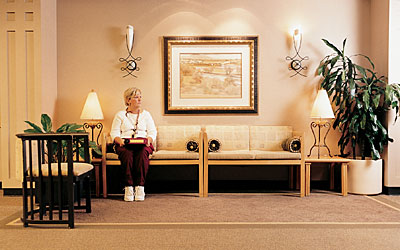
A cheerful waiting room at the Fresno Surgery Center
Global Health-Care Competition
Hospitals also face sharper competition, not just from nearby facilities, but from distant hospitals that offer special treatment packages. World-class medical centers in South Africa, India, Thailand, Malaysia, and Singapore, with good outcome statistics and physicians trained in the U.S. and U.K., now offer American consumers surgery packages at one-quarter their U.S. cost. But, without any connection to the U.S. insurance market, these packages used to attract only customers who could pay their own way. In 2005, that changed. U.S. employers and insurers started to cover procedures like heart bypasses and hip replacements performed at foreign medical centers, choking off even more revenue from already struggling U.S. hospitals.
Some health-care specialties, such as laser eye surgery and cosmetic surgery, are already consumer markets, because they are rarely covered by insurance. These industry segments show remarkably different patterns from the rest of health care. Their prices rise only moderately (or, in the case of laser eye surgery, have actually fallen steeply). They offer a proliferation of new techniques, of payment methods, of providers, and of information, and have rising quality standards — much like any other consumer market.
More and more hospitals realize that they have much to learn from consumer products companies. Scores of health-care institutions are teaching their entire staffs the Toyota production system (TPS), taking apart every process in the institution to see if it can be done better, faster, and cheaper, with more satisfied customers. In 2004, Park Nicollet Health Services in Minneapolis, with plans for an expensive new parking structure on the drawing board, undertook a TPS-inspired study to understand why the parking lot was always jammed. The group found that most of the cars belonged to patients who were sitting for long periods in waiting rooms. A “lean production” group at the hospital redesigned the workflow so that people would be given more accurate appointment times, and the parking problem disappeared — along with a certain amount of patient dissatisfaction.
Hospitals are also discovering that if they create strong brands, they can attract more customers and inspire more donors and volunteers. They also gain an advantage in negotiations with insurers, who cannot afford to ignore a locally popular institution. In addition, having a strong brand makes it easier for a hospital to expand its offerings, which is critical to keeping the red ink at bay. As New York Presbyterian’s Dr. Wilner points out, “There is no price elasticity in today’s market, so volume growth is the only way to improve the bottom line. The only way to succeed is to add programs and services, and a strong brand is essential to doing that.”
The passion people feel about health care has suddenly become a critical component of the business environment for medical providers. As a result, this strangely distorted industry is feeling the impetus to make deep internal changes that would have seemed unthinkable two decades ago. No magic wand will wave away the mess that is health care in the United States — overpriced, disorganized, short on results, and unnecessarily traumatic. But it may well be that a combination of market factors and new payment mechanisms can force the industry into reform that no legislation, litigation, or commission could ever have mandated.
It has already started, with a few five-star hospitals. If it spreads, its impact will be profound. The emotional power of illness and recovery marks us to our bones. Health care made more efficient, more effective, and deeply compassionate might just become the model and catalyst in the transformation of many another service industry.
|
Debit Cards and Drugstore Clinics: The Competitive Health-Care Future |
|
Many hospital executives equate people-centered health care with the need for improved amenities and facilities, but it’s really much more than that. As hospitals find themselves competing in an increasingly consumer-directed marketplace, they will have to transform their entire way of doing business. Too many executives, however, take the initially low enrollment in consumer-directed health plans (CDHPs) — less than 5 percent of the current insured population — as justification for skepticism. Unfortunately, hospital leaders who ignore the broad consumer health-care movement do so at their peril. Consumerism will likely follow the same path as managed care toward a clear tipping point. Many patients are already acting more in their own interests and expecting more from health-care providers. Although the transparency that consumers will ask for (and that health information technology will enable) is scary, the opportunities are huge. These include building not just new customer relationships, but also new business relationships with physicians, especially the procedure-based specialists who drive most hospital revenue and profits. For example, what if patients got one clearly organized bill for everything — doctors, medication, the whole package — related to a hospital stay? That is a near impossibility today, but it could happen from the bottom up, without any government agency or single company mandating it from the top. Two insurance giants, Aetna and the Blue Cross system, recently announced that they are introducing their own debit cards (with either Visa or MasterCard affiliation). Swipe one at the waiting room desk, and it will debit your health savings account. A smart hospital executive would be thinking about how to hook the doctors into this system so that this one card would produce a single itemized bill with radiology, the operating room, and the doctors’ charges included. Other kinds of grass-roots innovations have enormous potential to remake the industry: Drugstore chains are forming partnerships with insurance companies; insurance companies are partnering with hotel chains for premier health and wellness services; and Target and Wal-Mart have begun putting “minute clinics” in their stores as a more pleasant alternative to emergency rooms for people who suffer from relatively mild problems. Hospital leaders should ask themselves, “How would our core business be different if patients (and their intermediaries) could make purchasing decisions based on quality, customer service, and price?” Such a world Gary Ahlquist (ahlquist_gary@bah.com) is a senior vice president of Booz Allen Hamilton based in Chicago. |
Reprint No. 06108
Joe Flower (jflower@onlymyemail.com), a writer on management and medical issues, has been an editor of Health Care Forum and a contributing editor at Physician Executive.