
Beyond Brand Management
The anatomy of the 21st-century marketing professional.
(originally published by Booz & Company)
 |
|
Illustration by Seymour Chwast |
For the best part of the next half century, television and brand management held sway over marketing theory and practice. The practice was based on a judicious blending of television and print advertising, direct mail, and trade promotions, supervised by managers trained to analyze (and base decisions on) measurements of magnitude (the size of the audience reached). These managers were abetted by sets of contractors skilled, by turns, in art and science. To this familiar recipe, modern marketers added a pinch of the Internet, a sprinkle of product sampling, and a dash of PR, but the basic model remained largely unchanged.
Until now.
The marketing profession is currently undergoing its most significant transformation in more than 50 years. Driving it are massive shifts in technology and society (see “The Future of Advertising Is Now,” by Christopher Vollmer, John Frelinghuysen, and Randall Rothenberg, s+b, Summer 2006), which are converging to make the old marketing model obsolete. As the world changes, so must the capabilities of marketing professionals.
Marketers can read the writing on the wall. Many companies are experimenting with new approaches and techniques. But most of these experiments constitute mere tinkering with the traditional marketing model.
“Marketing communications in particular is stuck in the late 1980s paradigm of tactical implementation,” says Don E. Schultz, professor emeritus in the Integrated Marketing Communications program at Northwestern University’s Medill School of Journalism. “We keep planning on the basis of campaigns, looking for short-term returns, using measurement systems that don’t work. The real questions today are about how we can develop horizontal integrating processes and systems that work across disciplines, not just across communication formats. We need some new concepts and new approaches, not just rehashes of what we have been doing for the past 75 years.”
The transformation of media and markets has profound implications for the way in which marketing is organized, the skills and outlook required of professional marketers, and the types of training that marketers will need. Some features of the new professional model for marketers are already clear:
• More Diverse Skills. Marketing teams increasingly will address a broad, complex agenda for consumer engagement, through a wide range of communications media, including electronic, experiential, and nontraditional channels. Success will mean blazing new career paths that combine the sophisticated quantitative skills and the leadership ability needed to supervise teams working in multiple, rapidly changing markets, with traditional creative and management capabilities.
• Entrepreneurial Aptitude. The typical business marketing career has attracted gregarious people who operate comfortably within a familiar professional culture with well-defined techniques. But now marketers must not just select and purchase proven instruments. They must envisage, shape, and develop new tools for designing and engendering more effective consumer connections. This demands openness to experimentation, an inclination toward pioneering, and an ability to integrate marketing with strategy as never before. The new marketing team must do this while honing the number-crunching analytical ability that is needed to justify and fine-tune new strategies.
• In-sourcing the Marketing Value Chain. The new marketing organization will start to reintegrate the marketing supply chain. For the first time in decades, marketers will develop their own in-house, proprietary, and custom media operations. This wave of in-sourced media will put a premium on the marketing department’s ability to orchestrate a fluid marketing system with some new actors — and to do without outsourced help when it is faster and more effective to develop these tools internally.
The shape of the future of marketing is too novel and too important to be left to traditional marketers. Just as P&G pioneered brand management for the 20th century, now is the time for marketers to reinvent their role — and to shuffle the marketing team to do it.
Career Trailblazers
In the long period of incremental change since the arrival of commercial TV, marketing careers followed well-trodden paths. New university graduates with liberal arts or undergraduate business degrees trained for five or six years with one of a few major companies, such as Procter & Gamble or Unilever. They got broad cross-category marketing experience, often in an international context. Working with outside advertising agencies, they bought mass communications media, available to all competitors, on the basis of syndicated research, which was also available to others for a price. Advancing marketing professionals learned to choose and integrate outside agencies into the marketing team, to interpret consumer insights from a market research study, and, using those insights, to build a brand with TV commercials, print ads, consumer promotions, and trade promotions. Thus seasoned, in their 30s they became brand managers. In their 40s, they might become general managers — or they might leap to the “agency side.” This kind of career path established an industry-wide pattern: specialized grooming for a role with familiar lines and a well-worn plot. (See Exhibit 1.)
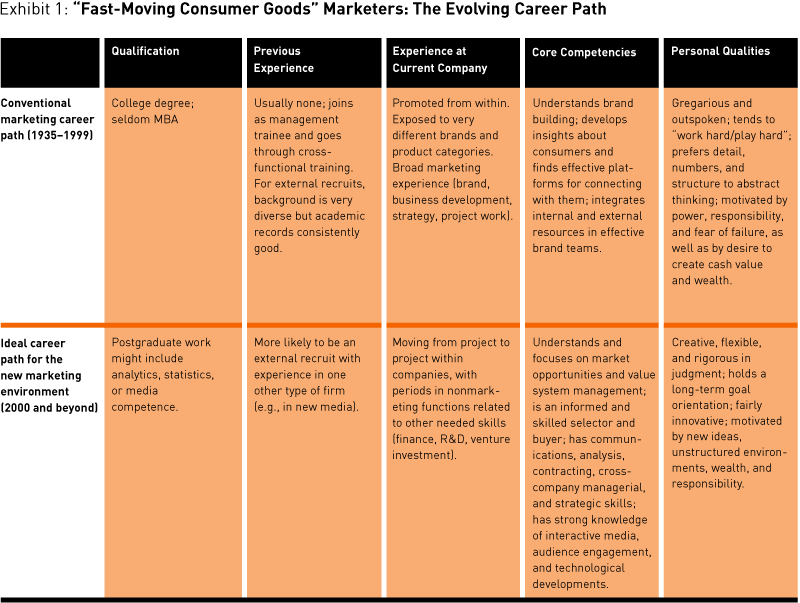
It also set a career trajectory that attracted people with energy and commitment, as well as a strong focus on action, results, and achievement. Their training helped marketers assess campaigns and pitches — for example, from advertising agencies — and to relate them to mass data on consumers and the market. But it did not attract or nurture abstract thinking. The 20th-century marketers tended to prefer detail and structure to the ambiguities and uncertainties of the new. They wanted (and knew how) to get things done, and their goal was to manufacture marketing as efficiently and as uniformly as they manufactured goods.
The capabilities required for marketing professionals in this century are already very different. Today, marketers have to create and assess business propositions built around seemingly polar opposites: vast databases on the one hand, and marketer-to-individual-customer interactions on the other. As Internet distribution of digital media moves beyond text, static images, and sound to include the equivalent of cinema and television, the range of media and consumer experiences is becoming as limitless as the number of Web pages. The 21st-century marketer will increasingly have to choose between investing in a music download site and investing in a campaign that makes use of mobile messaging, or between funding banner advertisements and funding a new video-on-demand service. Nobody yet really knows how to make all of these decisions with consistent success. It will require a great deal of experimentation and risk taking — qualities associated more with R&D than with marketing.
Most contemporary marketers are not accustomed to shaping, producing, and directly overseeing the media in which they place advertising. Yet those are the skills that are most needed today. Just as Procter & Gamble was active in the design and development of early TV programming, so marketers in the current period of media and marketing flux must expect to imagine, create, and finance new kinds of digital or interactive media and the innovative new forms of advertising and marketing they engender. Marketers, working inside consumer product and service companies, not for ancillary suppliers, will be among those who invent the new programs and formats that will be to the next few decades what soaps and sitcoms were to the past: vehicles for capturing audience loyalty and imagination.
For a marketing professional, exploring and shaping this kind of newly tailored consumer experience calls for much more than was ever required by conventional selection and purchasing decisions. To develop, deliver, and promote the new formats — today, it is Massively Multiplayer Online Games and Internet Protocol Television; tomorrow, we can’t even begin to guess — marketers will have to reengineer and reimagine the relationships among all participants in the marketing chain. Alternatively, they will do it themselves. Companies as disparate as P&G and the electronics retailer Best Buy have already begun to bring the necessary capabilities in house. Either approach requires a new combination of commercial entrepreneurship, technological competence, strategy skills, and consumer sensitivity.
Number-Crunching Creatives
Undoubtedly the most salient features of electronic media are the diversity and differentiation they bring to the marketplace. Digital media excel in selecting the “audience of one” (or, to be more accurate, in allowing it to select itself) and tailoring offerings to these individual consumers. Thus, a precise and highly tailored implicit contract is evolving between the consumer, who grants access and time, and the marketer, who reciprocates the consumer’s interest with responsiveness and opportunities for more extensive dialogue, as well as with entertainment and information.
To conceive, evaluate, and invest in new commercial propositions that engage audiences across many dimensions, marketers will be called upon to make decisions that reflect broad marketing savvy, close awareness of the product’s or service’s current position in the marketplace, and in-depth knowledge of quantitative techniques and the capabilities of new technology. Thus, one of the new marketer’s key skills is the ability to marry fluency in higher mathematics and computer modeling to marketing flair and creativity. Just as mathematics has revolutionized finance, it will now invigorate the marketing field, as new models and algorithms are developed to extract value from consumer and business databases, and to allow more precise targeting of “hot” topics to each consumer.
The exploding availability of electronic consumer data makes marketing a new frontier application for business mathematics. It is no wonder that Booz Allen Hamilton’s ongoing research with the Association of National Advertisers has found that 66 percent of senior marketers believe their greatest need is to develop capabilities in consumer insights and return on investment (ROI) analytics. The leaders that are doing so are outcompeting their rivals. These leaders are not just Internet powerhouses such as Google and Yahoo; they include innovative number-crunchers in retailing, finance, and other industries as well.
Consider the capabilities that took the Capital One Financial Corporation from its position as a spin-off of Signet Banking Corporation in 1994 to being the 115th-largest company in the S&P 500 in 2005, with more than $10 billion in revenues and 50 million customer accounts. Its credit-card business is built on a foundation of minutely fine-tuned product development, market testing, and analysis, all of it resting on a bedrock of terabytes of customer data. “When we started this company,” Chairman and Chief Executive Officer Rich Fairbank once told Fast Company magazine, “we saw two revolutionary opportunities: We could use scientific methodology to help us make decisions, and we could use information technology to help us provide mass customization.”
Another leader — in an utterly different industry — is the global consumer goods retailer Tesco PLC. Mining scanner data and personal data captured through the company’s Clubcard program, Tesco’s marketers practice intensive information analysis, cross-tabulating purchase data against the information gleaned from customer responses and requests, and distinguishing the “signals” of genuine indicators of customer purchase potential from the “noise” all around them. Using this technology, Tesco’s marketers have redesigned their traditional tools, like direct mail and “mother-and-baby clubs,” tailoring hundreds of thousands of individual messages to customers. In a supermarket industry characterized by historically low margins and fierce competition, Tesco reported revenues in 2005 that rose more than 10 percent from the year before, to $46 billion, with profits up 19 percent. More than 150,000 orders now come in weekly via the Web.
Does this mean that tomorrow’s marketers must be rocket scientists, cousins to the Ph.D.s who have long populated investment banks and the obscure corners of the financial-services industry? Not at all. But the pervasive disdain that many professionals express toward marketing science to this day — recall advertising legend Bill Bernbach’s scornful declaration that “advertising is fundamentally persuasion, and persuasion happens to be not a science, but an art” — must give way to a more nuanced understanding of the profession’s inherent, necessary cross-functionality.
The most successful professionals will display an intense curiosity about new approaches and tools, the ability to think in novel and creative ways, a higher-than-normal inclination to experiment, and much greater tolerance for ambiguity. These skills will be put to work as marketers evaluate propositions, define their strategies for media and creative investment, and devise new ways to engage with consumers in more intimate and effective marketing dialogues. General Electric Company CEO Jeffrey Immelt has stated that “sophisticated marketing” is now one of the company’s three imperatives, along with risk taking and innovation. The next-generation marketing team will itself embody all three of these qualities.
Sophisticated Integrators
A thoroughgoing change is also under way in the fragmented supply chain that has come to characterize the marketing world. Over years of stability and growth, marketing has subdivided itself into ever more finely granulated specialties. A typical fast-moving consumer goods company orchestrates a web of suppliers that includes advertising agencies, buying agencies, creative specialists, direct-mail firms, and market researchers of all manner. This proliferation of outsourcing has steadily grown since the rise of mass television in the 1950s and 1960s. Many specialties have subdivided, adding responsiveness to the marketing-services system, but also adding many layers of complexity.
With the increased use of international marketing suppliers spread across several continents, yet with media buying decisions often made in local markets, the complexity has mushroomed. Supervising that huge extended enterprise could be deemed the central skill of the hundreds of thousands of men and women currently serving in marketing management roles. (In the United States alone, 664,000 people were serving in sales, marketing, advertising, promotions, and public relations management in 2004, the most recent year for which figures have been published by the U.S. Bureau of Labor Statistics. Broadcasting accounted for another 327,000 jobs. The motion picture and video industries contributed 368,000 more.)
True, with so many participants, there are many springboards from which new ideas and practices can take flight. Local experimentation often works. But the complexity inherent in the system suppresses its ability to absorb that experimentation or use it on a larger scale. That’s why it is so hard to rewire an existing marketing strategy or move to a better approach, especially internationally. Each component in the system — each local agency, research supplier, or creative group — depends on others playing their established roles in the ecosystem. Change for one implies change for others. Yet with so much vested in the current ways of doing business, no individual supplier or department can be sure that its individual change will be met with complementary changes in the others — and few can (or should) take the risks of changing their practices unilaterally. Thus, only a radical approach to innovation, affecting many of the players at once, will succeed.
For many, the solution will be reintegration. After years of outsourcing, that won’t be easy or optimal. As Paul Bay, former director of consumer communications at Levi Strauss, has commented: “Being ‘integrated’ means the creative agency thinks of the idea and everyone else executes it. Changing that convention needs a lot of education. It will be very tough.”
Some of the giants of the marketing world have been the first to look beyond the current system to create new vehicles for integrated marketing supply chains. Strong retailers are a good example. They are the new arrivals on the branding front lines, with much less vested in the traditional marketing system. They have found it natural to do much of their marketing themselves. Tesco bypasses large chunks of the conventional marketing system in the U.K. and has integrated its market research and analytics capability, which was formerly conducted by an independent firm. Other retailers are reinventing media at the point of sale. Wal-Mart, for example, has made a major commitment to in-store TV, creating a new medium powerfully connected to the consumer shopping experience and to the purchaser’s moment of decision.
In traditional marketing teams, the action-oriented, authority-driven mind-set rules. Indeed, too often it squeezes out the more innovative dispositions and the exploration and experimentation they bring. But the strategic agenda for marketers has changed. Creative and commercial business-system perspectives must play a greater role in team composition, so that companies can look up and down the value chain to imagine and experiment with new ways of operating. As marketing teams gain diversity and balance, team management in turn becomes more integral to marketing effectiveness. It is thus crucial to have active and deliberate leadership capacity on the marketing team.
It is tempting to think that only outsiders, in the form of small, entrepreneurial upstart companies, can effectively tear down the international marketing system. Yet the big consumer goods companies are uniquely positioned to reinvent the marketing model for the 21st century. Indeed, they and the large retailers are the only companies positioned to do so. Only they can take responsibility for the system as a whole — and use their spending to reshape it. Their money and leverage influence the whole system.
These corporations also have the most direct and compelling need for the system to perform. Unlike the specialized suppliers, they don’t have to answer to any one client. This means they are less constrained than other members of the system and are free to reassemble the pieces in new and interesting ways. And some of the best are leaders in using their freedom and power. The broader agenda being pursued by such companies as Procter & Gamble, Capital One, Tesco, and Coca-Cola is symptomatic of the change that will affect marketers across industry and geography. The winners will be driven by their vigor and determination in reshaping the marketing team. That’s the place for companies to start. New times call for new capabilities, and for team structures that can win in an era of technology, uncertainty, and change.
Reprint No. 06205
Richard Rawlinson (rawlinson_richard@bah.com) is a vice president with Booz Allen Hamilton in London. He focuses on the leadership agenda for consumer products, telecommunications, and public-sector clients.