

The Megacommunity Manifesto
Public, private, and civil leaders should confront together the problems that none can solve alone.
(originally published by Booz & Company)
 |
|
Illustration by David Plunkert |
In multinational corporations, for example, “everybody is frozen,” says American Express Chairman and CEO Kenneth Chenault. “What has not kept pace in the business world is an understanding of how the uncertainty of the geopolitical environment has impacted business.” The ability to seize opportunities or make a profit often depends on unfamiliar and unpredictable factors, such as the reputation of the company and its grasp of changing trends.
Meanwhile, governments, which were previously relied upon to manage the problems of public society, can no longer spend or regulate their way into requisite solutions. “In the past, corporations could depend on the fact that government defined the answers,” says Stephen Merrill, formerly the governor of New Hampshire and currently president of Bingham Consulting Group LLC. But now, he says, business leaders are afraid that “government doesn’t even understand the questions.”
Moreover, there is a subtle but detectable waning of confidence within the public sector as governments around the world find themselves accountable for issues without easy answers: the changing role of the military; new economic uncertainties as emerging and established industries compete; and rising costs of health care. These problems often occur at an unprecedented and almost incomprehensibly vast scale. For example, as former World Trade Organization Director-General Renato Ruggiero notes, “Our current Western society fails to acknowledge two megatrends: the world population growth in the next decade, and the fact that this growth will be primarily driven from nonindustrialized countries. This will increase the immigration pressures at our borders and cause a change in the demographic structure.”
Nongovernmental organizations (NGOs), for their part, are finding that although expanding communications and the Internet have given them more voice than ever before, the demand for their work has increased commensurately, competition for funding has escalated, and they no longer understand constituents’ needs as easily as they used to. “We’ve had blinders on,” says Paul Leonard, the former CEO of Habitat for Humanity International. “We need to change course, to become more of a partner and a player; more knowledgeable about the large systems that exist and the role we can play in them.”
The root cause of the challenges confronting these leaders is complexity: the growing density of linkages among people, organizations, and issues all across the world. Because people communicate so easily across national and organizational boundaries, the conventional managerial decision-making style — in which a boss exercises decision rights or delegates them to subordinates — is no longer adequate. Solutions require multi-organizational systems that are larger and more oriented to multilateral action than conventional cross-sector approaches are. In such systems, the most successful leaders are not those with the best technical solutions, the most compelling vision, or the most commanding and charismatic style. The “winners” are those who understand how to intervene and influence others in a larger system that they do not control. We call this type of larger system a “megacommunity.”
Three-Sector Intersection
A megacommunity is a public sphere in which organizations and people deliberately join together around a compelling issue of mutual importance, following a set of practices and principles that will make it easier for them to achieve results. Like a business environment, a megacommunity contains organizations that sometimes compete and sometimes collaborate. But a megacommunity is not strictly a business niche. Nor is it a public–private partnership, which is typically an alliance focused on a relatively narrow purpose. A megacommunity is a larger ongoing sphere of interest, where governments, corporations, NGOs, and others intersect over time. The participants remain interdependent because their common interest compels them to work together, even though they might not see or describe their mutual problem or situation in the same way.
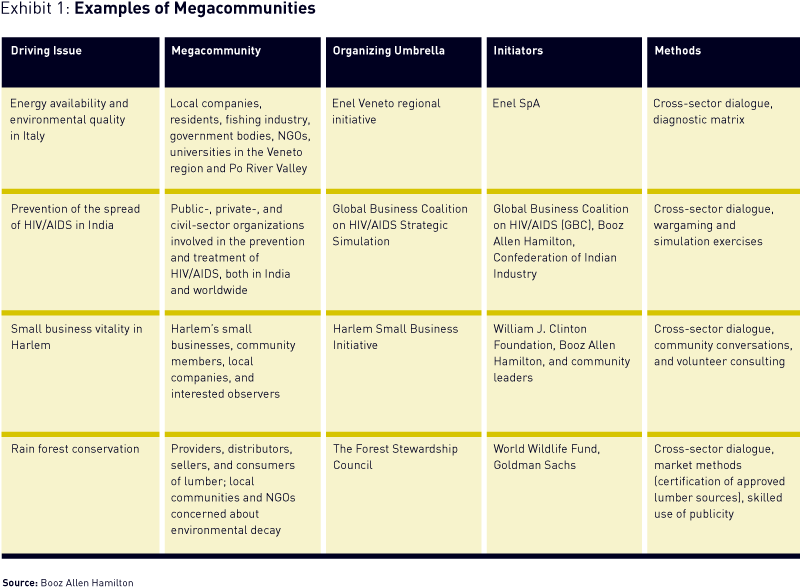
We chose the term megacommunity to reflect such a sphere’s character as a gathering place, not of individual people, but of organizations. We see megacommunities emerging in many locations, reflecting the evolution of long-standing communitarian and democratic traditions, and also the changing character of today’s business and political environments. Examples of megacommunities range from planet-wide systems, such as the community of corporations, governments, and NGOs concerned with rain forest management and conservation, to local enterprise-related civic/business environments, such as the New York City neighborhood affected by the Harlem Small Business Initiative. (See Exhibit 1.)
Whatever the scale and scope, all megacommunities have two things in common. The first is a connection to globalization. As technology has allowed the instantaneous transfer of money, images, ideas, and people around the world, “local” communities are neither constrained nor protected by the age-old boundaries of geography and demography. A vendor in a remote village in Costa Rica or India is bound, through communication, trade, and an increasing number of common interests, with an urban resident of Paris or Hong Kong.
Though globalization is often thought of as waxing and waning through history (with the world sometimes growing more closely linked, and sometimes splintering apart), the current wave of globalization involves a permanent structural change in many of the institutions of the world. Nations and companies alike have undergone an irreversible shift toward what management theorist Charles Hampden-Turner calls “universalism.” They move away from reliance on connections and loyalty (typical of societies with selective law enforcement) and toward such principles as merit and universal law.
This kind of shift makes even formerly closed societies more open to outside influence, and thus more powerful. But it also makes them more vulnerable, particularly to the problem of economic “winners and losers,” in which the benefits of globalization are not evenly spread. The megacommunity concept represents a movement toward sustainable globalization, in which contact with the outside world, instead of draining jobs and making a local system vulnerable, strengthens long-term quality of life, economic vitality, and community health. In other words, megacommunities provide leverage for retaining local identity while creating a viable middle class and competing on the global playing field. Or as former U.S. President Bill Clinton puts the problem: “After the Great Depression, we created an American middle class. How do you create a global middle class that’s bigger and bigger?”
The second common feature of megacommunities is a recognition of the changing nature of effective leadership. In the past, a problem like managing regional land use would have fallen to a government body, such as a ministry or port authority. Now, much of the work will be done by leaders of a group of separate but interdependent organizations. Fortunately, the skills and techniques of megacommunity leadership appear to be transferable, whether the scope of action is a city neighborhood, a regional watershed, a continent, or the globe. One can imagine a truly comprehensive “leader’s guide” to megacommunity engagement emerging from these kinds of initiatives.
Organizations that avoid megacommunity engagement do so increasingly at their peril, and at the peril of the communities they are trying to enter, influence, or help. Consider, for example, the case of a project in Brindisi, Italy, initiated by Enel SpA — a project that went astray when the company did not convene a megacommunity. Enel, Italy’s leading utility provider, is a partially privatized company; the government of Italy owns about 31 percent of the stock. In the early 2000s, Enel attempted to diversify its sources of energy by joining forces with the U.K. company British Gas (BG Group, or BG) to build a terminal for regasifying liquefied natural gas in Brindisi, an economically depressed area on the heel of Italy’s boot. The company expected the project to be greeted with popular support in Brindisi. It would have provided 1,000 jobs during its three years of planned construction and 250 permanent new jobs in the region. Enel and BG were very careful to fulfill all the legal requirements necessary for starting the project. But their legal outreach was far from sufficient to offset a long and unprofitable chain of events.
Soon after the project began, environmental activists published a paper highlighting its danger to the health and security of the local population. The paper triggered a much larger protest, amplified by the local press into a broad and persistent national issue. In October 2003, a civil petition with more than 10,000 signatures brought the first official halt to the project. In July 2005, more than 8,000 protesters took to the streets, shouting, “We must save Brindisi!” A few weeks later, construction was entirely shut down. Although Italy’s Supreme Court stepped in and construction began again four months later, Enel felt the need to withdraw from the venture, selling its 50 percent investment back to BG.
Although this episode is not yet concluded and BG still hopes to build the terminal, the outcome leaves Enel and BG still dangerously dependent on Russian and North African natural gas pipelines, which rely on oil cartels for supply. In addition, the two companies are less cost competitive, the shareholders get lower returns, customers pay higher prices for natural gas, and those 250 new jobs are in jeopardy.
What could Enel and BG have done differently? They could have explicitly assessed the overall socioeconomic and cultural environment in which they were about to operate. Rather than letting the government stand in for them in addressing the misgivings of the public, they could have engaged the local government and civil society, and made a proactive case in both arenas for the common goals and benefits of Brindisi development. This, in turn, could have had a transforming effect on the region.
In short, they could have taken the kinds of megacommunity measures that Enel is beginning to put into practice in the projects it initiates today.
Control-Free Zones
Potential megacommunities exist in many arenas, including just about any involving health care, transportation, public safety, or the environment. When enough leaders and organizations become conscious of their interdependence and reach out to one another accordingly, then something shifts in the capabilities of the community. Instead of continuing to fight each other or to cede authority to some governmental or quasi-governmental body, leaders come together as equals to develop a plan of action. It is as if, like a stone rolling down a hill, the community has converted its potential energy into kinetic motion.
Experience suggests that the critical factor in getting a megacommunity to move is the quality of the thinking and action of the involved organizations’ leaders. An observer might reasonably wonder why a comfortable chief executive or head of a government agency or NGO would be interested in operating in a “control-free zone” in the first place. There are two basic reasons. The first is concern: Leaders see that they and other organizations are involved together, often unintentionally, in a way that compounds the risks for each of them separately. The second is aspiration: Leaders also see that the interconnectedness in their operating environment can be converted from a liability to an asset. No individual organization may be able to jump-start a megacommunity unilaterally, but leaders of different organizations can engage one another to create one together.
One such example is the Harlem Small Business Initiative. In late 2001, a series of large chain retailers announced plans to open stores in New York neighborhoods. A number of Harlem small business owners, fearing the impact of this kind of competition on their long-standing customer base, approached President Clinton, who had recently set up offices for his new William J. Clinton Foundation in this uptown Manhattan locale, known globally as a center of African-American culture. Sifting through the different types of help the store owners might need, President Clinton suggested that they make the existing Harlem businesses more competitive and capable. To foster this, he suggested that the owners should create a new kind of partnership with not-for-profit status, calling on a wide range of organizations to help.
The Clinton Foundation and the store owners themselves were smart enough to recognize the limits on unilateral action. The new Harlem Small Business Initiative pulled in a large number of groups, including the office of Harlem’s U.S. Congressman, Charles Rangel; the Greater Harlem Chamber of Commerce; the Harlem Business Alliance; the Harlem Friends (a group of small businesses and citizens); the National Black MBA Association; New York University’s Stern School of Business; and our own management consulting firm, Booz Allen Hamilton. These were not figurehead groups or silent sponsors; each invested a great deal of time, effort, and creativity in the project. But none were “in charge,” nor did the groups take orders from the Harlem Small Business Initiative. Instead, they worked out a way to participate together, defining mutual goals and then playing their parts individually.
A 22-month program was launched in mid-2002, focusing on 10 local businesses, including a plumber’s storefront, a women’s hat shop, a florist, a dentist’s office, and a yoga center. The business owners loved their work and managed their businesses reasonably well (the plumber had put several kids through college), but they might typically keep their receipts in shoeboxes or let their phones go unanswered. They were highly vulnerable to competition from more organized retailers with citywide or national brand names.
Congressman Rangel’s office and the various local business alliances helped the other Initiative participants understand the fabric of the community and the value of these small businesses as both employers and vendors. The MBA students and volunteer accountants and management consultants taught business methods and marketing approaches. “We went in and created income statements and balance sheets from handwritten receipts that went back 10 years,” said one participant. “Then we analyzed the customers, and how they had changed over time, and whether [the stores] would benefit by hiring more staff.”
The result was wildly successful. Though some large chain retailers, including Starbucks, Disney, and Old Navy, have entered Harlem, the Initiative is credited with helping to keep the original neighborhood vibrant. An impressive number of the small businesses served by the Initiative doubled revenues and increased profitability within less than two years. Jobs were created, the tax base was enhanced, and the services to customers improved. As one entrepreneur said, “These kids are dedicating all this time. They’re not getting any money for it. How dare I not get excited about moving my business ahead when they’re so excited?”
In an earlier era, the Harlem Small Business Initiative might have ended up managed by one of the three sectors: a redevelopment agency, a neighborhood organization, or perhaps a business-funded partnership with a public- or civil-sector organization. It would not have been comprehensive; it would not have brought people together across all three sectors; and, most likely, the results would have been limited by the skills and experience of the few participating organizations. By contrast, the megacommunity approach brought dozens of organizations together on a single issue. There were moments when leaders from each of the three sectors balked, typically because they felt they would be committed to an investment or a promise over which they didn’t have exclusive control. But they all continued with the project, in part because they saw the others continuing as well. In May 2004, a second phase started, with similar programs launched in Brooklyn, the Bronx, and eventually Los Angeles. The Harlem Small Business Initiative has been renamed the Urban Enterprise Initiative.
Although no one possesses the title or power of “CEO of the megacommunity,” the quality of leadership within any megacommunity — from a neighborhood’s business community to a global undertaking — is the key factor in turning concern and aspiration into results. Since leaders can no longer solve problems by telling people what to do within the walls of their own enterprises, their success depends on their ability to convene and influence others outside their domains. Megacommunities thrive when leaders have a mind-set of “optimization,” as our colleague Chris Kelly terms it.
“Leaders have a choice,” says Mr. Kelly. “They can choose either to maximize the immediate benefits to their own operation, or to optimize the benefits to the larger system as a whole. It turns out that even though maximization often feels more efficient, optimization serves them better.”
A megacommunity does not become truly viable until leaders make it part of their personal agenda. Their passion and personal commitment are key factors. Thus, their experience base needs to prepare them to embrace, not just to accept, the challenge of working in a larger, more complex sphere of influence. For this reason, the most successful leaders of the future may be those with career paths through all three sectors, either migrating among business, government, and NGOs during their careers, or serving on boards of organizations in other sectors. Examples include Time-Warner CEO Richard Parsons (who worked in the Gerald Ford administration and chaired the Apollo Theater Foundation), New York City Mayor Michael Bloomberg (former board member of Johns Hopkins University and founder and former CEO of Bloomberg L.P.), and Renato Ruggiero (who served as Italy’s minister of foreign affairs and World Trade Organization director-general, and is currently the chairman of Citigroup in Switzerland).
Megacommunities in Practice
At least four critical elements are universal to effective megacommunity leadership. They are not necessarily new; indeed, the literature on each of them is vast. The trick for a group of leaders creating a megacommunity is to build their capabilities in all four domains together.
1. Start with understanding. George Yong-Boon Yeo, the minister of foreign affairs of the government of Singapore, advises CEOs launching ventures in his region to “adopt the attitude of a student, and not be too quick to preach. If you think you are there to teach before you have learned, you will fail.”
The same is true of all potential megacommunity leaders. Most know how to sense the needs of their own organizations, but the environment of sustainable globalization requires leaders to tune their antennae more broadly, picking up subtle signals from the world outside. “You have to begin that painful process of running your organization with many more constituencies than you’ve traditionally focused upon,” says Robert Switz, CEO of ADC Telecommunications Inc.
Leaders engaged with a problem might begin by identifying the potential megacommunity with questions like these:
-
What problems are we dealing with? Why can’t we solve them within our walls, and what other organizations are affected by the same issues?
-
What is the appropriate scale of this megacommunity? Have we involved enough of the necessary players and stakeholders to create a critical mass for dealing with the issues?
-
How do the entities interact? How do their interests and actions affect one another? How do others see my organization? How do their perceptions of my organization affect the way they operate?
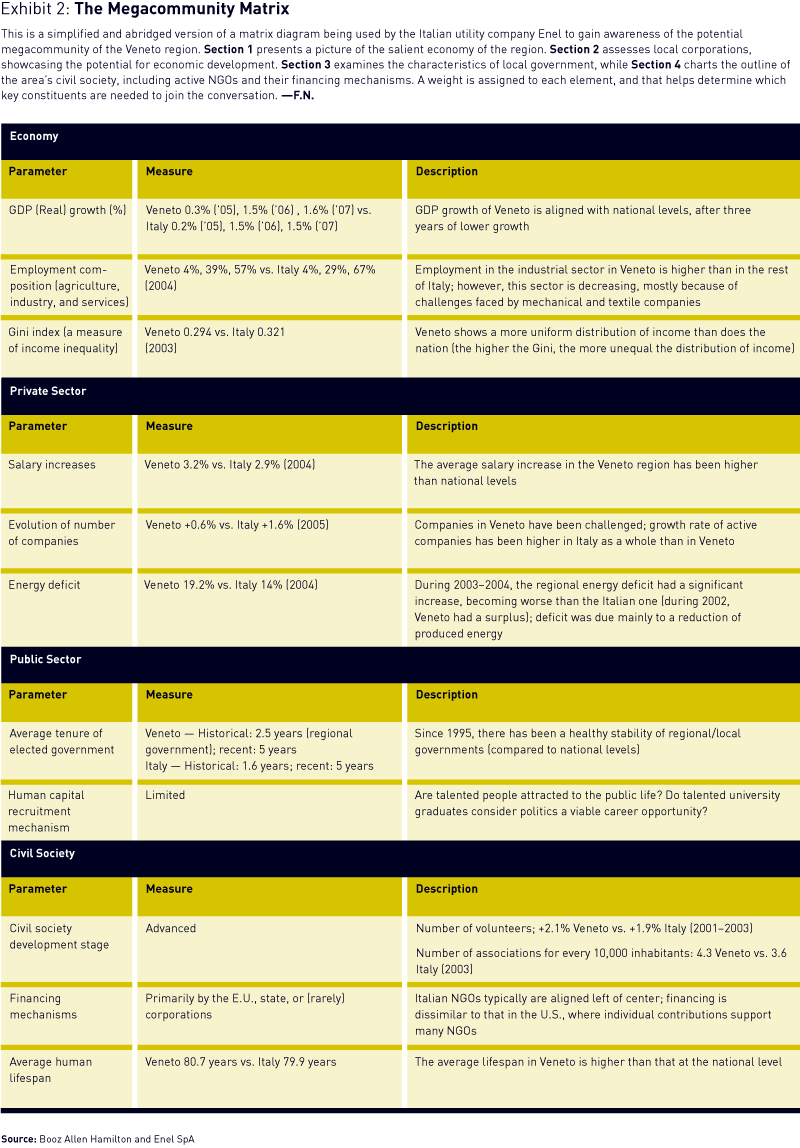
Some organizations, as they begin any new initiative with potential megacommunity implications, deploy specific methods to engage the relevant organizations and actors. For example, Enel, mindful of its Brindisi experience, is turning to the Veneto region, along the Po River, where it plans to overhaul current power-generating plants to burn green coal. Members of the power company’s strategic planning department, communications department, and a department responsible for institutional relationships are mapping the megacommunity with a matrix that shows the interrelationships of all key players, and that will help the company discover the region’s areas of potential instability and opportunity, and anticipate the impact of its possible actions in Veneto. (See Exhibit 2.)
In exploring and analyzing a potential megacommunity, more formal sources of knowledge are not necessarily best. “Many U.S. companies have come to Latin America to expand their businesses,” says Curt Struble, the U.S. ambassador to Peru. “They talk to a lawyer or to the formal authorities about the requirements, but they’re making a mistake. The local authorities are not representing the local people; they simply make decisions for them.” To develop reliable insight, he says, a leader must reach out to a wider cross-section of people.
2. Exert strong leadership and presence. The second element critical to effective megacommunity development is leadership. In business, government, and NGOs, it is important for a chief executive or minister to be outspoken and explicit. Each leader has a case to make to others; each leader will have to explain and support the megacommunity’s priorities to others within his or her organization. A corporate CEO, for example, must be able to convince boards and employees to take more responsibility for forms of accountability besides short-term profits. A government agency leader must be able to endorse measures that meet the needs of businesses and civil society. And leaders of all three sectors must be able, as Mr. Switz of ADC puts it, “to stay the course and make a long-, long-, long-term unwavering commitment.”
Leaders in a megacommunity function most effectively in a listening, learning, understanding mode. They must be prepared to view other sectors as potential resources and partners, instead of adversaries, and understand the growing permeability of boundaries between sectors. Says Minister Yeo of Singapore, “The most important first step is understanding the nature of the participants. Each person is complex. Each has a deep nature which you cannot completely change.”
3. Design and customize cross-sector engagement. John Ruggie, the director of the Center for Business and Government at Harvard University’s Kennedy School of Government, says: “Life in a world of sustainable globalization is a permanent negotiation.” The design of conversations depends on the culture and predisposition of each megacommunity. Specific events might include full-scale forums where all the participants come together for a day or two, wargame simulations in which people play out the ramifications of difficult decisions, or cascading dialogues in which small groups take on pieces of the puzzle. Agendas need to be both specific in content (with every meeting having an articulated theme) and relatively unstructured in scope, with plenty of informal time in which people can speak openly. Meetings can’t be conducted with the standard “packed-in” conference format of presentations and panel discussions, because the primary purpose of the meetings is to build relationships and help participants develop the ability to work together. That ability will atrophy if people only hear each other’s formal speeches.
Such conversations may seem unfamiliar at first, and many business and government leaders employ specialists to conduct and manage them. There are, after all, many barriers to success. Cultural and language differences exist not just across geographic distance, but among the public, private, and civil spheres. A word like profit can connote “resources for investment” to businesspeople and “exploitation” to a government minister or long-standing NGO executive. A word like bureaucracy can be a positive, negative, or value-neutral term. An enterprise that is “global” to one leader may be “planetary” to another and “multinational” to a third.
Participants gradually bridge such boundaries by learning, as dialogue expert William Isaacs has suggested, to “suspend” their assumptions — not to mask them, but to voice them dispassionately and allow them to be visible to all, as if suspended on a platform in the middle of the room. Conversations should be conducted among all levels of participating organizations, starting with the top leaders but including middle-rank managers and employees, who should be given the time to work on collaborative projects with their counterparts from other groups.
4. Launch experiments, learn from them, and collectively monitor progress. The final capability critical to megacommunity development concerns results. The initiators of a megacommunity need to develop their own model of effective action. Inevitably, they get involved in mutual projects. In other contexts, cross-sector collaboration is often plagued by a lowering of standards; participants bring less rigor to the process (including defining objectives, monitoring results, and managing the work) than they would in an internal project. But in an effective megacommunity endeavor, there is explicit agreement up front on what participants hope to accomplish, what they expect to see, and how they will judge success. A leader should ask his or her fellow leaders: If we do the right thing, what kinds of indicators might we expect to see? Will we see improvements in water quality? In revenues? In levels of community engagement? It is also very helpful, after an action, for participants to reflect together on the results and how they might have done better, and on the complementary ways that they can build one another’s skill bases.
Enduring Leadership
A megacommunity is a living entity. It is continually challenged to absorb new players; the current high turnover rate for heads of corporations and NGOs means that new leaders are always entering the system. There are also changes in government to assimilate and, perhaps most profoundly, changes in issues and goals. For example, once the requisite green coal plants are built in Veneto, will that be enough? Or will the leaders who came together for that project then use the relationships they built to turn their attention to other forms of economic and environmental development? Inevitably, the leaders of a megacommunity find ways to respond to change, rapidly and elegantly shifting their maps of the system to keep it up-to-date.
Participation in megacommunities will pose different challenges for each of the three sectors. Business leaders will have to align the imperatives of the outside world with their immediate agendas (such as profitability and shareholder returns). Successful corporate leaders will learn to explain to shareholders and stock analysts the ways in which a commitment to a megacommunity — for example, helping to build managerial capabilities among the schools and NGOs with which they work — is essential for realizing the company’s financial priorities. Farsighted companies learned long ago to develop better capacity for management along their supply chain; now they will be called to do the same with their megacommunity partners.
Businesses in sectors that have a great effect on the community at large — sectors such as energy, transportation, and media — may find themselves asked to join in conceiving and creating the infrastructure of the future. This is a rare opportunity for companies to not just comply with the public interest, but lead it. However, such an undertaking will also require a “listening and learning” orientation, and a kind of humility that is very different from the high-flying business ethic we saw in the last decade. “The end of the Internet era swept away the stereotype of the aggressive business leader who owned a sailing boat, who was very clever in buying and selling,” says Elio Catania, CEO and chairman of Italian railway company Ferrovie dello Stato. “That era has been replaced by a strong and urgent need for a different set of unchangeable values.”
Politicians and public-sector leaders, who in the past considered themselves uniquely positioned to act, must learn to acknowledge the fact that even if they have all the answers to a problem, they cannot fully control the solution. Government service, although still a magnet for ambitious people, no longer automatically attracts the most capable college graduates. In many countries, the best and brightest, attracted by larger salaries or greater independence, are turning to careers in the private sector or civil society. It has become fashionable in many circles to argue against government, but government still retains the role of mediating between the mercantile fallout of globalization (the fluctuations of prices and currencies) and the population’s need for stability and security. It is thus in everyone’s best interest, including the best interest of business and civil society, to have an effective, capable, and enlightened public sector. Fortunately, a new generation of political leaders is maturing, knowledgeable about globalization and ready for new solutions. In this type of cross-sector work, they will find their voice.
Many leaders of NGOs have spent years trying to be heard. But now they have unprecedented voice and influence. It is NGOs that often set the terms of public debate in both government and business spheres. For example, concerns about land mine safety, child and sweatshop labor, and government misappropriation of private land went largely unheard until NGOs took up those causes.
But NGOs still have constrained financial resources, limited staff, and little or no direct control over regulation and markets. They can gain influence only through engagement with the other two sectors. Unfortunately, many NGO leaders have unconsciously grown accustomed to thinking of their colleagues in the public and private sectors as beholden to special interests. This has limited the degree of openness and collaboration that NGOs have permitted themselves in the past. Now leaders of civil society are being called to become more relevant — indeed indispensable — to business and government, while maintaining their own integrity and recognizing the kinds of integrity that exist in the other two sectors.
As part of a megacommunity, all three sectors are in an excellent position to have a real and lasting effect on large and complex problems. It may seem that, joined together, the three sectors would make any situation more complex. But in fact, when designed and managed correctly, a megacommunity reduces complexity — as it has in Harlem, Veneto, and elsewhere. More and more leaders now seem to be aware of this. When megacommunities fail to form, it’s not from lack of desire, but from lack of capability. Will leaders be able to take up the megacommunity challenge and produce the results that the world needs? Experience suggests that they can; and we believe they will.
|
Convening a Megacommunity: The HIV/AIDS India Wargame |
|
More than 200 professionals met in New Delhi, India, on October 11, 2003, with a common goal: to establish a coordinated approach for combating HIV/AIDS in India. All sectors were present. Attendees included those representing leading multinationals such as PepsiCo (the global soft drink and food company), Lafarge (the building materials manufacturer), and the Tata Group (the giant India-based conglomerate). Civil society leaders included the chief executives of major global donor organizations; the director of the HIV, TB, and reproductive health programs from the Gates Foundation; and the heads of local NGOs, groups that worked with people in the cities, towns, and villages of India. From the Indian government came health department and executive officials, as well as senior military officers; the United States government sent senior leaders from the Department of Health and Human Services and the U.S. Agency for International Development (USAID). Leaders from the World Bank, several United Nations agencies, and the World Health Organization also made the trip. People living with HIV/AIDS were represented by the community workers who manage the disease every day. The event was organized and sponsored by three private-sector organizations: the Global Business Coalition on HIV/AIDS (GBC), Booz Allen Hamilton, and the Confederation of Indian Industry. The participants held no common view of how to stop the spread of the disease. But they all knew that, left unchecked, HIV/AIDS could undermine the future of the Indian economy, India’s people, and even the world’s economy. The prevalence of HIV/AIDS in India currently stands at 0.4 percent, a “mere” 4 million people. But what if the number of HIV/AIDS cases in India began to approximate that of Africa’s sub-Saharan countries, which have experienced more than 20 percent incidence rates? With just a 4 percent prevalence rate, India could face the possibility of caring for more than 40 million people with AIDS — more than the number who have died of HIV/AIDS-related causes in the entire world to date. Though no one was using the word megacommunity at the time of the New Delhi gathering, the concept was emerging: To successfully stop the spread of HIV/AIDS in India, fragmented solutions would not be sufficient. Many diverse people had a stake in the outcome — for example, a rise in AIDS levels could seriously threaten the skilled work force of this rapidly industrializing nation — but none could succeed unilaterally. With the limited time available, some kind of catalyst for a better mutual approach was needed. We conducted a wargame: a strategic simulation to engage participants at a deeper level than could have been achieved in a traditional conference or workshop. The basic scenario was established at the start: HIV/AIDS was beginning to spread dramatically on the subcontinent. Each individual was assigned to a team representing a major stakeholder — community, government official, businessperson, donor, activist, news reporter. A core of each team was made up of experts from that stakeholder group, but most participants were asked to represent stakeholders whose role differed from their real-life roles. The simulation was supported by a computer-designed model that kept track of events and tallied up the consequences of each new “round” of play. The event lasted two days and started with a great deal of tension. Many participants knew how to do their own “job” and had opinions about how the others should do theirs. No one was ready to let go of the rules, to find the simplicity on the other side of the complexity of this problem. That would have taken open and authentic collaboration across the game’s simulated boundaries. Instead, the simulated crisis kept getting worse. No one had answers. People complained, pointed fingers at each other, and explained why things could not be done. Then a small change took place. One team sent a note to another asking for help. “Would the members of the federal government team be willing to flow the majority of funds to state regions where they are needed?” Another team followed suit: “Could we use corporate facilities to help others in the surrounding region?” And another: “Treatment options need to be linked with counseling, but the drugs are too expensive…could we develop lower-cost solutions together?” A group of NGOs created a new pool of jointly funded programs to leverage their money and other resources more effectively. The most important outcome of the simulation was the conversations it started. By walking in one another’s shoes, participants could overcome taboos and develop a new type of win–win mind-set. In the end, the 200-plus professionals generated ideas for 54 partnerships focused on more than 100 programs. Based on the simulation’s metrics, we estimated that similar real-world measures could ultimately prevent 40 million cases of the disease over the next 20 years, with a combined estimated impact of more than $31 billion in regained GDP. And in the weeks following the gathering, some startling results emerged: Tata expanded its workplace and community activities to encourage effective HIV/AIDS prevention through mass awareness and education. The Lafarge Group and six other global companies (Anglo-American, Chevron Texaco, DaimlerChrysler, Eskom, Heineken, and Tata Steel) announced that they would use their facilities, employees, and other infrastructure to expand workplace HIV/AIDS prevention and treatment programs into communities where they operate. In early 2004, an Indian pharmaceuticals company announced an HIV/AIDS drug attainable for less than $1. The organizations are still talking and working together; they have formed a megacommunity whose enterprise against the spread of HIV/AIDS in India continues to this day. (See also “Avian Flu: A Test of Collective Integrity,” by Susan Penfield and John Larkin, s+b, Summer 2006.) Chris Kelly (kelly_chris@bah.com) is a vice president with Booz Allen Hamilton in McLean, Va., focusing on policy and strategy for global security. |
Reprint No. 06208
Mark Gerencser (gerencser_mark@bah.com) is managing director, global government markets, with Booz Allen Hamilton. Based in McLean, Va., he serves government clients worldwide. He previously led the firm’s business in information assurance and enterprise resilience.
Fernando Napolitano (napolitano_fernando@bah.com) is a vice president with Booz Allen Hamilton based in Rome and managing director of the firm’s Italian office. He specializes in organizational and change leadership, and has worked extensively in telecommunications, media, and aerospace. He is a board member of Enel SpA.
Reginald Van Lee (van_lee_reggie@bah.com) is a senior vice president with Booz Allen Hamilton in New York. He co-leads the firm’s engagements focused on the not-for-profit sector and has worked extensively with private- and public-sector clients on enterprise resilience, strategic transformation, and high-performance organizational design.
Also contributing to this article was Booz Allen Hamilton Vice President Chris Kelly.
