

Lights! Water! Motion!
The world’s urban infrastructure needs a $40 trillion makeover. Here’s how to reinvigorate our electricity, water, and transportation systems by integrating finance, governance, technology, and design.
The drought of 2006 in London, the worst in a century, will be remembered for the dirty little secret it exposed. Hundreds of thousands of liters of water — enough to fill 10 million bathtubs — were leaking every day from the city’s old and rotted pipes, some of which dated back to the Victorian era.
Around the same time, 3,000 miles away, a blackout in the New York City borough of Queens left nearly 100,000 people without electricity for nine days. Local officials were at a loss to explain the failure. Customers later learned that this borough, with more than 2 million residents and 15 percent population growth since 2000, gets its electricity through utility feeder cables that are 30 to 60 years old. These narrow and corroding conductors were not only unable to keep up with rising demand; they had also made it difficult for engineers to diagnose the breakdown.
 |
|
Photograph © Reuters/Corbis |
|
The Manhattan skyline during the largest electric power outage in North American history, August 14, 2003. Fifty million people lost power, 4 million people lost water, and many railroads and airports were shut down. |
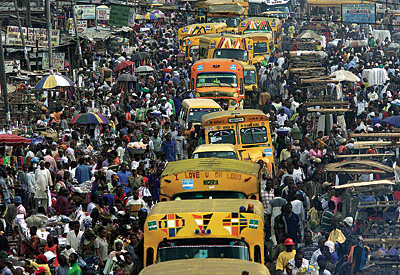
Across the world in Lagos, Nigeria, people were coping with a messy but familiar problem. It could take hours to travel even a couple of miles by car in this metropolitan area of more than 10 million people. The traffic authorities routinely ordered psychiatric tests for those drivers accused of jumping curbs, driving on the wrong side of the street, or starting fistfights — a form of lawbreaking brought about by what is known even officially as “insane gridlock.”
Cairo, Los Angeles, Beijing, Paris, Moscow, Mumbai, Tokyo, Washington, Sao Paulo: Each major city has its own story of electricity, transportation, or water systems in crisis. Although the circumstances vary from one urban area to the next, they all have one thing in common: The critical infrastructure that is taken for granted by both their citizens and their government leaders is technologically outdated, woefully inadequate, increasingly fragile, or all of the above. In some cities, the quality of water, power, and transportation infrastructure is noticeably declining. In others, it was never very good to begin with. And few cities have enough of it to meet future needs.
An estimate developed by Booz Allen Hamilton suggests the magnitude of the problem. Over the next 25 years, modernizing and expanding the water, electricity, and transportation systems of the cities of the world will require approximately $40 trillion (see Exhibit 1) — a figure roughly equivalent to the 2006 market capitalization of all shares held in all stock markets in the world.
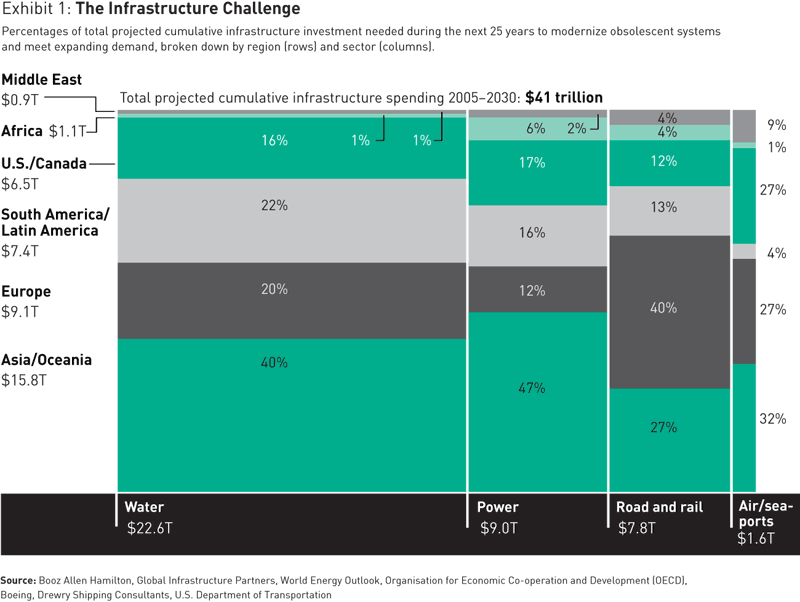
The challenge is exacerbated because we do not start with a blank sheet of paper. Cities have histories, cultures, dense populations, property rights, and deeply embedded political interrelationships that all demand respect. Past efforts to improve urban infrastructure have often led to disappointments. Not all projects have been equally deserving, not all forms of financing are equally advantageous, only some decision makers are sufficiently frugal and trustworthy, and wise judgment is not always applied in making and executing choices. Moreover, expertise cannot be applied the same way around the world: Getting an infrastructure project approved requires an entirely different political process for the multiple competing authorities of metropolitan New York than for the hierarchical government of a Chinese city like Beijing.
But the cost of not meeting the challenge could be even greater than $40 trillion. The global economy is rooted in an urban lifestyle, which evolved with basic assumptions that millions of people take for granted. They can commute from work to home, and have access to light, heat, and water at the flick of a switch or a tap. Anyone who has lived without that access — for example, in Abidjan during its frequent blackouts, in Mumbai, where water supply is restricted to a few hours per day, or in New York in the days after the 9/11 attack when transportation came to a halt — knows how difficult it is to function without it. Moreover, the prime enabler of global trade is the increasingly complex just-in-time supply chain logistics system, which depends, in turn, on reliable power, mobility, and water. A city’s ability to respond effectively to a crisis, such as pandemic disease or a terrorist attack, also depends on robust infrastructure: not just standard access to water, power, and mobility, but the extra capacity and backup needed for life under duress. In short, although the threats of global climate change and terrorist attack have occupied much of the industrialized world’s collective attention, inadequate and fragile urban infrastructure could well do more harm to a larger number of people.
 |
|
Photograph © Getty Images |
|
During the summer of 2006, one of the driest in England in 70 years, burst pipes like this one (photographed May 16) spewed water onto London streets. |
The solution is not simply more money or technological wizardry. At heart, we face a challenge of imagination. Solving the problem will require letting go of obsolete approaches to financing, governance, and management — approaches that no longer work in our politically, technologically, and administratively complex society. We will need new incentives for planners and builders and new ways of designing decision rights exercised among dozens of related players from the public and private sectors. We will also need to recognize a controversial truth: Transportation, energy, and water infrastructures are so interdependent that they cannot be effectively addressed separately from one another.
Sooner or later, the money needed to modernize and expand the world’s urban infrastructure will have to be spent. The demand and need are too great to ignore. The solutions may be applied in a reactive, ad hoc, and ineffective fashion, as they often have been in the past, and in that case the price tag will probably be higher than $40 trillion. After all, infrastructure projects are notorious for cost overruns. But perhaps the money can be spent proactively and innovatively, with a pragmatic hand, a responsive ear, and a visionary eye. The potential payoff is not simply the survival of urban populations, but the next generation of great cities.
Infrastructure Fatigue
This article, of course, is hardly the first to identify the urgency of the infrastructure problem, or to hypothesize a solution. But several trends combine to make the need to address the crisis more urgent than many people may realize.
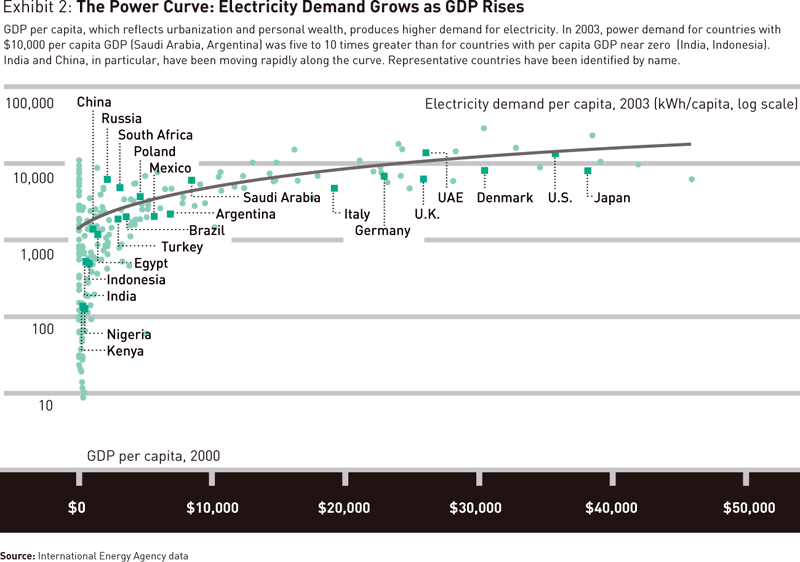
First, the demand for essential infrastructure is exploding. The world’s population is projected to increase by one-third, to exceed 8 billion by 2050, with — for the first time in human history — more than 50 percent of humanity living in metropolitan areas. The requirements for water, power, and mobility will rise accordingly, even as population density makes it more difficult to build and protect the robust infrastructure needed to satisfy that demand. (See Exhibit 2.)
In addition, a new wave of global workforce mobility has added to demand. As companies hire people from around the world, both employees and employers are less constrained by national or regional interests. Urban areas increasingly compete for the best, brightest, most hardworking, and most entrepreneurial residents. In a study of U.S. urban competitiveness, economist Joseph Cortright wrote: “Young adults, particularly college-educated 25- to 34-year-olds…will play an especially important role in determining which places grow.” Some U.S. cities attract young talent (Atlanta; Charlotte, N.C.; Portland, Ore.), while others (Philadelphia, Providence, Dallas) struggle to catch up. Access to global capital and technology has similarly reinforced the cultural magnetism of cities such as Bangalore, Barcelona, Curitiba, Dubai, Dublin, Milan, Perth, Prague, Shanghai, Sofia, and Toronto. Abundant and reliable power, water, and transportation are critical enablers of the higher quality of life — economic, social, and cultural — that makes these cities attractive and stems the so-called brain drain.
The typical life cycle of urban development also reinforces demand for infrastructure. As more people live and work in metropolitan areas, they need and expect more affordable housing. The default result, barring a coordinated effort to align mass transit systems and transit-oriented development, is a sprawling metropolitan area encompassing miles of suburbs — and in less-developed countries, shantytowns. In such low-population-density environments, roads and highways become the only transportation mode that works. This, as we have seen time and again, becomes a recipe for gridlock. Water and electricity grids must also serve more people over greater distances than in the past.
The acceleration of demand is already evident in the developing world. In 2002, the three geographic locales with the fastest-growing rate of electricity use, between 4 and 5 percent per year, were China, India, and Latin America (including Mexico and the Caribbean). Together, they consumed about 4,500 terawatt-hours (TWh) of electricity; the United States and Canada, with about one-tenth the population, used about the same amount. But by 2020, according to International Energy Agency projections, the combined electricity consumption of these three areas is expected to reach more than 12,000 TWh — double or triple the expected demand of North America, which itself is growing at 2 percent annually.
Meanwhile, the quality and quantity of supply are increasingly threatened everywhere:
-
Power. After the “energy crisis” of the 1970s led to a worldwide power generation boom, there were such gluts of electricity capacity that spending on utilities — new construction as well as maintenance — slowed measurably. The cycle has shifted back to scarcity, and cities everywhere now face shortages again. For example, even if the many European power plants built in the 1950s had been well maintained, there would still not be enough of them to meet the growing commercial electricity demand on that continent, especially in the awakening economies of Eastern Europe. The International Energy Agency’s last comprehensive study of world energy (“World Energy Outlook,” 2004) estimated that almost $4 trillion in power-sector infrastructure improvements will be needed in the OECD countries over the next 30 years: half for power generation and half for transmission and distribution. In the U.S., the North American Electric Reliability Council found that demand for electricity is increasing three times as fast as resources are being added.
-
Transportation. Although many roads, rail lines, and airports have been built or upgraded, need is growing at a faster pace. The U.S. Department of Transportation estimated in 2006 that freight bottlenecks and delayed deliveries due to congested highways and inefficient rail and deep-water transportation systems cost the U.S. $200 billion annually. According to the Texas Transportation Institute, rush-hour travelers in major metropolitan areas spent 3.6 billion hours in traffic jams in 2000. One measure of air travel congestion, the number of planes operated by private carriers, is up more than 30 percent since 1990, even as the number of airports serving commercial airlines has shrunk. To be sure, some of the demand for increased mobility is, as Danish planning professor Bent Flyvbjerg puts it, a desire for “utopian frictionlessness”: the impossible dream of being able to get anywhere, from anywhere, instantly. But if the population and mobility trends of the last 30 years continue for the next 30 years, the United States and Europe would have to at least triple their transportation infrastructure just to get back to the congestion levels of 30 years ago.
-
Water. Cairo provides a prime example of how a poor water infrastructure constrains the new urban centers and megacities of emerging markets. Dependent on old pipes and conduits that snake to the Nile River, Cairo residents regularly endure low water pressure and high levels of lead contamination. Because water and sewage lines run side by side, endemically corroded pipes often lead to leaks that pollute freshwater with wastewater. As a result, cholera and other waterborne diseases are a constant hazard for this relatively cosmopolitan Middle Eastern city, preventing it from assuming a more prominent role in the global economy.
Developed nations are no less vulnerable to water crises. In some of the largest U.S. cities, water mains and feeder pipes date back to the 1860s; it is not unusual for a metropolitan area to have as many as 1,000 water main breaks a year. In Detroit, where 35 billion gallons of water leak from the water supply each year, residents pay about $23 million annually for water that never reaches their homes or businesses.
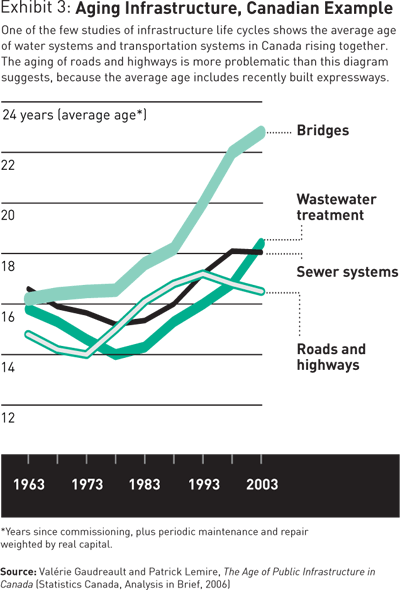
These problems would be challenging enough if they were happening separately. But they may all be hitting a crisis point simultaneously. Cycles of infrastructure fatigue seem to be timed in many metropolitan areas so that major replacement efforts will have to occur within a few years of each other — and decay in one technological arena (energy, transport, or water) may well exacerbate decay in others. (See Exhibit 3.)
At the same time, voters and taxpayers are increasingly resistant to funding massive new infrastructure projects. This can be traced partly to limited budgets, but it also reflects the poor reputation that many infrastructure projects and “megaprojects” have earned. For example, Ireland spent billions of dollars on highways between the mid-1970s and the mid-1990s, but the government favored two-lane roads where cars cannot easily pass one another. The result was a nation beleaguered by slow-moving traffic. (Ultimately, the authorities changed their approach, building high-density roadways connecting Belfast, Dublin, and Cork, and the problem eased somewhat.) If Ireland underestimated capacity, many projects do the opposite: The Channel Tunnel rail line, linking London and Paris, experienced cost overruns of 200 percent, and passenger and freight volume, after seven years of operation, was less than half the original estimates. Other negative associations also linger in the public mind. Neighborhoods demolished by freeways and highways gave rise to the antidevelopment movement made famous by writer–activist Jane Jacobs; Swedes disproportionately use the Øresund rail tunnel to take advantage of Denmark’s more liberal liquor laws; and the cost overruns and production problems of Boston’s “Big Dig” Central Artery/Tunnel project were linked, fairly or not, with the fall of a poorly anchored ceiling panel that killed a motorist in 2006.
Furthermore, citizens seem unwilling to make many concessions to improve the quality of their infrastructure. Urbanites regularly say they want to live in a place with high quality of life, but they resist the easiest means by which governments can pay for it: increased highway tolls, abandonment of water and heating fuel subsidies, and energy taxes. Because the political will to provide more than minimal services at the lowest possible cost doesn’t exist in many places, delivering infrastructure services on a sustainable cost-recovery basis is beyond the financial ability of most urban authorities. This is particularly true for nascent democracies, whose leaders are just learning how to lead in societies where their control is diluted.
Many governments have responded to these pressures during the last few decades by muddling through. They fix problems in a piecemeal fashion, “satisficing” the population, giving residents just enough improvement so that they don’t boil over in anger or move away. Highways expand from three lanes to four, but only in areas where the cost is low, which may not solve the worst gridlock problems. Or, as California did after its 2002 energy crisis, governments line up new electricity suppliers sufficient to meet current demand, but fail to plan for increased demand in the future. Some localities cope by refurbishing archaic technologies, without either the up-front investment or the eventual savings that a complete redesign would provide. Such incremental solutions not only fail to address the need for infrastructure, but exacerbate it in the long run, by drawing more people into the region without satisfying the need for better service.
Interdependence and Imagination
What, then, would a comprehensive solution look like? It would start with recognition of the interdependence of the many players involved. Water, energy, and transportation, for example, are typically administered by different regulatory bodies and innovated by separate companies. Yet they are closely related. Wherever roads and rails are built, water and power quickly follow. Electricity plays a central role in the control instrumentation that manages transportation and water systems; power plants depend on water for operations and transportation for fuel. Desalination of seawater, currently so complex and expensive that only wealthy, arid nations like Saudi Arabia use it routinely, can become much more cost-effective with expanded power capacity (along with new membrane osmosis technologies). Up-front costs have slowed the adoption of “smart grid” approaches (use of computer controls of the electric grid to balance peak loads, mitigate crises, and integrate multiple power sources) and “vehicle infrastructure integration” (use of wireless technology, sensors, and signals to coordinate traffic and thus improve highway safety and expand capacity). All of these approaches could benefit from being planned in tandem. But even when they take advantage of common resources, such as sharing rights-of-way, they are typically planned separately. That should change.
The roles played by the public and private sectors also need rethinking. Since the early 1990s, politicians and economists have engaged in a heated debate over a false dichotomy: Which form of authority is better at developing infrastructure, government or business? We now know that success or failure has little to do with this essentially meaningless question. Many well-known and conceptually credible projects have gone awry under public management; the Channel Tunnel and the Boston “Big Dig” are just two examples. But projects also falter under private management, particularly when there is a de facto monopoly in place. A series of German high-speed interurban rail projects undertaken in the 1990s by Deutsche Bahn AG led to that company’s near-bankruptcy; the privatized toll-booth plan for the Capital Beltway in Virginia went over budget by $100 million; and many independent power projects (IPPs) of the early 2000s, particularly those intended to generate electricity from natural gas, are now worth half of their original investments.
Experience suggests that the best projects are those that make best use of the public–private relationship. Unfortunately, government agencies and private contractors (such as engineering and construction firms) are typically not in a position to fully appreciate the dependence that each has on insights from the other or the potential advantages in working openly with each other. They lack the kinds of incentives, relationships, and information that would make it easier for them to plan and execute projects together.
But it doesn’t have to be that way. A more effective infrastructure approach starts with a series of questions. How can we create a public environment in which the private sector is naturally motivated to make the right longer-term investment decisions? How can the public overseers keep the project from becoming an inherent monopoly, without trapping the private-sector companies in a web of controls and obligations? How can the project as a whole set reasonable cost estimates and ultimately charge viable prices, when much of the population cannot afford the true cost of the energy, mobility, and water provided in even the most minimal “lifeline” service? And if the private sector does not perform to expectations, how can the investment of millions already spent be salvaged and transferred to newcomers?
Answers to these questions are emerging in each of the three basic stages of infrastructure management: design and approval, oversight and financing, and construction and operations.
 |
|
Photograph © Reuters/Corbis |
|
“Insane gridlock” on the commercial Oshodi road in Lagos, Nigeria, April 17, 2003 |
Light-Handed Government
Critics sometimes argue that there is “too much government” in design and approval. They typically mean that governments play a heavy-handed role in choosing and planning projects, often favoring those special interests that, through lobbying and other forms of influence, promote suboptimal projects and goals. But in fact, that is a symptom of too little government.
A genuinely effective planning process uses the government’s convening power to create a transparent, open discussion from the start, with sufficient opportunities to hear from stakeholders and anticipate possible problems before the design is finalized. This requires straightforward and complete statements of the plan’s objectives (unfortunately a real-world rarity), along with its costs and benefits, made clear to the public. It may also require a more coherent overlap between the geographic scale of a project and the coordination of authority. Consider the A86, the outer ring road around Paris; it meanders in parts because of the veto power held by local jurisdictions over its route. The road’s planning began in the 1970s, and because there was no single authority that could direct rights-of-way over private land, construction has taken more than 25 years. Contrast this to Beijing’s ring road system: four fast-flowing concentric highways, completed by a central authority in less than 10 years. In a democracy, cross-agency coordination plays a more critical role than many people realize; it will make or break many of the infrastructure projects that cities need to survive.
Government, in short, is best positioned to lead the initial planning stages, but deftly and selectively, with a firm but light-handed oversight role that emphasizes goals instead of means. One prerequisite is to build the capacity for local governments to act more effectively. Federal governments, rather than making decisions or providing financing, should limit their role to setting standards and drawing together expertise in a discriminating fashion. Local governments, which typically have direct jurisdiction over infrastructure projects, need to learn to set up inclusive, fair, and rational decision-making forums, open to the public and business sectors. The project process should be set up with deliberate incentives for the private sector, not just so companies can position themselves as contractors, but so they can offer their ideas and insights early in ways that can influence the entire planning process.
Sustainable Financing
The private sector should take the lead, meanwhile, in financing, pricing, and ownership. This in itself will represent a significant change in the way many infrastructure projects are developed, particularly in water and transportation. In general, the state makes a poor owner over the long term. Its financing is inefficient; the cost of capital is artificially low, which skews decision making; and the short time horizons of government bonds create few incentives to minimize costs, to seek innovation, or to prioritize.
The answer lies in deploying a new set of incentives that take advantage of the best aspects of government and business. Currently, the incentives found in most major infrastructure programs around the world nearly guarantee the approval of poorly conceived projects and cost overruns, because of the way they are designed:
-
The people most affected by a water, power, or transportation system don’t have the authority to approve its construction.
-
The people who approve it are not those who use it most.
-
The customers who use it most don’t pay most of the costs, and thus have little reason to use infrastructure resources wisely.
-
The people who pay the costs (taxpayers, those who underwrite the capital, and those displaced by its construction) don’t necessarily benefit from it.
-
Those who benefit most from maximizing its costs (developers, contractors, and particular businesses) often have too much of a voice in determining how it is organized and developed.
To overcome these problems, the most appropriate government role in financing is explicit without direct oversight management: setting up a transparent, nonpreferential financing process and then allowing capital markets to bear the risk and reap the financial reward. Allocating and syndicating risks is one of the things that the private sector does best (and most creatively). Capital markets are also hungry for this type of relatively low-risk, long-lived investment. With the establishment of basic and tested legal and financial instruments (such as securitization), infrastructure has taken off as an investment in recent years. It is particularly attractive to institutional investors because it is largely uncorrelated with other classes of financial assets available to them. And it can be profitable: Booz Allen estimates suggest that in 2006, five-year returns included 11 to 13 percent for airports, 10 to 13 percent for toll roads, 8 to 10 percent for rail passenger lines, and 10 to 14 percent for wastewater plants.
Using fees to reflect underlying costs is another critical component of a financially sustainable infrastructure sector. One way to accomplish this is through marginal pricing: charging more for “peak” service, such as rush-hour transportation or residential electricity use during early evening, when or where demand is high. Although this type of pricing is often criticized as making poor people pay more, it turns out to be the most effective way to create the kinds of feedback loops that improve cost performance and quality. And cities already have a great deal of experience using tax policies and targeted subsidies to overcome any regressive implications. Those who can’t afford to pay for electricity or water can be guaranteed a minimum amount to maintain a decent quality of life.
Marginal pricing also provides an incentive for suppliers of energy, transportation services, and water to provide higher overall value. And there is increasing evidence that the public will not just accept, but enthusiastically endorse, higher prices in exchange for greater quality. One prominent example is the “road pricing” highway fee system of Singapore and Hong Kong. London adopted the approach in 2002; since then, drivers who bring their automobiles into the inner-city traffic zone have been charged a daily fee (originally £5, later raised to £8). As a mechanism to control traffic, the program is a success. In the first six months of the plan, 60,000 fewer vehicles entered the zone than in the year before. Sixty percent of this reduction was the result of people shifting to public transport, 20 to 30 percent was attributable to drivers avoiding the zone altogether, and the remainder was attributed to car sharing (the British expression for carpooling). Travel times in and out of the zone were reduced by 15 percent.
This scheme has certainly generated some controversy; critics accuse it of merely displacing the gridlock to outer London. But according to a 2006 Royal Automobile Club report, 63 percent of motorists approve of the system, especially if the money is used to improve the roads and public transport. It has also led to stronger support for employer incentives to encourage bicycle commuting (with office showers and secure bicycle parking), telecommuting, car sharing, and other congestion-reducing schemes.

Another example is the willingness with which consumers pay for bottled water and in-home water filtration systems; they will pay a premium for what has historically been viewed as the most essential of infrastructure services, but in return they demand quality and a level of control.
Because marginal pricing reflects the real value of infrastructure services, it is essential for effective development, upgrading, maintenance, and conservation. Without it, private-sector decision makers cannot accurately forecast returns on investment; they will avoid infrastructure projects, believing that they will never truly generate returns adequate for the risks. To avoid some form of marginal pricing is, in effect, to subsidize the users of peak-demand services, which are always more expensive to provide. By contrast, “one-price-fits-all” approaches systematically encourage wastefulness and unsustainable development; consumers are not penalized when their use of water or electricity or their travel burdens the whole system, and thus they continue to waste the city’s resources.
Making Cities Magnetic
The final important area for change is in construction and operations. Governments are rarely equipped with the management skills needed to make projects work in an entrepreneurial, multifaceted global economy. Hampered by cumbersome procurement rules and local political constraints (the demand for local jobs, for example), they can’t leverage scale or speed in their supply chains to minimize costs. What’s more, the private sector can attract more innovators who could bring novel ideas to a major construction effort.
Therefore, the government’s role in construction and operations should be limited to oversight — not through enforcing rules and procedures, but through setting goals and incentives, establishing the criteria for success, and selecting the contractors in a structure that encourages both collaboration and competition within a project. This would allow the private sector to conceive and implement more novel, creative, and profitable infrastructure systems at lower costs. Ideally, excess revenue generated from innovation and efficiency would be retained by the private contractors, since they would also have taken on the lion’s share of the risks.
Some of the best-managed airports in the world are run this way. The government of the Netherlands, rather than choosing to manage Amsterdam’s Schiphol International Airport directly, formed a private corporation called the Schiphol Group. It operates the airport, leases the retail stores and office space, and runs associated logistics and data center businesses. In this case, it is owned by the State of the Netherlands, the City of Amsterdam, and the City of Rotterdam, but it could also be a publicly held company.
Where this kind of arrangement has worked, private contractors regularly provide comprehensive updates on the operations, detailing ongoing costs, maintenance needs, supply–demand balance, and the status of upcoming phases. The government, as well as nongovernmental organizations and local citizens, can easily and publicly respond to this information, pointing out the deficiencies in the company’s plans so they can be addressed before it is too late. The profession of asset-management specialists is emerging to help both public and private organizations navigate these new types of partnerships, bringing in awareness of best practices from around the world, and helping to define the incentives and procedures that will lead to better results.
One last change would also help: In conventional infrastructure initiatives, the same engineers who build the project often have a hand in approving it. That is a recipe for abuse, and it led, in the 1970s, to a backlash; one motto of the antidevelopment movement was “don’t trust the experts.” Both the abuse and the lingering backlash attitude from past abuses must be discarded. The relationship between the builder and the approver must be kept at arm’s length, but it need not be adversarial. There should be a thorough, up-front exercise in cost-benefit analysis, open to all onlookers, done in time to influence the decision. Incentives for meeting goals in quality, longevity, environmental impact, and employment should be clarified before companies bid for a project.
As people pour into cities, the abundance of power, water, and mobility will define their lives. Problems like this $40 trillion challenge are not solved overnight, and muddling through will probably work, as a substitute for strategy, for another five years. But the sooner we think about it comprehensively, the less expensive the solution will be.
In the end, some cities will organize their infrastructure more effectively than others. They will figure out how to balance public and private interests; how to put the right incentives in place for resilience and growth; and how to leverage the relationships between water, power, and transportation. They will become the cities of opportunity; they will be the cities, for example, where many readers of this magazine will choose to work and live. They will become centers of growth and innovation for the farsighted companies of the next 100 years. And they will become magnets for humanity, standing on the platform of quality infrastructure: a platform that goes generally unnoticed — except when it doesn’t work.
|
Beyond Vulnerability |
|
In March 2004, United Kingdom police raided the home of Omar Khyam, the 24-year-old ringleader of the so-called Operation Crevice terrorist plot. They found CD-ROMs with detailed plans of Britain’s electricity and gas systems. According to a New York Times report in November 2006, Khyam was recorded talking about a planned simultaneous attack on Britain’s gas, electricity, and water systems: “The electrics go off so it’s a blackout, and then the gas lot move in and bang. Then something goes wrong with the water.” Even in the absence of a planned attack, the world’s infrastructure for energy, water, and transportation is increasingly congested, fragile, and in need of costly modernization. Tens of millions of electricity consumers, for example, lost power for many hours in the eastern U.S. and Canada in August 2003 because a tree branch fell on power lines in Ohio. But terrorists are a great deal smarter than tree branches. Just as they figured out the vulnerabilities that could be exploited in our civil aviation infrastructure prior to September 11, 2001 (short knives permitted in hand luggage, flimsy cockpit doors), they can exploit the growing vulnerabilities of our energy infrastructure — as the defendants in the Operation Crevice case seemed to have intended for the U.K. That’s why it is so crucial to design and build the next wave of infrastructure with resilience in mind. At least the systems providing electricity and water are under the control of the societies that need them. Not so the infrastructure for oil, much of which is in the increasingly volatile Persian Gulf. In February 2006, Saudi guards fought off an attempted al Qaeda attack on Abqaiq, an oil production facility in northeastern Saudi Arabia through which roughly two-thirds of Saudi crude must pass. Had the attackers destroyed the sulfur clearing towers there, they could have taken 7 million barrels a day offline for well over a year and sent oil prices above $100 a barrel. Fortunately, three sets of technological developments may increase resilience around the world by making it possible to design new types of far less vulnerable infrastructure. First, genetically engineered enzymes and other biocatalysts, together with several new thermal and chemical processes, are now entering the market. They are making it possible to produce transportation fuels — ethanol, methanol, renewable diesel, biodiesel, and butanol — from inexpensive and widely available biomass feedstocks, including prairie grasses such as switchgrass, and even industrial, municipal, and animal wastes. As a result, transportation fuels will increasingly be produced in relatively small facilities, often located near farms, urban waste sites, or other sources of biomass. Such facilities may also function as small biorefineries, producing such compounds as polylactic acid (basic to many plastics) and propanediol (for textile fabric products). These developments have the potential to substantially reduce the world’s dependence on oil from the Middle East and other unstable regions. The economic implications of such a shift are profound. In 2007, the United States alone will borrow about $320 billion, nearly $1 billion a day, to import oil. Replacing only one-quarter of those imports with biorefinery feedstocks consisting of biomass and waste would transfer some $80 billion to the U.S. economy — an amount roughly equivalent to current total net farm income. The second technological development with profound implications is the continued development and decentralization of the electricity grid itself. Forty of our 50 states have net metering laws that enable individual electricity consumers to sell electric power that they generate back to utilities. But until recently, the cost of photovoltaic solar collectors, the inadequacy of modern wind turbines, and the limited capability of batteries for electricity storage have substantially restricted the practicality of small-scale electricity generation. Now the promise of thin-film solar collectors is beginning to be realized, making rooftop electricity generation considerably more efficient and affordable. Wind turbines suitable for individual building use are also beginning to come onto the market. Wind and solar collectors have an inherent complementarity; solar is most effective in the middle of the day, whereas wind tends to blow strongest during the morning and evening hours. New and far more powerful batteries will augment their capability and make feasible a new form of plug-in hybrid gasoline–electric vehicles. Dozens of prototypes of these vehicles exist; they demonstrate the flexibility of a hybrid (storing gasoline for long trips), with double the mileage of ordinary hybrids. Energy efficiency has also sharply increased in the design of items as varied as lightbulbs, appliances, and buildings. Before long, consumers may generate much of the electricity they use, even supplying a portion of their plug-in vehicles’ power needs — with transmission lines no longer than the distance from a rooftop collector device to an electrical outlet in the house or garage. The third factor is Moore’s Law: Computer chips’ power continues to grow even as their price continues to shrink. This longtime phenomenon is working its inexorable changes on today’s still-too-cumbersome communications infrastructure. New telecommunications systems such as wireless mesh, currently used mainly for emergency networks, are extremely resilient. They can permit voice over IP, videoconferencing, and other communication modes. Their use can greatly reduce business travel and commuting. A society that can fuel its vehicles from locally available biomass and waste, generate its essential electricity (including a share of its vehicles’ power needs) from its rooftops, and handle essential communications without vulnerable infrastructure will be much better equipped to face the challenges of the 21st century. R. James Woolsey (woolsey_jim@bah.com) is a vice president with Booz Allen Hamilton and former director of the United States Central Intelligence Agency. He has held U.S. presidential appointments in two Democratic and two Republican administrations. |
|
The Environment: Let’s Get It Right |
|
Today’s worldwide wave of urbanization is unprecedented in scale and scope. As our expanding “megacities” address the daunting challenge of renewing their infrastructure — their mobility, energy, and water systems — the impact on the quality of the natural environment (our forests, soil, air, and water) will be dramatic. This is not a new phenomenon. In his book Collapse: How Societies Choose to Fail or Succeed, naturalist Jared Diamond describes societies throughout history — including Roman, Anasazi, and Mayan civilizations, as well as those of Easter Island and Norse Greenland, and, more recently, communities in Rwanda, Haiti, and Montana — that have lost or are losing the ability to sustain their people. He concludes that human efforts to expand infrastructure can lead, often unintentionally, to ecological decline that in many cases catalyzes the whole society’s collapse. With the stakes so high, we must get it right this time. We should begin by better understanding the complex and powerful relationships among infrastructure, human behavior, and the environment. The power, water, and transportation systems in place today were mostly created without much regard for their impact on nature. Investment in the 19th and 20th centuries was primarily supply-oriented: Planners would predict population growth, assume that consumption patterns would remain unchanged, and provide energy, water, and transit accordingly. Few people imagined that these decisions could affect the atmosphere, the ocean, and the forest so deeply. Today, we know better. The quality of infrastructure and land-use planning “hard wires” the environmental impact of a given region. The more consciously we can build infrastructure that doesn’t harm, or that even helps restore, the natural environment, the more likely it is that those designs will endure. Cities, in particular, that design their infrastructure with a bias toward ecological awareness — for example, with minimal water leakage, energy-efficient buildings and appliances, well-designed mass transit, and expanded use of renewable energy and fuel-efficient vehicles — will be far more sustainable and resilient than most cities today. Conversely, cities that ignore environmental impact will find themselves facing another collapse of infrastructure 30 or 40 years from now, and our children and grandchildren will bear a much higher price tag. What would it mean to take environmental sustainability into account? Projects would include collaborative planning, decentralized funding, and demand-side management — promoting human habits, like more efficient use of energy or shorter commutes, that minimize environmental impact. We already have sufficient proof that “pollution prevention pays,” that reducing waste and conserving energy are cost-effective in the long run. But decision makers still often do not see sustainability as central to the infrastructure challenge and therefore rarely reap the benefits, even when the bottom-line implications are clear. That’s why enlightened planning and decision making may need to go beyond traditional return on investment measures. As the “$40 trillion challenge” concept suggests, many cities will make major infrastructure investments in the next 20 years. They will have no choice. Putting more time and thought into sustainability will ensure that their investment pays off in the short term, in attracting people and enterprises, and in the long term as well. Molly Finn (finn_molly@bah.com), a vice president with Booz Allen Hamilton based in McLean, Va., leads the firm’s environmental business. Gary Rahl (rahl_gary@bah.com), a vice president with Booz Allen Hamilton based in McLean, Va., leads sustainability initiatives in the public and private sectors. |
Reprint No. 07104
Author profiles:
Viren Doshi (doshi_viren@bah.com) is a vice president with Booz Allen Hamilton in London. An expert in leading strategy-based transformations, he works with companies in the energy sector across Europe and the Middle East.
Gary Schulman (schulman_gary@bah.com), a vice president with Booz Allen Hamilton in New York, is a leader in the firm’s global transportation business. He specializes in procurement strategy and mission integration for aviation infrastructure, highway, and mass transit clients.
Daniel Gabaldon (gabaldon_daniel@bah.com) is a principal with Booz Allen Hamilton. Based in McLean, Va., he focuses on providing strategic advice to leading participants in the global energy and infrastructure sectors.
Also contributing to this article were Booz Allen Hamilton Principals Michael Delurey and Jack Opiola, Associate Max Kattan, and Senior Consultant Kierstin Case.
