

Win-Win Sourcing
The most effective procurement model fosters knowledge sharing, not mistrust.
 |
|
Illustration by Dan Page |
This is one of many ways in which far-reaching manufacturers like Honda and Toyota rewrite the conventional rules of procurement. Their methods add up to a form of procurement based on shared information and insight: One could call it knowledge-based sourcing. With this approach, manufacturers and suppliers share a long-term commitment to improving each other’s capabilities, starting by working together to eliminate wasted effort and inefficiencies. The two sides, instead of being at odds, collaborate openly on lowering costs and raising overall performance, with the expectation that this mutuality will continue over many years, benefiting both companies. They use sophisticated costing tools and industry data, as well as discussions with other suppliers, equipment manufacturers, and competitors to produce realistic cost targets that change over time. They set prices that reflect the supplier’s true economics for each process, part, component, or system. These prices include a reasonable profit margin for the supplier as well as incentives for lowering costs, improving quality, expanding innovation, and making design changes in subsequent years.
Contrast this with the alternative ingrained in many companies’ purchasing departments: price-based sourcing. Essentially, this approach pits the interests of the supplier against those of the manufacturer. Each side reveals as little information as possible, for fear of giving the opposing side an edge. Components, parts, raw materials, and finished goods are purchased through competitive bidding, with specific volumes and deadlines spelled out in advance (hence those agonizing negotiations). The primary cost-cutting option available to manufacturers is to squeeze every possible cent out of procurement contracts. Purchasing managers focus exclusively on attaining cost savings greater than those of the previous year; their compensation hinges on it. Suppliers, in turn, focus on calculating bids that will win them the jobs.
Once they have made a successful bid, suppliers are stuck with its terms. They have no reason to speak openly about their true costs, because they believe their customers won’t pay a penny more. They have no incentive to improve their product, its design, or its manufacturing processes. They thus feel they have no recourse except to game the system by overstating their expenses or charging exorbitantly for design changes. Both sides lose, and mutual suspicion and resentment are rooted so deeply in the system that they’re almost impossible to overcome. This all-too-common story ends with rising costs, increased time-to-market, a loss of any shared innovation practice — and ultimately, supplier bankruptcies.
Indeed, many suppliers today are in serious trouble. With raw material prices rising, margins cut to the bone, and purchasing departments struggling to meet corporate expectations for cost reductions, suppliers feel pressure from all directions. In the motor vehicle industry, Delphi, Dana, Dura, Tower Automotive, and Collins & Aikman have all filed for bankruptcy. Even suppliers with a long record of success have been squeezed, with profit margins often falling below the cost of capital. These financial crises are causing, in turn, a huge cost to buyers. Expenses associated with bankruptcy can swamp any perceived savings.
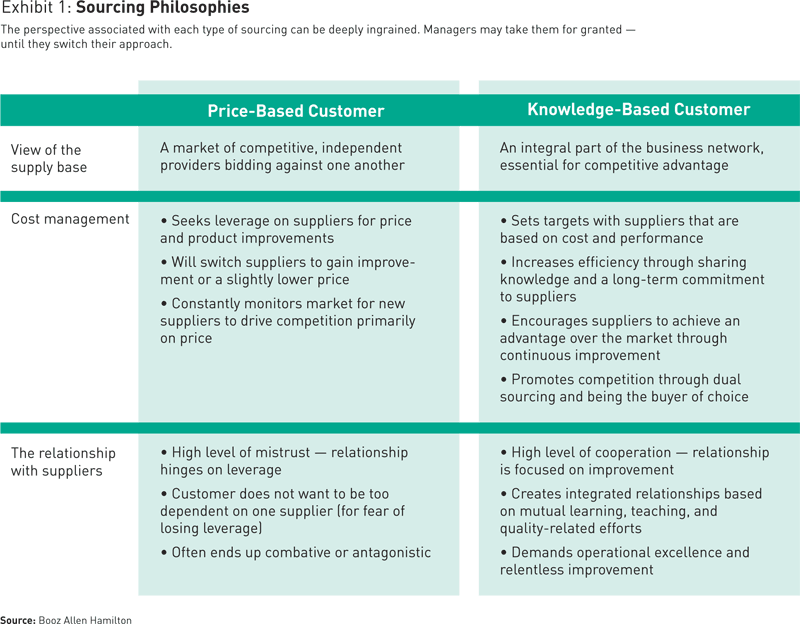
No wonder knowledge-based procurement models, and the management philosophy underlying them, are becoming more attractive to many manufacturers. (See Exhibit 1.) Although they are not perfect, the Toyota and Honda sourcing models consistently earn high marks from suppliers — and favorable terms. As one automobile manufacturing executive put it recently, “Honda cost estimators can tell suppliers their own costs within 1 percent accuracy.” That’s meaningful because suppliers are often unable to identify their own manufacturing expenses with anything near this degree of certainty, and thus often suffer overruns. Backed by accurate cost information, automakers and suppliers can jointly develop a performance improvement plan to reach their cost goals.
Manufacturers are equally rewarded. For companies that adopt the Toyota/Honda approach, the acquisition costs for parts such as pistons, exhaust manifolds, and cylinder heads are 35 to 55 percent lower than those from traditional procurement models. Several factors account for this: First, product and part designs can be delivered at lower costs. Second, productivity and quality improve as suppliers practice joint process coordination and improvement. Third, manufacturers’ purchasing departments can be quite small because they work with fewer, more strategically chosen suppliers. Fourth, warranty costs drop as much as three percentage points. Finally, fewer components need to be reengineered after launch. Both manufacturer and supplier thus avoid the added costs of changing product designs at the most expensive time, during production.
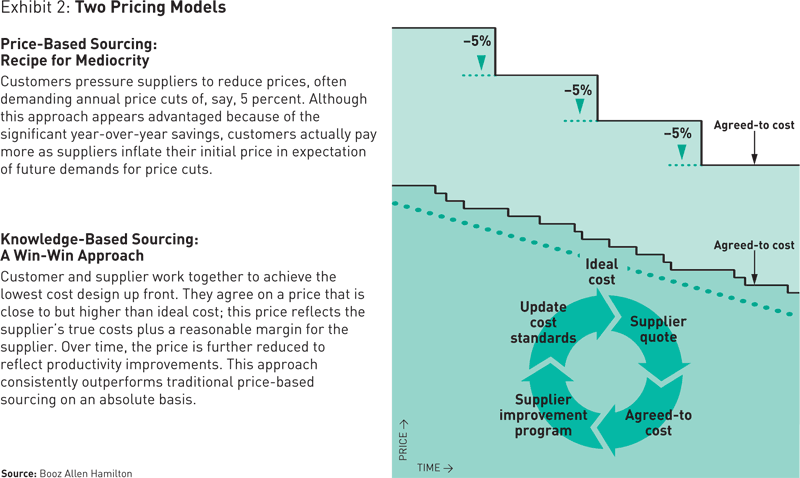
For all these reasons, in everyday practice, knowledge-based sourcing consistently outperforms the traditional bid-based model. This is true for companies in a variety of industries, and particularly for repeat purchases of anything that is not a true commodity. In most cases, even taking into account annual price cuts of approximately 5 percent, the quoted price under competitive bidding doesn’t approach the agreed-to cost under knowledge-based sourcing for the life of the contract. (See Exhibit 2.) More importantly, this form of win-win sourcing ensures that the improvements learned on one program or product will be transferred to the next. Meanwhile, the improvement plan continues to achieve new levels of success each year, until productivity gains draw the supplier ever nearer to ideal cost expectations, which reflect more closely the supply and demand realities.
Yet as advantageous — and profitably innovative — as knowledge-based sourcing can be, many companies, particularly Western ones, have had a hard time adopting it. Some executives find it difficult to accept the idea that knowledge-based purchasing savings of 3 percent per year could be more profitable than the 5 percent annual savings mandated under the price-based system. “Impossible,” one chief financial officer protested. But it’s not impossible. It merely requires a company to overcome its ingrained habits and internal obstacles. The path to knowledge-based sourcing includes reframing supplier relationships, building and sharing knowledge along the supply chain, and instituting new employee training in factory processes, product development, and industry operations so that employees can accurately gauge ideal costs and potential cost improvements.
Don’t Copy Toyota
For executives and procurement managers who want to adopt knowledge-based sourcing, but who have not grown up with Asian purchasing techniques, a framework can translate these techniques into more familiar Western-style rubrics. American and European businesses that adopt knowledge-based sourcing often need a new set of formal cost and performance metrics and new employee incentives. These standards replace old price-based sourcing metrics, which were most likely aimed at attaining those old-fashioned annual procurement cost savings. The new metrics are designed to help managers work closely with suppliers, in an atmosphere of mutual trust, to achieve the ideal cost for each item. They incorporate improved supplier measurement techniques, worker evaluation programs, and a system of salaries and bonuses geared to meeting performance goals — not to meeting narrowly defined purchase price or cost objectives.
Such metrics are not direct copies of the Toyota or Honda metrics. Indeed, the best knowledge-based sourcing practices are tailored to each company’s situation. For example, Toyota and Honda typically favor suppliers whose factories are in close proximity to the automakers’ plants; the automakers frequently acquire an ownership stake in the businesses. Although at times this leads to somewhat higher costs because suppliers are located in more developed and expensive regions, Toyota and Honda prefer this system because it minimizes product lead times, eliminates quality and disruption risks, affords them more control, and dovetails well with just-in-time, lean manufacturing philosophies.
But this approach overlooks the favorable economics found in low-labor-cost nations like China, India, Vietnam, and the Philippines, benefits that should be strongly considered — though not necessarily as the dominant factor — in a procurement program. Western companies can counterbalance the advantages that Japanese companies gain from proximity and ownership through carefully constructed strategic relationships with key suppliers elsewhere around the world.
Every company has internal strengths that can allow it to change models. But to fully make the transition to knowledge-based sourcing, four critical changes are required:
1. Establish suppliers as strategic long-term partners. Toyota invests directly in its suppliers — using a keiretsu model of interlocking ownerships — to manage its alliances. But that isn’t necessary. More important is an alignment of goals and cultures.
Indeed, one of Toyota’s preferred suppliers is not part of its keiretsu. Johnson Controls Inc., a U.S.-based company that makes automotive interior and battery products, has been cited by Toyota for perfectly matching the automaker’s standards of quality, on-time delivery, diversity, and performance excellence. By sharing operations, knowledge, and expertise, Toyota and Johnson Controls have developed a mutual learning and development pact buoyed by a steady rate of manufacturing improvement.
The same is true for most other Toyota suppliers. They often describe the automaker as both their best customer (providing predictable volumes and profitable margins) and their most demanding customer (requiring excellent performance levels, continuous improvement, and highest quality at lowest total cost).
For suppliers to become willing partners, they must be convinced that the new knowledge-based practices — setting cost, quality, and delivery targets and then more ambitious ideal cost and performance levels — will not be used against them. It must be clear that suppliers who meet the required standards and consistently improve performance will benefit from more consistent business, which in turn will allow them to operate more efficiently and enjoy higher profit margins in the future.
Long-term partnership does not mean exclusivity. At times, when these relationships are not producing the expected returns, manufacturers choose a second supply source as a backup. Chiefly, this creates competition that encourages the original supplier to meet its targets and protects the manufacturer from receiving parts that are lower quality, more expensive, or delayed. If a supplier is continually unable to raise its performance to agreed-upon levels, manufacturers transfer some volume to the secondary source, always in hopes of eventually improving the initial supplier’s operations sufficiently to take on more business again.
2. Set up an ongoing system to eliminate waste through collaboration across the supply chain. One facet of knowledge-based sourcing that many manufacturers readily embrace is the drive for transparency in costs. Suppliers are asked to reveal their ideal cost performance: the cost to produce components under perfect circumstances. In a true collaboration, this would then lead to a mutual effort between suppliers and manufacturers to improve production throughput, quality, and delivery, with the ideal cost performance demonstrating the potential savings that suppliers could achieve. In many current cases, however, the ideal cost performance becomes yet another target, a new form of leverage that manufacturers use to press suppliers to cut their margins. This defeats the entire knowledge-based effort; rather than providing incentives to collaborate, it gives suppliers every reason to obfuscate their true costs.
Instead, deliberately design the costing approach as a self-reinforcing learning process for both buyer and supplier. Establish up front that, for each component, the ideal performance levels in cost, quality, delivery, and innovation are expected to continually change. For each component, suppliers submit a cost breakdown — that is, what they believe it would cost at their current level of productivity to produce the item. Working with suppliers, manufacturers reset this price on the basis of industry data, productivity benchmarks, and a competitive analysis. Ultimately, this process is meant to produce an “agreed-to cost” that is acceptable to both the manufacturer and the supplier, providing competitive cost and performance for the manufacturer and profit margins and stable volume for the supplier.
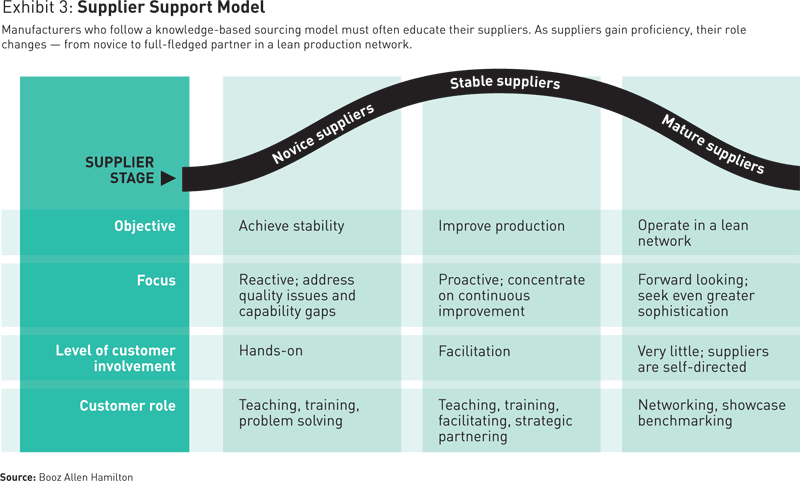
As they collaborate to achieve these continually changing performance goals, the manufacturer and supplier develop a manufacturing improvement plan together. This plan lowers the supplier’s cost further over time while improving the quality of the output and the performance of the factory. The extent of the manufacturer’s involvement depends on the supplier’s capabilities and process sophistication. (See Exhibit 3.) Although more hands-on assistance may be required to fix quality issues and build capabilities at some suppliers, the most mature suppliers are largely self-directed in their continuous improvement efforts. Even with the most sophisticated suppliers, a consistent focus on open communication and mutual assistance between both parties helps reduce waste along the supply chain.
One fascinating example of this virtuous learning circle occurred in the late 1990s, when Toyota asked the ExxonMobil Corporation to produce motor oil at 30 percent below its bid. At first, the oil giant was convinced this was impossible and told Toyota management so, adding a few choice words about what the automaker knew — or didn’t know — about motor oil. However, six months later, after exploring Toyota’s offer more closely, ExxonMobil had a change of heart. It turned out Toyota was right, and ExxonMobil agreed to the deal and used the knowledge gained from it to improve its cost structure for all its jobs. ExxonMobil likely would never have realized this performance reward without the benefit of Toyota’s sourcing model. It had helped that Toyota’s executives were willing to challenge established attitudes. Indeed, this kind of capability for constructive challenge will make more of a difference to a knowledge-based sourcing initiative than any number of borrowed best practices.
3. Get it right the first time. Because the price-based system favors cost reduction over quality, it often leads companies to launch products on deadline but with unresolved flaws — which must then be corrected in subsequent releases, recalls, and updates. Engineers often end up tinkering with aspects of the post-release product, sometimes for months, trying to justify the additional retooling costs by arguing that the changes will add product value. Some manufacturers even demand from suppliers the option of reengineering products after launch, billing the requirement as a cost-reduction measure.
But no matter how it’s justified, the net effect of the price-based system is to raise costs — for three reasons. First, it sanctions sloppy engineering; if suppliers know that redesigns are likely, they may feel less pressure to insist on flawless engineering the first time. Second, and more pragmatically, suppliers figure out the game very quickly; they build in features that will then be removed to give the appearance of saving costs. One designer at an automotive company said in a moment of candor, “I always overdesign the product so I can hit my cost reduction targets after launch.” Third, when overhead and marketing costs are factored in, engineers working on an already launched program create only a third of the value of those involved in a new effort.
With knowledge-based sourcing, a short time after product launch, the engineers are pulled from the project and redirected toward developing new products or new versions of existing products. The manufacturing function, meanwhile, can focus attention on in-plant productivity improvements, not on retooling for product redesigns. In other words, by creating a well-managed up-front phase, manufacturers gain a long-term, significant, and often unexpected benefit. Suppliers are equally enthusiastic. (See “Innovation Agility,” by Kevin Dehoff and John Loehr, s+b Summer 2007.) “U.S. automakers reinvent for each program,” comments one supplier. “They make eight to 10 design changes for each program, while Toyota makes maybe two. What’s more, [the Detroit manufacturers] continue to change up to the last minute but don’t want to pay for the changes.”
4. Respect and develop human capabilities. Underpinning knowledge-based sourcing is a significant degree of people development. Toyota and Honda, as well as many other Japanese companies, invest in instilling in their employees a profound sense of cooperation. They also build a deep and company-specific well of product and process knowledge, identifying and codifying their best practices and pursuing ideal performance levels with their supply base. Few Western companies can claim this type of educated workforce, and thus a major training effort is needed to improve overall procurement performance.
In companies that pursue knowledge-based sourcing successfully, we see the following skills present among a wide range of employees, from the shop floor to the purchasing department:
-
They can map the underlying processes, materials, and technologies that lead to or promote competitive performance.
-
They can produce cost models that accurately reflect supplier and industry economics.
-
They can identify world-class factory output.
-
They can help suppliers reach recognized top-of-the-line standards.
Shifting from a traditional manufacturing model to this new knowledge paradigm is culturally difficult. Managers at many companies change jobs often; this makes it virtually impossible to acquire the depth of experience and information needed to work closely with suppliers on continuous cost and performance improvement. Moreover, compensation is usually based on straightforward cost and revenue benchmarks, not on quality and performance improvements. That is why one of the first steps is to design creative incentives that reward employees for successful long-term supplier relationships and for improved communications between purchasing, engineering, and the executive suite. These incentives can alter old-fashioned perceptions quickly. Other forms of support include focused training — on topics such as supplier relationship management and development, cost modeling, and industry economics — and career tracks that allow people to grow and develop without shifting positions. Some companies have successfully developed and implemented a training and certification program for cost management that encompasses all of the purchasing and much of the engineering organization.
The Path to a New Model
The practice of knowledge-based sourcing is still evolving; a “next-generation” approach is emerging now as more companies in a variety of industries adopt Japanese techniques and incorporate them into their own corporate cultures. The most effective manufacturers will build up supply chain management teams with differentiated capabilities, balancing commercial, technological, and managerial skills. They will align their values, incentives, and key performance indicators to the relationship-based system, focusing on performance management and support instead of by-the-book cost reductions. They will build networks of suppliers who will work together more regularly and effectively across the value chain, ensuring compatibility among components and seamlessness among their processes. Finally, they will adopt more modular approaches in which components are distinctive when necessary, but standardized when distinction matters little to customers. In short, careful attention to sourcing quality and logic will finally be seen as the strategic capability it deserves to be, positioned with a top management mandate.
To be sure, a knowledge-based sourcing model is not appropriate for every situation. If a company is buying a part or component just once and is unlikely to require the supplier in the future, there is little need to spend resources on improving operational and systemic output. However, any company’s most important supplier agreements involve the most essential components. In those cases, manufacturing productivity improvements are critical in maintaining high quality, reliability, and a continuously advantageous cost base. Knowledge-based sourcing may not be easy, but by implementing the four steps outlined here, most companies will find themselves on the road to making the transition, relatively certain to reach the end. 
Reprint No. 07207
Author profiles:
Bill Jackson (jackson_bill@bah.com) is a senior vice president with Booz Allen Hamilton in Chicago. He works on major organizational change programs, including restructurings, postmerger integrations, and growth, for a variety of industrial clients, especially in the global automotive industry.
Michael Pfitzmann (pfitzmann_michael@bah.com) is a principal with Booz Allen in Chicago. He serves automotive and other industrial clients and specializes in sourcing, manufacturing strategy, competitive cost analysis, and operations management.
