A Blueprint for Strategic Leadership
How to build an organization in which executives will flourish.
 |
|
Illustration by Dan Page |
The challenge of leadership is not what it used to be. For the past few decades — at least since the genre-defining book Leadership by historian James MacGregor Burns was published in 1978 — writers on business and society have understood that the quality of a leader’s character makes all the difference. Burns, for example, wrote that civilization depended on its “transforming” leaders — those who didn’t just solve the problems handed to them, but who helped to raise society as a whole to higher levels of motivation and morality. Other business writers picked up the theme: Corporations, as Warren Bennis put it, also needed leaders who could not just “do things right” but also “do the right thing.”
But what sorts of leaders could be counted on to do the right thing? Creative, experimental risk takers, like Richard Branson? Charismatic, domineering battlers like Lee Iacocca? Ruthless pursuers of performance like Jack Welch? Dedicated “servant leaders” like Herman Miller’s Max De Pree? Quiet stoics like Darwin Smith, the CEO of Kimberly-Clark whom Jim Collins lauded in Good to Great? Or simply people whose “leadership secrets” have been collected, like Attila the Hun? Each style has had its advocates and acolytes over the years. But for all the sophistication of the experts, for all the books published on the subject, there is still no definitive consensus on the most effective style of leadership.
Indeed, the quality of individual leadership matters. In case after case, in organizations and in society at large, when the single individual at the top is replaced, everything else changes — either for the better or for the worse. But the effectiveness of leaders depends, more than is generally realized, on the context around them. Over time, the leader’s capability is shaped by the top team’s quality, and by the capabilities of the full organization. These can either provide invaluable support for the changes a leader wants to make or render those changes impossible. Hence the best leaders pay a great deal of attention to the design of the elements around them: They articulate a lucid sense of purpose, create effective leadership teams, prioritize and sequence their initiatives carefully, redesign organizational structures to make good execution easier, and, most importantly, integrate all these tactics into one coherent strategy.
One prominent example of this approach to leadership is Procter & Gamble under chief executive A.G. Lafley. In 2007, Lafley was singled out for his leadership quality by such management experts as Bennis and Noel Tichy (in their book Judgment: How Winning Leaders Make Great Calls); Harvard Business School Professor Joseph L. Bower (in his book The CEO Within: How Inside-Outsiders Are the Key to Succession Planning); Ram Charan (who is coauthoring a book with Lafley called The Game-Changer, due from Crown in April 2008); and the Academy of Management, the world’s preeminent association of business academics, which named Lafley its 2007 Executive of the Year.
As Jeffrey Sonnenfeld, the associate dean for executive programs at the Yale School of Management, notes, Lafley is becoming “almost Jack Welch–like” in influencing the executive style at other companies. No doubt P&G’s stock price — which has doubled, from US$30 to $60 per share, since Lafley took office in 2001 — helps explain this CEO’s growing mystique. But neither outsiders who write about the company nor Lafley himself attributes P&G’s success primarily to a focus on financials. Instead, they single out the combined effect of P&G’s sense of purpose, the strength of its top team, and its emphasis on improving both processes and people.
“Our job — and this is particularly true for CEOs,” said the soft-spoken CEO in his Academy of Management award acceptance speech, “is to bring together the many businesses, functions, and geographies and to leverage learning, scale, and scope.” As the most critical distinctive factors in P&G’s success, he named purpose and values, goals, strategies, strengths, organizational structure and systems, innovation, leadership, and culture. He particularly emphasized the “rigorous, intentional way we approach leadership development,” including his own direct role in career planning for P&G’s top 500 people. “I review their assignment plans, assess their strengths and weaknesses, and determine where I can help them grow.”
This comprehensive approach to leadership development is deeply embedded throughout the company. When Lafley became CEO, according to the magazine of his alma mater, Hamilton College, he removed the oak-paneled executive offices on the 11th floor of P&G’s Cincinnati headquarters, lending the paintings that hung there to a local museum. He moved the divisional presidents’ offices nearer those of their staffs and converted the former executive space to an employee learning center. He did it, Lafley said, “so people understand we’re in the business of leading change.”
Other chief executives lauded for their leadership in recent years — including Jeffrey Immelt at General Electric, Jim McNerney at Boeing, and New York City Mayor Michael Bloomberg — all share with Lafley an emphasis on building a long-term capability for generating results. To be sure, these accolades aren’t always reflected in corporate stock prices; analysts tend to be justifiably skeptical of CEOs’ loftier ambitions. But there is some evidence of the financial value of integrated leadership. Consider Fortune magazine’s list of the “100 Best Companies to Work For,” a compendium produced by the Great Place to Work Institute in San Francisco. (Procter & Gamble, which has been on the list five out of the six years since Lafley took office, ranked number 68 in 2007.)
When our own firm, Booz Allen Hamilton, joined the list in 2005, we realized the in-depth attention to organizational design that is needed to make the cut. Companies must provide extensive quantitative and qualitative data on their workforce profiles, programs, and policies. The Institute’s researchers survey at least 400 randomly selected employees, and audit such employee-related factors as promotions and training, pay and benefit practices, communications to and from management, celebrations, and fun on the job. The criteria are weighted toward organizational structure (how companies are set up to involve and engage people), strategic direction (how compelling their vision is), and the optimism of the company’s culture.
Whether or not you agree with the ranking of any particular “Best Company,” the success rate of this group over time suggests that attention to a multifaceted, broad-based context for leadership is consistent with sustainable positive results. According to Gurnek Bains in his book Meaning, Inc. (Profile Books, 2007), annual investments in the publicly held “Best Companies” would have yielded, from 1994 to 2006, a return of more than 600 percent. By comparison, an investment in the Standard and Poor’s 500 would have yielded 250 percent, and the 18 companies lauded in Built to Last, the 1994 bestseller written by Jerry Porras and Jim Collins, would have yielded only 150 percent. (The high returns for the “100 Best Companies” have been confirmed by other research, such as one current study by economist Cullen Goenner.)
Few companies will prosper by copying P&G, or any other member of the “100 Best Companies,” directly. Great management practices are not replicable in recipe fashion. But companies can develop a design for strategic leadership. It would draw upon both long-established ideas and recent management research — emerging, for example, from the University of Southern California’s Center for Effective Organizations, where faculty members such as James O’Toole, Edward Lawler, Warren Bennis, Jay Galbraith, Chris Worley, Sue Mohrman, and Kathleen Reardon have tracked the relationship between leadership styles and corporate performance for more than 15 years.
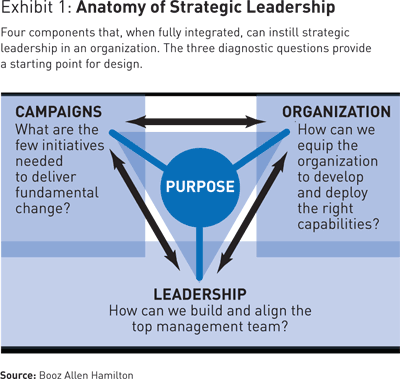
A design for strategic leadership is an integrated group of practices that build a company’s capacity for change. To develop and maintain this capacity, four critical elements need to be integrated together: the commitment to the company’s purpose; the makeup of the top management team; the capabilities and motivation of people throughout the organization; and a sequence of focused, well-chosen strategic initiatives that can take the company forward. (See Exhibit 1.)
Four Starting Points
Conventional wisdom would have it that a crisis is the most common trigger for change. A company faces bankruptcy, court proceedings, or sudden, fierce, business-destroying competition. Current strategies aren’t working. Urgent turnaround is needed. And in fact, the perceived threat of extinction is often a prelude to the dramatic entrance of a turnaround artist from the outside, such as Carlos Ghosn at Nissan in 1999, Robert Stevens “Steve” Miller at Delphi in 2005, and Robert Nardelli at Chrysler in 2007. The fate of the company often depends on how well this new heroic figure can draw upon leadership capabilities: his or her own, those of the senior leadership team, and those of people throughout the company.
In our experience, however, only about 15 percent of the companies that voice a need for change are truly in crisis. A far more common situation — involving as many as 60 percent of those companies — is a state of inconsistency. A leader recognizes that, of the half dozen or so strategic initiatives currently under way, one or more aren’t delivering results or living up to expectations. “Why aren’t we getting a better multiple?” asks the leader. “How can we improve our poor performers?” This was the condition of General Electric when Jack Welch was appointed CEO in 1981; he famously dealt with it by decreeing that every business unit would have to be number one or number two in market share in its niche; otherwise, he would “fix, sell, or close” divisions. The number-one-or-number-two criterion doesn’t apply to every company, but the general challenge is much the same: to find a prescient way to distinguish the value of activities and improve or prune the laggards.
We estimate that another 15 percent of the companies that seek advice on leadership are doing well, at least by their own criteria, but the leaders at the top want to take on new challenges. They worry that the organization will not make the leap with them, if only because the employees are too focused on executing day-to-day business. To combat this complacency, John Barth, CEO of auto components manufacturer Johnson Controls from 2002 through 2007, initiated what he called a “growth culture” at this already profitable company — moving into Asian markets, driving for more competitiveness against other component manufacturers, and expanding Johnson’s air-conditioning and heating systems and battery-manufacturing businesses into green technology enterprises.
The remaining 10 percent of the companies that seek help are recovering from a poorly designed full-scale transformation (an effort to change the entire firm’s culture, organizational structures, and leadership practices at once). Typically, the chief executive had called for a bold new direction, and 20 or more initiatives had been started, all overseen by a “turnaround leadership team” of seemingly committed executives. Some shorter-term cost reduction efforts had paid off; bankruptcy or a forced sale may have been averted. But it had soon become clear that it would take a lot more attention and effort to grow the top line than anyone had expected. The company’s leaders had thus “declared victory,” written up the preliminary results as a success, and moved back to business as usual. Comparatively few of those companies reach out for further help — they’re usually too exhausted — but some do.
If you are a leader initiating a major change or a board seeking a leader to oversee change, then those are your starting points: crisis, inconsistency, complacency, or exhaustion. How long do you have to put in place a design for strategic leadership? For an answer, consider the statistics on CEO tenure. Although chief executive terms may last anywhere from one to 20 years in large global corporations, the average tenure for the CEO of a global corporation is just under eight years, according to Booz Allen’s most recent annual study of CEO succession. This is consistent with Joseph Bower’s estimate in The CEO Within — that a chief executive has between six and 10 years to make a mark and build a legacy.
And if the company needs to reposition itself or renew its capabilities, then all those years will be needed. Harvard University professors John Kotter and James Heskett report that, in 200 corporate transformation cases they studied, the most common time span from beginning to end was five to seven years. Successful transformations — those that don’t produce a backlash, don’t exhaust the organization, and do produce most of the desired results — generally occur in waves. An overall strategy for change taking place through strategic initiatives with relatively concrete goals, each requiring two to three years, tends to provide maximum impact.
As is the case with most other comprehensive efforts to change a large system, several things need to happen at once. A logical starting point is a set of diagnostic questions for the CEO and other key leaders: How do we build and align the top management team? What few initiatives do we need to deliver fundamental change? And how can we equip the organization to develop and deploy the right capabilities to produce the results we want?
The “Why” Factor
During its high-growth years in the early 1990s, the purpose of the computer company Dell Inc. was clear to its leaders and employees. Dell existed to reshape the personal computer hardware business in its own image through its innovations in supply chain management and real-time customization. One critical enabler of this purpose was a reputation for offering the highest-quality customer service and support. When a Dell computer broke, the company’s help desk would often say, “Send it back to us, and we’ll send you a new one.”
Around the time that Michael Dell turned over the CEO role (to then Chief Operating Officer Kevin Rollins) in 2004, the company seemed to change direction. Dell began to focus on cutting costs to beat back Asian competition. Among the casualties was the help desk; customers suddenly began having a much harder time getting their computers fixed, which was intolerable for a business dependent on mail order. In May 2007, New York State Attorney General Andrew Cuomo sued Dell for deceptive business practices and false advertising, mostly related to customer service. By that time, CEO Kevin Rollins had resigned and Michael Dell had returned to the helm.
Why did Dell lose its way? Without a strong corporate purpose, the company did not know how to set priorities. Rather than focusing on those distinctive customer-focused factors that made it the leader of its industry, the company kept cutting prices (in effect, training its customers to wait for discounts) and introducing products, such as large-screen televisions, that required a different business model. Today, Dell is seeking to regain its purpose as a company that once again can reshape and lead the personal computer industry. To accomplish this, its leaders have recognized that they must reach out to individual consumers through more diverse retail channels. And Dell is reportedly rebuilding its customer support as a key component, not just of its value proposition, but of its corporate identity.
That is the power of the “why” factor: a clear, focused explanation of a company’s purpose. Articulating “why we do what we do” allows leaders to set priorities and explain the relevance of their decisions (or, as O’Toole and Lawler put it, to “frame the direction of success”). The answer attracts a higher-quality group of employees, drawn not just to making money but also to meaningful work. In their recent book, The Enthusiastic Employee (Wharton School Publishing, 2005), David Sirota, Louis A. Mischkind, and Michael Irwin Meltzer sum up the research showing the power of purpose in attracting employees, particularly those between 17 and 30 years old. A well-articulated purpose also motivates employees to go beyond “business as usual,” it helps leaders set priorities and balance short-term and long-term measures, and it gives the entire organization a sense of confidence about the future. Most of all, it sets the stage for a focused set of strategic initiatives (also known as campaigns). Not all will be successful, but all will be relevant, in some way, to the company’s ultimate success — if only as failures to learn from.
The two most powerful writers we know on the subject of purpose, Gurnek Bains (Meaning, Inc.) and Nikos Mourkogiannis (Purpose, Palgrave Macmillan, 2006), both make the same basic point: Strategic leaders don’t simply invent an organization’s purpose in a vacuum. They draw forth a purpose that resonates with the values and capabilities of its people, and with the nature of its existing business. Thus, according to Bains, the Virgin Group succeeds because it exists to continually meet fresh challenges. In 2005, when CEO Sir Richard Branson announced the formation of Virgin Galactic, with plans to offer orbital space flights to paying customers, it let his employees and customers know that they could be part of an audacious, risk-taking, history-making enterprise for the rest of their careers. Similarly, according to Mourkogiannis, BMW has always attracted both customers and employees because it embodies excellence. To be sure, it makes a handsome profit, but first and foremost it makes beautiful cars.
Purposeful Initiatives
Most executives recognize that significant change takes place through action. And the familiar way to achieve this is through strategic initiatives: launching a product, changing a practice, or staking out a market position. Unfortunately, that often seems to mean “the more action, the better,” especially when each potential initiative, product launch, or improvement campaign has its own advocates within the company.
This is the path to exhaustion. All too often, the strategic initiatives lack a clear connection to the organization’s purpose; therefore, their relevance is uncertain and they generate little excitement. People comply in the sense of “checking off a box,” but the desired result is never realized.
A more effective approach to strategic initiatives starts by considering purpose. What is this company here for? To discover new things? To dominate its niche? To serve others? To operate in a globally responsible manner? Once the answer is articulated, leaders can frame a campaign: a sequence of high-priority campaigns that reinforce one another and that people throughout the enterprise feel comfortable with, even if those actions represent a dramatic shift in direction.
When Carlos Ghosn came to Nissan in 1999, the company was moribund. Ranked as the number-three auto manufacturer in its region, it was suffering from $30 billion in debt and was viewed as inefficient and sluggish on product development. Ghosn almost immediately began to articulate a purpose: The combined Nissan–Renault company would become a new kind of automobile company, a “global alliance” (as he put it) that was truly multicultural, and better positioned than any other company to bring automobiles to every part of the world. Neither Nissan nor Renault had the capabilities to achieve this purpose at the time. Ghosn set a three-part program in motion to bring Nissan to the point where it could fulfill its part.
Ghosn began the first phase, a cost-cutting strategic initiative called the Nissan Revival Plan, by announcing a set of audacious goals: Nissan would raise the ratio of operating income to sales margin to 4.5 percent and reduce consolidated debt to less than ¥700 billion (US$6 billion) by 2002. The automaker achieved those aims a year ahead of schedule. The second campaign, which started in 2002 and was called Plan 180, set new five-year goals of zero debt, a million-car sales increase, and 8 percent return on sales; Nissan achieved each within three years. By late 2007, the company had cash reserves of $165 billion, and was midway through its third initiative, christened Value Up, with the goal of achieving 20 percent return on invested capital, in part through renewed emphasis on innovative products. Each campaign has helped build the capabilities needed for the next one. And although Value Up is behind schedule, the complexity of the challenges facing Ghosn’s alliance has increased, and his success is uncertain, the revival remains the only successful automobile company turnaround since the 1980s.
As the Nissan story demonstrates, effective strategic leadership requires whittling down the list of possible strategic initiatives to a manageable set; perhaps three successive waves of activity, with four to six projects at one time, each designed to build the capabilities needed for the next wave. Before engineering a million-car sales increase, for example, Nissan needed not just the cash flow to pay for expansion, but the capabilities that reducing debt and raising operating income had provided. These initiatives are also deliberately experimental. When some of them start to fail (as some inevitably will), the organization and leadership can adjust and learn from their mistakes.
Balanced Top Teams
Most of the executives we know are satisfied with the quality of their top management team; after all, these are generally handpicked colleagues with a great deal of capability. And therein lies the problem, for human judgment about close colleagues is notoriously vulnerable. “No matter how hard-nosed some leaders may appear,” write Tichy and Bennis in Judgment, “they have feelings about other people. They become attached to them, or maybe detest them, to degrees that hardly ever apply when they are considering strategic business plans. And it’s these feelings that can keep them from making good, objective calls [about the leadership team].”
As Max Weston and Andra Brooks of Panthea Strategic Leadership Advisors have noted, many CEOs (consciously or not) handpick people they feel comfortable with to sit on critical leadership teams. They recognize the need for technical and functional expertise; the CIO must know about systems and the CMO must have marketing experience. But CEOs do not typically assemble people who are diverse enough in their personalities and backgrounds to play the complementary roles necessary in a business context. Nor do they invest much in explicitly building the trust and accountability that team members will need to work closely together.
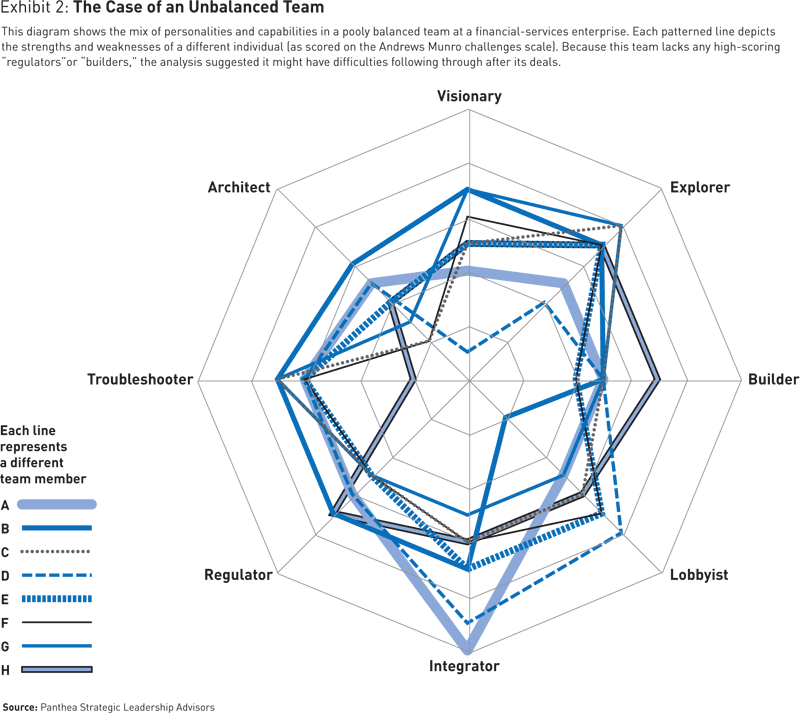
Those companies that explicitly balance talents and temperaments tend to use a variety of methods. The Myers-Briggs personality inventory is the best-known; some companies that use this test assign people to teams so that strong and weak characteristics are balanced. Panthea’s TIME model of leadership skills (which suggests that different leaders are better at either thinking, inspiring, mobilizing, or empowering) borrows from the Andrews Munro “business challenges” framework, which identifies eight management styles: the visionary, explorer, builder, lobbyist, integrator, regulator, troubleshooter, and architect. Organizational systems consultant David Kantor proposes another set of categories, in which, for example, some people are better at moving (initiating new actions), and others prefer the roles of opposer, follower, and bystander. To Kantor, a team is truly healthy when people can easily move among these roles, raising challenges one day as an opposer, being an enthusiastic follower or mover the next day, and stepping back to offer detached commentary as a bystander the following week.
Whatever the details and categories may be, some explicit design for team composition can help prevent teams from being either stuck in recurring conflicts or prone to groupthink. At Panthea, this design includes a diagnostic of team members (see Exhibit 2) and an effort to add people who can fill in the personality gaps.
With the requisite diversity of thinking in place, the ability to plan and act together requires in-depth rehearsal, over time, often with experts from outside companies who can help provide perspective. That’s why effective leadership teams are often proficient at strategic exercises, where they role-play or conduct wargames involving typical business problems, experimenting with various strategies in a fictional environment before trying them in the real world. Meanwhile, the CEO should be planning his or her succession, using the senior team as a crucible for developing others who will be capable of filling the top position in the future.
Is it worth the trouble? One organization famous for this kind of practice is India’s Tata Group, a global conglomerate made up of 100 companies, 300 subsidiaries, and 40 diverse business units. Tata’s broad range of business lines includes automobile manufacturing, chemicals, insurance, electric power generation, publishing, tea, and engineering services, which all fit together (as Gurnek Bains notes) in achieving the common core purpose of building “what India needs next.” Chairman and CEO Ratan Tata is known for selecting and fostering internal boards for the group’s many subsidiaries. The boards are not caretakers; they are expected to make strategic decisions, and their leaders coalesce to coordinate major decisions for the Tata Group as a whole. The boards are also expected to create managerial bonds among Tata’s businesses while maintaining their independence.
Organizational Capabilities
Through their actions, leaders have a great deal of influence over an organization’s culture, but very little of that influence is direct. They can’t make a team more skilled or committed through directives alone; requirements mean very little if they cannot be translated into specific behavior changes. We’ve learned this at Booz Allen through our own work on building organizational capabilities for change, and in particular through the body of practice known as organizational DNA. By changing the reporting relationships and structures, the networks through which people exchange information, the motivators and incentives, and the decision rights in an organization, organizations can shift their capabilities and motivate people to act in sync with the organization’s purpose.
These four “building blocks” (as organizational DNA theorists Gary Neilson and Bruce Pasternack call them) are not the only factors that leaders can use to influence organizations. Indeed, management literature is rife with levers for change, ranging from new information technology to new human resources practices. They all have one thing in common: Unless they are explicitly aligned with the purpose and strategy of a company, they will tend to forestall and undermine the desired strategic direction.
Consider the short time frame of executive assignments in many American and European companies. Brand managers in consumer products and pharmaceutical companies, for example, are accustomed to rotating positions every 18 to 24 months. This means they often escape dealing with the consequences of their decisions, and they are unwilling to make investments (such as in developing innovative new products) that will outlast their tenure. But companies that try to counter this by making assignments last longer, as Japanese companies do, risk losing talented people who assume, “I’m a high-potential person, and therefore I should be moving.”
To deal with this dilemma, a series of interventions may be needed, depending on the purpose of the company and the nature of its industry. For example, if the company is focused on what Nikos Mourkogiannis calls “discovery” (the continual search for new ways to do business and learn about the world), it may be possible to keep a brand manager in place by building the capacity for continual invention. This might mean using informal networks — arranging regular calls and meetings, for example, between marketing and R&D. It might mean giving people more opportunities to take courses or collaborate with others outside the company. A company interested in altruistic goals, like service, could offer very different incentives (such as a more flexible schedule that allowed employees more control over their time) or more formal links between marketing and customer service.
The Right Questions
An immense body of literature already exists on each of the four areas highlighted in this article: purpose, the top management team, organizational capabilities, and strategic initiatives. But research in the strategic leadership field is so fragmented, unreliable, and obscure that many designers of strategic leadership initiatives base their approach on only a small fraction of the knowledge that exists.
That’s a shame, because the broader your awareness of work in the field, the more effective your design can be. It’s helpful to know, for example, that (as David Sirota and his colleagues report from their research on The Enthusiastic Employee) deliberate efforts to accentuate fairness, camaraderie, and recognition lead to improved workplace productivity. Or that (as organizational researcher Elliott Jaques proposed) organizational hierarchies work well when structured to fit with employees’ cognitive capacity. Or that (as neuroscientist Jeffrey Schwartz and executive coach David Rock have written) successful organizational change initiatives require day-to-day practices that focus people’s attention in a habitual manner.
Because every organization is different, diagnosing your situation and culture is critical. The questions will vary with your company’s situation. (See Exhibit 3.) The process will involve your most talented and committed senior executives. And it may take several months of concerted effort before you all understand each other and feel comfortable with the company’s purpose and in defining the right set of initiatives to pursue. But sometimes you have to go slow to go fast. Extra time and care in bringing people to a common understanding at the beginning means far less time lost in false starts and retrenchment later.

This approach to designing strategic leadership will not appeal to every executive. Indeed, as companies experience increasingly intensive pressure from institutional investors, regulators, private equity firms, and hedge funds, it sometimes feels as though the well-developed long-term leader is an endangered species. (“Just get a CEO who can put a strategy in place, push people to execute it, and fire those who don’t!”) But a growing group of CEOs, and their boards, recognize that the purely utilitarian approach is not sustainable. It won’t retain talent, it won’t build competitive advantage, and, in the end, it will create only acquisition targets.
A design for strategic leadership is the alternative. It is not a new approach; it is simply the practiced, considered strategy for change that the best and most long-lived companies have always used. There is no real mystery to it, but it takes the kind of commitment, dedication, and respect that truly makes a company a greatplace to work. 
|
Jeffrey Immelt’s Three-Part Story Line |
|
When Jack Welch handed over the reins of General Electric to Jeffrey Immelt in September 2001, Immelt knew that he would soon be making some changes. During Welch’s 20-year run as CEO, GE had dramatically outperformed the economy, creating over US$400 billion of new market value. Still, Immelt knew that if he limited himself to tinkering around the edges and making GE’s current business model run better, the company would not retain its preeminence for long. Immelt officially became the chairman and CEO of General Electric on September 7, 2001. Four days later, terrorists attacked the United States. In only a few hours, just about every aspect of, and every assumption about, the future direction of the world’s economies and of geopolitical life was called into question. At such times, a leader’s capacity for laying out the future story of his or her organization is vitally important. It provides a platform for making the key people, strategy, and crisis judgments. To be effective, a leader’s “story line” (as we call it) has to answer three questions about the organization and its potential: Where are we now? Where are we going? How will we get there? To Immelt, the world in which GE had to operate after 2001 would be marked by slower growth and more volatility. “There’s not going to be a rising tide to lift all ships universally,” he said. “There are going to be businesses that win, and businesses that lose; countries that win and countries that lose.” To attract and motivate good people in this environment, Immelt believed, GE needed to become more humane. In fact, society and government would demand better corporate behavior. “Just being great isn’t enough any more. Companies and people have to be both great and good to be successful in the future.” Based on this story line, Immelt made judgments about what businesses GE should be in and how it would conduct those businesses. Those judgments included making sure that his own pay package was moderate compared to that of other CEOs and that all his incentives were tied to GE performance. The next element in his story line was to figure out how GE could operate most successfully in this changed world. The answer he arrived at was that GE could best generate organic growth by using its strong research and technology base to develop new markets. Some of the markets offering huge opportunities would be developing countries that needed to build infrastructure for power, water, energy, and transportation. In the more advanced economies, the best opportunities would be in unserved or underserved markets: health care, energy saving and production, and environmentally friendly products. This assessment informed strategic decisions that included buying The third element of Immelt’s story line (“How will we get there?”) describes how GE will go about succeeding in these markets. Because he saw that global warming and the need for sustainable energy were serious concerns, Immelt made the judgment that GE would come up with a strong response. In 2005, GE launched its Ecomagination initiative, a multidisciplinary campaign to apply GE technology to drive energy efficiency and improve environmental performance. He also provided much greater transparency to the investor community than GE had in the past. He proactively set standards for other companies in the post-Enron, post-Tyco, Sarbanes-Oxley world. He is continuously pushing the boundaries of how transparent GE can become without giving away too much information to its competitors. Immelt also created a growth process for GE. This included, for example, hosting “customer dreaming sessions” to drive innovation. These are one- to two-day sessions held at the company’s John F. Welch Leadership Development Center at Crotonville, N.Y., with the CEOs and key leaders from the GE businesses. His job as a leader is to create the platform for other GE leaders to make good strategic judgments. Jeff Immelt works closely with the CEOs of the GE businesses on their strategy, budgets, and succession planning, and on their involvement in corporate initiatives such as lean Six Sigma quality programs, growth platforms, leadership development, and technology transfer. He personally teaches at Crotonville every few weeks. He visits GE’s Global Research Center as often as four or five times a year. He gathers the heads of the business together with key corporate staff four times a year for multiday workshops at Crotonville. Immelt also goes out to each business unit to do succession planning reviews, all-day strategy reviews, and operating plan reviews. Even though, as CEO, Immelt makes the final call on the big items, judgment at GE is a team sport. Noel Tichy (editors@strategy-business.com) is a professor at the University of Michigan’s Ross School of Business and the author of The Cycle of Leadership: How Great Leaders Teach Their Companies to Win (with Nancy Cardwell, HarperCollins, 2002) and many other business bestsellers. Warren Bennis (editors@strategy-business.com) is distinguished professor of business administration at the University of Southern California, and the author of Reinventing Leadership: Strategies to Empower the Organization (with Robert Townsend, William Morrow, 1995) and many other business bestsellers. This article is adapted from Judgment: How Winning Leaders Make Great Calls, by Noel Tichy and Warren Bennis (Portfolio, 2007). |
Reprint No. 07405
Author profile:
Steven Wheeler (wheeler_steven@bah.com) is a senior vice president with Booz Allen Hamilton based in Cleveland, Ohio. He leads the firm’s work focused on strategic leadership and has served multiple industries with a focus on consumer packaged goods and durables.
Walter McFarland (mcfarland_walter@bah.com) is a vice president with Booz Allen based in McLean, Va. He specializes in maximizing human performance for public- and private-sector clients, with extensive experience in human capital and learning systems and leadership development.
Art Kleiner (kleiner_art@strategy- business.com) is editor-in-chief of strategy+business. A new edition of his 1996 book on the history of corporate change, The Age of Heretics, will be published by Wiley Books in 2008.
Also contributing to this article were Adrienne Crowther, director of Booz Allen’s work in strategic leadership; s+b Contributing Editor Ann Graham; Max Weston, a senior partner and founder of Panthea Strategic Leadership Advisors; and Andra Brooks, a partner with Panthea.