The Next Industrial Imperative
Facing up to climate change requires a revolution in business thinking.
 |
|
Illustration by Paul Wearing |
Of all industrial countries, Sweden is probably the farthest along in weaning itself from fossil fuels. Today, the country depends on oil for only 30 percent of its energy, down from 77 percent in 1970. (The United States, by contrast, depends on fossil fuels for 85 percent of its energy.) Fifteen percent of all cars sold in Sweden in 2007 can run on ethanol, up from 2 percent in 2000. A car running on ethanol made from sugarcane or cellulose is estimated to emit 85 to 90 percent less greenhouse gases than a gasoline-powered car. All the major Swedish motor vehicle manufacturers, including Scania, the largest truck manufacturer in Europe, now offer flexible-fuel cars or trucks, which run on either ethanol, conventional gasoline, or a blend. In 2005, a government-sponsored commission announced its intention to make Sweden the “world’s first oil-free economy,” starting with an existing “BioFuel Region” (as it is called): an area encompassing 22 municipalities and located on the Gulf of Bothnia, roughly 200 miles (about 320 km) north of Stockholm. In this region, lower-emission ethanol is as readily available and economical as ordinary gasoline.
One might assume that changes of this magnitude require a massive government effort involving tens of thousands of people, substantial government subsidies, and years of extensively funded research. But until recently, no such support, government-sponsored or otherwise, existed. Instead, countless local networks developed quietly, catalyzed by the efforts of small groups of committed and courageous leaders from the public and private sectors.
The Sweden story is a valuable model of what historians call “basic innovation”: fundamental changes in technology and organization that create new industries, transform existing ones, and, over time, reshape societies. Basic innovations — including electrification, the automobile, commercial air travel, digital computing, and, most recently, the Internet — involve not just a single new technology but a collection of new inventions, practices, distribution networks, businesses and business models, and shifts in personal and organizational thinking that combine to transform the way business is conducted, technology is deployed, and people are engaged.
Over the past few years, as the implications of global climate change have become clearer, a new wave of basic innovation has begun. Much of it is occurring in household-name companies. DuPont, one of the oldest and largest companies in the United States, is shifting the materials in much of its product line from petroleum-based to bio-based feedstocks; its leaders see opportunity in the creation of new products (such as soy-based polymers and thermoplastics made from corn sugar) that could reduce dependency on conventional oil and gas. Coca-Cola formed a partnership with the World Wildlife Fund in 2007, with the goal, according to Coca-Cola Chairman Neville Isdell, of replacing “every drop of water we use in our beverages and their production,” that is, not removing more water from a watershed than the company can replenish. Nike has reduced its carbon footprint by more than 75 percent since 1988. “To do this,” noted Darcy Winslow, when she was general manager of the Nike women’s fitness division (she has since moved on to the Nike Foundation), “we are having to completely rethink how we design, produce, and distribute our products and how we recover them at the end of their lifetime.”
It may be tempting to see all of these efforts as isolated cases, but in truth they are all related. They are responses to the same shift of context, in which the prospect of global climate change, in particular, and of growing waste and toxicity and diminishing key resources, in general, has catalyzed a new way of thinking. In this shift, the entire industrial age can now be seen as a kind of extended bubble, showing some of the same dynamics as a financial bubble and being equally unsustainable in the long run. The stories of the Swedish BioFuel Region, and of DuPont, Coca-Cola, Nike, and many other companies, provide clues to what will happen in the new era when the bubble and the ways of thinking embedded in it no longer hold sway.
The Industrial-Age Bubble
In financial terms, a bubble is a phenomenon in which the prices of assets — be they shares of stock, real estate holdings, or other forms of capital — outpace the assets’ fundamental value. When financial bubbles pop, the same question is always asked: How is it that overexpansion and collapse occurred yet again, drawing in otherwise bright and knowledgeable people?
The answer is that during a period of overexpansion, two parallel views develop, one from inside the bubble and one from outside. Each perspective feels real to those who hold it. The more the bubble grows, the more people are drawn into the powerful reinforcing beliefs and perceptions it inspires. Eventually, those inside the bubble become so absorbed by its new reality that they can no longer understand the point of view of those outside the bubble.
Recall the exchanges between those inside and those outside the dot-com bubble of the late 1990s. Those inside the bubble were living in a “new economy” with new rules, with momentum that seemed to speak for itself. Believers judged success by their technology, hits on their Web site, their site’s “stickiness” (how long people stayed on it and how frequently they returned to it), buzz, and frequently a cool, anticorporate image. So many people thought this way, at the bubble’s height, that profitable “old economy” businesses saw their market value decline in comparison to their dot-com counterparts, despite the fact that many of the most celebrated dot-coms had little or no profits.
But there was a different reality outside the bubble: Profits did matter. Eventually it became clear to investors within the bubble that the price of dot-com assets was not supported by the companies’ value-making potential, and the bubble burst.
Bubbles are not entirely pernicious; indeed, they usually provide some real benefit — at least to some people or for some time. Some dot-com stocks were great assets. Some subprime mortgages did improve lives. The longer the bubble endures, the more people and resources get drawn into it, the more people benefit from it, and the more the beliefs supporting it become entrenched. If a bubble can last for generations, it becomes hard to imagine an alternative to it. But at some point the tensions and inconsistencies between life inside the bubble and the larger reality outside it must be resolved. The bubble cannot expand indefinitely.
The industrial age constitutes an extended bubble of just this sort. Its expansion has continued for more than two centuries, so it is easy to assume that it will continue forever. Its positive impact has been undeniable: Life expectancy in the industrialized world has roughly doubled since the mid-1800s, literacy has jumped from 20 percent to more than 90 percent, and benefits hitherto unimaginable have sprung up in the form of products (canned foods, machine tools, iPods), services (air travel, eBay), and astounding advances in health, communication, education, and entertainment.
But the more harmful side effects of the industrial age have also been apparent from the beginning, at least to those who looked for them. They include a host of environmental crises, including increased waste and toxicity, growing stresses on finite natural resources, a loss of community, and a commodification of daily life that led to a widening gap between the rich and the poor. Biologist Edward O. Wilson calls the view from outside the industrial age bubble “the real real world.” From this perspective, no matter how valuable the assets of industrialization may be, their overall costs make the bubble unsustainable. One might argue about exactly when or how the bubble might end, but there are already signs that the kinds of investments of money, effort, and attention that brought success during the bubble are less likely to yield the same benefits now. Investments outside the bubble are another story. They will produce both more wealth and a more sustainable life, as people leave their old assumptions and practices behind.
Costs of Industrialization
Global climate change is only one of many side effects of industrial growth, but it has two unique aspects. First, the current and prospective costs are enormous. Second, it provides simple, numerical indicators of just how far out of balance humanity is with nature — and how rapid and strong the adjustments must be if we are to avert disaster. Looked at this way, climate change can be considered a gift: an alarm clock telling us how rapidly the industrial age is ending.
The alarm clock consists of a wide range of research and computer models, but it can be summed up with a few basic facts. Levels of human-caused carbon dioxide (CO2) emissions — the primary component of greenhouse gases — have grown exponentially throughout the industrial age. Today the level of CO2 in the atmosphere is 35 percent higher than at any time in the past half million years, leading to a consensus among scientists that human actions are the primary causal factor of a very dangerous trajectory in the global climate.
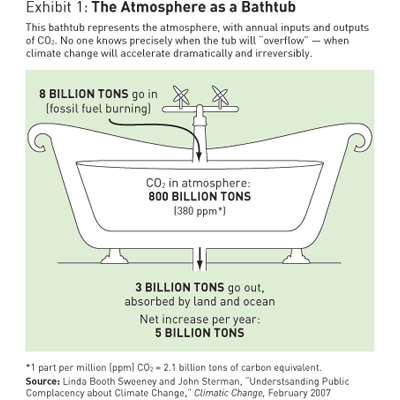
The critical distinction is between the “stock” of CO2 (the amount present in the atmosphere) and the “flow” of new emissions each year. This simple distinction has confused many people, including many in leadership positions who believe that stabilizing the flow of emissions, as mandated by the Kyoto Protocol in 1997, would be enough to solve the problem. The current flow of global CO2 emissions is about 8 billion tons of carbon per year worldwide (the scientific convention is to measure emissions in tons of equivalent carbon). This is more than 2.5 times the amount — about 3 billion tons — that is removed per year from the atmosphere, either absorbed by natural biomass like trees, plants, and plankton, or dissolved in oceans.
The difference between “inflows” and “outflows” of CO2 in the atmosphere works like water in a bathtub: So long as the inflow exceeds the outflow, the bathtub continues to fill. At some point, the tub will overflow. In other words, CO2 levels will cross a threshold at which the effects of climate change are irreversible and are devastating to humans and other species. (See Exhibit 1.) No one knows exactly when the bathtub will overflow, but the pace of climate changes happening already (such as melting glaciers and ice caps, and increased weather instability) is leading to a consensus among scientists and some business leaders that catastrophic overflow can be avoided only by rapidly reducing emissions to equal or fall below the rate at which CO2 is removed from the atmosphere in the next two to three decades. To achieve this will require a 60 to 80 percent reduction of worldwide emissions in 20 years. This is the “80-20 challenge” facing industrial society.
How successful have efforts to address this crisis been? In 2000, the fossil fuels burned in the United States produced about five tons of CO2 emissions per person — more than 1.5 billion tons altogether. Other countries are doing just as poorly; China has already exceeded U.S. levels. Meanwhile, the costs of climate change are significant, and rising. In 2007, Oxfam International, one of the world’s largest and most respected nongovernmental organizations, published the first study on the financial impact of climate change on poor nations through drought, crop damage, water shortages, species extinction, and disease. The aggregate damages have reached US$50 billion per year. In the developed world, insurance premiums are increasing dramatically, reflecting the risks of climate instability: They’ve gone up by as much as 40 percent in Florida, 20 percent in coastal Massachusetts, and 400 percent for some offshore oil rigs. These rates make so-called self-insurance (establishing reserves for future losses instead of purchasing insurance) economical for many businesses and homeowners in high-risk areas. The influential review The Economics of Climate Change, commissioned by the U.K. government in 2006 and led by former World Bank Chief Economist Nicholas Stern (currently a professor at the London School of Economics), concluded that, if dramatic changes are not made soon, the impact on world economics in the next few decades will be comparable to “those associated with the great wars and the economic depression of the first half of the 20th century.”
The New Real World
Think the Earth Project
We cannot meet the 80-20 challenge under the present industrial system. Success will require a sea change in the prevailing kinds of energy we use, cars we drive, buildings we live and work in, cities we design, and ways we move both people and goods around the world. It will require other changes that no one can yet imagine. That’s why basic innovation is so important: Humans must rapidly rethink and rebuild their infrastructure, technology, organizations, and approach to working with nature. Meanwhile, the growing recognition of this 80-20 challenge — among scientists, businesspeople, and citizens — is itself a signal that the industrial age bubble has reached its limits, just as general recognition of the unsustainability of many Internet businesses preceded the bursting of the dot-com bubble of the 1990s.
Moving beyond the bubble does not mean returning to a pre-industrial way of life. But it does mean making choices that reflect very different beliefs, assumptions, and guiding principles. In nature, for example, there is one main source of energy: solar radiation. By contrast, 90 percent or more of the energy used within the industrial age bubble comes from burning fossil fuels. Moving beyond the bubble means learning to live within our “energy income,” and relying on forms of energy, such as solar, wind, tidal, and plant-based energy, that come from renewable sources. Nature produces no waste: every by-product of one natural system is a nutrient for another. The industrial age bubble generates enormous amounts of waste. In a post-bubble world, everything — cars, cell phones, office buildings, appliances — must be 100 percent recyclable, remanufacturable, or compostable. There also needs to be a different attitude toward the gap between rich and poor; in an increasingly interdependent world, it is not sustainable for 15 percent of the people to have 85 percent of the wealth. All the institutions of society must accept, as the first responsibility of human beings, the need to leave a healthy global biosphere for future generations. And in this new real world, it is understood that human beings are just one of the species that matter and that all species depend on others.
Learning to live outside the industrial age bubble — and meeting the 80-20 challenge, in particular — will require basic innovations of a scale and speed never seen before. That is one reason that some institutions are turning to narrow, top-down solutions, such as restrictive regulations on particular types of energy use or materials. But these approaches can often lead to the types of solutions known in system dynamics circles as “shifting the burden”: trying to solve complex problems by addressing individual symptoms alone. Many real-world successes start small, gradually attract wider involvement, then grow to a significant scale. They unfold in the same way that the original Industrial Revolution unfolded, but today they do so at a vastly accelerated pace.
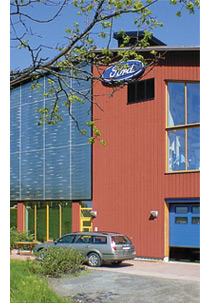
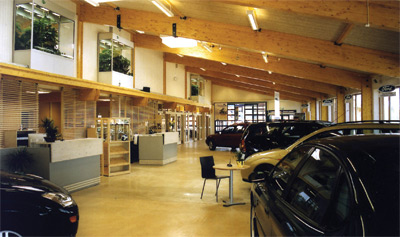
As in the original Industrial Revolution, business must play a critical role: Businesspeople can apply their skills in management, entrepreneurship, and economic acumen to galvanize a collective shift. That was Per Carstedt’s contribution. Carstedt was the owner of a large Ford dealership in northern Sweden, a family business founded by his father. After several years of living in Brazil, during which he attended the 1992 Rio Earth Summit, the first global sustainability conference, Carstedt found himself deeply immersed in what he called “big-picture questions.” How long could the Industrial Revolution, driven by access to cheap energy, be maintained? The more he read and talked to friends, the more connections he saw among different problems. Says Carstedt, “I saw the scope and scale of changes that were necessary. But, I asked myself, ‘What can one person do?’”
Photograph courtesy of Ford Dealership
An answer came when a foundation contacted him, wanting help in getting ethanol cars into the Swedish market. “I had driven ethanol cars in Brazil. For me, it was no big deal, but people said they wouldn’t work in Sweden. It was too cold. The cars wouldn’t start. There were no filling stations. There was no market for them.”
After many inquiries, Carstedt found a person at Ford in Detroit who was in charge of a small flexible-fuel vehicle program. “It turned out his wife had been an exchange student here; he loved Sweden. He saw me as a potential ally, and helped [our dealership] buy three cars in 1995. Ford had no program for this and didn’t even know we were doing it.” When the cars generated little interest in Sweden, Carstedt persevered. He and a colleague from the Swedish Ethanol Development Foundation (later renamed the BioAlcohol Fuel Foundation) spent the next four years traveling from city to city until they formed a buyers’ consortium of 50 municipalities, companies, and individuals committed to buying 3,000 cars.
In Carstedt’s mind, he was “simply doing the next logical thing.” But he was also doing what comes naturally for an entrepreneur. Instead of debating with manufacturers whether there was a market, or organizing more market research or academic seminars, he, in essence, arranged a field test. Along the way he was also getting others engaged — primarily local government officials — to help build momentum for his idea. Before long, the BioAlcohol Fuel Foundation was working in concert with scores of individuals and organizations.
But what good is importing cars that run on ethanol when no ethanol is available? By the time the foundation imported the first 50 flexible-fuel vehicles, Carstedt had persuaded only two filling stations, one in his home region of Örnsköldsvik and one in Stockholm, to install ethanol pumps. As they imported more cars, members of the BioAlcohol Fuel Foundation began a campaign of persuasion aimed at gasoline retailers, often coming up with the financing themselves.
“By 2002, we had 40 stations in the entire country, and in June 2004, we inaugurated the 100th. I think I was at the official openings of the first 50,” he says with a laugh. The number of fueling stations doubled in 2005, doubled again in 2006, and reached 1,000 stations (25 percent of the nation’s total) in August 2007. “The first 100 stations took 10 years to develop,” Carstedt says. “Nowadays we add 100 stations every three months.”
In the late 1990s, Carstedt set out to find a major auto manufacturer to help develop the next generation of ethanol-based automobiles for Sweden. In making the rounds, he realized that the manufacturers were not monolithic: “Companies are made up of individuals, and if you are lucky enough to find those who are like-minded, you work with them and support them — that’s how to get things moving.” The most sympathetic people, to his surprise, were not power-train engineers or biofuel researchers, but marketers. The vice president of marketing at Saab, for example, saw the promise of ethanol as a way to differentiate the company. “He convinced the technical guys,” Carstedt says. Saab redirected money from a marketing budget to produce a small number of ethanol cars to test in the Swedish market.
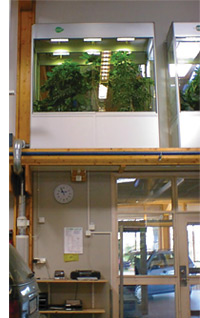
All these initiatives, when combined, created a new fuel industry in Sweden. But Carstedt wanted to address the sustainability challenge more completely, because greenhouse gas emissions from transportation account for only about a quarter of all emissions. Opening a branch of the family car dealership in Umeå, a city in northern Sweden, he and an architect, Anders Nyquist, decided to “build the most environmentally friendly car dealership in the world.” It would work like a natural system — recycling wastewater, conserving heat, and being as energy efficient as possible. The idea evolved into what Carstedt and Nyquist dubbed the “Green Zone,” a block of businesses that included Carstedt’s car dealership, a McDonald’s restaurant, and a gas station (selling both gasoline and biofuel). Following the concept of industrial ecology (in which wastes from one industrial plant are used as supplies for another), they designed systems connecting the businesses — for example, piping excess heat from the restaurant kitchens to the car dealership and the filling station. Overall energy use dropped until it was only 20 percent of that used by comparably sized conventional retail neighborhoods.
 |
|
Photograph © Mariko Harada/ Think the Earth Project |
Eventually, the idea of a scaled-up Green Zone — an entire industrial region free of fossil fuels — started to take shape. Participants articulated three goals: increasing energy efficiency (producing enough renewable fuel to provide for their energy needs and then some), building a regional industrial base that could provide jobs and business development, and pushing the envelope of innovation. “If [our part of Sweden] is to be seen by the world as a leader,” says Carstedt, “we have to engage universities and other institutions in continual knowledge creation.”
Today, the BioFuel Region initiative in northern Sweden includes more than 200 people working actively for sustainability through student research projects and innovative efforts in local businesses, and in the fields of building and urban design, feedstock development, and ethanol production. In mid-2004, a pilot plant opened for producing cellulosic ethanol from wood chips, currently a waste by-product of Sweden’s large forestry industry. “There will be lots of process improvements that we can share with others,” says Carstedt. “The new production plant involves technologies that can be viable in many other parts of the world.”
Businesses, local governments, designers, and students are engaged in deep and ongoing conversations to establish common goals and visions. Carstedt is also helping coordinate a €25 million (US$39.4 million) global project sponsored by the E.U., involving 10 regions seeking to follow in northern Sweden’s footsteps. “The key is to be thinking 30 to 50 years ahead,” says Carstedt, “and developing processes, designs, and sources of energy supply that are sustainable over that time horizon. To get the reduction in emissions we need in the world, we need systems change. This means people working together to create different automobiles, buildings, energy infrastructures — and lots of things that have never existed.”
Skillful Innovation
Other success stories share many characteristics with the Sweden experience. Some, like the Leadership in Energy and Environmental Design (LEED) building certification system, were developed and championed by industry groups (in this case, the United States Green Building Council). Some have been led by companies, others by government agencies. In all cases, people learn to seek allies outside their own organizations, and although the long-term benefits require both courage and the willingness to adapt and learn along the way, the short-term benefits often tend to exceed expectations.
For example, there is significant money to be saved. Companies in all sectors, including IBM, Alcoa, and Wal-Mart, have achieved massive savings from reducing waste and energy usage. DuPont saved $3 billion. General Electric Industrial saved $12.8 million per year just by upgrading the lighting in its plants to its own high-efficiency products. Ford has dramatically reduced the amount of time it takes to paint a new car as it comes down the assembly line, by inventing a technology that applies three coats of paint simultaneously. This eliminates the need for costly, energy-intensive drying equipment. The change will allow Ford to reduce CO2 emissions from production by 15 percent and volatile organic compound emissions by 10 percent. The process will also reduce painting time by 20 percent. Some computer companies, Google and IBM among them, have found that energy efficiency gives them a competitive edge — because powering and cooling computers over time can cost more than the hardware.
Just as there is money to be saved, so is there money to be made. As Fast Company reported in November 2007, General Mills sells its oat hulls, a Cheerios by-product, as heating fuel, earning more than it used to spend to dispose of them. Customers include U.S. Steel and the University of Iowa. And according to the National Homeowners Association, the market for green (energy-efficient and low-waste) buildings hit $7.4 billion in 2005 and is projected to reach $38 billion by 2010. Enterprise Rent-A-Car uses energy savings as a differentiator; 334,000 of its vehicles, about half its fleet, get more than 28 miles per gallon. (This is nearly 10 times the number of fuel-efficient cars and trucks offered by Enterprise’s closest competitors.) Major retailers, including Costco and Wal-Mart, now favor suppliers that can demonstrate prowess in sustainability.
Perhaps most important, the companies that figure out how to escape the bubble early — how to contribute to an infrastructure or create a product line that embodies ecological principles and cuts greenhouse gases dramatically — will end up shaping the future of their industries. Toyota, Honda, Sony Europe, GE, Shell, and many other companies are reorienting themselves this way. GE initially committed to doubling its R&D investment to $1.5 billion for its suite of Ecomagination technologies, which include wind power turbines, energy-efficient appliances, desalination systems, and low-emission aircraft engines and locomotives. The company has since increased those investments substantially. It is well ahead of its growth plan to double revenues to $20 billion from $10 billion for that growing product category over five years, and by the first quarter of 2008, total orders since inception had surpassed $70 billion. A related investment division, GE Energy Financial Services, announced in early 2008 that it had raised its 2010 renewable energy investing target by 50 percent to $6 billion, and had just topped $3 billion in actual investments. It’s notable that many of the division’s investments in wind and solar power, landfill gas, electricity grid efficiency, and lithium-ion batteries go to a wide range of small and midsized companies, not just its own projects. GE’s investments are improving the overall growth prospects for the renewable energy and clean-tech sector.
All of these examples show that learning to live beyond the bubble can be exciting, profitable, and strategically powerful. However, it is not easy. In many industries, no clear guidelines for change exist. It is up to managers to figure out how to balance the long-range imperatives of technological and operational change with the day-to-day imperatives of short-term business. No one can take on a challenge like this alone, which means that an effort starts with talking to other people — and often ends there. What seems obvious to one person is far from obvious to another, and one group’s urgent necessities present questionable premises for others. Given the immense uncertainties and risks involved, the only thing surprising about such communication breakdowns is that we still view them as surprising. Sustainability innovators must learn to foster engaging conversations that build mutual understanding and the ability to work together.
Executives at GE, for instance, started by asking questions about how to expand their various businesses in the long term, a move that was closely tied to the company’s traditional emphasis on growth and innovation. After asking current and potential customers about their vision and needs for clean energy and clean water 15 years into the future, they saw that meeting these needs represented significant opportunities for GE. But they found they had limited credibility in selling high-efficiency electric motors, lighting systems, and equipment to customers unless they could answer with a resounding “yes” the question many customers asked: “Are you using these products in your own facilities?” That, in turn, led GE to a wave of rethinking its own processes and practices, new investments, and major remodeling.
We are just beginning to face the 80-20 challenge. Everything that has happened so far to address this issue, all the measures taken around the world, are small compared to what is coming. No one knows how an 80 percent reduction in global carbon emissions can be achieved in two decades, but it certainly won’t happen through minor adjustments in business as usual. Many individuals and organizations are leading the way now; many more will follow. And as they coalesce, innovate, and interact, their leadership will shape a world profoundly different from the “take–make–waste” industrial age society.
Reprint No. 08205
Peter Senge is a senior lecturer at the Massachusetts Institute of Technology and founding chair of the Society for Organizational Learning (SoL). He is the author of The Fifth Discipline: The Art and Practice of the Learning Organization (Doubleday, 1990 and 2006) and coauthor of The Fifth Discipline Fieldbook (Doubleday, 1994) and Presence (Doubleday, 2005).
Bryan Smith is a member of the faculty at York University’s Sustainable Enterprise Academy, and the president of the consulting firm Broad Reach Innovations Inc. He is a coauthor of The Fifth Discipline Fieldbook and the related fieldbook series. He was a senior partner for 18 years at Innovation Associates, a firm that pioneered the practice of organizational learning.
Nina Kruschwitz is the editor of Reflections: The SoL Journal on Knowledge, Learning, and Change. She is also the managing editor for the Fifth Discipline fieldbook series.
This article was adapted from The Necessary Revolution: How Individuals and Organizations Are Working Together to Create a Sustainable World, by Peter Senge, Bryan Smith, Nina Kruschwitz, Joe Laur, and Sara Schley (Doubleday, 2008).