
P&G’s Innovation Culture
How we built a world-class organic growth engine by investing in people.
 |
|
Illustrations by Michael Klein
|
With an introduction by Ram Charan.
The heart of a company’s business model should be game-changing innovation. This is not just the invention of new products and services, but the ability to systematically convert ideas into new offerings that alter the very context of the business.
As they lead to repeat purchases, these offerings reshape the market, so that the company is playing an entirely new (and profitable) game to which others must adapt. A number of game-changing innovators are operating today, including such household-name enterprises as Procter & Gamble, Nokia, the Lego Group, Apple, Hewlett-Packard, Honeywell, DuPont, and General Electric. Wherever you see a steady flow of noteworthy innovations from one company, you can probably assume that it is a game-changing innovator, with the distinctive kinds of social connections, culture, and supporting behaviors that enable it to play that role.
The strategy+business Collection: Don’t Blame Your Culture
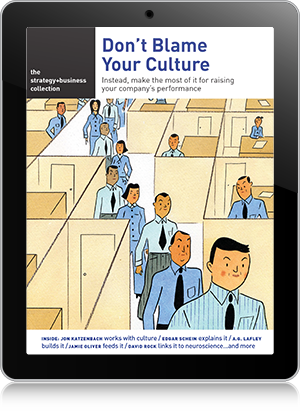 This article is featured in the strategy+business app “Don’t Blame Your Culture,” available for smartphone and tablet devices. The app pulls together s+b’s best writing on organizational culture and change, featuring Jon Katzenbach, TV chef Jamie Oliver, former P&G CEO A.G. Lafley, and more, explaining why companies resist wholesale change, and how to make the most of the culture you have.
To download, select your device:




Consider the case of Procter & Gamble Company. Since A.G. Lafley became chief executive officer in 2000, the leaders of P&G have worked hard to make innovation part of the daily routine and to establish an innovation culture. Lafley and his team preserved the essential part of P&G’s research and development capability — world-class technologists who are masters of the core technologies critical to the household and personal-care businesses — while also bringing more P&G employees outside R&D into the innovation game. They sought to create an enterprise-wide social system that would harness the skills and insights of people throughout the company and give them one common focus: the consumer. Without that kind of culture of innovation, a strategy of sustainable organic growth is far more difficult to achieve.
A.G. Lafley and I coauthored The Game-Changer: How You Can Drive Revenue and Profit Growth with Innovation (Crown Business, 2008) to explain how to make game-changing innovation drive growth on a consistent, well-paced basis. The critical factors that we cover in the book include keeping a laser-sharp focus on the customer; establishing a disciplined, repeatable, and scalable innovation process; creating organizational and funding mechanisms that support innovation; and demonstrating the kind of leadership necessary for profitable top-line growth as well as cost reduction.
One aspect of building an innovation culture deserves more attention than we could give it in The Game-Changer: designing a social system that would spark new ideas and enable critical decisions. In the article that follows, A.G. explains the human factors that fostered innovation at Procter & Gamble. It could be thought of as the “missing chapter” to The Game-Changer; a vital component that isn’t always obvious, even to experts, precisely because it is so fundamental.
— Ram Charan
When I became CEO of Procter & Gamble in 2000, we were introducing new brands and products with a commercial success rate of 15 to 20 percent. In other words, for every six new product introductions, one would return our investment. This had been the prevailing ratio in our industry, consumer packaged goods, for a long time.
Today, our company’s success rate runs between 50 and 60 percent. About half of our new products succeed. That’s as high as we want the success rate to be. If we try to make it any higher, we’ll be tempted to err on the side of caution, playing it safe by focusing on innovations with little game-changing potential.
The decision to focus on innovation as a core strength throughout the company has had a direct influence on our performance. P&G has delivered, on average, 6 percent organic sales growth since the beginning of the decade, virtually all of it driven by innovation. Over the same period, we’ve reduced R&D spending as a percentage of sales; it was about 4.5 percent in the late 1990s and only 2.8 percent in 2007. In that year, we spent US$2.1 billion on innovation, and received $76.5 billion in revenues. We’re getting more value from every dollar we invest in innovation today.
The focus on innovation has also had a direct effect on our portfolio of businesses. The Game-Changer describes how we sold off most of P&G’s food and beverage businesses so we could concentrate on products that were driven by the kinds of innovation we knew best. As it turns out, with this narrower mix of businesses, we can more easily devote the resources and attention needed to build a broad-scale innovation culture.
We also focused on creating a practice of open innovation: taking advantage of the skills and interests of people throughout the company and looking for partnerships outside P&G. This was important to us for several reasons.
First, we needed to broaden our capabilities. Each of our businesses was already practicing some form of innovation improvement, but they were not all improving at the same rate. As the CEO, I could lead and inspire the company as a whole, but I could not substitute my judgment for that of other leaders who knew and understood their specific businesses far better than I could. The decision makers in each business would have to examine their competitive landscape and their own capabilities to figure out what kinds of innovation would work best and win with consumers.
Second, building an open innovation culture was critical for realizing the essential growth opportunity presented by emerging markets. During the next 10 years, between 1 billion and 2 billion people in Asia, Latin America, Eastern Europe, and the Middle East will move from rural, subsistence living to relatively urban and increasingly affluent lives. They will have more choices, a greater connection with the global economy, and the ability to realize more aspirations. Along the way, they will become, for the first time, regular consumers of branded products in categories such as personal care, fabric care, and prepared food.
It would seem relatively simple to execute a strategy for reaching these new consumers. But the days of achieving automatic growth by entering new markets are essentially over. Just as retailers often reach a level of saturation — where it doesn’t make sense to open any more stores in a particular market — many mature consumer products companies are rapidly running out of the so-called white space in new regions. P&G, for example, already has a market presence in more than 160 countries, with large operations on the ground in more than 80 of them. We can grow our business in these countries only by consistently developing new products, processes, and forms of community presence. And to do that, we need to involve people, inside the company and out, who are comfortable and familiar with the values and needs of consumers in these parts of the world.
A third reason for focusing on open innovation had to do with fostering teams. The kinds of innovation needed at Procter & Gamble must be realized through teams. The idea for a new product may spring from the mind of an individual, but only a collective effort can carry that idea through prototyping and launch. If innovation is to be integrated with both business strategy and work processes, as we believe it should be, it requires a broad network of social interactions.
Moreover, our experience suggests that many of the failures of innovation are social failures. Promising ideas, with real potential business value, often get left behind during the development process. Some innovations are timed too early for their market; others are lost in execution. Often, the root cause is poor social interaction; the right people simply don’t engage in productive dialogue frequently enough.
For all these reasons, we consciously set in place a series of measures for building an open innovation culture at P&G.
“The Consumer Is Boss”
Procter & Gamble is known for its highly capable and motivated workforce. But in the early 2000s, our people were not oriented to any common strategic purpose. We had a corporate mission to meaningfully improve the everyday lives of the customers we served. If 15 seconds with a deodorant or two minutes with a disposable diaper have made a small part of your life a little bit better, then we’ve made a difference.
 But we hadn’t explicitly or inspirationally enrolled enough of our 100,000-plus people around the world in our mission; it was neither fully embraced by employees nor fully leveraged by the company’s leadership. Our innovation efforts suffered accordingly.
So we expanded our mission to include the idea that “the consumer is boss.” In other words, the people who buy and use P&G products are valued not just for their money, but as a rich source of information and direction. If we can develop better ways of learning from them — by listening to them, observing them in their daily lives, and even living with them — then our mission is more likely to succeed. “The consumer is boss” became far more than a slogan to us. It was a clear, simple, and inclusive cultural priority for both our employees and our external stakeholders, such as suppliers and retail partners.
We also linked the concept directly to innovation. From the ideation stage through the purchase of a product, the consumer should be “the heart of all we do” at P&G. I talked about it that way at dozens of company town hall meetings during my first months as CEO. More and more people began thinking about how to apply the “consumer is boss” concept to their work. Resources were still scarce, and there were fierce debates about which ideas deserved the most attention and where to deploy money and people. But this concept came to matter more than those other concerns. People became more willing to subjugate their egos to the greater good — to improving consumers’ lives.
It’s natural for a mature company to become more insular. So we explicitly tried to build better connections with the people who bought our products. For example, in the early 1990s, we had acquired the Max Factor and Ellen Betrix cosmetic and fragrance lines from Revlon Inc. Innovation in fine fragrances had always been driven by fashion. With slow growth of 2 to 3 percent a year, low margins, and weak cash flow, fine fragrances didn’t seem to be an attractive business for P&G. But we saw a chance to change the game.
We began by clearly and precisely defining the target consumer for each fragrance brand, and identifying subgroups of consumers for some brands. We didn’t walk away from the traditional approaches of the fine fragrance business. We still maintained partnerships with established fashion houses, such as Dolce & Gabbana, Gucci, and Lacoste. But we also made the consumer our boss. We focused on a few big launches and on innovation that was meaningful to consumers, including fresh new scents, distinctive packaging, provocative marketing, and delightful in-store experiences. We also took advantage of our global scale and supply chain to reduce complexity and enable a significantly lower cost structure.
The result? Our team turned a small, underperforming business into a global leader. In 2007, P&G became the largest fine fragrance company in the world, with more than $2.5 billion in sales — a 25-fold increase in 15 years.
Elsewhere in our company, we experimented with new ways to build social connections through digital media and other forms of direct interaction. We designed Web sites to reinforce consumer connections, to better understand consumers’ needs, and to experiment with prototypes. For example, we used to hand-make baby diapers for a product test. Now, we show people digitally created alternatives in an onscreen virtual world. If the consumers we’re talking to have an idea, we can redesign it immediately and ask them, “Do you like that better? How would you use it?” It allows us to iterate very quickly. In effect, we are building a social system with the purchasers (and potential purchasers) of our products, enabling them to codesign and co-engineer our innovations.
Integrating Innovation
We are constantly innovating how we innovate. We keep refining our product-launch model — from idea to prototype, to development, to qualification, to commercialization. Applying this sequential practice on a large scale, and making it replicable, does not mean eliminating judgment. In fact, there’s still a fair amount of judgment that’s applied along the way. That’s why we need active leaders and a strong innovation culture.
Scalability is critical at a company the size of Procter & Gamble. If we can’t scale our processes, they don’t have much value for us. In fact, scalability is often the justification for our existence as a multinational, diversified company. Our innovation practices are thus designed for deliberate learning, across all our functions, product categories, and geographic locations. Once people understand a particular process, they can replicate it and train others. It soon becomes a part of normal decision making.
P&G had not treated innovation as scalable in the past. We had always invested a great deal in research and development. When I became CEO, we had about 8,000 R&D people and roughly 4,000 engineers, all working on innovation. But we had not integrated these innovation programs with our business strategy, planning, or budgeting process well enough. At least 85 percent of the people in our organization thought they weren’t working on innovation. They were somewhere else: in line management, marketing, operations, sales, or administration. We had to redefine our social system to get everybody into the innovation game.
Today, all P&G employees are expected to understand the role they play in innovation. Even when you’re operating, you’re always innovating — you’re making the cycles shorter, or developing new commercial ideas, or working on new business models. And all innovation is connected to the business strategy.
In fostering this approach and building the social system to support it, the P&G leadership has had to be very disciplined. For instance, we are now set up to see many more new ideas. Our external business development group is very small; all it does is meet with individuals, groups, research labs, and other potential collaborators, including (as we noted in The Game-Changer) P&G’s competitors on occasion. Any of these may propose new technologies, new product prototypes, or new ways to connect us to our consumer base. Last year, the business development group reviewed more than 1,000 external ideas. This year, they’ll see 1,500. We tend to act on about 5 to 7 percent of them.
We are also open to ideas from more regions than in the past. Innovation used to travel primarily from developed markets to developing markets. When new technology appeared in Japan, Germany, or the U.S., it flowed across the regions and down the hierarchy. Today, more than 40 percent of our innovation comes from outside the United States. People in India, China, Latin America, and some African countries have become part of our social system. Their presence has made us more open, and this helps compensate for our natural tendency to become more insular.
We maintain open work systems in a lot of places around the world. Executives’ offices don’t have doors. Leaders don’t have a secretary cordoning them off. All the offices on the executive floor at Procter & Gamble are open; the conference room is an open, round space. We made it round as a small symbol of the new approach. We’re seeing indications that this new social process is catching on all over the world.
The Talent Component
P&G used to recruit for values, brains, accomplishment, and leadership. We still look for these qualities, but we also look for agility and flexibility. We believe the “soft” skills of emotional intelligence — fundamental social skills such as self-awareness, self-fulfillment, and empathy — are needed to complement the traditional IQ skills. (See “Tea and Empathy with Daniel Goleman,” by Lawrence M. Fisher, s+b, Autumn 2008.) Maybe “soft” isn’t the right word: These skills are every bit as hard to master as some tough analytical skills. People just learn them in a different way.
 Some people at Procter & Gamble have struggled with this new approach, but most of our best people have done really well with it. Curiosity, collaboration, and connectedness are easy to talk about but difficult to develop in practice. We have tried to carefully identify and ease out people who are controlling or insecure, who don’t want to share, open up, or learn — who are not curious. And in the process, we have discovered that most of our people are naturally collaborative.
We also try to develop people by giving them new stimulation and greater challenges. As they move through their careers, we deliberately increase the complexity of their assignments. That might mean entering a market that’s not developed yet or a market with a competitor already firmly established. Whatever the challenge, it stretches them.
We give our most promising people time in both functional and line positions, because we think our best leaders are great operating leaders and great innovation leaders. We also move people around geographically. We bring people into our Cincinnati headquarters from around the world, and we make a point of moving our headquarters people to our global businesses. Almost all of us have worked outside our home region. Almost all of us have worked in developing or emerging markets. And almost all of us have worked across the businesses. We track that progress very carefully.
We’ve been fortunate that some of this flexible, multifaceted ethic exists in our heritage. For example, Procter & Gamble pioneered a technician-based system in its manufacturing plants during the 1960s and ’70s. In this system, we avoided the approach in which one person was assigned to do only one job. The technician system still operates today: To get the highest evaluation rating in a P&G factory, you learn how to do all the jobs on the line. And, once you have that rating, we expect you to be capable of problem identification, problem solving, and innovation. This background has made it easier for us to plug manufacturing and engineering into the innovation culture.
Once people have succeeded at innovation, you can see the energy in the company changing. People routinely say, “We can do this. This is feasible.” The attitude changes are incredible to watch; once people see the simplicity, durability, and sustainability of an innovative mind-set, it continually reinforces itself.
 On average, younger managers and younger employees are more open to fresh, innovative thinking. Since 2000, we’ve lowered the average age of our people by almost 10 years because of our acquisitions and our moves in emerging markets. We have also recently brought in people from outside to enable and stimulate creative thinking. This was unprecedented for a company that has traditionally hired only entry-level people and promoted from within.
Virtually every leading practitioner of our new design capability came from the outside as a mid-career hire. They arrived from BMW, Nike, and some of the best design shops in the world. We probably have 150 to 200 such people and, although it’s not a huge proportion of the P&G staff, it’s big enough to make a difference. They bring us not just the art and science and practice of design, but an integrative way of thinking.
Integrative Thinking
One of our favorite examples of integrative thinking involves Febreze, a very successful odor-control product. One of the active ingredients in Febreze surrounds a malodor and removes it, as opposed to covering it up or masking it. Febreze started out as a fabric refresher. Now it’s also an air freshener in the U.S. and elsewhere.
Not long ago we took the Febreze package, product, and brand name to Japan. We tested it on a small scale with Japanese consumers. They rejected it. As interpreted by the P&G team (a relatively junior-level group), the gut reaction of the Japanese was: “Here’s another Western product that’s not going to work in our country.”
But we persisted. “Were there any Japanese households or consumers who really liked the product?” we asked. The team didn’t know, but they went back and looked at the research. Lo and behold, 20 percent of the first survey group absolutely loved the product.
Personally, I wasn’t surprised. I had spent eight years living and working in Japan and I knew that Japanese people can be hypersensitive to malodors. A man can smoke cigarettes outside or in a subway station, but many Japanese women won’t let their husbands smoke in the house. When the husband comes home, he may have to take his smoky clothes off and wash them before he can sit down.
So we resolved to try again. The P&G team changed the viscosity of the product. They changed the fragrance from high profile to a very low profile scent. They changed the bottle to a much more delicate design that more Japanese people felt comfortable having visible in their homes. They changed the spray pattern to a mist. They changed everything but the core technology of the product, and it became a phenomenal success in Japan.
This is a story we tell ourselves at P&G to drive home the need for integrative thinking. The project started with a consumer-centric concept. It involved people in a variety of functions and at least two regions. It opened our team members’ eyes to other possibilities. And it came to fruition because we were skilled at having the kinds of processes and conversations that would lead people to synthesize their ideas.
Our long-standing middle managers, people who have grown up in the P&G system (as I did), are starting to recognize that better innovation processes can expand their personal and leadership skills. They’ve all been through cost-cutting and productivity exercises. But that’s not the same as creating top-line opportunities that can earn kudos from consumers. Nobody is telling them they have to be the geniuses who invent an idea. They will get credit for turning ideas into replicable processes and learning from their mistakes. In operating cross-functionally, they are also moving away naturally from the old silos.
The result of P&G’s focus on innovation has been reliable, sustainable growth. Since the beginning of the decade, P&G sales have more than doubled, from $39 billion to more than $80 billion; the number of billion-dollar brands, those that generate $1 billion or more in sales each year, has grown from 10 to 24; the number of brands with sales between $500 million and $1 billion has more than quadrupled, from four to 18. This growth is being led by energized managers — innovation leaders — who continually learn new ways to grow revenues, improve margins, and avoid commoditization. Our culture of innovation is helping P&G leaders be more effective, and in the process, they’re renewing our company every day.
Once people have succeeded at a game-changing innovation, the level of energy in the company elevates. Even people who weren’t directly involved are affected through the social networks. It becomes easier for them to expand their idea of what is feasible. Building this sort of capability often has the rhythm of, say, skilled basketball practice: a group of people who gradually learn seamless teamwork, reading one another’s intentions and learning to complement other team members, ultimately creating their own characteristic, effective, and uncopyable style of successful play. 
|
Becoming a Great Innovation Team Leader |
|
As you read about Procter & Gamble’s social system and innovation culture, you may be thinking, “There are some good ideas here…for someone else. In my shop, we can barely keep the trains running on time. How am I supposed to do all this?” Leaders of innovation take their game to another level through a particular set of practices:
|
Reprint No. 08304
A.G. Lafley is the chairman and CEO of Procter & Gamble Company. He was named Executive of the Year by the Academy of Management in 2007 and serves on the boards of General Electric Company and Dell Inc. He is the coauthor, with Ram Charan, of The Game-Changer: How You Can Drive Revenue and Profit Growth with Innovation (Crown Business, 2008).
Ram Charan is a Dallas-based advisor to boards and CEOs of Fortune 500 companies and the author or coauthor of 14 books, including the bestsellers Execution (with Larry Bossidy; Crown Business, 2002), Confronting Reality (with Larry Bossidy; Crown Business, 2004), and Know-How (Crown Business, 2007).
Also contributing to this article was Geoffrey Precourt.