

Not Just for Profit
Emerging alternatives to the shareholder-centric model could help companies avoid ethical mishaps and contribute more to the world at large.
(originally published by Booz & Company)When Muhammad Yunus and the Grameen Bank received the Nobel Peace Prize in October 2006, one endeavor lifted into the limelight was Grameen Danone Foods Ltd. This was a pathbreaking collaborative enterprise, launched that year as a 50–50 joint venture between Groupe Danone — the US$16 billion multinational yogurt maker — and the Grameen companies Yunus had cofounded. Yunus called the joint venture a “social business,” which he said could be a pioneering model for a more humane form of capitalism. As Yunus explained in his book Creating a World without Poverty: Social Business and the Future of Capitalism (PublicAffairs, 2007), a social business is a profit-making company driven by a larger mission. It carries the energy and entrepreneurship of the private sector, raises capital through the market economy, and deals with “products, services, customers, markets, expenses, and revenues — but with the profit-maximization principle replaced by the social-benefit principle.”
 |
|
Farmers delivering milk to a Grameen Danone yogurt factory in the village of Bogru, Bangladesh — one of many small community enterprises established by this joint venture.
Photograph © HALEY/SIPA |
The mission of Grameen Danone Foods is to bring affordable nutrition to malnourished children in Bangladesh with a fortified yogurt, under the brand name Shokti Doi (which means “yogurt for power” in Bengali, the country’s language). It began in October 2005, when Franck Riboud, the CEO of Groupe Danone, took Yunus to lunch in Paris. “We would like to find ways to help feed the poor,” said Riboud. Yunus suggested the revolutionary joint venture and proposed that a new structure be invented for it, a hybrid between nonprofit and for-profit.
Like a conventional business, Grameen Danone must recover its full costs from operations. Yet, like a nonprofit, it is driven by a cause rather than by profit. If all goes well, investors will receive only a token 1 percent annual dividend, with all other profits being plowed back into the business. The venture’s primary aim is to create social benefits for those whose lives the company touches. For example, the first Grameen Danone factory, which opened in November 2006, was deliberately built small, as a prototype for community-based plants that would provide jobs across Bangladesh. “It’s just a tiny little plant, but it has a big message,” said Yunus in a speech to the Global Alliance for Improved Nutrition, the nonprofit organization brought in to monitor the company’s impact on local health. “While we make money, we can also do good.” Riboud adds, “I’m deeply convinced that [humanity’s] future relies on our ability to explore and invent new business models and new types of business corporations.”
Yunus and Riboud are not alone in seeing the critical importance of instilling a purpose other than short-term profits at the core of corporate designs. In a celebrated January 2008 speech at the World Economic Forum, Bill Gates called for a new form of “creative capitalism.” And around the world — largely beneath the radar of mainstream awareness — alternative designs are being developed that, like Grameen Danone, seamlessly blend a central social mission with profitable operation. These include the burgeoning microfinance industry, emerging hybrids like nonprofit venture-capital firms, new architectures like Google.org that embody “for-profit philanthropy,” dual-class shareholding structures, employee-owned companies, the foundation-owned corporations of northern Europe, and a variety of cooperatives on every continent. These models vary enormously in size and mission, but they are significant for the same reason: Together, they represent an evolutionary step in the development of corporate structure.
The Soul of a New Design
For years, critics of the corporation have argued that the prevailing design of publicly held corporations is innately flawed. That design involves a board that is elected by shareholders — with votes allocated proportionately to the number of shares held — whose members then appoint a semiautonomous CEO as the shareholders’ agent, who in turn delegates authority down through the ranks. In many ways, this has been a highly effective model. The “managerial hierarchy” structure, as corporate historian Alfred D. Chandler Jr. called it, has accomplished more in a short time than any other form the world has known.
But this shareholder-centric model has also contributed over the years to what former Citigroup CEO John Reed has called the “iron triangle of short-term pressures” — hedge funds, stock options, and stock analysts — that keeps companies narrowly focused on quarterly profits.
The financial meltdown of 2008 was a direct result of the pursuit of immediate profit by investment bankers and mortgage brokers who disregarded the impact of their actions on customers, on the larger economy, and indeed on stockholders and the company itself in the long term. Those who wanted to operate with integrity found it difficult. They were constrained by a corporate design that reinforced the need to “make the numbers” by any means possible — a design that bestowed the greatest governance power on short-term shareholders, the stakeholders with the least interest in long-term performance or the external community. Conventional methods for preventing abuses, such as regulation and criminalizing egregious behavior, are only partially effective. In the long run, the best way to get to the root of the problem will be for corporate ownership and governance design itself to evolve.
If the idea of creating alternative forms of corporate ownership and governance is unfamiliar in conversations about the meltdown (or other business abuses), it’s because the prevailing form of corporate design is generally taken as a given. Under the laws of most countries, it’s difficult for corporations to adopt any other form. But against the odds, tender green shoots of new company designs are emerging today, and existing alternatives are being adapted. Some emerging models are as likely to be profitable as more conventional companies, and all are more adept at pursuing goals that conventional for-profit companies usually fail to reach: treating customers fairly, protecting the environment, creating a healthy workplace, and supporting the communities in which they operate.
Richard Nelson, an economics professor at Columbia University who cofounded the field of evolutionary economics, observes that social systems evolve because of two kinds of innovation: advances in physical technologies (such as new environmental and energy technologies), and advances in social technologies (such as new forms of organization). As these two types of innovation influence each other, the governance models that emerge, such as microfinance-related structures, take their place alongside older, more established alternative models, such as cooperatives, employee-owned firms, and government-sponsored enterprises. These designs can be thought of as emergent new organizational species, occupying a new sector of society that is a greenhouse of design experimentation in which the future of our economy may be growing.
One helpful way of thinking about these designs is as representing a hybrid between the traditional for-profit archetype, which has profit at its nucleus, and the traditional nonprofit archetype, which has social mission at its nucleus. This type of hybrid has been dubbed the “for-benefit enterprise” by Heerad Sabeti, CEO of the TransForms Corporation — a North Carolina–based manufacturer of wall decorations with about $2 million in revenues, which routinely employs people with disabilities and invests heavily in developing its workforce. Sabeti is one of several people who have begun to explore the parameters of this new archetype. (Another source of exploration is the Corporation 20/20 initiative, organized by Allen White and me at the Tellus Institute in Boston.) All of these initiatives conceive the new type of organization with a blended purpose at its core: serving a living mission and making a profit in the process. The essential framework of such a company — its ownership, governance, capitalization, and compensation structures — are designed to support this dual mission. And it is this design that enables companies to escape the pressure to maximize short-term profits and instead to fulfill a more fundamental purpose of economic activity: to meet human needs and be of benefit to life.
Future experimentation is inevitable; the fully realized for-benefit corporate design — with all the right elements, a design that’s capable of replacing the dominant model of today — may not exist yet. We may be entering a new era of design diversity, in which different designs serve different functions. Today, at least three broad approaches to for-benefit architecture offer promising models: stakeholder-owned companies, which put ownership in the hands of nonfinancial stakeholders; mission-controlled companies, which separate ownership and profits from control and organizational direction; and public–private hybrids, where profit-driven and mission-driven design elements are combined to create unique structures.
Stakeholder-owned Companies
The cooperative model of ownership, which dates to the mid-19th century, was conceived as an alternative to the shareholder-based ownership model that developed at roughly the same time. The defining feature of the cooperative model is that these companies are owned and controlled by the members they serve. Members might be customers (as in a credit union), producers (as in a farmers cooperative), homeowners (as in a housing co-op), employees, or the community. (There is some overlap between cooperatives and employee-owned companies, but they are not the same; employees can own corporate shares either through cooperatives or in more conventional business structures through such measures as employee stock-ownership plans.)
 |
|
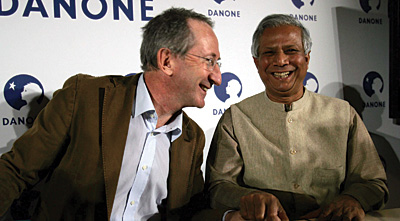
Franck Riboud, CEO of Groupe Danone (left), and Nobel Peace laureate Muhammad Yunus in 2006, announcing the launch of an investment fund for social businesses and naming Grameen Danone Foods as its first project.
Photograph © HALEY/SIPA |
Cooperatives are a globe-spanning phenomenon, with membership now at 800 million people — more than double the total from three decades ago. In Colombia, SaludCoop provides health-care services to a quarter of the population. In Spain, the Mondragón Corporación Cooperativa is the nation’s seventh-largest industrial concern. More Americans hold memberships in co-ops than hold stock in the stock market. When they are successful, these stakeholder-owned firms can be extraordinarily long-lived, with remarkable business and social impact: Rabobank Group in the Netherlands and the Springfield ReManufacturing Corporation in the Missouri Ozarks are two examples of companies that have prospered by drawing on the commitment and engagement of their shareholder–customers and shareholder–employees, respectively.
The success of firms owned and governed by stakeholders shows that, contrary to some economic assumptions, there’s nothing innately better about independent shareholders or directors. But stakeholder ownership also has its flaws. Cooperatives have failed to match the growth of shareholder-owned companies because they lack access to capital (laws governing cooperatives often put restrictions on capital returns), and they can fail to retain leaders who perceive less chance of accumulating personal wealth. On the other hand, when employee ownership is matched with involvement, businesses can achieve results that would be considered near-impossible in conventional companies.
The Cooperative Regions of Organic Producers Pool (CROPP), better known by its brand name Organic Valley, is a producer-owned marketing cooperative in La Farge, Wis. CROPP is owned by the 1,200 organic family farms that produce the dairy, eggs, and meat it distributes. The company’s mission is to save the family farm, which means paying as much as possible to farmers. “We don’t have any need for profits much over 2 percent,” says CEO George Siemon. “We’d just pay taxes on it. We’d rather give it to the farmers.” Though growth has slowed in recent months, for years the company grew 30 to 40 percent per year. With 2007 revenues of $433 million, Organic Valley stewards one of the nation’s four largest organic brands.
Similarly, the John Lewis Partnership PLC, with £6.8 billion (about US$10 billion) in revenues in 2007, has a stated purpose of serving the happiness of its employee–partners. It is the largest department store chain in the U.K., and also owns 200 Waitrose supermarkets. It is 100 percent owned by its 69,000 staff members, among whom all profits are shared each year. It is overseen by an unusual bicameral governance structure: The company has a traditional board of directors as well as a second employee-based governing body, the partnership council, directly elected by employees. The partnership council in turn elects five of the 12 board members. The council also influences policy and holds management to account, since it has the formal power to dismiss the chairman.
Mission-controlled Companies
A little-appreciated but powerful for-benefit model can be found among companies that manage to be publicly traded while keeping control in mission-oriented hands. Take Interface Inc., for example. This Fortune 1000 flooring company, with 2007 revenues of $1.1 billion, is well on its way to meeting its ambitious 2008 pledge of “Mission Zero by 2020” — a pledge to have zero negative impact on the environment within 12 years. This means eliminating waste and switching entirely to renewable energy, as part of the company’s larger vision of being the first company that, as founder and CEO Ray Anderson puts it, “shows the entire industrial world what sustainability is in all its dimensions.”
Other publicly traded companies have tried to make this kind of long-term commitment, but have had to soften the goal through the ups and downs of the stock market. What supports Interface’s mission is a rarely mentioned but vital element in its social architecture: a dual-class governance structure that puts super-voting shares in the hands of Anderson and a few other top executives, giving them control of 72 percent of votes for the board, although they own far less than a majority of publicly traded shares. Super-voting shares are generally unavailable to the public, which insulates the company from hostile takeovers. In effect, it allows Interface to be a mission-controlled enterprise, one whose governance structure reflects both the need for ongoing sufficient profit and a broader social priority.
Mission control allows capital to trade freely, even as it ensures that the mission is not for sale. It allows leaders to focus the company so that mission becomes the focal point while profits are energetically pursued.
There are other companies with publicly traded stock and revenues greater than $1 billion that are similarly mission controlled. They include the family-controlled New York Times Company, with its mission of serving an informed electorate; foundation-controlled Novo Nordisk A/S, a Danish pharmaceutical company with a mission of defeating diabetes; and trust-controlled Grupo Nueva SA, headquartered in Chile, with a mission of contributing to a sustainable Latin America. Perhaps the most notable recent example of mission-controlled architecture is Google, which adopted a two-tier stock configuration, vesting power with its founders, when it went public in 2004.
In the best of these designs, the mission’s control of voting shares is strengthened by an explicit commitment to mission in the company charter and in the design of governance procedures. Novo Nordisk, for example, has adopted an ambitious charter that spells out the company’s values and commitments, including a commitment to ensuring that all products and services “make a significant difference in improving the way people live and work.” Each year the company board must report to the foundation board on how it is ensuring that operations are “economically viable, environmentally sound, and socially fair.” The foundation board includes an electrician, scientists, a physician, and a lab technician, so that participants represent many relevant points of view. Without design elements like these to keep the mission in focus, super-voting share structures run the risk of creating company monarchs unanswerable to anything but their own whims — which may or may not remain benign over the long run.
Mission-controlled architecture can offer a solution to the challenge that socially responsible companies face as they struggle to keep their social mission alive after founders depart or sell their shares. It is rarely sustainable for the mission of a company to be embodied in the personality of a single individual. Research shows that once founders depart, the company mission often shifts — and in the absence of thoughtful for-benefit design, the pressure of mainstream cultural norms and financial practices makes it easiest to revert to short-term results as the primary goal.
One of the companies that is most explicit in using design to achieve a mission is the Upstream 21 Corporation, a socially responsible holding company launched by the social investing firm Portfolio 21 Investments in Portland, Ore. This holding company was set up explicitly to buy local companies in order to build natural, social, and economic capital within the region. Oregon stakeholder law says directors may consider the interests of many stakeholders, not just stockholders, in making decisions, and Upstream’s articles of incorporation adopt language saying directors shall do so. The Upstream design also reconfigures voting rights, giving greater power to hands-on owners (including employees) and less power to absentee owners.
The “directors’ duty” aspect of this design has since been replicated by more than 130 companies signing on to become B corporations, or beneficial corporations. This model is being promoted by Jay Coen Gilbert and his colleagues at the nonprofit B Lab in Philadelphia, who aim to create a unified marketing presence and certification process for B corporations. Unfortunately, they did not replicate Upstream’s redesign of voting rights in their model. Because virtually all B corporations today are founder controlled, these firms may be vulnerable to losing their mission when the founders depart. But as the B corporation model becomes more widely adopted, a community of practice could emerge — similar to the communities of employee-owned companies and cooperatives, with their networks of attorneys and consultants — that could help in the evolution of this promising new model.
Public–private Hybrids
A third school of for-benefit design involves company architectures that deliberately blur the lines between for-profit and nonprofit modes of operation — like Grameen Danone. One powerful model here is being termed “for-profit philanthropy,” and it is famously embodied by Google.org, a boundary-spanning entity created by Google. Google.org currently manages an annual philanthropic budget of $2 billion; the amount is based on Google’s initial public offering, which announced the company’s intention to contribute 1 percent of equity and 1 percent of profits to charity.
As Brooklyn Law School Professor Dana Brakman Reiser observed in a recent paper, Google.org is not a traditional foundation but a division of Google, standing alongside the engineering, sales, and finance functions, yet tasked with addressing climate change, disease pandemics, and poverty. By eschewing tax-exempt status, it gains the running room to combine investments with grants as it pursues its ambitious goals — drawing fully on Google’s staff, technology, and products in the process. As Reiser put it, “Google.org’s use of an integrated for-profit division inaugurates a new model: ‘for-profit philanthropy.’” The director of Google.org is Larry Brilliant, known both for his business acumen (he cofounded the Whole Earth ’Lectronic Link [WELL] computer network) and for his medical philanthropy (he was a primary figure in the World Health Organization’s eradication of smallpox and a cofounder of Seva, a foundation that has brought eyesight to more than 2 million blind people).
Another cross-sector governance structure involves nonprofit companies that create for-profit subsidiaries. The Great Neighborhoods Development Corporation (GNDC) in Minneapolis — where I serve on the board — has ushered in a renaissance in the once-blighted Phillips neighborhood by driving out disreputable bars, drug dealers, and prostitutes and bringing in a business incubator, health clinic, grocery store, and retail shops. Although GNDC is a nonprofit organization, its real estate projects are designed to operate in the black. “We’re in the business of changing the lives of the poor, and we’re using real estate business development to do it,” says Chief Executive Officer Theresa Carr.
Yet another model in this category would be “nonprofit venture capital” funds such as the Acumen Fund, which raises charitable donations to serve the poor but takes an investing rather than grant-making approach, offering equity and loans to both for-profit and nonprofit organizations that deliver affordable housing, energy, and clean water in South Asia and Africa.
Principles beyond Property
There is now enough experience with these three basic schools of design — stakeholder-owned companies, mission-controlled companies, and public–private hybrids — to begin to identify some broad principles at work. Deeply embedded in them is the aim of delivering human or ecological benefits. A company might be a producer cooperative designed to save the family farm, a pharmaceutical company aiming to defeat disease, an employee-owned firm making the workplace into a community, a microfinance institution seeking to end poverty, a development corporation revitalizing the inner city, or a public company laying a path to sustainability. In tangible ways, all aim to benefit life. Social issues are not relegated to an ethics office in room 201 or left to the whims of particular leaders, however noble they may be.
All the successful examples embody a view of enterprises as living systems. Most economists and law professors still view companies primarily as forms of property, owned through their shares. But for-benefit design starts with the assumption that companies are organically evolving entities, living social systems — in other words, human communities. And their design reflects that view.
These designs also reflect the added complexity of the for-benefit sphere, and the need to encourage innovation while safeguarding against potential abuses. The track record in the microfinance sector shows why safeguards are needed, and why trumpeting good intentions, in itself, isn’t enough. The original Grameen Bank business model pioneered by Muhammad Yunus — alleviating poverty by lending small amounts of money to micro-entrepreneurs who then become depositors, allowing communities to recirculate capital — led to dramatic success in Bangladesh. But it also inspired an international microfinance industry, which today has its own rating agencies, consultants, conferences, institutes, and billions upon billions of dollars in international lending. Central Asia alone is now home to more than 1,000 microfinance institutions. In India, the number of microfinance clients grew 10-fold over four years, to surpass 10 million at the end of 2007. As this industry grew, the mission of the original model was sometimes lost. New microfinance banks dispensed with critical governance features, such as training local lending officers to work closely with teams of borrowers. Instead, many simply lent at the highest rates possible. The result has been a new set of abuses. Banco Compartamos SA, a Mexican microbank portraying itself as a gentler lender to the poor, hugely enriched its initial investors when it went public in 2007. Yet it reportedly made that fortune in part by charging annual interest rates of almost 100 percent to illiterate Mexican mothers.
Some may wonder if these alternative designs are intended to promote or lead to socialism, but in fact the concept of private ownership is deeply intrinsic to them. Instead of doing away with private ownership, these firms redesign it. It has been clear since the days of Adolf Berle and Gardiner Means — who published their breakthrough book, The Modern Corporation and Private Property, in 1932 — that business ownership is often separated from its most vital element, control. These designs go further by concentrating control in a deliberately chosen group, selected as stewards of the firm’s living mission. Ownership shares can be bought and sold like property, but controlling shares represent a living essence that is not for sale — or for sale only under restricted conditions.
In the case of Grupo Nueva, control is vested in the VIVA Trust, which is charged in perpetuity with protecting the vision and values of the firm. In describing the value of the trust, founder Stephan Schmidheiny said, “Now there is an ownership structure that is permanent, reliable, and committed to the long term, and that will not be a victim of speculation or personal whims or the lack of preparedness of a successor; all this reduces risks for the investor.”
In other cases, the mission is preserved through governance designs that feature nonfinancial stakeholders. At CROPP (Organic Valley), for example, governance by a central board is supplemented by a network of regional farmer pools, each with staff support. In still other cases, for instance, with cooperatives, governance design is shaped by laws that stipulate a policy of one person, one vote, as contrasted with one share, one vote. Diversity is the hallmark of these governance innovations. For if capital is the only group with a seat at the table, capital’s view of the corporation is likely to prevail: The company will be seen as a piece of property whose worth is measured by stock price.
Meeting the Mainstream
Leaders of traditional firms may recognize the opportunities in these new forms. They can achieve a broader array of goals by adopting a for-profit philanthropic division, as Google has, or attempt a social–business joint venture, along the lines of Grameen Danone Foods. They can rapidly improve their operational excellence through the engagement inherent in employee ownership, as founder and CEO Jack Stack has at Springfield ReManufacturing. A few may even attempt to transition to a mission-controlled design, like that employed by Interface.
Such models will have to overcome long-standing, deeply embedded cultural traditions and legal imperatives. But as nascent alternatives to the conventional structure quietly succeed, options may continue to open in coming years, particularly among business startups. “It is the entrepreneurial spirit that has always led the evolution from one age to the next,” said Mike Thomas, a former executive with Granite Construction Company who is now a senior partner at the Monterey Institute for Social Architecture in Monterey, Calif.
In certain cases, alternative enterprises best serve their social mission by keeping profits low. On the other hand, some alternative models can be very economically competitive. Studies have shown, for example, that employee-owned firms modestly outperform their peers, and that when these companies have high employee involvement, they do even better. In a 2002 paper, Steen Thomsen and Caspar Rose of the Copenhagen Business School found that foundation-owned firms — common throughout northern Europe — perform no worse than and even slightly better than traditional firms. The critical difference is that these companies do not set making money apart from other goals; there is no false choice between making a profit and fulfilling other missions. The design of the company is aimed at accomplishing multiple goals at once.
We live in an age when short-term pressures have allowed speculation to overtake the more traditional, human functions of business. Alternatively designed companies offer important lessons in how corporate ownership and governance can evolve differently. And they’re important in their own right as well, for they are likely to prove better adapted to the cultural and ecological demands of the 21st century than the industrial age models they might one day replace. Such businesses may seem like anomalies today. But they more closely reflect the priorities that have engendered the longest-lasting businesses throughout human history.
Reprint No. 09105
Marjorie Kelly is a senior associate with the Tellus Institute in Boston and is writing a book with the working title Economic Genesis, from which this article is adapted. Formerly the editor of Business Ethics, she is a cofounder of Corporation 20/20, a multi-stakeholder network working to envision and advance alternative designs.
