

Digital Darwinism
In the new marketing and media ecosystem, some will fail, some will thrive, and all will have to evolve.
(originally published by Booz & Company) |
|
Illustration by Dan Page
|
In 2007, Hewlett-Packard Company (HP) sponsored an online contest to design the skin of HP’s new special-edition entertainment laptop. The company promoted the contest selectively in 13 countries via the television, Web, and mobile channels of its media partner, MTV Networks. But word spread virally, and more than 8,500 entries poured in from 112 countries in just over a month. The contest site got more than 5 million hits, prompting HP to re-forecast sales to five times its original estimate. And it was “all because we opened the doors and allowed our customers to design our products,” says Mike Mendenhall, HP’s chief marketing officer.
As someone who has dedicated 50 percent of his company’s marketing budget to digital media — compared with an average among national advertisers of 5 to 10 percent — Mendenhall is keenly aware that digital platforms and capabilities are transforming the ways in which consumers experience advertising. What’s more, they are dramatically reshaping the relationships among marketers, advertising agencies, and media companies.
This shift, which has become increasingly apparent in the last few years, has been confirmed by “Marketing & Media Ecosystem 2010,” a landmark cross-industry study that Booz & Company recently completed in partnership with the Association of National Advertisers (ANA), the Interactive Advertising Bureau (IAB), and the American Association of Advertising Agencies (AAAA). An ecosystem is an appropriate metaphor for today’s marketing environment. It is a dynamic, complex, and interconnected community in which marketers, advertising agencies, and media companies depend on one another, to a certain extent, to survive and thrive. But it is also a brutal, competitive arena, where a kind of “digital Darwinism,” or survival of the fittest, holds sway, rapidly distinguishing winners from losers. Companies that possess certain preferred traits in their organizational DNA or that have superior skills of self-adaptation are positioned to flourish in this ecosystem. Those without either face almost certain extinction.
The marketing and media ecosystem has arrived at an evolutionary threshold. Old structures and ways of working persist but are fundamentally challenged by newer, more dynamic, more innovative alternatives. Numerous developments have brought the industry to this transition point. Consumers have more control and choice. Their media usage has fragmented. Many more advertising platforms exist. And marketers are insisting on greater precision in targeting and accounting for their ad spend.
The recent economic turmoil only accelerates this evolutionary transition. Companies across the ecosystem have to acquire or develop three dominant traits to survive: relevance, interactivity, and accountability.
Mammals among Dinosaurs
HP’s Mendenhall sums up the nature of this new environment best. At the ANA’s annual conference in October 2008, he declared, “Web 2.0, which enables multiparty, multimedia, simultaneous, digital conversations, has completely upended the traditional relationship between companies and consumers. The power of a single individual to shape perceptions on a massive scale is a dramatic and fundamental shift. It is no longer just about where businesses put their ad spend. A comprehensive digital media strategy across all operations of a company is required. As marketers, we need to ask ourselves, ‘How can we drive efficiency and stakeholder engagement in this interactive environment…while still managing the reputational risk to our brands?’”
HP has navigated this challenging environment well, if advertising awards and sales results are any measure. Its successful TV and Web campaign, developed with ad agency Goodby, Silverstein & Partners, features such cultural icons as self-styled CEO of hip-hop Jay-Z, tennis champion Serena Williams, and Olympic snowboarder Shaun White showing off the contents of their personal computers. With its launch, HP stopped engaging Dell Inc. in a price war it could never win and changed the terms of the PC marketing debate: Your personal computer is not a bargain, it’s your autobiography, and it matters that it’s an HP. Within months of the multi-platform campaign’s launch in 2006, the company officially passed Dell in global sales and market share, and it has remained in the number one position.
To maintain momentum and tap into the prodigious energy and input of its 18- to 35-year-old target consumers, HP has since worked closely with MTV Networks on several marketing and brand entertainment initiatives. But HP’s experimentation is not limited to its marketing. Gary Elliott, HP’s vice president of corporate and brand marketing, said during a panel discussion at the 2008 ANA conference that HP is also trying out new models for its relationships with agencies and media partners, including pilots that bypass agencies and work directly with media companies.
Mendenhall noted that digital formats and platforms are redefining not only HP’s relationships with its external marketing partners, but also its internal organization and capabilities. HP is building its own networks and forums such as IdeaLab, a Web site that offers visitors demos, downloads, descriptions, and videos of HP’s emerging innovations, so consumers can test-drive them and help the company refine them. “As marketers, we have an opportunity and a responsibility to drive change within our companies, because all public touch points — increasingly digital — now impact our brand and our revenue,” Mendenhall says. “Brands aren’t defined by campaigns anymore, but by the consumer ecosystems we nurture to support them.”
As digital platforms and capabilities redefine what it takes to succeed in advertising, certain characteristics, consequences, and casualties are already apparent. The impact and potential of those platforms and capabilities are now evident in every aspect of the marketing process and brand experience, redefining the very nature of commercial messages and audiences.
But it is not necessarily clear what marketers, agencies, and media companies need to do about it. Hence the “Marketing & Media Ecosystem 2010” study, which has yielded valuable insights on the gaps and gold mines in today’s landscape. More than 450 professionals in the relevant fields responded to the survey’s questions about the trends that would reshape the industry by 2010; more than 75 senior executives, including CMOs and CEOs from many leading marketers, agencies, and media companies, granted in-depth interviews. Taken as a whole, their observations bring into focus the priorities, capabilities, and partnerships that will transform the value chain of the three parties.
Adaptation and Collaboration
The rise of digital advertising has triggered many of the mutations we are now witnessing. Already, the shift in advertising dollars to online media is pronounced. Whereas newspapers took 127 years to reach US$20 billion in ad revenues in the U.S., and cable television took 25 years, online media have garnered that amount in just 13 years. In fact, at roughly $21 billion in 2007, online advertising spending now exceeds spending on outdoor media and the Yellow Pages — and it is approaching the level spent on radio and cable television.
It is clear that most marketers have moved beyond their early view of online and other digital media as “experimental” when allocating ad dollars. In fact, 88 percent of marketers expect to spend more on digital ads, and 82 percent believe insights into consumers’ digital behavior and related targeting tools will only become more important.
Marketers are not alone in recognizing this digital tidal wave. Nearly three-quarters of media company respondents said they expect their existing advertisers to shift more money online. And 71 percent of agency respondents said they expect online ad spending to experience significant share growth in the next two to three years. Many, in fact, acknowledged that digital ad platforms better address marketers’ desire for accountability, and a majority said they believe traditional media are no longer the most effective way to build brand equity.
Marketers understand the urgent need to adapt quickly; roughly 90 percent of them recognize that the speed of marketing execution itself has accelerated because of digital advances. Their focus is increasingly on creating campaigns that are integrated and that include digital media — which, in turn, requires more active collaboration across multiple agencies and media companies. These circumstances are compelling agencies to change, too. They are being asked to partner with other service providers as never before. And they themselves are initiating new partnerships to access deeper data and analytic capabilities and expand into high-growth platforms such as mobile and social networking.
Most players, however, are still struggling to harness the power of digital media and build new capabilities. A major education gap, especially with marketers, still needs to be bridged. Thirteen years into the online era, only about one-quarter of marketers regard themselves as digitally savvy, and half claim they lack the support at senior levels to substantially increase the marketing dollars allocated to digital media. Media companies view educating the rest of the ecosystem as an area of opportunity, with 70 percent investing to expand their training and education capabilities, targeting both marketers and agencies.
In this emerging ecosystem, digital media companies have some important inherent advantages. Their points of contact and their data on target consumers swamp those of their traditional media counterparts. Yahoo Inc., for example, has 811 touch points with an average consumer each month, including searches, pages viewed, and videos watched. The Walt Disney Company, by contrast, has 64, and the New York Times just 45, according to the Times itself. Other major digital media players, such as Google, Microsoft, AOL, MySpace, and Facebook, sit atop similar treasure troves. With their richer view of consumer preferences, these digital media companies can slice and dice their audiences, better matching ads to consumer segments, thereby increasing marketers’ efficiency and effectiveness. Adding to these adaptive advantages, digital platforms enable media companies to mutate beyond being mere aggregators of eyeballs: They now offer marketers and agencies broader services such as performance marketing, e-mail marketing, and lead generation. Digital media companies are in turn morphing into aggregators of demand.
What we’re describing here is more than just a change in the marketing mix or media buy. The marketing function, equipped to broadcast brand messages to consumers, has now become a center for dialogue, geared to gleaning what consumers want, and when and where they want it. Advertising has evolved from an interruption — grabbing attention for a product or brand — into an experience, an application, a service that the consumer actually wants. This new marketing model doesn’t shout; it listens and learns. And relevance, interactivity, and accountability are its essential ingredients.
Redrawing the Boundaries of the Ecosystem
It is daunting to live in this ecosystem as roles and responsibilities become more demanding and complex. Boundaries between different types of organizations are growing blurry, and every bit of established tradition is now fair game for transformation.
Marketers, for example, are openly agitating for new models of interaction with agencies and media partners. HP’s Elliot says that traditional ecosystem relationships lack the required speed-to-market, and the company is intent on forging tighter relationships with its agencies and media suppliers by working on some initiatives with just one key partner. HP’s dynamic partnership with MTV is an example, and HP is not alone. A majority of marketers believe these kinds of closer, deeper, more collaborative partnerships with media companies will become more important to their business success. Some marketers are also moving to in-source more advertising capabilities: Forty-two percent of national advertisers have set up in-house ad agencies, according to a recent ANA survey.
Media companies, in turn, are taking on responsibilities that were once the exclusive preserve of advertising agencies, in a bid to secure a more strategic relationship with marketers. Ninety-one percent of the media companies we surveyed are currently providing some kind of consultative service to marketers, including campaign development, customer content creation, and cross-platform execution. Although nearly two-thirds of media companies concede that the development of such services will cause friction with agencies, more than half still expect to do more business directly with marketers in the future.
These developments are cause for some consternation on Madison Avenue. Even agency insiders are questioning the viability of the traditional agency business model. Only 42 percent of agency respondents said they believe that full-service agencies deliver all the services that marketers want. Three-quarters of agency respondents said they have seen price competition worsen and believe it will intensify through 2010. And nearly 60 percent believe innovative digital agencies such as AKQA Inc. and others are poised to take on broader roles and responsibilities as lead agencies, perhaps even evolving into full-service shops.
To compete, agencies need to restructure their organizations to reduce or eliminate costs, a particular challenge when marketers are demanding both more custom-tailored solutions and more innovation. In response to this imperative, nearly two-thirds are upgrading their technology systems, and almost half plan to fundamentally restructure their business. Beyond defensive maneuvering, the most forward-thinking advertising agencies are making their own incursions into new areas of the value chain. Seventy percent are taking on roles traditionally played by media companies, creating branded entertainment and other media assets for marketers. Equally important, many agencies are seeking to expand into other high-value offerings, especially in technology, consulting, and media services. And two-thirds are hopeful that future business models will permit greater monetization, perhaps via licensing fees, of the intellectual property that agencies create for their clients — including new product lines or brands, original digital media, or proprietary software applications developed for a campaign.
Survival of the Fittest
The five behaviors that all players — marketers, agencies, and media companies — must display to perform at a high level in this ecosystem are now evident. They revolve around getting closer to consumers, engendering conversations, mastering the context of marketing messages, making better use of consumer data and insight, and building new and more collaborative relationships across the value chain.
• Turn consumers into “prosumers.” Recognizing the power consumers hold, marketers have gone to great lengths to understand and connect with them. Four out of five marketers we surveyed believe consumer insights are more important than they were five years ago and will be even more important in the years ahead. Roughly half of the ad agencies are deepening their commitment to delivering proprietary insights into consumer behavior. And an overwhelming 87 percent of media companies believe that providing unique consumer insights creates competitive advantage, distinguishing their media properties from the glut of other options for advertisers.
One new aspect of this connection is the growth of conversations among consumers about brands. By both prompting and monitoring these dialogues, marketers are identifying and drafting “brand advocates”: people who enthusiastically recommend products and services to others. More than half of our marketer survey participants agreed that advocacy is a more important marketing objective than awareness. Dave Morgan, founder and chairman of Tacoda Inc., the world’s largest advertising network that specializes in targeting consumers based on their behavior (acquired by AOL in 2007), stresses this point. “Marketing will be about leveraging and activating consumer groups,” he says, “turning consumers into prosumers.” Brand evangelists, equipped with the right tools and motivation to extol brands to family, friends, and casual acquaintances, can be core elements in a campaign, and leading marketers like Nike Inc. and Procter & Gamble Company (P&G) are fully focused on converting these consumer advocates.
To “activate” a consumer, you must understand the consumer. To understand a consumer, you must listen and observe. When you listen and observe, you drive insights. Traditional marketers have extensive experience in observing consumers in conventional settings. P&G understands, for example, how consumers interact with its products at the retail shelf. Johnson & Johnson has the same read on patients in the doctor’s office. But marketers are still struggling to identify the equivalent “moment of truth” on the Internet. Does a parent searching for diaper rash remedies start with a Google search or a visit to a discussion board, or instead go right to www.babycenter.com or www.pampers.com? Companies throughout the marketing and media ecosystem continue to scan the horizon for the insight that will allow them to better target, cultivate, anticipate, and cater to the consumer.
• Build bilateral brand experiences. Brands today must go beyond simply broadcasting their message; they must beckon the consumer into a conversation. When consumers use digital media to search, shop, blog, socialize, or seek entertainment, their actions create opportunities for marketers not only to gain insight but also to gather ideas to improve their brands, marketing messages, and media mix choices.
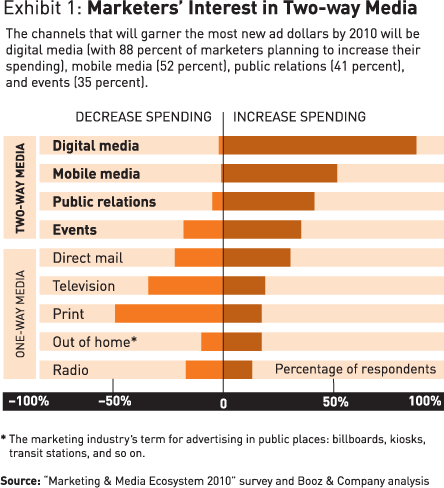 In fact, the majority of leading marketers are using two-way media such as blogs, word-of-mouth programs, and social networks to connect with consumers while employing predictive modeling tools to determine and continuously update their media mix. Moreover, marketers are shifting their spending to the channels, both digital and nondigital, that offer them the opportunity to engage in a dialogue with consumers. (See Exhibit 1.)
Nike has long been a pioneer in innovative strategies for interacting with its consumers. Take Nike+, a joint initiative with Apple Inc. and digital agency R/GA, which allows runners to monitor their workouts via a sensor in their Nike footwear that sends live data on heart rate and calories burned to their iPod. Runners can post their workout results online and participate in a community of both serious runners and novices at www.nikeplus.com. Recently Nike used the Web platform to engage 800,000 runners in the “largest race in the history of the planet,” according to Joaquin Hidalgo, Nike brand CMO. The Nike+ Human Race on August 31, 2008, featured 10K races in 25 cities around the world.
As the physical event literally moved across the globe — from Singapore to Tokyo to Los Angeles to Bogota to Sao Paulo to Paris to Munich to Seoul — digital media enthusiasts tracked its progress live online. “It was a consumer experience we couldn’t get anywhere else,” noted Hidalgo during a recent speech. “Our revenue climbed as running became our fastest-growing category. And, more importantly, it showed us all how we could combine consumers’ physical and digital experiences to create powerful new connections with our consumer.”
• Place context on par with content. The distribution of marketing messages — their timing, context, and relevance — is becoming as important as their creative execution in today’s ecosystem. You have only to witness the meteoric rise of search-based ads to understand that clever creative content takes a backseat to clever placement, at least in online advertising.
Consequently, marketers are steadily raising the profile of media strategy and planning within their organizations. They are establishing senior media positions and shifting their recruiting strategies in order to build capabilities in “communication planning” — the current term of art for the function charged with allocating a company’s entire marketing spend across both paid media and below-the-line programs. Approximately one-fifth of the marketers in our study have already invested in internal communication planning functions. And the majority of marketers expect their media agencies — those that plan and execute their media buys — to become ever more important partners.
Associated with this heightened focus on the media mix is the demand for greater flexibility and speed. In fact, most marketers are already buying and adjusting media on a weekly or even daily basis as needed. More than half of the marketers in our survey said they expect the media buying process to look more like the stock exchange in five years; media will be bought and sold on a real-time, transparent, and continuous basis. Good-bye, upfront. Hello, 24/7 marketplace.
Marketers that have not shifted greater focus to media planning will have to play catch-up. They need to incorporate media earlier in the marketing strategy process than they do now and keep it fully integrated as campaigns and initiatives unfold. Moreover, they need to institutionalize vehicles for media experimentation and innovation. Currently, fewer than one in four marketers has a centralized fund for media experimentation.
• Master the new calculus of communication. If there’s a single point on which marketers, agencies, and media companies can agree, it’s the need for clearer and more consistent measures of advertising effectiveness across traditional and digital media channels. Indeed, the lack of reliable and standard metrics is the principal impediment to the entire ecosystem’s transition to a new marketing and media model. More standard metrics would give marketers and their partners permission to move beyond experimental spending and toward lasting innovation and change. Moreover, they would enable entirely new ROI and compensation models.
It’s one thing to collect digital information; it’s quite another to draw intelligence from it. Leading marketers are building partnerships with digital agencies, traditional media agencies, and media companies to track ad placement, versioning, and effectiveness. And marketers, agencies, and media companies alike are hiring “quant jocks.” Nearly a quarter of marketers surveyed are adding positions in marketing and media analysis and fishing from a new talent pool of digitally savvy mathematicians, engineers, and computer scientists.
But they are unlikely to succeed unless they can learn to collaborate on a recognized set of metrics. Carolyn Everson, chief operating officer for ad sales at MTV Networks, notes, “New digital platforms generate a ton of data, but we haven’t yet cracked the code in developing universal measures of success across both traditional and new media. For marketers to plan, measure, and optimize audiences, metrics require standardization. For example: How will we track audiences across multiple platforms? What is the value of cross-platform reach and engagement? We are constantly working with clients to address these questions.”
The principal hurdle in the development of a universal standard appears to be lack of cooperation. Six out of 10 agencies in our study reported that marketers’ unwillingness to share objectives or targets inhibits their ability to measure effectiveness, and nearly half indicated that marketers are using old methods of measuring success that do not include digital media. Three-quarters of media companies want to better understand what marketers want to measure; the relevance of metrics can vary by industry and sometimes even by brand.
Although greater standardization will come with time, marketing and media ecosystem players will retain much metric heterogeneity for the foreseeable future. If they want scorecards, they will have to create their own. MTV, for example, developed a proprietary planning tool called T-ROI, which helps marketers assess the total return on their investment in MTV’s media properties. Leading marketers are already looking beyond such popular allocation tools as historical spending adjustments and marketing mix modeling and are incorporating new tools, such as targeting based on consumer behavior, database marketing, Web analytics, and predictive modeling, in planning their media activities. These are the companies that stand the best chance of “torturing the data until it confesses,” as Paul Price, global president of ad agency Rapp Collins, puts it.
• Collaboration is king. The marketer–agency–media chain used to be simple and straightforward. Now, that linear model has morphed into a spiderweb of overlapping connections and interdependencies. In a more complex marketing ecosystem, where marketers want best-of-breed ideas and execution, everyone needs to develop partnering skills to get things done and access new sources of data.
Marketers are partnering directly with media companies, specialty agencies are multiplying, large agencies are diversifying their portfolios, and media companies are expanding the depth and breadth of their services. This erosion of boundaries has hardly been free from tension, but it has compelled companies to move in important new directions. As an example, WPP Group PLC, parent company of numerous marketing and advertising agencies, is jointly funding research on the efficacy of online marketing with Google — a company that WPP CEO Martin Sorrell famously characterized as a “frenemy.” WPP rival Publicis Groupe SA has also entered into partnerships with Google as well as Microsoft, Yahoo, and AOL to support its open source ad network, dubbed VivaKi. Publicis and Google are also working together on various mobile advertising initiatives.
Marketers, ad agencies, and media companies need to partner in conceiving, executing, and monitoring winning marketing strategies. Various models will emerge that are tailored to the unique dynamics of the company–consumer relationship, but the dominant model is likely to be led by marketers.
Becky Saeger, chief marketing officer of Charles Schwab & Company, asserted at a recent ANA panel discussion of the “Marketing & Media Ecosystem 2010” study that the client must play the role of quarterback “whether we want to or not, because the fragmentation is so intense.” Co-panelist Steve Sullivan, senior vice president of communications at Liberty Mutual Group, agreed: “Today’s marketing plans are much more like a mosaic of thousands of little pieces. And you’ve got to figure out which ones go where and what the patterns are, and then glue them all together.”
Already, leading marketers are investing in capabilities that bridge the gaps between media, creative, and brand strategy. The savviest companies will develop an internal “integrator” position (which could reside in communication planning) and will appoint senior media leadership.
Other marketers will rely on their advertising agencies to play this integrator role, at least in selected circumstances. For a recent deodorant product launch, for example, Unilever PLC hired one agency to serve as the “conductor,” integrating all the other agencies and elements of the campaign. This conductor agency was responsible for the budget, the time line, and the overall execution of the entire program. Kevin George, vice president and general manager of the company’s combined antiperspirant, deodorant, and hair care business, acknowledges that it was initially “politically challenging for our other agencies, but it gave our brand teams one point of contact, which saved a great deal of time, strain, and complexity on our end. This is not the right approach all the time, but we gained a lot of learning about a different way of working.”
Dell and WPP pursued a different route. Frustrated with the sheer complexity and loss of efficiency associated with coordinating the efforts of some 800 providers of marketing services, Dell put its entire account up for review. It ended up awarding a budget of $4.5 billion over three years to a brand-new bespoke agency, Enfatico, that was created, staffed, and fully customized to Dell’s needs by WPP. This agency is devoted to Dell and Dell only for the term of the contract.
Media companies are also stepping up and taking on greater responsibilities in integrating various campaigns. Media companies sit atop a mountain of valuable data on consumers; they have direct visibility into what consumers want and do, so there is a substantial opportunity for them to provide insights and consultative services to marketers and agencies. In the process, they can benefit their own ad sales efforts. In fact, three-quarters of media companies recognize the importance of providing insight into consumer behavior to marketers and believe they should have a role in doing so — a view, incidentally, not shared by the majority of ad agencies, which believe that this responsibility lies primarily with them.
Navigating the New Ecosystem
It’s not just digital media companies that are in the vanguard of such innovation. The Meredith Corporation, a publisher of women’s magazines, has in the past couple of years acquired five digital agencies specializing in customer relationship management, word-of-mouth marketing, custom health care, and online marketing. Now Meredith can not only offer advertisers such as Kraft Foods Inc. the opportunity to reach women through Better Homes & Gardens and Ladies’ Home Journal; it can provide clients like Kraft with a variety of digital solutions and related agency services as well. The benefits to Meredith are twofold. The company can broaden and deepen its relationships with key advertisers, and it can expand into revenue streams that go well beyond print advertising sales.
In the near future, marketers will need to develop an understanding of which capabilities they should keep in-house (e.g., those that can achieve scale across the portfolio and that create essential advantage) and which should be outsourced to external marketing, media, and technology partners. Agencies and media companies, in turn, need to open their minds to alternative ways of working with marketers and one another, ways that are more strategic, solutions-focused, and streamlined.
The greatest opportunities for surviving in this new ecosystem — and, in the end, securing a leading position — all relate to making the system itself less complex. Ownership and responsibility need to be clarified; the marketing process itself must be made more flexible, fast, scalable, and precise. To accomplish that end, marketers, agencies, and media companies need to bring digital platforms out of the back room. It is increasingly evident that digital acumen is no longer a niche capability; it is part of the central and requisite skill set for all marketers, agencies, and media companies. Nor is electronic media an ancillary revenue stream; it can and will be the core component of many campaigns.
Winning marketers, therefore, have shifted their creative and media strategies and aligned their organizations and culture to fully capitalize on the online opportunity. Industry-wide, companies are making digital media a bigger priority in their brand strategies. Mass advertising will continue to perform a role in driving awareness, but marketers will prioritize channels that deliver accountability, relevance, and interactivity.
As we look out on the marketing and media ecosystem and witness its evolution, we will continue to see competitors emerging in new forms and traditional players taking on roles formerly outside their purview when it comes to connecting with consumers. The linear value chain that used to characterize marketing has been replaced with a vast, interconnected community of brands, consumers, and media. Just as no one species is assured success, no one species is necessarily destined to fail. Survival hinges on the ability to adapt. Those companies that convert through conversation, that collaborate in executing and measuring what matters, and that emphasize the medium as much as the message carry a decided advantage.
|
How Media Brands Become Marketers’ Partners |
|
Audiences today relish the on-demand lifestyle afforded by digital technology, which makes those audiences more fragmented, distracted, and mercurial than ever. Many of MTV’s young viewers are online while they are watching TV, and they are prone to skip through ads with the aid of their digital video recorders (DVRs). We know this, and our advertisers know it too, which is why MTV Networks (MTVN) has made branded entertainment and brand integration a major part of the company’s business model. |
|
Courting — and Counting — Consumers |
|
Digital platforms transform the traditional marketing and media ecosystem into an intimate, immersive, accountable environment, in which consumers can interact with brands at every level of the purchase funnel. This environment engages consumers by providing relevant, interesting value in the form of an idea, a product, a service, an experience, or an application, rather than just a marketing slogan or jingle. It benefits marketers by furnishing a direct, uninterrupted view of the consumer and a measurable, efficient read on the return marketers are generating on each investment. |
Reprint No. 09106
Christopher Vollmer is a partner with Booz & Company in New York. He leads the firm’s North American media and entertainment practice, focusing on strategy development and implementation for clients in those industries as well as in consumer goods. He is the author of Always On: Advertising, Marketing, and Media in an Era of Consumer Control (McGraw-Hill, 2008).
The survey referred to in this article was conducted by Booz & Company with the following organizations:
- The American Association of Advertising Agencies (AAAA) is the national trade association representing the advertising agency business in the United States.
- The Association of National Advertisers (ANA) is the leading forum for the marketing community.
- The Interactive Advertising Bureau (IAB), composed of media and technology companies, educates marketers, agencies, media companies, and the wider business community about the value of interactive advertising.
