

Measuring Your Way to Market Insight
To build closer connections to customers, start by developing analytical prowess.
(originally published by Booz & Company) |
|
Photograph by Holly Lindem
|
But the company had no way to evaluate the effectiveness of this spending. The sheer number of events was daunting, and each brand ran its promotions in its own way, most with a seat-of-the-pants approach to measuring success. For one event, a salesperson could only quantify the results this way: “There were more than 600 people there. They were young and single and had money to burn.”
It wasn’t long before the company’s leaders realized that they needed a more rigorous analysis of the return on their investment in this campaign. They finally imposed this rigor by creating a database of event cost information and requiring a simple breakeven analysis for any proposed event: calculating the number of bottles of liquor the attendees would have to purchase to cover the cost.
The results were eye-opening. It turned out that the breakeven cost of the events varied widely. In the most extreme cases, for the company to break even, each attendee would have had to purchase no fewer than 80 bottles of the premium Scotch being promoted — more than many people would consume in a lifetime.
By helping the company’s marketers understand how much volume each event would have to deliver to make financial sense, a basic business case analysis allowed them to gauge their spending. As a result, about one-fifth of the budget was reallocated away from events whose profitability was doubtful, and a 10 percent improvement in marketing effectiveness was captured.
As marketers move to a more varied, shifting mix of advertising and promotion, they are coming face to face with the lack of insight they have historically had about which media choices work well, why customers buy, and what returns will be generated by their spending. This lack of insight did not matter very much when marketers had no choice but to depend on television, radio, and print — the traditional mass-market media. Television’s gross ratings points (GRPs), which measure the percentage of a target audience reached by a particular advertisement, didn’t explain why particular ads or placements led to increased sales and others didn’t, but that combination of mass media and metrics was the only game in town. Now, however, there has been an explosion of media vehicles, and data is much more complete, granular, and evocative of consumer attitudes and willingness to purchase products. It is possible to accurately quantify the return on marketing spend (also known as marketing ROI). All that’s lacking is the sophistication needed to gain insight from analytics, and the will to use that insight — not just in the marketing function, but in the company as a whole.
The Path to Mastery
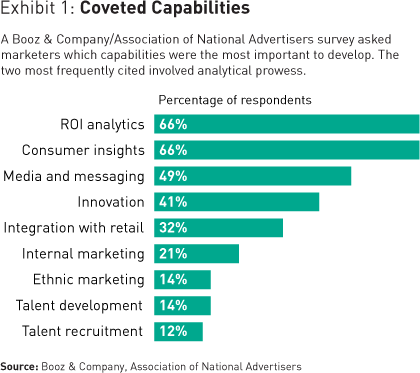 The need for marketers to develop analytical prowess — the ability to use data and analytical approaches to optimize the return on marketing spending — is already well established. An ongoing study by Booz & Company and the Association of National Advertisers (ANA) reveals that ROI analytics and consumer insights (many of which are derived from analytics) are the two capabilities that marketers identify as the most important to develop. (See Exhibit 1.)
For all of their interest in analytics, however, relatively few marketers have mastered them. Our own conversations with senior marketing executives suggest that perhaps one in 20 has fully developed analytical prowess. How can they build this capability? The starting point is data. Marketers must first learn how to identify and collect the data they need. There are two broad categories: financial data and customer response data.
• Financial data. For the purposes of marketing ROI, financial data comes in two varieties. The first is data pertaining to the cost of the event. Event cost data includes all the expenses incurred preparing for, staging, and responding to an event. For a golf tournament sponsorship, for example, that might include the sponsorship fee; the cost of designing, printing, and installing signage; and the ancillary costs of hosting guests, such as tent rental, catering, and waitstaff.
It is relatively easy to collect event cost data because these expenses are paid from the marketing budget. But complications can arise when individual events are part of a larger program or media buys are outsourced. In cases like these, costs are often bundled together; isolating the data at the individual event level may require the marketer or vendor to do some extra work. Highly decentralized marketing spending, common in retail banking and with some retailers, can create another barrier to collecting event cost data. This may require the creation of data collection processes that extend throughout the organization.
The second type of financial data, profitability data, includes much of the information that companies use to calculate their margins, such as the selling price, variable cost of goods sold, and other variable costs such as shipping. (It does not include fixed costs such as overhead in a plant or at headquarters.) Essentially, this data answers the question, How much money do we make when we sell an extra widget thanks to our marketing program?
Profitability data is essential to the calculation of marketing ROI, but it can be more difficult for marketers to collect. Marketers’ access to such data varies widely. Some companies embrace the concept of open-book management and share profitability data across the organization; others refuse to provide even their senior marketers with profitability data.
Additional complications arise because some companies group their expenses into line items that make it difficult to isolate variable costs from fixed costs; others don’t account for costs with enough precision to enable reasonably efficient data collection. In these cases, the collection of profitability data can require changes in the reporting system. Nevertheless, there is a silver lining: Profitability data is internal data, and when marketers make a strong business case for gaining access to it, they must enlist the support of their colleagues in finance. They thus have an opportunity to begin creating organizational buy-in for an ROI approach.
• Customer response data. This data also comes in two varieties. The first is self-reported data, information that customers provide about themselves. This information includes attitudinal data such as brand loyalty, awareness, and the willingness to recommend a product to others, as well as purchase data (in this case, information that customers volunteer about their purchases).
Self-reported data is gathered in a variety of ways. Most large companies have in-house market research departments that survey current and potential customers to learn about their attitudes and behaviors vis-à-vis the company’s brands. There are also many external sources, such as independent research firms that package and sell this data or accept commissions for dedicated studies.
The second variety of customer response data is behavioral data. This can be observed or recorded, as in test-drive statistics for car dealerships or reports on the forwarding of marketing e-mail. But most often, behavioral data is based on transactions, collected at the point of purchase from scanners at cash registers; from retailers, dealers, and distributors; and from a variety of other sources. Transactional data tells the marketer what the customer bought, where and at what time the purchase was made, the frequency of repurchase, and similar hard facts. It is the most valuable ROI data because it represents actual customer behavior.
Transactional data can also be the most difficult data for marketers to obtain. For instance, when a designer apparel manufacturer tried to determine the ROI of its annual New York Fashion Week advertising blitz, it was able to capture transactional data from company-owned stores, but the department stores that sold the majority of the company’s apparel refused to share their transaction data because they viewed the company as a direct competitor. In this case, the only available solution was to develop a model that estimated the advertising impact in the company stores and then extrapolated that impact to the larger universe of department stores.
Marketers simply are often unaware of the data that is available to them. For example, pharmaceutical company marketers invariably say that they cannot obtain the same level of detailed response data that consumer packaged goods marketers enjoy. But every filled prescription is recorded, and firms such as IMS Health Inc., which gathers information from 850 million prescription sales in 100 countries each month, have created huge repositories of this data. Pharmaceutical marketers are well aware of these databases in other contexts; in fact, many of them already buy aggregated data and analytics from IMS. So when marketers say they can’t get the data for use in ROI analytics, it is often a reflexive answer. They simply have not thought about how to obtain response data at the granular level and how best to use it.
Demystifying Analytics
There is no “silver bullet” in marketing analytics — no single approach that is always the best choice to meet the various constraints that marketers face in the real and often chaotic world of business. Some types of analytics produce more accurate results; some are more mathematically sophisticated. But, when properly used, all of them can produce viable answers for marketers. Thus, if the first step for marketers developing analytical prowess is to learn how to identify and collect the data needed to establish ROI, the second step is to understand the analytical options and how to choose among them.
There are three broad categories of analytics. A good way to visualize them is to think of them as existing on a continuum. (See Exhibit 2.)
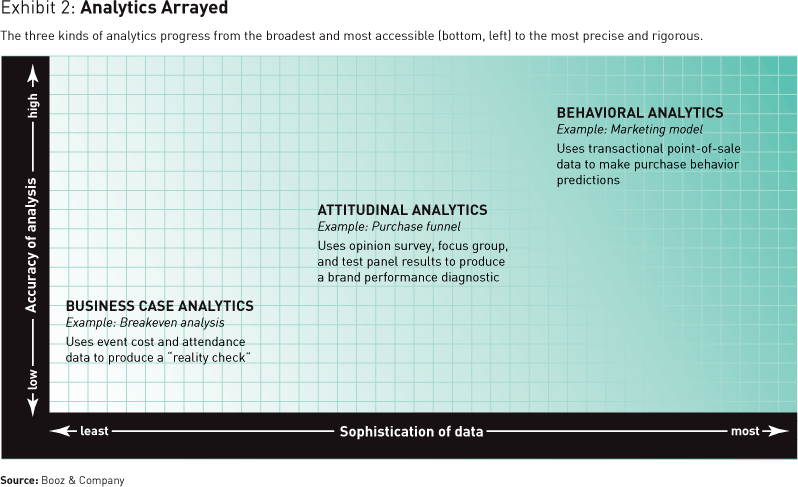
• Business case analytics. Business case analytics (those used to directly evaluate a proposed marketing investment decision) don’t require customer data or produce an ROI. But they can be implemented with a minimal amount of data that is usually close at hand within the company. Typically, these analyses are relatively uncomplicated and require only simple, “back-of-the-envelope” calculations. For these reasons, they are particularly useful when initial reality checks are needed, analytics capabilities are not yet fully developed, or other types of data are unavailable.
Breakeven analysis, for example, does not generate an ROI. But it does produce an upper and lower set of boundaries that marketers can use to weigh their investment decisions. There are many ways to use breakeven analysis, depending on industry, company, and market vehicles. For instance, the aforementioned global wine and spirits distributor used it to evaluate promotional sampling events because the financial data was incomplete and customer response data was unavailable.
• Attitudinal analytics. Attitudinal analytics measure customer opinions, perceptions, and self-reported behaviors. Their advantage is the ability to measure and forecast qualitative metrics, such as brand awareness and purchase intent. They allow marketers to understand brands more comprehensively than business case analytics, but they are less accurate and less ROI driven than their behavioral counterparts.
One very useful framework for attitudinal analytics is called the purchase funnel. (See Exhibit 3.) This well-known conceptual map traces prospective customers from their first exposure to a brand (brand and product awareness), through growing levels of interest and engagement, triggered by a succession of “actionable levers”: different types of marketing and promotion. At each level of the purchase funnel, various measures can provide insight into how well a product is performing. Most companies measure performance through a combination of self-reported, behavioral, and financial data. Taken together and combined with sophisticated analytics, these measures can indicate the likelihood that, for any given product, customers will move down to the next level of the funnel, toward greater purchase probability and brand loyalty.
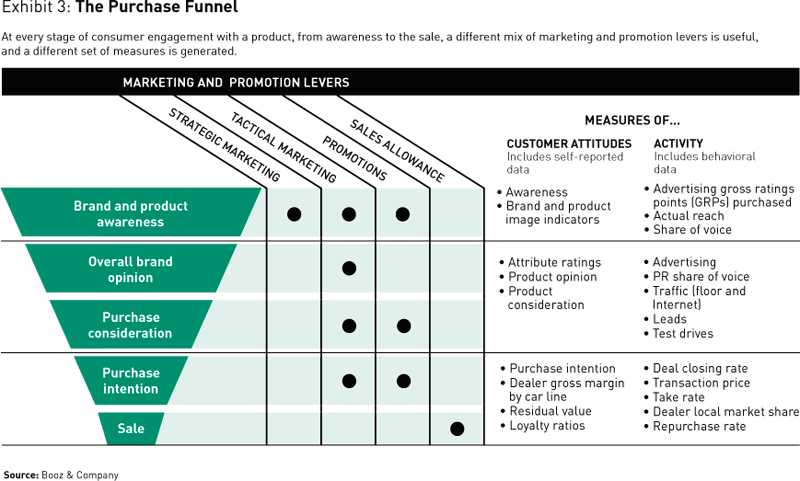
As diagnostic tools, attitudinal analytics augment the funnel by measuring the views held about the brand by its current and targeted customers at any point in time. With this information, marketers can look at their “scores” for the different levels of the funnel and identify ways to improve response. For instance, if a specific brand of car enjoys a consumer awareness score of 99 percent, but only 17 percent of consumers have a positive opinion of it, its marketers know they should focus their attention and spending on the brand’s reputation.
When combined with regression analysis (statistical methods used to describe the causal relationships among changing variables), attitudinal analytics also enable marketers to predict how marketing investments would affect consumers’ attitudes about the brand. For instance, car marketers can predict what impact a higher opinion score for the vehicle would have on consumers’ purchase consideration or actual purchases.
• Behavioral analytics. Behavioral marketing analytics are driven by computer models, powered by algorithms, and fueled by transactional data. These sophisticated analytics use actual customer responses to measure ROI and to predict how customers will respond to events such as a price change, a promotion, or a TV ad.
The most valuable such models predict the purchase behavior of customers. Developed over the last 25 years, they allow marketers to isolate the impact on sales volume and ROI of factors such as advertising, pricing, promotion, word of mouth, special events, and seasonality, as well as those variables that marketers have little or no control over, such as weather and the actions of competitors. These models apply multivariate regression analysis to manipulate data around a series of variables and produce a simple yet often highly accurate prediction.
Marketing models designed to help companies manage and optimize their spending in new media are also emerging. For instance, Yahoo Inc. has teamed up with ACNielsen (a division of the Nielsen Company) to form Yahoo Consumer Direct, a service that offers marketers a way to reach narrow customer segments online and to measure responses on the basis of actual purchases.
Today, several analytics companies are busy building and refining the holy grail of marketing analytics — the modeling of a company’s entire marketing mix. These models can tell marketing executives how much of their budgets to invest in various vehicles such as print, TV, radio, and Internet. M-Factor Inc., a company based in San Mateo, Calif., has built a model that can cover all marketing vehicles; they have turned it into a software-based service used by such major marketers as Kellogg, Wendy’s, and Coca-Cola. The potential value of marketing mix models is enormous; according to a study by the Marketing Leadership Council of the Corporate Executive Board, based in Arlington, Va., companies expect that use of these models will boost returns on their marketing spending by 20 to 30 percent.
Choosing among Approaches
To develop the best portfolio of analytics for its specific situation, a company should consider three variables: data availability, internal capabilities, and brand objectives and vehicles.
Because analytics require data, the first consideration in choosing among them is the availability of that data. If transactional data is available, behavioral analytics should be the first choice. If transactional data is not available, but self-reported data is at hand, then attitudinal analytics are preferable. And if profitability and event cost data are the only data available, business case analytics may be the best option.
The second consideration in choosing analytics is the internal capacity of the marketer’s organization. For instance, there is no sense in collecting transactional data and choosing modeling as an analytical approach if the organization doesn’t have the statistical expertise needed to build a model or the budget to buy one. The company must focus on analytical approaches that it has the expertise to execute immediately.
At the same time, company leaders should start thinking and planning for the long term. What metrics do they need? Which analytical approaches can provide insight into them? The critical issues of analytics are reproducibility and reliability. The marketing ROI capability cannot be outsourced, and eventually, even if calculations are outsourced, internal expertise will be needed to manage the process and ensure the quality of the outsourced service.
The third consideration in choosing analytical approaches is the marketing objectives for the company’s brands. Ideally, marketers set brand objectives based on where the brand is in its life cycle. They then determine which vehicles can best achieve those objectives. Different campaigns employ different marketing vehicles that produce different levels of data availability and involve different levels of investment, and thus require the use of different analytical approaches.
For example, launching a new product typically requires large investments to build brand awareness. The marketer would choose vehicles such as billboards, Web sites, and sponsorships in support of that goal, and an analytical approach — probably the purchase funnel — that is focused on a qualitative metric. Conversely, if a company were trying to boost purchase on a mature brand in a competitive market, it might choose consumer coupons, TV ads, or Internet direct sales and use an analytical approach — in this case, modeling — that measures purchase behavior more directly. In general terms, brand-building efforts that seek to affect customer perceptions generally suggest attitudinal analytics. Objectives focused more directly on sales and volume generally suggest behavioral analytics.
When marketers fully develop their analytical prowess, they can use multiple analytical approaches to optimize their return on spending and stimulate accountability and creativity. In weak economic conditions, this capability is not only critical to maintaining a strong corporate commitment to marketing — it may well be essential to the future of the company as a whole.
Reprint No. 09107
Leslie H. Moeller is a partner with Booz & Company in Cleveland. He leads the firm’s North American work in the consumer, media, and retail industries, and previously led the firm’s global efforts in marketing and sales.
Edward C. Landry is a partner with Booz & Company with two decades of experience in consumer industries. Based in New York, he focuses on strategy development, business transformation, and sales and marketing effectiveness across a broad range of consumer businesses.
This article was adapted from The Four Pillars of Profit-Driven Marketing: How to Maximize Creativity, Profitability, and ROI, by Leslie H. Moeller and Edward C. Landry, with Theodore Kinni (McGraw-Hill, 2009).
