
The library rebooted
Even in an era when you can “Google” just about anything, many libraries have remained as vibrant, dynamic, and popular as ever. They’re staying that way by redefining the business they’re in.
Up until a decade ago, the community library was the go-to place for the sixth grader writing a report on a political election or the parent helping her child investigate college options. There was no better source for that information. Research libraries served a similar function for scholars needing access to rare documents, authors looking into remote corners of history, and lawyers seeking precedent. Again, no place was like the library.
 |
|
The main reading room of the New York Public Library in midtown Manhattan. The library has raised US$250 million to renovate the facility and transform it into the world’s largest comprehensive library open to the public.
Photograph by Dean Kaufmann |
The Internet has supplanted that core function of the library’s purpose by giving users access to much of the world’s information in roughly the time it takes them to start their computers and make a cup of coffee. In the era of the instantaneous Google search, information research and retrieval are irrevocably changed. And Google itself has, to all appearances, stepped into the library business directly with a massive project in which it intends to digitize all of the world’s books.
How to stay relevant? That question has been gnawing at library administrators and boards for years, as more and more information makes its way to the Web. And the question has become especially pressing amid a global economic downturn that is reducing libraries’ funding at the very moment when they would like to experiment and stake out new ground in the digital future. In this respect, library administrators are a lot like executives at newspaper companies, magazine publishers, movie studios, and major music labels — indeed, any business that markets something that can be delivered digitally. They must break out and offer something new and different at the same time that their investment capital is shrinking.
And yet even as the Internet encroaches on their turf, one seldom sees signs of lifelessness or decline at libraries. To be sure, some research libraries that have done little to stay current have lost visitors and are fading. But all over the world, from the East End of London to malls in Singapore to just about every part of New York City, libraries are serving hundreds of thousands of visitors each year, bustling with activity, and increasing the number of items they loan out. Their vitality is unmistakable. Libraries, it’s clear, retain at least some control over their future — and the changes they are making may be instructive to information organizations throughout the private and public sectors. Those changes include overhauling operating models that in some cases are decades old, and launching new digital initiatives to meet users’ needs.
The Community Library’s Relevance
Like many for-profit industries, the library business isn’t monolithic. Libraries exist in two fundamental forms. There are the public, or community, libraries, usually funded by local city and state taxes and charged with a civic mission. They provide a place for young children to learn, for students to socialize and study, for job applicants to gather information, for immigrants to learn their adopted country’s language, for seniors to read the newspaper, and for any cardholder to borrow books, music, or videos. The good ones are run by entrepreneurial librarians who understand the needs of the community and actively seek to meet them. Second, there are the research libraries, like the U.S. Library of Congress, the British Library, and university libraries that serve as repositories for unique or important documents that never leave the building, and that are used primarily by scholars, authors, and graduate students with serious academic and research needs.
Not surprisingly, it is the community library that is finding it easier to demonstrate its relevance in the age of the Internet. To see why, one need look no further than the Bronx Library Center, a three-year-old branch of the New York Public Library (NYPL).
Near the entrance are shelves holding DVDs and CDs. Shopping baskets — the kind you’d pick up at the entrance of a supermarket — are stacked on the floor, inviting visitors to carry multiple items. A back wall displays the library’s collection of illustrated novels — the full-length adult comic books that have recently become popular with younger readers. A sign with scrolling red type above the checkout desk advises patrons of the live performances that will be taking place over the next few weeks in the downstairs auditorium; today it features a show by the Thunderbird American Indian Dancers, a cultural preservation group. Inside the auditorium, powwow drums thump out their rhythms; most of the 150 seats are filled.
On the library’s four main floors, the stacks of books have been placed at each end, leaving ample space in the middle for tables that have computers on them, many with broadband access to the Internet. The people using the computers are young and aren’t necessarily using them for academic purposes — here is one doing a Google search on Hannah Montana pictures, there is one updating his Facebook page, and over there a few children are playing video games, including The Fight for Glorton. Librarians answer questions and organize online gaming tournaments, and none of them are shushing anyone. The place is packed with people, most of them under the age of 18. They have been drawn by an environment that seems more reminiscent of a community center, Internet café, or bookstore than a library. An observer might quarrel with the library’s de-emphasis of books, but he or she would be wrong to assume no learning is going on here. Kids are reading, exploring, and acquiring knowledge. They’re just not doing it the old-fashioned way.
Clearly, what this branch of the New York Public Library is doing is redefining the business it is in. The Bronx Library Center is no longer just in the book-lending business; rather, it is in the gaming business or the entertainment business or maybe the information connectivity business. And yet, these “loss leaders” (the language of retailing seems appropriate) allow the library to also offer services that are consistent with its civic mission. The high school junior can find SAT and ACT test books. At the career and education center, visitors can learn to write a resume or cover letter, find out about scholarships, or get help applying to college. And the library’s overwhelmingly young audience does take out books, as well as CDs and DVDs — four times the number of these items borrowed at the average New York Public Library branch.
 |
|
Egypt's Bibliotheca Alexandrina,
Photograph © Sylvain Grandadam/opened in 2002, offers computer access and a wide range of programs and events. The Image Bank |
The NYPL isn’t alone in following this approach to maintaining relevance in its branches. Library systems in Los Angeles, Singapore, and Alexandria, Egypt, among others, have likewise added youth centers to drive foot traffic. The Toronto Public Library encourages teens to drop in for online games and music videos on Friday afternoons. The Stanford University library has created an online identity in Second Life, the online “virtual world,” allowing users to explore the library in this popular new medium. The Idea Stores, which the London borough of Tower Hamlets is building in some of its most densely populated neighborhoods, provide Internet access in a country where only about 42 percent of the population has Internet access at home. Community libraries might offer a similar benefit in nations such as Italy, Greece, and Turkey, where adult literacy rates are high (99, 98, and 88 percent, respectively) but the vast majority of homes do not have Internet access. In all countries, Internet-connected computers at community libraries offer a bridge across the digital divide to immigrants and those on the lower rungs of the economic ladder. In a more abstract sense, community libraries also embody a civic virtue, since they remind us of what it means to live in a society that is enlightened and progressive and that values the intellectual enrichment of its citizens. This is good for the users of the libraries, good for the libraries’ communities, and — ultimately — good for the taxpayers who fund the libraries.
The Research Library’s Digital Challenge
It is at the research library that we run smack up against the power and ubiquity of the Internet, and where the question of future relevance becomes harder to answer. Why would you go to a research library if you can find what you need faster and more efficiently online? The answer is you wouldn’t, and this explains why, globally, visits to research libraries have been declining dramatically. The decline may become even more precipitous as Google gets deeper into its Google Books Library Project; for this multiyear effort, the search giant has been scanning tens of millions of books and has already secured the cooperation of about two dozen richly endowed library systems, including Harvard’s, Princeton’s, and Columbia’s.
By turning over substantial parts of their collections to Google, aren’t libraries contributing to their own obsolescence? That risk is always there, but the libraries’ hands are tied. Most of them barely have the funds to preserve and expand their physical collections — and a comprehensive digitization initiative, at a cost of roughly US$15 to $25 a book, would cost some of these institutions $1 billion or more. There’s no getting around the fact that in working with Google, the libraries are taking the same kind of chance newspapers have taken in making their content free on the Internet — the risk that fewer and fewer people will feel the need to hold the physical object in their hands.
Research librarians need to accept that people will no longer come to them for certain things, now that the information is available online, but they also need to think about the role-expanding possibilities that the Internet affords them. Where research librarians were once primarily in the business of being collectors and curators, and of providing one-on-one research assistance to those seeking it, they now have an opportunity to share their expertise and collections with a much wider audience. Digitizing the best parts of what’s in the vault and making a virtual exhibit out of it? Bringing related collections from other research libraries under one digital roof? Helping to actively build a virtual community of scholars and shaping the research agenda? The research-librarian-cum-blogger? It’s time to try new things. The alternative is having no digital strategy to speak of at a time when research is overwhelmingly moving online.
The issue of copyright has already slowed Google’s efforts to create a universal online library. Many of the most valuable rare materials that libraries possess, and that researchers would be interested in — early versions of a manuscript that would go on to become a literary classic, for instance, or the correspondence between world leaders during a time of crisis — are protected by U.S. copyright laws, which cover written materials from 1923 onward. A library acting as the guardian of such materials couldn’t turn them over to Google even if it wanted to. Complicating matters further, many libraries have rights to use and share physical documents but don’t have intellectual property rights to digitize or create a digital representation of them, since agreements to manage many of these collections predate the Internet.
Google is, of course, aware of the copyright issues, which it spent two years negotiating with the Authors Guild and the Association of American Publishers. And it went a long way toward settling the matter in October 2008, when it agreed to pay $125 million to compensate authors and publishers and to set up a registry to guarantee copyright holders payment for the use of their materials. As a result of the settlement, the vast majority of rights holders are likely to let Google post the full content of their books online. That may prompt research libraries to opt to not digitize some of their most valuable collections, to preserve exclusivity through physical possession — a move that may help them in the short run but that could cause disaffection among researchers in the long run.
As they struggle with their shrinking domain in a digital era, the best research libraries aren’t standing idly by. The New York Public Library is re-creating its landmark Fifth Avenue research library by moving much of the storage of its vaunted research collection underground, beneath the adjacent Bryant Park, and devoting the freed-up space to a lending library and areas for children, teens, and seniors. The library is also narrowing its research focus and selectively digitizing some parts of its collections, while looking for ways to get users to interact with those digital collections. Prioritization and selective digitization are going to become important capabilities at all research libraries in the future. Indeed, such libraries may want to consider commercial enterprises’ approaches in this regard, even to the point of selling off or exchanging “nonstrategic” parts of their collections in arrangements with other libraries.
But can research libraries really make their treasures (often created with quill pens on parchment) come alive online? The U.K.’s biggest library provides an exuberant answer to that question. Under Chief Executive Lynne Brindley, the British Library has created digital exhibits of some materials complete with a curator’s narration. The project amounts to a guided Web tour of some of the most prized parts of the library’s collections, and one could argue it provides a more compelling experience than seeing the physical pieces under glass. An online visitor can use the library’s Turning the Pages software to view the original manuscript of Lewis Carroll’s Alice’s Adventures in Wonderland, browse through Leonardo da Vinci’s notebooks, or see some of the notations that Mozart made in December 1784 as he worked out parts of a piano concerto. (A link allows the visitor to listen to the passage being played on a piano.) These are examples of repurposing content using an engaging interactive experience, as a television network might do by putting snippets of its shows online or a movie studio might do by posting outtakes or behind-the-scenes features.
These approaches partially address the question of how to maintain relevance. None of them, it must be said, provides a full answer. However, together they offer insights into the steps libraries are taking as they seek to ensure their value at a time when the Internet has reset user expectations.
Seven Imperatives for Library Leadership
The challenge of relevance is leading libraries away from a conventional mind-set toward one that is analytical and pragmatic about opportunities, yet open to transformation and effective at implementing new strategies. In a sense, what library executives need to do is not that different from what their business-world peers are doing in media industries threatened by the Internet, and it is just as important to survival and continued service. Following are seven imperatives that we have identified through our work with leading libraries around the world — including assisting the NYPL in designing its new strategic plan.
1. Rethink the operating model. Many of the old assumptions about running a library — that the measure of a library’s quality is the size of its book collection, that there’s value in keeping even infrequently loaned books on the shelves, that library staffing decisions shouldn’t be questioned — are outmoded and need to be set aside. This is not to say that libraries will be able to re-create themselves as purely digital, service-oriented organizations; that would be a lot to ask of an institution that got its start some 5,000 years ago, with business records and hymns engraved in clay tablets in ancient cities. But many libraries today, operating in paper and film, haven’t changed some of their operating practices since World War II. Their role as the preservers of recorded history means they have to spend a lot of their resources just maintaining the assets they already have.
Still, they can and should try many other things. Libraries may not have the budget to put their entire book collections online — but they should focus on building and enhancing those collections where they have unique strengths that can be leveraged. They should also explore new ways of serving users more conveniently, effectively, and efficiently. Perhaps they can create an online reservation system that patrons can use for a small fee if they want to have a book waiting for them at the front desk when they arrive. Libraries may not have the budget to add a collection of foreign films on DVD, but perhaps they can “find” the money in their budget by eliminating acquisitions of the kinds of books that experience shows have rarely left the shelves. Libraries may be under political pressure to keep all branches open, but they must at least tailor their staffing approaches at these branches to make more efficient use of their resources.
One library we worked with was able to stay open for two hours more per day simply by altering workers’ shifts, rethinking services, and changing library layouts. Such analytically enabled improvements are necessary as libraries come under increasing budgetary pressure.
2. Understand and respond to user needs. Libraries have only the most general information about their users — how many of them there are, what they do when they are at the library, and what they borrow. We don’t blame libraries for not wanting to put themselves in the position of having to provide information to government authorities about their users’ reading habits and other activities. In the U.S., for example, library administrators are right to be concerned about some provisions of legislation enacted after the terrorist attacks of September 11, 2001.
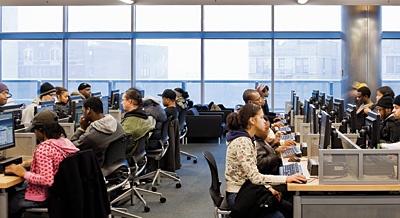 |
| The NYPL's Bronx Library Center was built in 2006 to reflect the way that visitors want to access information today. Photograph by Dean Kaufman |
However, the solution most libraries have settled on — namely, to avoid gathering any detailed information about users’ needs and activities — is far too timid. Libraries should develop advanced capabilities to build aggregated profiles of users, or what retailers call customer segmentation analysis. Who is visiting the library and how often are they coming? What are they doing once they get there? Which books do they borrow most often? Which books never leave the shelves? Which services get used most often; which least? Merchandisers and retailers have tools to help them answer these kinds of questions. Libraries, too, should adapt or create these and similar tools.
3. Embrace the concept of continuous innovation. This is not the time for libraries to shy away from new strategies. Library executives need to do more than innovate, however. They need to approach the innovation challenge with an entrepreneurial mind-set: test, measure, refine. And if something does not work, they must go through the process again: Test, measure, and refine using new ideas and concepts.
The innovation doesn’t have to be of any one type; it can happen across the whole library value chain. For instance, changes might be operational — like the Toronto Library’s use of radio frequency identification (RFID) readers to bring a measure of self-service to the checkout function or the Seattle Public Library’s creation of a conveyor-belt book sorter to reduce handling time. Changes might be atmospheric, such as the background music the Seattle Library now pipes into its domed young-adult sections. Finally, there might be changes in format, including the opening of smaller library “outlets” in what is essentially a variation on a theme already being practiced by retailers like Lowe’s, Wal-Mart, and Tesco. Libraries should appropriate the many traffic-building enhancements that retailers are making to their stores.
4. Forge a digital identity. As not-for-profit institutions, libraries have limited operating funds. In its 2007 fiscal year, for instance (before the crisis hit Wall Street), the NYPL had operating support of about $300 million; the British Library, of about $220 million (£111 million). By our estimate, no more than one-fifth and probably far less of any library’s funds are used to advance its digital initiatives. By contrast, Google, in its 2007 fiscal year, spent more than $2.1 billion on research and development alone.
Clearly, there is no way that libraries could transform themselves into leading-edge Internet organizations even if they wanted to. Nor should they aspire to that. A great many things are in flux, and a library that goes too far with a digitization initiative today runs the risk of creating data structures that will be incompatible with future standards. But some experimentation is in order. Should libraries let people reserve books remotely, from their home or office? Should they adopt a convenient delivery-to-home model, à la Netflix? Should they make their librarians available at all hours to respond to online inquiries? And to the extent that they do these things, should they (as part of rethinking their operating model) charge for some of these services, as the Toronto Library does with a fee-based custom research service? Finally, should libraries pursue these initiatives alone or in concert with one another?
5. Connect with stakeholders in ways pure Internet companies cannot. What determines who wins in a fight between a bear and an alligator, as one saying goes, is the battleground — where the fight takes place. Libraries can’t provide faster online data retrieval than a search engine, and that’s not where they should try to compete. What they can do, on the community library side, is take advantage of their local strength, and, on the research library side, share their service-oriented expertise in new ways and through new channels.
In practice, this means that the leaders of community libraries should have an understanding of the institutions in their community, so they know how to serve students, seniors, the poor, and those without Internet access. Community library leaders who get out and make connections in the community will successfully transform their institution into a fulcrum for many of the issues and concerns that touch local residents. Their programs, services, and offerings will all be better off as a result of this outreach and connectedness.
Research librarians must move beyond collecting and curating and become more adept at connecting with scholars. They should aspire to help build broader and more connected communities among the primary users of their collections. In this regard, they may want to take a page from newspapers’ new playbooks, where staffs are increasingly breaking out of standard news-reporting mode to contribute to blogs, produce online video segments, and answer questions in reader forums. This more personalized approach keeps news — which is already available from innumerable online aggregators — from becoming a commodity. Likewise, the research librarian who enters into an online dialogue with users offers something that will never be available directly from a search engine.
6. Expand the metrics. As they refine their mission, libraries will also have to change how they measure success. Keeping track of the number of monthly and annual physical visitors will still matter, as will monitoring the number of books (and other offerings) in circulation. But online-specific metrics will have to be added, especially as libraries invest more resources in digital initiatives and put bigger parts of their collections online. And it will be important, no matter whether the asset is a physical or a digital one, for the measurements to move beyond the strictly countable (number of books on loan, number of page views, etc.) into attitudinal areas like level of engagement and customer satisfaction.
And at a time when budgets are tight and new operating models are being explored, libraries will have to introduce new metrics to measure staff performance. There may be some resistance to this, especially if the library’s staff is conditioned to think of what it does as a government service that isn’t in jeopardy, that could never be in jeopardy, and that doesn’t operate in a changing “marketplace.” But in the bigger context of changes, this resistance to measurement should be easy to surmount. Institutions that proactively measure performance, embrace change, and look for ways to serve users will have an easier time getting financial support in an era of reduced public resources and private donations.
7. Be courageous. It’s no wonder that the best library executives are feeling a sense of urgency these days, along with a little uneasiness. Their world has changed — a lot. The library’s underlying promise hasn’t changed; the library is still a way for us to break beyond the immediate boundaries of our world, to help our children become better educated, to foster literacy and self-improvement, and to make our societies more prosperous. But the environment in which libraries operate has certainly shifted, and the challenge for those running them is to figure out the evolutionary path they should follow. There is no one answer, which may provide an advantage to those with an appetite for intelligent risk taking. After all, nothing nowadays — nothing at all — is written in stone. 
|
Reinventing the Role of the Research Library |
|
When I first came to the New York Public Library, in 1993, I got a tour of highlights from the library’s collections, including the successive typescripts of Edward Albee’s Who’s Afraid of Virginia Woolf? You could see the corrections Albee made and the way he continuously revised the text and made it better. You could get this close to the creative process. It was a miracle to see. To my mind, Albee’s Woolf papers go to the heart of what makes a research library important. And they show why research libraries in general aren’t in danger of being sidelined by Google, which has set out to digitize the world’s books. As long as there are special pieces covered by copyright, like the Woolf papers, and as long as a library withholds some parts of its collections, Google can’t make those directly available to the public. Someone interested in seeing them would have to come to our library, or to the British Library, or to the Bibliothèque Nationale de France, or wherever the collections existed. I like Google. I was giving a speech the other day, and I wanted to find some clever aphorisms about gratitude. In the old days, I would have gone upstairs to the reading room and spent 45 minutes pulling books of quotations off the shelf, finding them and writing them down. Now, all I did was Google “gratitude quotations,” and I got a lot of great ideas. It was effortless, effective, and efficient. Of course, online search engines are also creating a problem for libraries. Fewer people are coming, because their information needs can be met online. This is less of an issue for neighborhood libraries because many people who use them do so not for research purposes but because there are things there that they cannot afford to have access to otherwise, like computers, or because they need a place to be with other people. Business at our lending libraries is very strong; the numbers are up substantially. Foot traffic has been a bigger concern at our research libraries, and we are taking steps to address that. To start with, we had some data showing that a lot of the materials in the stacks of our Fifth Avenue research library simply weren’t being used or were being used infrequently. We realized we could move the collection underground and use the reclaimed space to create a big circulating library — and a gorgeous new facility for the public. We are transforming the library’s physical footprint. The other part of our strategy for revitalizing our research libraries is to refocus the collections, scaling back our commitment to those that generate less interest and emphasizing unique collections, including archives, photographs, and prints. The idea is to own things that exist in few, if any, other places. To the extent that we can do this, we can make the library a place you need to come to if you want to use those materials — until such time, obviously, as we decide to put them online. And we will be putting things online; our goal is to build a substantial digital library as well, and turn ourselves at least partly into a Web destination. Is it worthwhile for libraries to start the process of having their books — at least their public-domain books — scanned and digitized? Yes, it is. That is why we pushed to be one of the founding participants in the Google Books Library Project. We were the only public library in that first cohort of five libraries. Google performs a very important function for its library partners, which is that they will store your digital files and spare you the cost. That’s a value. Still, there are a few things that libraries do uniquely well. Libraries are really good at sorting things in traditional, vertical silos, and letting you move up and down through them. That’s very different from the broad horizontal searching enabled by Google. Indeed, I believe it will be the libraries participating in Google’s project that will eventually aggregate Google’s book database into something more cohesive. The Internet will also make it easier for librarians to play a role in bringing scholarly communities together and shaping the research agenda. The core library missions of collection and preservation haven’t gone away. We see our preservation role almost as a sacred one — we are the guardians of human expression, if you will. It’s a value system that really isn’t based on the kinds of things one generally takes into consideration in a business environment, where the use of something justifies the expenditure on it. Here, it’s much more of an abstraction; we justify the expenditure because our people have made a decision that a piece of work, a document, is important. And once we make that decision, and the work or document comes in, we’re bound by a certain kind of compact that exists on an intellectual, maybe even ethical level, to make it last. Now, some people may wonder why physical preservation is so important if Google will end up digitizing everything anyway. If a written piece is available online, does its physical instantiation really matter? That’s a very logical question to ask. The problem is that it assumes Google will be around forever. That’s true of very few companies. Our public funding is an important advantage in this regard; this isn’t like running a company that could be acquired or go out of business. We don’t even think in those terms. At the same time, we realize that, like any other institution, we occasionally have to transform who we are and what we do. Our main library branch renovation project, in which we will invest about US$250 million, is a big step in that direction. When it’s completed, the landmark building on Fifth Avenue will be the largest comprehensive library open to the public in human history. We have made extensive organizational changes to support this project, and to make our neighborhood libraries more responsive to the needs of New Yorkers. In the future, one challenge for all libraries will be to fulfill their preservation mission at a time when much of the world’s written material is being produced digitally. We know how to preserve a book. We can stabilize the paper; we can deacidify it. We can basically guarantee it’ll last for the next 500 or 1,000 years. Nobody knows how to do that with digital information. There will have to be some fundamental basic research done in preservation techniques. The research doesn’t necessarily have to go on within a library, but it has got to be done with an eye to the library’s needs. Paul LeClerc is president and chief executive officer of the New York Public Library. |
|
Why Libraries Are Good Investments |
|
A year ago, the New York Public Library (NYPL) asked me to make a major gift to its US$1 billion capital program. I thought the library’s strategic plan — to reinvigorate the library system and make it more efficient from a cost perspective and much more user-friendly — was exceptionally well put together. As a longtime library board member, I didn’t need any special solicitation. It took me all of three or four minutes to say yes. I believe in the three-part vision that was put forward. The first part is the dramatic expansion of the 42nd Street branch, the headquarters of the library, to create a major new lending library co-located with the existing world-class research library. Second is the enhancement of the very powerful hub system in the city’s boroughs, dramatically adding access to computers and the Internet so that we can provide a gateway for middle-class and lower-income residents who want to fully join the digital world. The third part is a rapid digitization of the library’s collections so they will be available not just to the people of New York but globally. All these changes will drive new traffic to the library system — whether in person or online. The changes at the main 42nd Street branch alone, including an architectural transformation of the interior, will generate a lot of excitement and could increase the physical traffic from 1 million to 3.5 million people a year. And those are just the immediate numbers. It’s stunning to think of the seminal thinkers, writers, and achievers who have been helped by the NYPL. Warren Buffett, who was a graduate student at Columbia University and spent a few years as a stockbroker on Wall Street, often used the library as a place to work and study. Barack Obama basically found his job as a community organizer through the NYPL. The next generation is always looking for ways to get ahead, too, and in the United States it’s almost impossible to do that without academic achievement. Libraries provide an essential supplement to the education system. They offer much more than books. Their fixed asset base includes computers that are freely accessible to people for whom access might otherwise be unaffordable. Once people have been provided that digital access, along with a nurturing environment and physical resource material, they have the means to progress and be successful in the information age. As for me, I have been going to libraries since I was 8 or 9 years old. The branch library near my home in northeast Philadelphia was a big, quiet place where you could find your own chair and your own table. Later, when I was at Yale University, I made the library my main place of study. I found it comforting and conducive to thought, in a way that my dorm room couldn’t be. I don’t think this is unusual. Many people prefer a location other than their homes to access material, think, and study. The physical setting of the library provides that sort of separation. Not everyone needs it, but enough people do (and certainly enough people need computer access) to assure me that people will be going to libraries regardless of how much information becomes available on the Internet. This is especially true in a multicultural city like New York where there are vast differences in income and backgrounds and language skills. There are challenges ahead. The worldwide decline in equity values will have a big negative impact on people’s ability to support all nonprofit institutions, and the NYPL is going to get caught up in that to some degree. It’s inevitable. Still, I am hopeful that over the long term, the funding will exist to fulfill the library’s plan. One of the extraordinary things about the NYPL — about any public library, really — is that it is free. There isn’t much in life that is free, let alone the services of a great institution. All you have to do is walk in the front door — it’s accessible to anyone. That’s a pretty neat thing. Stephen A. Schwarzman is the chairman and cofounder of The Blackstone Group. In March 2008, he made a gift of $100 million to the New York Public Library. |
Reprint No. 09108
Scott Corwin is a partner with Booz & Company based in New York, with extensive experience in developing enterprise transformation strategies for clients in the automotive, media, information, and consumer industries.
Elisabeth Hartley is a senior associate with Booz & Company in New York, with experience supporting clients in media, consumer, and nonprofit sectors to develop growth and organizational strategies.
Harry Hawkes, a partner with Booz & Company based in New York, leads the firm’s operations work globally for media and entertainment clients and focuses primarily on performance improvement and business transformation.