
Herman Miller’s Design for Growth
The office-furniture design leader is betting on innovation as it continues to push the envelope of management practice.
(originally published by Booz & Company)At the start of the 2000s, Michael Volkema, then the chief executive officer of Herman Miller Inc., became convinced that growth in the white-collar workforce was going to slow in the company’s main markets. That was a threat to this office-furniture maker, based in Zeeland, Mich., whose revenues depended on products sold to the white-collar workforce — products such as office desks, chairs, panels, shelves, and cabinets. Volkema’s solution was to create the Creative Office, a capability within Herman Miller for identifying adjacent markets in which the company could build businesses that would provide significant new streams of revenue.
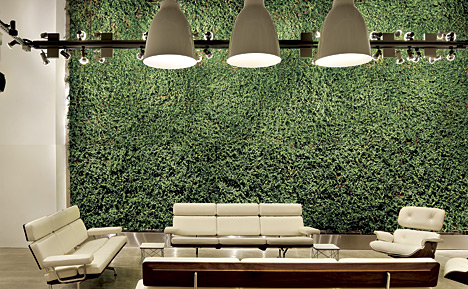
The meeting room at Microsoft’s new Envisioning Lab can be quickly reconfigured as a more traditional meeting room or boardroom, thanks to Herman Miller’s Convia system. The room was designed by the Envisioning Lab team in partnership with Seattle architect Eric Cobb. Photograph by Lara Swimmer
The CEO chose Gary Miller, a 26-year company research veteran, to spearhead the effort, with the aspiration of doubling the size of the company’s business playing field in three to five years. Miller (no relation to the Miller in the company name) knew he would be exploring unfamiliar market territory. Although he would stay within the boundaries of office interiors, he would need to step beyond Herman Miller’s traditional niche making furniture and cubicles.
Still, Miller didn’t want to butt heads with incumbent companies. Why compete with giants dominating existing markets? “Gary went out and asked, ‘What are the unsolved problems out there?’” says Brian Walker, the company’s former chief financial officer, who took over as CEO in 2004. “He didn’t ask, ‘How do I respond to the market for specific products like lighting?’”
Miller’s multiyear research and development effort, which included creating a partnership with West Coast and East Coast technologists and architects, led to a burst of new concepts. In lighting, for example, GE, Philips, and Osram Sylvania were then focusing on light-emitting diodes (LEDs) as substitutes for standard incandescent light fixtures. Miller and his team saw an alternative: using the low-voltage DC power of LEDs for novel kinds of illumination — light tunnels, walls, lighted objects, wearable light. Why restrict lights to conventional overhead fixtures? Why not integrate them into office furniture and fixtures in new ways?
That effort led to a suite of product prototypes dubbed Programmable Environments, and later to a new business named Convia. Among the prototypes were illuminated, movable “visual shields” that changed color and a suspended wall with integrated LEDs. Integral to the new product suite was the notion of programmability. Office workers themselves would be able to use various devices, including their desktop computers, to reconfigure and reprogram the office environment. The new hardware and software allowed Miller and his team to redefine how people would think about personal space, office geometry, privacy, and illumination. In the end, the R&D project spawned 25 patent applications, and Convia was established as a Herman Miller subsidiary in 2006.
The creation of Convia might sound like a tale of pure product innovation, or even of technology adoption, but it is actually a story about management — and only the most recent of several similar stories at Herman Miller. Over many decades, the company has made itself a laboratory for testing new management ideas and turning them into effective practice. Since 1995 in particular, under CEOs Volkema and Walker, Herman Miller has adopted a string of management innovations — shareholder value–based decision making, lean production, supplier and dealer integration — and made them work for the long term.
As testimony to the benefits of disciplined management practice, Herman Miller has weathered the recent financial storm while continuing to fund high-risk ventures like Gary Miller’s. Herman Miller competes in an industry slammed by arguably the worst commercial real-estate crisis in a generation. Still, despite a 19 percent plunge in sales for fiscal 2009 (ending in May), the US$1.6 billion company reported a $68 million profit, albeit down from $152 million in fiscal 2008. Over the last 10 years, its stock has consistently outperformed the Standard & Poor’s 500 index.
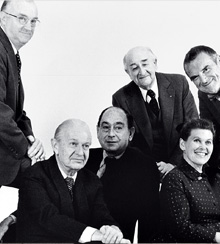
D.J. De Pree (fourth from left) with noted designers (left to right) Robert Propst, Alexander Girard, George Nelson, Ray Eames, and Charles Eames, photographed in 1975. Photo courtesy of Herman Miller
Building the Foundations
Herman Miller’s management journey started with decades of nurturing by the De Pree family. D.J. De Pree founded the company in 1923. (He named it after his father-in-law, who put up the money for the firm.) D.J. passed the CEO baton to his sons, first Hugh (for 18 years) and then Max (for seven years). The family, with D.J. De Pree in the lead, embedded two key principles that continue to inform the company’s management approach. One was a commitment to participative management; the other, a problem-solving approach to design.
The company adopted the so-called Scanlon plan for employee gain-sharing in 1950. A maverick idea at the time, the Scanlon plan called on production workers to make decisions to boost productivity, and recommended paying workers bonuses for doing so. Although the plan has gone through many incarnations, the company still engages all workers in decisions and pays them bonuses based on performance.
Max De Pree, CEO from 1980 to 1987, drew broad attention to the culture at Herman Miller by writing the bestselling Leadership Is an Art (Dell, 1990). Of participative management, he wrote: “Each of us, no matter what our rank in the hierarchy may be, has the same rights: to be needed, to be involved, to have a covenantal relationship, to understand the corporation, to affect our destiny, to be accountable, to appeal, to make a commitment.”
As if to complement the novelty of participative management, the company adopted a unique approach to problem solving, stemming from D.J.’s decision to involve the company in the world of premium industrial design — in particular, contemporary design. Outsiders familiar with Herman Miller often know more about its iconic products than anything else about the company. The Eames Lounge Chair, a cradle of molded wood veneer holding calfskin cushions, introduced in 1956, is in the collection of the Museum of Modern Art in New York. The Aeron, the mesh-backed, ergonomic desk chair that became an icon of the dot-com era — and is still ubiquitous in many offices — was named the Design of the Decade (1990s) by Business Week.
Herman Miller came up with these products because D.J., and then Hugh and Max, made big bets on the vision of outside designers, a practice uncommon in industry then and now. Perhaps the most revered of these outsiders was Charles Eames, who started work for the company in 1946, and, together with his wife and close collaborator, Ray Eames, produced pathbreaking designs into the mid-1970s. Many continue to sell well today, decades after their introduction. The Eames Lounge Chair remains a classic in both homes and offices.
Though observers often see the Eameses’ designs as works of art, the couple’s approach was highly analytical and practical, and left its mark on Herman Miller. Charles Eames held that the first task of a designer was to recognize “constraints,” including factors like price, size, production time, strength, and support, and that the best design was the one that best balanced them. In a New York showroom, he reportedly said, “Don’t give us that ‘good design’ crap.... The real questions are: Does it solve a problem? Is it serviceable? How is it going to look in ten years?” Even though he was never a Herman Miller employee, Eames’s image appears in photos and posters across Herman Miller’s facilities and literature. His thinking has become Herman Miller’s thinking. And even today, company managers talk about business in Eames’s terms of constraints and problem solving.
Solving a Financial Crisis
Despite Herman Miller’s grounding in the disciplined management of the De Pree family, executives at the company began to lose their way in the early 1990s, and the board of directors became concerned, particularly about a lack of spending discipline and a decline in profitability. The board promoted then president Volkema in 1995 to be CEO, giving him the urgent task of restoring solid financial performance.
Volkema, who stepped down as CEO in 2004 but remains chairman, notes that healthy profitability should have been a cinch when he took over: The industry was growing at a double-digit rate. The company “had really gotten off track,” he says. “We had operating margins that were out of control. We were going to break even in a year when we really should have made a lot of money.”
To rectify the lackluster profitability, he and then CFO Walker took the path many companies started down in the 1990s: focusing on shareholder value. The key lesson that Herman Miller took to heart was that a company doesn’t create shareholder value unless it creates economic value added, or EVA — and it doesn’t create positive EVA unless it generates returns above the cost of capital, enough to pay for debt and equity capital. In much of the industry, that insight resulted in a lot of cutting and restructuring, little more. But at Herman Miller it also involved an effort to get people at every level to make better, more informed financial decisions.
Walker led a program to cascade EVA training down to every employee, very much in the spirit of D.J. De Pree. He wanted everyone at the company to calculate the financial effect of decisions big and small. It didn’t matter if they were involved in buying, selling, building, designing, billing, paying, or financing. Or whether they were charged with controlling quality, reliability, inventory, waste, energy use, scrap, or the kinds of staples people used. They were expected to embed EVA into their thinking. As everyone grasped what it took to create a true economic profit, Walker established a new level of business literacy.
Heather Kerres, who started as a cushion stapler on a chair assembly line, remembers the introduction of EVA. Before that time, she recalls that she and her co-workers sometimes bought things “frivolously.” Afterward, she says, “On the line, we really watched what we spent.” Her assembly line also strived as never before to make chairs perfect the first time, so the company could sell more. They understood they needed to exceed the previous year’s EVA. If they didn’t, they wouldn’t get a bonus.
Walker himself hewed closely to the shareholder value constraint. During the dot-com crash, he and Volkema used EVA to nix one appealing acquisition. The target company, which Walker declines to name, fit nicely with Herman Miller’s product line. It was growing fast, had good margins, and could pump up revenues and earnings handily. But an EVA analysis revealed a different picture. For every spurt of growth, the operation would need a slug of capital. “It was uneconomic,” the CEO says. He walked.
Developing the Performance System
Although the focus on economic profit restored financial discipline to Herman Miller, Volkema faced another crisis at the same time, this one in manufacturing. Ironically, the crisis first emerged in a unit Volkema had himself run some years before. At the company’s Spring Lake, Mich., file cabinet plant, big customers like Hewlett-Packard and AT&T were pulling their orders. So was one of the company’s own business units, an express-delivery division that accounted for some 25 percent of Spring Lake’s volume. A Herman Miller competitor just 60 miles away was offering better quality at lower prices. “We’d reached one of those threshold moments when you have to do something,” says Ray Muscat, operations chief at Spring Lake at the time. “Here’s someone in the family telling you they don’t want your services.”
Muscat (now senior vice president of operations engineering) and others started to question the wisdom of their commitment to batch manufacturing, for which they had spent heavily to build product in lots of 500 or more. At Spring Lake, they had invested in a giant robot assembly that welded supports inside file cabinet housings, including a tractor-trailer-length automated welding line with 1,000 sensors. The Holy Grail of this approach was to drive labor completely out of the process. “Our dream was a ‘lights out’ factory,” says Matt Long, then the head of manufacturing engineering.
But the batch manufacturing approach had created several problems. Some customers had started to reduce the size of orders. They wanted file cabinets in lots of 100 instead of 500. Other customers wanted file cabinets in two weeks instead of six. And many of them wanted much higher quality, the kind apparent in products like the Lexus and Acura cars that were now dominating the luxury auto market.
The Spring Lake plant couldn’t deliver, and certainly not for the lower prices customers demanded. To Muscat and his colleagues who had been raised on the wonders of big-batch manufacturing, the prospect of change was mind-bending. Desperate, they searched for solutions, finally reaching out to the global leader in lean manufacturing, Toyota. Starting in 1995, they adapted Toyota’s leading-edge formula for plant-floor management into an approach they called the Herman Miller Performance System (HMPS).
Having followed these lean principles for more than 10 years, the plant now ships a product in two and a half hours instead of the former 60. It engages 20 people on one assembly line rather than 120 on two. Instead of manufacturing in lots of 500, it manufactures in lots of one. As just one example, a metal stamping machine once took more than four hours for changeovers. Now operators conduct a changeover in about 15 minutes — and are working toward a goal of eight minutes. So adept are workers at what people now call lean manufacturing that the plant has been used as a demonstration site by Toyota itself for many years. Toyota’s inspectors reaffirmed that status in mid-2009.
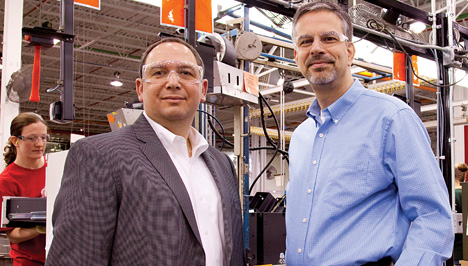
Senior vice president Ray Muscat (left)and lean production chief Matt Long at the Spring Lake plant. Photograph by Kevin Miyazaki
In implementing the HMPS approach, plant managers across Herman Miller have learned that the best-run plants rely on people, not machines. Only people can solve problems to make assembly lines go faster, run cheaper, and deliver higher quality. As Long (now director of the corporate HMPS team) toured the file cabinet plant recently, a visitor paused by a welding robot and asked, “Why don’t you use more robots?”
“Robots,” Long said, “can’t make themselves better.”
Another lesson that the Herman Miller team learned from the lean approach was the importance of reducing waste — waste in space, cost, material, motion, process, and inventory. In the world of lean production, “waste” is anything that doesn’t yield customer value. At some companies, managers make periodic stabs at cutting waste. At Herman Miller, they make a practice of it daily.
Muscat, Long, and others then spread the essence of the lean production system to all Herman Miller plants. Meeting demand for the company’s best-selling Aeron ergonomic chair required five assembly lines back in 1998. Although the lines could collectively make several thousand units per week, they covered 27,000 square feet (2,500 square meters), and employed 77 people in three shifts. Now Herman Miller has equal or greater production capacity in a mere 2,500 square feet (230 square meters), using 24 people in three shifts on one line.
Adopting Win-win Supplier Relations
The success of testing and adopting lean manufacturing in Herman Miller plants led to efforts to similarly transform the supply chain. The company recognized that its suppliers ran their plants largely the way Herman Miller did at Spring Lake in the 1990s, and that they were equally rife with wasted effort and material. If suppliers were to help Herman Miller in lowering costs, changes in supply chain management were required that would be probably even more radical than those that Herman Miller had undertaken in its internal operations.
Purchasing chief Drew Schramm launched the “First Mile” program in 2002 to reverse old practices. Each person in Schramm’s operation had been managing 30 to 40 suppliers, spending most of his or her time studying spreadsheets and working the phone for quotes. In the new program, Schramm shifted some purchasing people to managing only core suppliers. Instead of 30 suppliers, people in the core group manage just five, spending their time developing their capabilities. This became the dawn of Herman Miller’s adoption of collaborative, win-win supplier relations.
Schramm kicked off the First Mile program by meeting with small groups of core suppliers, usually represented by presidents or owners. This is what he told them: Herman Miller wants continuous improvement in quality, delivery, and price. We will help you, providing experts such as former shop-floor leaders from Spring Lake, to work on your shop floor to introduce HMPS-style changes. The alternative outcome is that Herman Miller will gradually shift its business to other, leaner suppliers.
The first hurdle was to get suppliers to take Herman Miller’s new overture seriously. The purchasing business had long been a game of playing one supplier off against another to drive prices down, and the suppliers were used to the way the game was played. Chad Anderson, a member of the lean manufacturing consulting team that now works with suppliers, says the suppliers’ first reaction was one of incredulity: “You mean the guy who was beating me up is now going to help me?”
Progress on the new program was uneven. One large supplier signed on but lacked enthusiasm. After making one round of improvements, the supplier’s vice president of operations argued that the value of the gains was modest. He said Herman Miller was due about $6,000 in pricing benefit. By Herman Miller’s estimates, the benefit should have been more like $100,000.
Schramm, annoyed, was ready to cut ties with the supplier. But events intervened. The supplier’s parent company demanded the supplier vacate 20,000 square feet (1,860 square meters) of space to make way for more parent-company manufacturing. The vice president, with no room to spare yet a demand from his higher-ups to shrink his plant footprint, suddenly embraced the notion of lean manufacturing as a solution, and he asked Herman Miller to ramp up its First Mile effort.
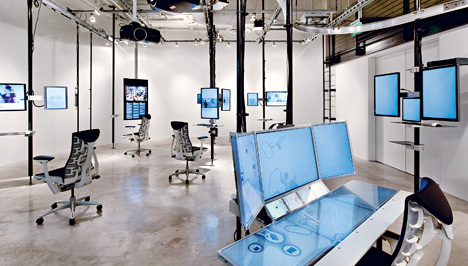
Inside Microsoft’s Envisioning Lab, the Convia system makes the building hardware as modular as the software on display. Photograph by Lara Swimmer
Herman Miller, now armed with leverage to press the supplier to move quickly, asked to receive its share of the expected benefits from reduced waste and increased efficiency up front. Herman Miller managers estimated that the supplier would be able to pass savings of $150,000 on its charges through to Herman Miller. To their surprise — and in a reversal of previous behavior — the supplier came back with a whopping pricing benefit of $890,000.
To the Last Mile
On top of spreading the lean thinking upstream from company operations, Herman Miller extended it downstream, launching, in 2004, a “Last Mile” program to target its dealers. Last Mile aims to help make dealers as healthy and successful as possible — and to help them best represent Herman Miller’s strengths as a company.
The Last Mile experts began by improving the dealers’ purchase-order-to-cash cycle. Paul Iles, vice president of distribution, reports that Herman Miller has helped shorten those cycles by 15 to 20 days. The company has since taken a close look at how dealers install products. Iles likes to remind people in Herman Miller manufacturing that in the customers’ eyes, “We don’t actually make the product. It’s our dealers.” After all, the dealers do the final assembly of panel systems, desks, and other parts of the office interior; they are the face of Herman Miller.
The dealers now struggle with several issues. One is that unpacking trailers, which were loaded to suit Herman Miller shipping requirements, often takes longer than installing the products. Another is that Herman Miller products come with many supplemental parts, because the factory doesn’t know the configuration in which the dealers will install the pieces. Any excess parts are waste.
Herman Miller’s engineers have been visiting dealer sites to observe installations. They figure they’ll find plenty of waste to cut. Perhaps the simplest example, beyond supplemental parts, involves instruction sheets. A dealer receiving multiples of a product receives multiple sheets — maybe dozens. Herman Miller spends $1 million a year printing them, so big savings are possible from eliminating extras.
The Last Mile program has begun to change dealers’ handling of the logistics of Herman Miller products. Ten years ago, when delivery and quality were abysmal, dealers routinely added weeks of buffer time to delivery commitments. They also stashed plenty of extra stock in warehouses, knowing they couldn’t count on timely deliveries. Now that Herman Miller delivers on schedule 99.7 percent of the time, dealers can do away with both the buffer time and the buffer space.
In effect, Herman Miller has taken its program for win-win supplier relations and begun to duplicate it with its dealers, creating an increasingly smooth end-to-end process. One sign of the dealers’ pleasure with this development: The Office Furniture Dealers Alliance chose Herman Miller for its 2008 Manufacturer of the Year Gold Award.
Creating New Markets
The management skills and rigor acquired by Herman Miller since the 1990s provided the stability and financial support for the skunkworks program of Gary Miller, its Programmable Environments initiative, and the creation of the new Convia subsidiary — which may significantly expand the playing field on which Herman Miller can battle for future revenue. Early on, the Convia team was concerned about its survival because it launched during the dot-com crash, at which time Herman Miller sales plunged as much as 40 percent in some quarters.
Volkema and Walker continued to fund the program in the midst of huge cuts in costs and workforce, reinforcing the company’s commitment to long-term growth. And they continued to support the approach taken by Gary Miller, demonstrating once again Herman Miller’s devotion to fresh thinking about management.
Miller’s first challenge was setting up his Creative Office unit in 2001. To do so, he took into account several facts of corporate life. One was the tendency for companies to support only work that replicates past successes — the not-invented-here syndrome. Another was the tendency to use all available capital to feed the maw of the current product stream — something Miller calls the “tyranny of the urgent.” A third was pressure in economic downtimes for top executives to cut high-risk investments.
Any one of these concerns could have killed Miller’s new-markets initiative. So for starters, he asked Volkema, Walker, and two other top people to sit on his internal board of directors. The objective was to have top decision makers invest themselves in the work — to be companions on the journey, not simply judges of it. “The idea,” Miller says, “was to change the dynamic from traditional review-and-approve to advocacy.”
Second, he walled his group off from current operations. Herman Miller had always formed partnerships with outside designers — like Eames or more recently Bill Stumpf and Don Chadwick for the Aeron chair — and then had inside engineers complete development. Miller wanted his group to go it alone, independent of any internal staff resources. The team would give birth to ideas, incubate its own prototypes, and lay the groundwork for the new business.
During the first six months, his group of seven identified key trends and studied current products. They all found the same thing: Incumbent companies plied the waters of many established, but separate, oceans of commerce — but none were exploring the uncharted waters between them. The incumbents weren’t even talking with one another. “That’s our opportunity,” Miller realized. “It’s in the gray space.”
That’s when his group recognized the opportunities to use LED lighting in new ways. Flush with that and other design concepts, the team looked for an outside designer. By fiat, Miller prohibited the hiring of a furniture designer. Instead, he hired two well-known technologists and alumni of Disney Imagineering — Bran Ferren, an architect and special effects designer, and Danny Hillis, a computer designer — from Applied Minds, a Glendale, Calif., think tank cum prototype shop. Miller also hired Sheila Kennedy, a Boston architect who teaches at Harvard University. He then gave the team a set of product boundaries instead of a product brief.
The new team created a stream of innovations, reinventing many aspects of office interiors. In a 5,000-square-foot (465-square-meter) Glendale warehouse, they installed the suite of product prototypes that included the LED concepts; a programmable electrical system; and articulating, ceiling-mounted walls and room dividers. From the explosion of design created by the team, Herman Miller chose a subset for development.
Herman Miller launched Convia in 2006 as a product suite mixing hardware and software, with the intent of addressing an entirely new market, for programmable workspace. The hardware amounted to an infrastructure backbone. Installed in a building’s ceiling, the backbone carried an intelligent, modular electrical system with its own data network to enable programmability. It also provided a structure for suspending components of office interiors. The software allowed facilities managers and building occupants to program all aspects of the backbone’s operation.
Herman Miller now had a product to help it grow in a market outside its traditional furniture niche. To property developers, the company could sell a means of building and reconfiguring offices without throwing away wires, conduits, panels, or other material. For facilities managers, it could sell the benefits of managing energy, light, and HVAC for each desk. To users, it could promise the ability to personalize space, light, heat, and sound with a few clicks of a mouse or hand wand.
Miller admits to waking up in the middle of the night during the multiyear project. He worried about how much he had spent, how little distance he had covered. “It takes patience with ambiguity to the nth degree,” he says. One of the biggest hurdles was figuring out how to commercialize products in a market — building infrastructure — in which Herman Miller was a novice. Miller solved that problem in 2009 by partnering with Legrand and its subsidiary Wiremold, a maker of electrical and network gear for buildings.
Whether Convia and Programmable Environments will solve the bigger Herman Miller problem of growth into new markets remains to be seen. The hurdles are many: selling a new concept to builders, teaching a furniture sales force how to sell to builders, complying with unfamiliar electrical and building codes, and of course showing customers the value of the new products. But the new business has gotten off to a solid start. It has attracted customers like Notre Dame, Hewlett-Packard, and Microsoft, which chose the Convia system for the Envisioning Lab — a facility at the Redmond, Wash., campus where the company shares its long-term vision of technology with customers and partners.
So far, Legrand has trained 400 sales reps to sell the Convia technology. And Herman Miller continues to expand its product line. It recently introduced an energy management component to help companies detect energy-saving opportunities and monitor reductions.
Herman Miller has moved itself from selling furniture to providing the entire building envelope with intelligent infrastructure. If it succeeds in this effort, the company will have demonstrated that it has successfully applied a new process for producing breakthrough products in new markets. That capability would add another leading-edge practice to its portfolio of management capabilities.
Steady in the Storm
The biggest challenge of late for Herman Miller has been staying focused on its management practices during the financial meltdown. Innovative programs often fall by the wayside when corporations are under severe financial pressures. But Herman Miller seems to regularly demonstrate that time-tested practices will not lose support.
As markets contracted in 2009, CEO Walker says he told executives that the company had to cut costs more, but cutting more people would probably hurt the company’s future. Walker decided to make other moves instead. First, he made a decision similar to one made by many other companies during the downturn. To save money, all employees, executives included, would be furloughed every other Friday. He also suspended matching contributions to 401(k) plans.
Second, he created a new bonus plan called a wage-recovery plan. On top of the bonus that originated with the Scanlon plan (and that had been reformulated to use EVA), Walker and his executives proposed to pay people back for money they lost in the furlough — provided the company did well. The finance people calculated how much money the company had to make to sustain itself, without cutting outlays for key investments. Walker then guaranteed that if the company reached that goal, the plan would split every additional dollar 50/50 between employees and shareholders. Walker admits that there were skeptics. The board, he recalls, asked: “You’re going to pay them when they don’t even work the day?”
But Walker argued that in the feeble economy, the main goal was to keep the business sustainable, not to increase profitability at the expense of employees. He believed that instead of sapping employees’ energy during a retrenchment, the wage-recovery plan would show them they should continue to make progress through the management practices that had sustained the company for so long. Walker says he hoped employees would reason this way: “Gee, I can continue to innovate in my work in a way that improves the performance of the business, and if I do that, I’ll get some of the money back.”
As it turned out, in the first three months after the plan was initiated in the spring of 2009, Herman Miller earned more than the threshold amount. Employees won a wage-recovery bonus worth nearly half of what they had lost in the furlough. In the second three months, employees earned no bonus, but in the third, they earned well more than half of what they lost. Walker says he has no regrets about paying people for time not worked, as the program generated a lot of goodwill and credibility for top management.
Of course, the program has done something else as well: It has reinforced Herman Miller’s dedication to sticking with its longtime management practices — in this case, paying bonuses to people for improving company fortunes, just the way D.J. De Pree did nearly 60 years ago.
Reprint No. 10206
Author profiles:
- Bill Birchard is a journalist, author, and book consultant who specializes in management and the environment. He is at work on a book about Herman Miller.