
Eat Your Peas: A Recipe for Culture Change
The methods used by celebrity chef Jamie Oliver to promote health in a West Virginia city can also be used to raise organizational performance.
(originally published by Booz & Company)
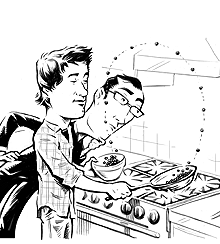
Illustration by Lars Leetaru
When the well-known British chef and television reality show host Jamie Oliver arrived in Huntington, W.Va., in early 2009, he had a daunting goal in mind: to alter eating habits. Just a year before, Huntington had been dubbed the unhealthiest city in the United States by the U.S. Centers for Disease Control and Prevention. The community of 50,000 led the nation in rates of heart disease and diabetes. Half of its adults were considered obese. Oliver had chosen this small city for an initiative (and subsequent TV program) branded Jamie Oliver’s Food Revolution, with the idea of having a broader impact. If people could make themselves healthier here, they could do it anywhere.
In any community, food is closely tied to culture. And for any leader interested in change, watching Jamie Oliver’s Food Revolution can provide an inviting and immediate sense of how cultural patterns can be altered in the real world. Of course, Oliver is not an expert in organizations or management, but before bringing his show to Huntington he had already completed a series of campaigns to improve eating habits in the U.K.; he had been named a member of the Order of the British Empire for this in 2003. The expert chef, now 36, first gained fame in 1999 as a young cook known as “The Naked Chef.” He is known for his optimistic, boyish television persona; his ardent declarations that food should be healthy (fresh; prepared close to its raw state; and uncompromised by processed ingredients, sugary flavoring, trans fats, or other additives); and the cheerfully confrontational style of his programs.
The strategy+business Collection: Don’t Blame Your Culture
 This article is featured in the strategy+business app “Don’t Blame Your Culture,” available for smartphone and tablet devices. The app pulls together s+b’s best writing on organizational culture and change, featuring Jon Katzenbach, TV chef Jamie Oliver, former P&G CEO A.G. Lafley, and more, explaining why companies resist wholesale change, and how to make the most of the culture you have.
To download, select your device:




As portrayed on Food Revolution, Oliver’s success depended not just on a plan or on expertise, but on his willingness to experiment, learn, and intuitively shift gears on the fly. He began his West Virginia campaign the way many leaders of change begin: with exhortations and slogans about the new behaviors needed to eat and live in a healthy manner. “I’ve been in South Africa, in the townships,” he told a group of school cafeteria cooks at one point, “and they’re getting better food than your American kids.” But he soon discovered that he could not force or persuade people to change their minds. Instead, he made it easier for them to change their habits first, while keeping their own views and values. He did this by starting on a very small scale, with a tiny vegetable: the pea.
Learn the Local Culture
Oliver came to Huntington with confidence that the rightness of his goals, along with his charisma and the town’s opportunity for TV exposure, would be enough to carry the day. Almost immediately, however, he ran into opposition. One of his first efforts to seek support, at the popular radio show of local disc jockey Rod Willis, turned out to be a disaster. Willis leveled Oliver’s plan with one withering line: “We don’t want to eat lettuce all day.” As shown on the reality show, the disc jockey reduced Oliver to tears, questioning his ability to effect change and his motives — intimating that the former Naked Chef was presumptuous and glory-seeking.
This initial public relations disaster was followed by Oliver’s first trip to Central City Elementary School, where he wanted to shift the students’ lunch plan toward healthier foods. Here, he was waylaid by the cafeteria’s tough-minded head cook, Alice Gue — referred to on the show as “a lean, mean, processed-food cooking machine.” Oliver had assumed at first that Gue would naturally share his attitude toward the food she had been serving. But she was more antagonistic, and prouder of her existing menu, than Oliver had expected.
This first stage of change was most important, it turned out, not for what Oliver taught the town — but for what the town taught him. He assumed a great deal about the town’s receptivity and its nature, underestimating the cumulative power of inertia and collective attitudes. Once he realized that the resistance came from a culture, rather than from individuals, he set out to learn about that culture instead of trying to defeat it outright. As he said at the end of the first episode, Huntington “is not a statistic. It’s a town. It’s a community. It’s a family.”
In subsequent episodes, Oliver moved more deeply into the town’s culture, developing relationships and conducting listening sessions. He eventually opened a storefront called Jamie’s Kitchen in downtown Huntington, where he offered nutrition advice and cooking lessons at no charge.
If you are a CEO or other senior leader seeking to change behavior throughout your organization, you may feel you are on more familiar ground than Jamie Oliver was. You presumably know your company well; you may have grown up in it yourself. Yet your very familiarity with the culture can be as much of an obstacle as Oliver’s outsider status was. Both too much knowledge and too little can lead to incorrect assumptions about the reasons people do what they do.
You must thus examine and explore the culture of your organization, as if seeing it for the first time — to make sure you are not blindsided, as Oliver was at the outset. You can accomplish this with your own counterparts to Oliver’s listening sessions: deep, structured interviews; workshops; and problem-solving groups. This type of inquiry can reveal the existing culture and the specific issues or themes that need to be addressed.
Demonstrate Success
As Oliver got to know the residents of Huntington, he realized he faced a formidable information and education barrier. One class of first graders could not identify a tomato. (They insisted it was a potato.) Others, including many adults, did not know how to use a knife or fork. After years of fast food like hamburgers and pizza, they didn’t have to. Nor did the school cafeteria provide knives or forks; the menu didn’t require them.
Oliver attempted to remake the eating habits of one household, the Edwards family, by talking with them at length about nutrition; he went food shopping with them, loading their home with recipes and fresh ingredients. But when he returned later to their house, he found many of the fresh ingredients uneaten; he also found milkshake containers and other telltale signs of unhealthy food. Providing information was not enough. Oliver had to lead the citizens of Huntington across a threshold of attitude change by addressing their behavior first. So he turned his focus from how they ate to what they ate — and making sure they ate differently.
He began with peas. Perhaps because of the British love for peas, Oliver was determined that the Central City schoolchildren should eat peas for lunch. To accomplish this, he dressed up in a green costume, racing around the school grounds trying to get the kids to engage with him as a pea. He was tireless in his banter and cajoling. He held up two fingers as a peace sign — which he referred to as a “peas” sign. Even if they didn’t quite get it, it made them laugh. He monitored their eating. He used rewards and recognition, handing out stickers after lunch that said “I’ve Tried Something New!” Not every child cooperated, but many peas were eaten — and Oliver had laid the groundwork for further and deeper changes.
For the kids who participated (and perhaps for some of their parents and the school staff), peas became a “proof point”: a bit of evidence, drawn from direct experience, of the possibility and value of change. Oliver had demonstrated that children could eat healthy food enthusiastically, that they could accept a change agent as a leader, that they could support one another without ridicule as pea-eating peers, and that all of this might actually be good for them.
Similarly, when you are a leader involved in change, success requires finding your own proof points in a few areas aligned with your agenda. Choose carefully the behaviors you target; they should match your organization’s strategic aspirations and convince specific subgroups and individuals in areas where change is most needed. Oliver’s strategic aspiration was better health; thus, he focused on improving diets. A company looking for cost efficiency might focus on eliminating unnecessary meetings and oversight reviews. Pick the people whose participation is most keenly needed (and who might be expected to resist), show that they can adopt new behaviors, draw a link between these new behaviors and higher performance, and develop the metrics you need to track the changes in results.
Identify Key Influencers
The more time Jamie Oliver spent in Huntington, the more success he enjoyed. Essential to this turnaround was his cultivation of allies within the community. For example, he sought out the most influential teachers — adults who already had the trust of the schoolchildren. Once they saw better health was possible, it became a genuine motivator. Gradually, they warmed to the idea of encouraging and even prodding the kids to make smarter choices during their lunch hour. Oliver’s persistent but respectful approach eventually earned the confidence of Alice Gue; this brought the entire kitchen (and many others in the school) over to his side. He even won over Rod Willis, the belligerent disc jockey, by betting him that in a single week Oliver could attract 1,000 townspeople to his storefront, Jamie’s Kitchen, to learn to cook healthfully. The DJ ended up broadcasting his show from the storefront on the last day of the bet. This episode marked a moment when many townspeople internalized the value of change; it was no longer simply “good for Jamie,” but also good for their community.
Then, as Oliver moved from the elementary school environment to Huntington High School, he changed his approach (and, not coincidentally, his demeanor, donning a leather jacket and toning down his children’s-talk-show-host speaking style). He explicitly recruited “ambassadors of change” — a group of students who met with him and signed on to promote his ideas.
By this point, Oliver had encountered three types of influencers, all of whom are important to any organizational culture change:
1. Culture carriers: visible figures, like Willis and Gue, who maintain the fabric of the community’s common beliefs and values. Culture carriers are not necessarily limited to people with hierarchical authority; they can include people who are well networked or popular, or who maintain an internal newsletter or blog. In any organizational change effort, it is important to identify who these visible figures are, and what they can do to enable or influence change. How can you enlist them as sources of positive energy, to spread insights virally across the organization?
2. Authority figures: those who are officially responsible for articulating the desired goals and the specific behaviors that will be needed to reach them. Often, different people have authority over different parts of the relevant workflow or social system. In Huntington, authority figures included the school principal, a local pastor, the West Virginia state inspector for school food, a businessman who donated US$150,000 to the nutrition effort, and then West Virginia governor Joe Manchin (now a U.S. senator). A sufficient number of these leaders must be seen as invested in the change they are promoting.
3. Pride builders: people who are respected as peers and are part of the groups where change is targeted. They embrace new behaviors as early adopters, and influence others in turn. The importance of pride builders has been evident in the work of other researchers, including University of Illinois psychologist Leann Lipps Birch (who convinced resistant children to eat peas in the late 1970s by seating them at tables with other kids who liked the vegetable) and Booz & Company Senior Partner Jon Katzenbach (whose book Why Pride Matters More Than Money: The Power of the World’s Greatest Motivational Force was published by Crown Business in 2003). In Huntington, some of the teenagers Oliver worked with became role models for their friends. In your organization, gaining the cooperation and support of such individuals will help instill the voice of the employees into every new approach and policy. Pride builders can also help refine your view of what changes are needed and how to implement them.
When they work in harmony, these three categories of individuals can accelerate the pace of change, and help one another see what is being accomplished. For example, in a customer service environment, the culture carriers can put forth an aspirational message of service excellence, explaining why it will attract customers. The authority figures can mandate new behaviors that demonstrate service excellence, and put in place the incentives, rewards, and metrics needed to track progress. The pride builders might include frontline service workers who are willing to embrace this new ethic, and who can show others how to translate the idea that “the customer is always right” into new types of behaviors. Every time you introduce a relevant change, all three types of influencers can be drawn in to reinforce it.
Formal and Informal Change
After several months in Huntington, Jamie Oliver managed to catalyze change among many groups of people — at the elementary school, the high school, and in the community at large. Jamie’s Kitchen is still operating; according to its website, it is funded by four local organizations, including a clinic and a not-for-profit hospital. There were other efforts in place to change attitudes about food, but Oliver’s energetic outreach brought many more people to embrace the idea that eating healthy gets easier over time and feels better.
Oliver’s West Virginia story can serve as a crash course in bringing about change. Some elements — defining the aspiration, finding key influencers, targeting behavior — are analogous to the informal elements of any organizational change initiative. Oliver’s success in Huntington came in part from his uncanny ability to energize and motivate the citizens, build informal networks, and help individuals experiment with new healthy eating behaviors.
But Oliver also deployed formal mechanisms — the same kind to which executives often turn when embarking on a transformation initiative in a corporate setting — such as redesigning reporting structures, setting goals, and communicating priorities to the whole organization. These top-down, rational activities are commonly seen as primary levers for aligning the organization in the same direction. For Oliver, these formal mechanisms included finding food suppliers for the school kitchens that could meet the budget criteria, working with the state inspector to modify policies concerning what counted as serving “a healthy meal,” training the kitchen staff in cooking healthy food from scratch, and ensuring that forks and knives were available in the school cafeteria. His attention to the formal side of change management appeared later in the series, as he clearly came to realize the importance of some of these less-showy organizational modifications.
To achieve sustainable success when implementing cultural change, you must integrate formal and informal efforts. For example, a new performance management system may require shifting the reporting structure of the HR function, alongside an agreement among key leaders to conduct appraisals differently. With both types of mechanisms working together, new, contagious ideas can reach the large scale necessary for impact in a global company.
Cultural interventions are difficult, but they can be successful. You need to clearly define your goals and have a plan for how to reach them — but you also need the willingness and ability to discard your preconceptions and adjust your plan when reality doesn’t line up with your expectations. You are likely to encounter resistance at first, as Oliver did, if you approach changing your organization’s culture in a heavy-handed, top-down way. But when you approach culture more thoughtfully, taking a holistic view of how the organization works in practice, you can make a real difference, even in parts of the culture that seemed intractable before.
Perhaps the most powerful aspect of culture change is the way goals expand after an early success. As Steve Willis, pastor of the city’s First Baptist Church, said to Oliver, “This isn’t going to change lives. This is going to save lives.” He meant literally that people would live longer, but also that the whole city would see its capabilities broaden. Of course, there are still overweight people in Huntington, W. Va., and if the community overcomes one challenge, there will be many more to follow (such as rebuilding the economy). Your own company will go on to face other problems as well. But once you learn how to change habits and get an organization to “eat its peas,” you’ll soon be ready to take on new challenges — whether that means eating tomatoes or eating the competition. 
Reprint No. 11205
Author profile:
- Rutger von Post is a principal with Booz & Company based in New York. He specializes in organizational change and leadership for the financial-services and healthcare industries and is a fellow of the Katzenbach Center.