
The Folly of Forced Ranking
Mythic leaders like Jack Welch swear by distribution curves to remove low performers. But there are pitfalls in playing the percentage game.
(originally published by Booz & Company)
 |
|
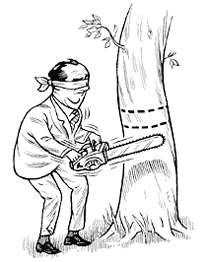
Illustration by Lars Leetaru |
GE is not alone in using this system. Similar policies have been adopted by Ford Motor, Conoco, Sun Microsystems, Cisco Systems, EDS, Enron, and a host of other U.S. corporations.
At first glance, it makes sense to systematically identify and remove the worst employees. They can be replaced by better employees, and ridding the organization of poor performers also sends a strong message of low tolerance for poor results. But is using a system that requires the firing of a certain number of underachievers the best way to create a high-performance organization? My research suggests it is not.
Companies certainly need methods and processes to accurately identify people who are not making the grade. But quota systems don’t work for many reasons, including flaws in the normal distribution curve approach that is used to identify poor performers, as well as limitations in human judgment. In fact, systems that force managers to cut a certain percentage of their people often don’t reveal the root causes of problems, often do not elevate performance, and can ultimately be counterproductive.
Potential legal exposure is also a problem with quota systems. Numerous court cases in the U.S. have challenged the use of forced ranking or distribution systems. In 1975, I was an expert witness in a class-action age discrimination suit against the Sandia Corporation that focused on the validity of its forced distribution appraisal system. Sandia lost the case precisely because it couldn’t prove that the forced distributions it created led to valid measures of individual performance. Recently, Ford Motor Company, reacting to the same problem, abandoned its forced distribution system after the company was threatened with lawsuits.
Allowing poor performers to continue as they are in a company isn’t acceptable either. Indeed, doing so can be very destructive, ultimately promoting a culture in which employees believe substandard performance is all right, and good performers leave because they don’t want to be part of an organization that accepts less than the best from its people.
My quarrel isn’t with the premise that companies need to identify and eliminate poor performers. Setting high standards, and dealing with those people who don’t meet or exceed them, is necessary in order to continuously improve organizational performance. The issue is how to do this effectively. What are the best methods for properly and fairly identifying poor performers, for motivating individuals and developing their talents, and for cutting losses for the individual and the company when someone is not working out?
Kinks in the Curve
The notion that the bottom 5 or 10 percent of employees can be eliminated every year assumes that the performance of individuals fits a normal distribution curve (Jack Welch calls it the vitality curve). In a normal distribution of employees, the number of average performers is large and flanked by a small number of outstanding and poor performers. In some work groups or departments, the employees actually do fit a normal distribution; however, there is no reason to assume that this will always, or even frequently, be the case.
Normal distributions consistently occur only when they involve random events and a large sample. This is not typical in companies. A large sample for statistical purposes means not 10, 20, 30, or even 100, but thousands of individuals. Further, in most work situations, each employee’s performance is a planned and controlled event. Individuals are not randomly placed in positions and expected to perform; they are carefully selected, trained, and motivated to do their jobs.
Because employee performance patterns in organizations often do not follow a normal distribution, identifying poor performers using a forced ranking system is fraught with difficulties. First, a very real danger exists that some satisfactory employees will be misidentified as poor performers. For example, some divisions, departments, or teams are always better staffed than others. In those areas, individuals who are satisfactory or even outstanding performers on a company-wide basis may be judged to be underperformers just because they happen to be among a group of very good employees. The right thing to do is to strengthen weak areas where there are a large number of poor performers by replacing them, rather than removing “the worst of the best” from areas dominated by high performers. Most forced distribution systems do not produce this result because every area, regardless of the quality of its employees and its performance, is required to make the same percentage of cuts.
Second, a department or team may consist of a large number of employees who are essentially similar in performance, with no individuals who clearly don’t deliver. This means a supervisor has to separate nearly identical individuals, targeting some for dismissal and others for retention. It is hardly surprising that supervisors resist making such choices, and that when they have to do so, it very often engenders charges of unfair treatment.
Companies that use forced distribution systems are particularly open to legal challenges when individuals who are part of a protected group because of their age, gender, or ethnicity are fired because of their performance. Courts have said that a performance-related dismissal is acceptable only if deficiencies in a person’s work can be proven. In other words, if the company cannot prove that its performance appraisal system identifies poor performers accurately, then it will likely lose its case in court.
Identifying and dismissing poor performers is particularly difficult and damaging when it is done year after year. The first year it is often relatively easy to do because there are usually a few individuals who have obvious work-related problems that either have not been addressed or cannot be resolved. Once these people are eliminated, however, often there are few, if any, truly poor performers left. Furthermore, there are likely to be more only if the “replacement” workers hired turn out to be poor performers, or if some previously satisfactory employees suddenly develop serious performance problems. These are possible but unlikely events. It is particularly unlikely that year after year 10 percent will fall into an
easily identifiable bottom group; instead, there is likely to be a large group of individuals who are performing well, a smaller group of outstanding performers, and a few, if any, poor performers.
Mr. Welch notes in his CEO memoir that by the third year of forced firings, “it’s war.” It is also stressful. What manager wants to face every year having to identify his or her lowest-ranking subordinates and recommend which ones should be fired? Sometimes managers just lack the courage to fire someone, which of course is why forced distributions are put into place in many companies. But this is only one reason managers don’t like forced distribution systems. Managers also worry about what will happen to these individuals. And they’re concerned about firings disrupting the work of other employees and increasing their workload.
Managers aren’t likely to get much insight into who is working below standard from employees’ self-assessments because most people do not feel that they are poor performers. In fact, my research shows that when asked to rate their performance, more than 80 percent of employees feel that they are average or better performers. Even if someone knows he is having performance problems, he is unlikely to ask for help because he knows it could make him a candidate for dismissal.
Mr. Welch, nonetheless, argues ardently that it is important to win the war and to keep eliminating the poorest-performing 10 percent no matter how hard it is to find them. He does not worry about whether managers are comfortable with the process except to argue that managers who resist doing it probably are not good managers and may themselves be in the bottom 10 percent.
Costs of Turnover
Even if a reasonably effective job can be done of identifying the bottom 10 percent, the cost of turnover alone makes the practice problematic. Any turnover, whether forced or voluntary, can be expensive. In fact, mandated turnover may be particularly expensive because it often requires the continuation of benefits and may result in lawsuits and large settlement payments. Finding good replacements, training them, and waiting for them to develop the relationships and knowledge necessary to be fully productive employees is expensive. Thus, in many cases, the smarter and more cost-effective solution is to diagnose why someone, especially someone with years of experience and deep relationships, is underperforming, and to give that person a chance to correct the situation.
Many studies on the actual cost of turnover suggest it frequently is equal to at least one year’s salary of the replaced employee. Further, unless the employee who is let go is clearly inferior, the new hire may be no, or only slightly, better. In this instance, all the company has done by dismissing its “lower 10 percent” is set in motion an expensive termination and hiring process. With so much potential for error, it may take a long time before the organization gets a financial return on replacing poor performers. This is particularly true if the work the dismissed employee does is complex and involves extensive new training and adjustments for co-workers.
Finally, in some labor markets, there simply are no people, much less better people, available to replace employees who are let go. Although the availability of people depends on economic cycles and the departing employees’ skills, it is likely to be difficult to find good candidates for knowledge-work jobs in such growth industries as information technology, biotechnology, and professional services. Even if better people are available, they may not be hired because most selection processes do not effectively identify the best candidates. Thus, even when firing someone rids the organization of a below-average performer, it may not make sense to dismiss the existing employee.
Managers’ Reactions
Managers who are required to get rid of a fixed percentage of their peopleoften try to beat the system because they think it is dysfunctional, or because they find the whole process distasteful. For example, to meet their reduction number, managers may keep bad employees around until the performance-rating period, instead of firing them earlier in the year, so that they will have people to select when it is time to make the cuts. And if managers have more candidates than they need to meet their quota one year, they may retain the “extras” as targets for the next round of appraisals. There are also examples of managers creating false employee performance records so they can justify firing them.
Forced ranking systems also influence how managers develop their employees. It hardly makes sense for managers to invest in developing individuals who are marginal performers when they believe that, in a relatively short time, they will have to eliminate them. Instead, they invest development dollars and personal effort in individuals who are likely to survive the annual performance assessment and firings. The result is that the best get better, while the poor performers have little chance to grow and improve.
Forcing annual turnover can also cause regrettable turnover of very good people if it is not balanced by a focus on the best performers. When managers are preoccupied with identifying the least productive people, they may fail to give enough encouragement and support to better performers. A recent study at one major global pharmaceuticals manufacturer that uses the forced distribution approach determined from exit interviews that several hundred people in its worldwide finance organization who had been identified as top performers by their managers left because they felt undervalued.
Managers tend to disown the appraisals and blame the quota system when they are forced to identify poor performers. They say to those individuals, “Well, I know you’re not really a bad performer, but I have to identify somebody, and you are the unfortunate one.” Supervisors thus discredit the entire appraisal system by not taking responsibility and significantly contribute to negative perceptions of the system among employees.
Forced firings also create an unhealthy competition among peers. When employees in a work area compete with each other for ratings, knowing there is always a percentage at the bottom who will be forced out, it creates fear and selfishness. People are much less likely to help each other, train each other, share information, and operate as an effective team. In today’s flatter, knowledge work–driven, more team-based organizations, this can take a significant toll on organizational performance.
A better way of dealing with poor performance starts with replacing bureaucracy and rules with leadership and judgment. Companies that require managers to fire a certain percentage of poor performers every year are simply imposing a rule to try to correct for the poor leadership behavior of managers. Senior management needs to take talent management extremely seriously, including leading a rigorous annual evaluation of the performance appraisal process itself. Human-capital management decisions need to be the outcome of a senior management–led analysis of the business situation, the capabilities and performance of the organization, and the business strategy. None of this can be done effectively when managers are forced to comply with an arbitrary bureaucratic guideline.
At the core of an effective appraisal system is a process that ensures all individuals are accurately assessed on their current performance and their potential. The system needs to go beyond simply measuring performance; it needs to expose the causes of poor performance. And appraisal procedures, corporate culture, and senior leaders’ actions need to encourage managers to work hard to find solutions other than dismissal.
Some of these solutions may seem painful initially, but they can, in the long run, prove to be fruitful for the individual and the company. For instance, when poor performance occurs because a person is the wrong fit for a job, the best action may be to move that person to a new job, even if that means a demotion. Alternatively, a development plan may be needed to improve the individual’s skills. If motivation is a problem, a cut in pay with the promise of an increase if performance improves can be a strong motivator for doing better. Finally, in a tight labor market, a manager may want to think twice before letting someone go even if his or her performance isn’t as good as it should be.
Effective Appraisals
Before managers are asked to identify poor performers, it is critical that organizations create effective performance management systems. Balanced Scorecards and enterprise resource planning systems are two resources that can be used to increase the amount and quality of data that managers have to use for performance measurement. If executives lack performance appraisal skills, they need to be trained, as do the individuals who are being appraised. Both need to know how to behave and what to expect.
Managers should be evaluated on how well they measure the performance of their subordinates, and their bonuses and career development need to be tied to the quality of their appraisals and to how well they develop their employees. For example, one company’s annual leadership-development assessment of its top-level executives identifies “effectively dealing with problem performers” as a critical characteristic in determining who is given the highest performance rating.
Companies also need to develop effective ways to assess nonfinancial or hard-to-quantify activities. It is one thing to evaluate the results of sales professionals with similar territories and production workers with quantitative output goals; it is quite another to measure the performance of knowledge workers who operate in teams to produce such hard-to-measure output as software code, new product ideas, and advertising campaigns. Inevitably, the assessment of knowledge workers is a subjective one. It has to depend on a supervisor’s ability to effectively set clear goals along with hard and soft measurements that identify and track the development of the software, new products, and ad campaigns. Performance then needs to be rigorously assessed against goals, with input from peers and customers that closely examines the performance of each individual.
Cross-calibration meetings are a good way to ensure that appraisals are done properly. Typically these meetings are an annual event that brings together groups of managers who rate the relative performance of the individuals who report to them. In these meetings, a hundred or more employees are reviewed, and their final performance ratings are determined by their appraisals and the performance of their work units. Individuals from different work areas are compared based on data from their bosses and others. This process helps ensure that all employees, regardless of the strength of their particular area, are rated consistently throughout the organization. It may well be that a manager does have universally outstanding employees and rates them accordingly. But that manager must be able to defend this assessment in a meeting of his or her peer managers and executives. In essence, this process is a way to avoid the “good group/bad group” problem that exists with forced distribution systems.
Having an effective performance management system and making good judgments about which employees to retain, which to dismiss, and which to develop are likely to become an increasingly critical organizational capability. Ideally, recognition of the importance of this capability will cause organizations to move beyond rigid rules and policies to systems and practices that are led by managers who think of their people as capital, and who make educated, thoughtful decisions about how to increase their value. 
Reprint No. 02304
| Authors
Edward E. Lawler III, elawler@marshall.usc.edu Edward E. Lawler III is the director of the University of Southern California’s Center for Effective Organizations and a Distinguished Professor of Business at USC’s Marshall School of Business. Professor Lawler specializes in the study of human resources management, compensation, and organizational development. His previous contribution to strategy+business was “From Meek to Mighty: Reforming the Boardroom,” written with Jay A. Conger. |