

Best Business Books 2002: Leadership
Theory and Practice: So Happy Together
A year had passed since our last strategy+business review of leadership books and CEO memoirs, so a trip to Borders was in order to see what was new in those categories. We discovered almost all the books in the management section had been published within the last calendar year (apparently, most business books have a short shelf life). However, there was a notable exception: Leadership for Dummies (John Wiley & Sons, 1999), by Marshall Loeb and Stephen Kindel, was well stocked and in the same prominent place on the shelf as a year ago … and was now in its second printing. Perhaps the parlous state of America’s corporate governance explains why Dummies has found such traction. Nonetheless, hoping to find some advice by and for “smarties,” we loaded five volumes with more-promising titles into our canvas tote bags. Admittedly, we may have been drawn to these particular books because all but one were penned by dynamic duos, and two of those were nicely balanced (in our biased view) between the worlds of practice and theory from which their authors hailed. Perhaps, we thought, this is a trend.
Still, we feared at the time that our process of selection might prove no better than a random grab. But upon finishing our reading, we were pleased to find the experience had been nothing like picking up books by five different economists; on the contrary, our authors draw consistent conclusions. They describe the tasks of leadership in much the same way, albeit from different professional, disciplinary, and values perspectives. Moreover, their arguments echo much of what we are hearing about the challenges of leadership from our clients, and what we are reading in the latest research literature. Hence, it might stand as some validation of the advice these authors offer in these five highly accessible leadership tomes that, while reading them, we often emitted positive sighs of recognition.
 Two Generations
Geeks and Geezers: How Era, Values, and Defining Moments Shape Leaders (Harvard Business School Press, 2002), by noted leadership scholar Warren G. Bennis and consultant Robert J. Thomas, builds on the theory of leadership development Bennis put forth in his 1989 bestseller On Becoming a Leader (Addison-Wesley Publishing Co.). As refined here, that model is relatively simple: Leaders are formed by a combination of their individual personalities and the events of the era in which they spend their formative years, factors then united “in a crucible of experience.” Individuals who are able to “organize the meaning” of their experiences effectively emerge from that crucible with four core leadership competencies: adaptive capacity, the ability to engage others, a distinctive “voice,” and integrity.
Bennis’s great conceptual contribution is that leaders are developed by way of the process he calls “reflection on experience.” Although everyone has experiences that are potentially relevant for personal growth, the mark of successful leaders is their ability to draw meaningful lessons from both good and bad ones, and then apply those lessons to leadership tasks. Since the life experiences of Geezers (whose characters were formed during the Great Depression and World War II) differ greatly from the experiences of Geeks (children of the high-tech era and now-battered New Economy), Bennis and Thomas ask the obvious question: “Do the approaches to leadership of members of those two generations differ accordingly?”
Two salient differences emerge from their interviews of members of both generations: First, Geeks are far more concerned than Geezers with balancing work and nonwork activities; second, Geezers have “heroes” — leadership role models like Franklin Delano Roosevelt and Winston Churchill; Geeks tend to model themselves after their parents, friends, and co-workers. The latter is not surprising, considering what is reported elsewhere in the book: Geeks apparently don’t read much. So how could they be expected to know anything beyond the world they experience personally?
In the book’s final — and quite profound — chapter, the authors raise a more subtle question: “Why are some people able to extract wisdom from experience, while others become its victims?” It seems all the Geek and Geezer leaders they interviewed had one thing in common: Each was able to tell a story about a defining experience in his or her life. The authors describe these “transformational” events that were “a test and a decision point, where existing values were examined and strengthened or replaced, where alternative identities were considered and sometimes chosen, where judgment and other abilities were honed.” Moreover, at this juncture all of the individuals displayed a marked “openness to experience.” In essence, “they were eager to learn” and, in parallel, were eager teachers.
Bennis and Thomas explore the implications of their findings for corporate processes of selection, training, mentoring, job rotation, and the like, and conclude that, for all the talk about — and dollars spent on — such activity, little of it is truly useful when it comes to leadership development. Hence, they reluctantly advise would-be leaders to learn how to develop themselves. If Geeks are even remotely as underdeveloped as they are portrayed to be in the book, they can look forward to a lifetime of serious self-help.
Up and Down the Line
Geeks and Geezers is about learning how to change yourself in order to become a more effective leader. In contrast, Leadership on the Line: Staying Alive through the Dangers of Leading (Harvard Business School Press, 2002), by Harvard professors Ronald A. Heifetz and Marty Linsky, is about learning how to help others change themselves (in order to change their organizations). The authors warn readers that attempting such leadership is “dangerous” because we “put ourselves on the line” when we disturb the easy assumptions of others, raise important questions they would rather not face, and surface unresolved conflicts they try to keep buried. Elaborating on the theory Heifetz introduced in his Leadership Without Easy Answers (Harvard University Press, 1994), the authors argue that effective leaders don’t solve problems for others; instead, they create conditions under which people learn to solve problems for themselves. The rub is that organizations “serve to maintain the familiar, restore order, and protect people from the pain of the adaptive work” involved in such change efforts. So, when someone tries to lead, others resist with the force of the entire organization. In that sorry process, the would-be leader of change is systematically “marginalized, diverted, attacked, or seduced.”
What is powerful about this book is its ready acknowledgment that not all leadership comes from the top. Indeed, most of the authors’ examples concern people down the line who go beyond the bounds of their authority to lead change. Although business readers may find some difficulty connecting these examples (often drawn from the worlds of medicine and government) to their own leadership challenges, the lessons presented are useful nonetheless. Of particular value is the exposition of some 10 strategies for overcoming resistance to change. In these, the authors show that leaders are more likely to enlist followers when they “keep in check their own hungers” for power, control, affirmation, and importance — and, above all, when they avoid personalizing a change effort. The trick is for leaders to remember that the purpose of leading change is to help their followers create a better end for everyone in the organization — and not to make themselves rich, famous, or powerful (as too many leaders assume). Here the Bennis and Heifetz models overlap on a key dimension: the creation of meaning. In both models, leaders are said to infuse an enterprise with a higher purpose (for example, realizing the potential of all its members).
Heifetz and Linsky say the value added by leaders in change interventions is not the work they do directly but, rather, their success in getting followers to take responsibility for solving their own problems. In doing so, however, leaders invariably encounter resistance and leave themselves vulnerable to attack. Nonetheless, the authors encourage readers to take the risk of leading, to “put yourself and your ideas on the line” because, in the end, that’s what it really means to be alive. They say there is such intrinsic value in leading that we should all partake in the risks, responsibilities, and rewards of trying to make our organizations, and the people in them, perform up to the level of their potential. And they say we should do so even though the effectiveness of such leadership can’t be gauged by conventional metrics.
Modesty and Greatness
However, consultant and former professor Jim Collins offers some fairly convincing metrics for doing just that, gauging leadership effectiveness, in his best-selling book (and strategy+business’s “best business book of the year” in 2000-2001) Good to Great: Why Some Companies Make the Leap … and Others Don’t (HarperBusiness, 2001). Measuring sustained results over a period of 15 years, Collins identifies 11 well-established companies that made the nearly impossible leap from being “good” to being “great.” The most important factor in those transformations is what he calls Level 5 Leadership, “a paradoxical blend of personal humility and professional will.” Such leaders “channel their ego needs away from themselves and into the larger goal of building a great company.” (For more on the Level 5 Leadership framework, see “Climbing to Greatness with Jim Collins,” by Art Kleiner, s+b, Fourth Quarter 2001.)
Significantly, the CEOs of the great companies Collins identifies are not the high-profile celebrities whose faces regularly grace the covers of magazines. The only CEO he mentions who has anything amounting to a high profile is the late Ken Iverson of Nucor Steel (whose own book on leadership, Plain Talk: Lessons from a Business Maverick [John Wiley & Sons, 1997], we reviewed here last year). Instead, Collins says his leaders modestly work behind the scenes to build the capacities of their followers, getting them to “face the brutal facts” that they have to change their own behavior if the organization is to achieve its potential for greatness. As in the Heifetz model, Collins’s CEOs “lead with questions, not answers”; “engage in dialogue and debate, not coercion”; “conduct autopsies without blame”; and “build red flag mechanisms that turn [data] into information that cannot be ignored.” Collins admits he doesn’t know why these leaders developed the way they did, but he suspects it had to do with such factors as “self-reflection, conscious personal development, a mentor, a great teacher, loving parents, a significant life experience…” — which turn out to be the very developmental factors Bennis and Thomas identify.
In essence, the convincing body of data Collins amasses (with the help of a team of researchers) is consistent with the theories advanced by Bennis and Heifetz: The characteristics of the leaders Collins cites fit their models; their models explain the success of his examples. The overlay between his facts and their theories may not be perfect, but it is about as close as it’s possible to get when describing the complexity of human behavior. We suggest there is utility in reading these three books in conjunction with each other, because Collins provides the convincing examples missing in the other two works, and Bennis’s and Heifetz’s theories help readers fill in the blanks to explain why and how Collins’s great leaders got that way. Moreover, the findings of all three books about how leaders use data, rather than charisma, to get their followers to confront the “brutal facts of reality” squares with our own study about the characteristics of “yellow-light leadership.” (See “Yellow-Light Leadership: How the World's Best Companies Manage Uncertainty,” s+b, Second Quarter 2002). Although no one has all the answers with regard to leadership effectiveness, if one adds up the many available bits and pieces of knowledge, a generally consistent pattern of behavior may come into view.
 Getting Things Done
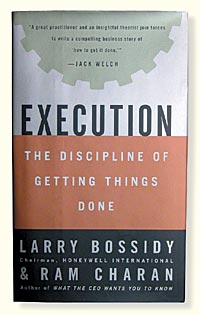
An even more fully developed picture of leadership emerges when the perspectives of retired Honeywell International Inc. chairman Larry Bossidy and consultant and professor Ram Charan are added to the mix. Their slim how-to manual, Execution: The Discipline of Getting Things Done (Crown Business, 2002), could just as well have been titled “Seven Behaviors of Highly Disciplined CEOs.” The behaviors include “know your people and your business,” “insist on realism,” “follow through,” and “expand people’s capabilities through coaching.” These would be no more than truisms if they weren’t fleshed out as they are here. Basing his writing on his practical experience, Bossidy walks us step by step through how to think about strategy, how to undertake a plant inspection, how to do a quarterly review, how to get the right people in the right jobs, and so on down the list of important executive activities. We ended up making pages of useful notes, and in discussions about the book with clients and colleagues, we noted they are doing the same.
Bossidy and Charan also identify three major CEO responsibilities: performing analysis, closing the gap between a company’s ambition and its actual performance, and, finally and especially, “getting things done.”
The secret to creating effective alignment of a company’s strategy, expectations, and people boils down to the CEO’s mastery of what Bossidy and Charan call “the social software of execution.” Given Bossidy’s reputation as one of America’s toughest bosses, what is striking here is his almost Socratic philosophy of execution. Instead of command and control, he describes a three-part systematic leadership process.
The first part is careful and informed questioning; instead of telling people what to do, he says leaders challenge their comfortable assumptions. Next is follow-through; at the end of every meeting, a leader sends all participants a note summarizing what they agreed to do. Finally, accountability is reinforced by leaders who evaluate the extent to which their people make good on promises, and then reward them accordingly. Indeed, Bossidy and Charan are positively Bennis-like in telling the leader to “know thyself,” Heifetz-like in stressing the centrality of “expanding people’s capabilities,” and in step with Collins in “insisting on realism.”
Those similarities were unexpected. It is less surprising to find Bossidy and Jack Welch agreeing on practically everything. The two worked closely together for many years at GE, and the similarities between their philosophies and leadership behavior has long been noted by informed commentators. That said, Welch’s expansive and autobiographical Jack: Straight from the Gut (written with Business Week’s John A. Byrne, Warner Business Books, 2001) is quite unlike Bossidy’s short, impersonal, nitty-gritty handbook. Moreover, when analyzing the functions of the CEO, Welch starts with such “big picture” elements as strategy and bold “game changer” initiatives, whereas Bossidy starts with the details relating to systems and operations (they eventually meet in the middle). Given all that has been written about Welch and GE over the years, it should come as no surprise that there are no surprises in Jack. But what is different here is that we get to see some of Welch’s familiar management practices from his perspective and with the benefit of his hindsight. For example, he recalls how a participant at one of his storied Crotonville “workouts” challenged his oft-quoted strategic formula:
For nearly 15 years, I had been hammering away on the need to be No. 1 or No. 2 in every market. Now this class was telling me that one of my most fundamental ideas was holding us back.
I told them, “I love your idea!” Frankly, I also loved the self-confidence they had shoving it in my face...
Having a high share of a narrowly defined market may have felt good and looked great on a chart, but the class was right: We were getting boxed in with the existing strategy…
I took their idea and put it into my closing remarks at our annual officers meeting … I asked each of the businesses to redefine its markets and give us a page or two of “fresh thinking” on this.
Welch then relates the story of how managers of GE’s Power Systems took up his challenge: Previously, the division had defined itself into a low-growth corner with 63 percent of a $2.7 billion market in repairs and spares of its own products; as a result of Welch’s prodding, the managers then were able to create tremendous upside potential by redefining their position as only a 10 percent share of the total ($17 billion) market for power-plant maintenance. This anecdote illustrates several aspects of leadership Welch stresses in the book: relentless questioning and repetition of initiatives, leveraging the brainpower of the organization, frequent and thorough appraisals, dispelling self-delusion, and openness to ideas. It is also significant that the incident occurs at Crotonville because Welch stresses the practical applications of managerial development throughout his book in much the same way Bennis models the process in his new volume. Welch talks about selection, development, and assessment processes built around the “four Es” of GE leadership: “very high energy levels, the ability to energize others around common goals, the edge to make tough yes-or-no decisions, and finally, the ability to execute and deliver on promises.”
Here Welch is on track with Bossidy. Welch also offers a touch of Heifetz when he warns that bosses shouldn’t “pile on” subordinates who have just made big mistakes; instead, leaders should help followers learn from their errors. And he includes many ideas Collins would agree with, the most important of which is that a key role of chief executives is to rid their management teams of delusions about their businesses.
Yet Welch and Collins disagree on a few practical issues: Welch says he “never saw a business fail because it cut costs too quickly,” whereas Collins praises his 11 CEOs for their patience in introducing change at a pace followers can assimilate. Welch’s GE did not make the cut in Collins’s selection of “great” companies, although GE’s financial record was strong enough to keep it in the running with 19 other “good” companies until the third, next-to-last round. (AlliedSignal, where Bossidy served as CEO, was cut in the first round, as was Honeywell, where Bossidy also served briefly as CEO after a merger.)
We also note that not all of Collins’s 11 great companies sustained their “built to last” performance through the current recession and bear market, although nine of them fared quite well. Moreover, we suspect Welch and Bossidy might not have been honored to be ranked among the “Level 5 Leaders” whom Collins describes as “quiet, humble, modest, reserved, shy, gracious, mild-mannered, self-effacing, understated, did not believe their own clippings.” Instead, from the rather muscular way in which Welch and Bossidy describe themselves, they each sound more like the quintessential “Level 4 Effective Leader,” who, Collins writes, “catalyzes commitment to and vigorous pursuit of a clear and compelling vision, stimulating higher performance standards.”
Although there is growing consensus on what leaders do in terms of questioning, challenging, and developing followers, there is still considerable difference of opinion about the values and ultimate purposes of this important endeavor. Yet, on one key point, all our various authors are in complete accord: They say that great leaders draw lasting lessons from transforming events. So the $64,000 question for leaders today appears to be, What lessons are they learning, variously, from the high-tech meltdown, the prolonged recession, the events of September 11, 2001, and, especially, the recent spate of corporate governance scandals? If our authors are correct, the next generation of great leaders will be those who learned the most from these sobering experiences. 
Reprint No. 02407
| Authors
Bruce A. Pasternack, pasternack_bruce@bah.com Bruce A. Pasternack is a senior vice president with Booz Allen Hamilton in San Francisco. He is the coauthor, with Albert J. Viscio, of The Centerless Corporation: A New Model for Transforming Your Organization for Growth and Profit (Simon & Shuster, 1998). James O’Toole, otoole_jim@bah.com James O’Toole is research professor in the Center for Effective Organizations at the University of Southern California. His research and writings have been in the areas of political philosophy, planning, corporate culture, and leadership. He has written 13 books, including Leading Change: Overcoming the Ideology of Comfort and the Tyranny of Custom (Jossey-Bass Inc., 1995). |
