
Corporate Governance: Hard Facts about Soft Behaviors
Seven steps to fixing what Sarbanes-Oxley can’t.
Here’s a test for Corporate America — and Corporate Europe and the Corporate Pacific Rim, for that matter.
- In the wake of the accounting, leadership, and governance scandals at such large companies as Enron, Tyco, and WorldCom, the provision in the Sarbanes-Oxley Act of 2002 that CEOs and CFOs personally certify the accuracy of their financial statements will restore investor confidence. True or false?
- All the problems with corporate governance boil down to one thing: Boards of directors aren’t independent enough. True or false?
- Holding chief executive officers to stricter performance standards will cause corporate performance to improve. True or false?
 |
|
Illustration by Jack Unruh |
Are these changes in the structure of business necessary? Probably. Are they sufficient? Certainly not.
Current attempts to embed irreproachable business behavior in the composition and structure of corporate boards are, we believe, doomed to fail. The Enron Corporation board met even the most rigorous independence criteria and represented a wealth of financial acumen; its audit committee head was an accounting professor and a former dean at Stanford’s business school. Tyco International Ltd. was a case study in governance best practices. CEO Dennis Kozlowski was the only insider on its board; directors ran for election annually; and a lead outside director ran board meetings, set the agenda, ran executive sessions without Mr. Kozlowski, and conducted annual evaluations of individual board members.
The fixes many firms are rushing to institutionalize may even be naively counterproductive. The drive to more tightly regulate the membership and functions of corporate boards is already encouraging companies to view governance as a legal challenge rather than a way to improve performance. Moreover, evidence exists that such externally imposed governance requirements may compromise long-term performance. (See “Does Good Governance Translate into Superior Returns?”)
|
Does Good Governance Translate into Superior Returns? |
|
No fewer than 50 studies have been devoted to the question of whether board composition — specifically, measures of board independence — correlates strongly with financial performance. Empirical research findings to date, however, have been inconsistent and conflicting. Studies of “outsider” ratios and firm performance have produced correlations ranging from positive .33 to negative .15, whereas other studies have found that the effect of the board’s composition on corporate financial performance is essentially value-neutral. Last year, Sanjai Bhagat of the University of Colorado and Bernard S. Black of Stanford University Law School published the first large-sample, long-horizon study of whether the degree of board independence (represented by the fraction of independent directors minus the fraction of inside directors on a company’s board) correlates with various measures of long-term performance among large American firms. Their conclusion was, essentially, “no.” Firms with more independent boards are not more profitable; indeed, there were hints in the data that they perform worse than other firms. Corporate governance experts Ira M. Millstein and Paul W. MacAvoy came up with more encouraging news in their study of independent boards. Comparing the returns after the cost of capital for companies rated A+ in corporate governance by the California Public Employees’ Retirement System with the returns of F-ranked companies, they determined that the performance gap exceeded 25 percent. Both of these studies were among the dozens analyzed in 2000 by the Conference Board, which concluded there was no quantitative evidence to either prove or disprove a link between corporate governance and performance (at least as indicated by externally observable measures). Similar studies conducted in the U.K., Southeast Asia, and elsewhere have generated similarly conflicting findings. In sum, the quantitative research done to date is inconclusive at best, suggesting that a board’s performance should be measured by the merits: the quality of the dialogue, the insights of individual directors, the overall tone set by the CEO. — P.F.K., C.B., and B.B. |
“Hard” solutions, in short, will not resolve the challenges companies face in simultaneously serving the interests of shareholders and other stakeholders. By reducing the critically important issue of corporate governance to what amounts to a box-checking exercise, corporate directors and senior executives are addressing the symptoms, not the root cause, of the governance crisis.
Our experience in advising boards and CEOs in the United States, Europe, Australia, and Asia; our primary research in these markets, including interviews with hundreds of directors and corporate officers about board effectiveness; and a review of contemporary best practices leads to one universal conclusion: Governance begins at home — inside the boardroom, among the directors. It is embedded in how, when, and why they gather, interact, and work with one another and with management … in other words, the “soft” stuff. But qualitative reforms to the behaviors, relationships, and objectives of the directors and the CEO are meaningless unless they are subjected to the “hard” mechanisms of performance criteria, processes, and measurements.
This combination of soft and hard solutions can turn governance from a vague concept into a means to deliver organizational resilience, robustness, and continuously improved corporate performance.
Qualitative Reform
It was, perhaps, inevitable that the bubble economy of the late 1990s would be followed by both decline and introspection, but the degree of soul-searching today is striking nonetheless. Forty-six percent of the corporate executives surveyed by Kennedy Information, publisher of Shareholder Value magazine, said the recent wave of corporate scandals had harmed the way investors viewed their companies, and 43 percent were committed to changing the way they did business.
The problem is, in too few cases is such reflection prompting companies to change, a situation that almost begs governments to attempt regulatory solutions — which will not, by themselves, create conditions for better governance and improved performance. “A lot of people who have not served on the inside think the reforms can be imposed from the outside,” says Bill George, former chairman of Minneapolis medical device maker Medtronic Inc. and the National Association of Corporate Directors 2002 Director of the Year. “These are necessary but not sufficient conditions for good governance.”
What distinguishes superior performance among boards is the “qualitative” reforms that companies put in place between the structural boxes and the lines of legislative mandate. With tens of thousands of publicly traded companies around the world, the recipe for reforming the soft side of governance will need to be adjusted to the specific circumstances of an individual company. Still, although governance regulations and management culture differ from firm to firm, our experience persuades us that the following best practices can — and should — cross borders:
- Select the right directors
- Train them continuously
- Give them the right information
- Balance the power of the CEO and directors
- Nurture a culture of collegial questioning
- Gain from directors an adequate commitment of time
- Measure and improve
Although many of these principles may seem self-evident, in our experience, they too frequently are more honored in the breach. Too often, firms assume that “soft” reforms cannot be assessed, or even implemented, rigorously. But if a company aims to serve shareholders’ interests better — and adapt to the rigors of an increasingly competitive global economy — it must address board culture and behavior through a systematic and solution-oriented approach.
Select the Right People
The first imperative, naturally, is choosing the right directors — with the right skills, expertise, and personalities. An impulse in the current crisis environment will be to try to satisfy regulators simply by changing the insider–outsider mix on the board. But board balance alone is an insufficient guarantor of effectiveness. Boards need to possess, collectively, the diverse array of skills and knowledge needed to perform effectively in their advisory and oversight capacities. The central test for a director should be: Does he or she add value?
Sometimes the skills needed — and absent — are painfully obvious. Frank Cahouet, retired chairman of the Mellon Bank Corporation, recalls recruiting Ira J. Gumberg when, in the late 1980s, Mellon was burdened with bad real-estate loans. Mr. Gumberg, a developer and still a Mellon director, worked directly with the company’s real-estate department to give managers hands-on advice on how to extricate the bank from its loan-portfolio mess. “Directors all have strong suits,” says Mr. Cahouet, now a director at executive recruiting firm Korn/Ferry International and Allegheny Technologies Inc. “What you do is pull on their special knowledge.”
Possessed of such business acumen and technical know-how, directors also need charm and the chutzpah to engage in debate. Again and again, when asked to describe the key activities and characteristics of a well-run board, directors we’ve interviewed say the same thing: debate, dissent, active engagement. “What you’re looking for is an open, rigorous discussion, with people challenging each other, challenging the CEO,” says Marc Epstein, a business professor and governance expert at Rice University in Houston.
Surveys conducted by Korn/Ferry support this contention. Nine out of 10 directors polled by the firm cite “willingness to challenge management” as either the most important criterion or among the most important criteria in selecting new directors.
Clearly, conflicts of interest also need far better internal policing than they now receive. Research by the New York Times discovered that at 20 percent of the 2,000 largest U.S. companies, members of the board compensation committee had business ties with the CEO. Other, seemingly more benign, relationships — such as service by a corporate CEO and a philanthropic organization head on each other’s boards — can also compromise the independence and authority of the board, and stifle debate before it can begin. We don’t advocate banning all board–CEO associations, but we certainly favor greater clarity about them.
Train the Watchdogs
Serving as a corporate director is not an honorary commitment. A director requires a thorough understanding of the company’s past, present, and potential performance to ask intelligent questions. The New York Stock Exchange recognized this when it mandated, as part of its new listing requirements, that governance principles address “director orientation and continuing education.” Yet most companies have failed to furnish that training. A survey of 300 public companies conducted by the Financial Executives Institute in 2002 found that 86 percent of the respondents did not provide a continuing program for educating board members.
In fact, a surprisingly large number of company directors have little or no background in the businesses they are monitoring. As one Australian executive director we interviewed put it, “Most of our directors have little or no real understanding of our various businesses.” Today, not all directors can even work their way through financial statements. One CEO recently asked Professor Epstein to join his board because the chief needed help figuring out his own financial statements. If the CEO isn’t fully financially literate, Professor Epstein wondered, how can the directors be expected to be? He declined the invitation.
Companies that get high marks in governance invariably devote significant time to educating their directors. Pfizer Inc., for example, subjects every new director and audit committee head to an orientation program that includes sessions with the CFO, head of research, general counsel, and corporate secretary, as well as the business unit heads. Directors are then connected to Pfizer’s senior management network and issued a directory with the home addresses and phone numbers of the top 30 to 40 Pfizer managers. “That gives directors low-tension access to information,” says Constance Horner, chair of Pfizer’s governance committee and a guest scholar at the Brookings Institution. “You don’t want to be calling the CEO all the time.” (See “Focus: How Pfizer Makes Directors Effective.”)
Companies should develop training regimens for directors, and nominating committees should gain potential board members’ commitment to engage in such schooling as a prerequisite for election. Other stock exchanges should follow the NYSE’s lead and institute training requirements.
|
Focus: How Pfizer Makes Directors Effective |
|
When Robert Burt took over as chairman of the Pfizer audit committee, the retired CEO and chairman of the FMC Corporation headed back to school … as the only student in his class. For four hours following each of his next three Pfizer board meetings, he was tutored by senior managers from the divisions of internal audit, investor relations, tax planning, treasury operations, budgeting, corporate communications, and a host of others. A lead partner from KPMG LLP, Pfizer’s external auditor, sat in on every session. Not only did Mr. Burt learn a lot about his new role, he built relationships with the people reporting to him. Pfizer has long been lauded for its commitment to maintaining a strong board. Such governance experts as Richard Koppes, formerly with CalPERS, Nell Minow, editor at the Corporate Library, and Patrick McGurn, vice president at Institutional Shareholder Services, have repeatedly cited the company as a role model for board best practices. In 2002, Pfizer won the Wharton/Spencer Stuart Board Excellence Award. One of Pfizer’s hallmark strengths is the way it cultivates and trains both new and veteran directors. The governance committee of the board — not the CEO or senior management — recruits candidates for board positions. In fact, three recently hired directors were unknown to the CEO prior to joining the board, says Terence Gallagher, chief executive of Corporate Governance Associates in Scarsdale, N.Y., and the former Pfizer vice president who launched its corporate governance department in the early 1990s. The governance committee deliberately chooses directors from diverse backgrounds. Today, Pfizer’s board includes current and former CEOs from a range of industries, along with a former congressman, a Nobel Prize winner, and a university president. Pfizer CEOs from Edmund Pratt to William Steere to current CEO Henry McKinnell have developed the tradition of reaching out to directors over the years to solicit their advice. In fact, Constance Horner, chair of Pfizer’s governance committee and a guest scholar at the Brookings Institution, praises Mr. McKinnell for being “alacritous” in putting items raised by directors on board agendas. The real making of a Pfizer director begins when he or she first joins the board. All new directors undergo an intensive orientation that immediately welcomes them into the fold of senior management. Ms. Horner, as an example, frequently has one-on-one dinners with Karen Katen, CEO of Pfizer’s global pharmaceutical business. “The rubric is social, but the outcome is a help to me in understanding the company better,” Ms. Horner says. Director training does not end with orientation; it’s a continuing process. An internal group is charged with forwarding directors’ information from third-party sources. Moreover, all directors are encouraged to make facility visits. Robert Burt says Pfizer paid him $1,500 when, while on vacation, he took time to visit the research facility in Sandwich, England, where scientists developed Viagra, among other drugs. Pfizer also organizes group trips. “Collegiality is ... extremely valuable,” Ms. Horner says, particularly in times of intense activity. When Pfizer acquired Warner-Lambert Company in 2000, Pfizer’s CEO drew on input from all his directors to make decisions on compensation, personnel, accounting, and other issues. Ultimately, the hostile deal turned friendly, but before it did, Pfizer, remarkably, relied on its board to choose a slate of seven directors for a new Warner-Lambert board. Board effectiveness, according to Ms. Horner, depends on the quality of the individual directors, on the relationships among them, and on the joint work of the group. Pfizer has fostered an environment that encourages the right result in all three of these areas. In so doing, not only has it attracted good directors, but it has also kept them eager to contribute. Says Mr. Burt: “The thing that makes [the Pfizer board] superior is everyone wants to come and be successful.” — B.B. |
Inform and Empower
“Management writes the board agenda. We tend to look only where they shine the light,” complained one director we surveyed. It’s true. Most of the information reviewed by boards of directors is provided by management, generally a week to 10 days before the board meets. It is too little, too late.
A steady supply of credible and comprehensive information is the foundation of an effective board’s power to govern competently. To gauge the adequacy of a board’s information sources, Paul Lapides, director of the Corporate Governance Center at Kennesaw State University in Kennesaw, Ga., suggests directors ask themselves, “Can we have a conversation about this company without someone from management being there?”
The frequency, format, sources, channels, and content of that information all influence whether directors develop the knowledge needed to do their jobs. Edward Lawler III, professor of management at the University of Southern California and coauthor of Corporate Boards: New Strategies for Adding Value at the Top (Jossey-Bass, 2001), argues that this knowledge base should encompass more than financial results. “Simply looking at accounting data is inadequate,” he says. “Directors need to develop a better mix of indicators of how the corporation is performing.”
Professor Lawler suggests nonfinancial as well as financial indicators, leading indicators and lagging indicators, and indicators that include customer and employee satisfaction, quality, cycle times, and so forth. According to his research, companies that provide their boards a range of indicators enjoy significantly greater stock and investment returns than firms that do not.
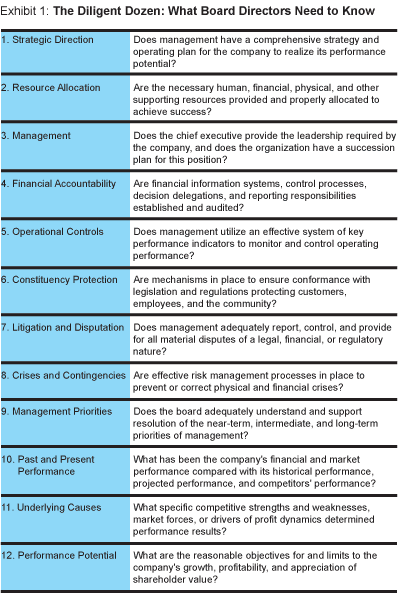
The ideal model for information provision is a “push and pull” approach, in which companies provide directors with regular, standardized briefing books of summarized information that is timely, comprehensive, and presented in order of importance, but directors are also able to request — and receive with reasonable speed — any other information they want. (By providing board members with executives’ home telephone numbers, Pfizer exemplifies this best practice.) Directors should also take it upon themselves to obtain the information they need to help govern the company. In the course of our client work, we’ve come up with a list of questions we’ve dubbed the “Diligent Dozen.” These are the questions that every director should be able to answer — with a “yes,” in the case of the first nine, and with a reasonably comprehensive explanation in the case of the latter three. (See Exhibit 1.)
The presentation of information is also critical, and an area in which directors we interviewed identified significant room for improvement. James Baker, the retired chairman of Arvin Industries, advocates the use of “consent agendas.” CEOs should group routine topics — check-signing authority, lease renewals, small-time option grants, review of on-par operations — at the end of the agenda for collective approval. That lets directors focus on higher-priority matters. When Mr. Baker was chairman of Arvin, he got the directors to agree that they wouldn’t even talk about routine manufacturing operations at meetings unless something unusual came up.
Boards can and should take charge of their information needs. When Mark Leslie, former CEO of the Veritas Software Corporation and a director of Avaya Inc., became Avaya’s audit committee chair in 2002, he called a meeting of the four-person committee right away and posed the question, “How can we do our job better?”
He began by narrowing the focus of the committee from audit and finance to just audit. Then he and the other committee members revamped the format of the management letter from the external auditing firm to make the review process more efficient. Now each report comes with a color-coded cover page that rates pending issues as red, yellow, or green, denoting no progress, slowing progress, or adequate progress. The format helps the committee ignore the green issues and focus attention on the more pressing red and yellow ones.
As a result of the reforms Mr. Leslie has put in place, Avaya’s audit committee is thoroughly schooled in the company’s financial performance. In fact, the discussion of the audit results is led by members of the committee, rather than management, which has brought a whole new flavor to the discussion.
Counterbalance the CEO
Few issues are more hot — or more contentious — right now than the relationship between the CEO and the board of directors. “Independent” boards — that is, boards with few inside directors — have become the trend du jour. But as the Enron and Tyco sagas illustrate, even companies that comply with the recommended ratios of outsiders to insiders can stumble badly. “The fulcrum of governance is the chief executive officer,” Federal Reserve Board Chairman Alan Greenspan, a veteran of more than a dozen boards, told the U.S. Congress in July 2002.
Balancing the power of the CEO with that of the board is critical to effective governance, but it takes more than optimum insider–outsider ratios to establish equilibrium. At some companies in which the CEO also serves as chairman, boards are appointing another member to serve as lead director. But this, too, seems little more than a palliative: If directors believe there ought to be a separation of power between management and the board, they ought to insist on the appointment of a nonexecutive chairman.
Our experience persuades us that companies benefit when the roles of CEO and chairman are split. The 1992 publication of the Cadbury Commission report on corporate governance in the U.K. ushered in a sweeping change in governance practices in Britain. Today, only a few major U.K. companies have a single chairman/CEO; the increased transparency resulting from better-balanced governing mechanisms prepared British companies for the era of increased shareholder activism, as Financial Times columnist John Plender remarked recently.
But there are other, less obvious reasons to recommend this separation of powers. One of the most prevalent private complaints of chief executives is that they have no one with whom they can talk deeply and seriously about the difficulties, some of them intensely personal, of running a complex enterprise. The avidity with which hundreds of CEOs flock to the annual meeting of the World Economic Forum in Davos, Switzerland, attests to their thirst for contact. A nonexecutive chairman can become the confidant and coach that so many chief executives crave, especially if (as is often the case in the U.K. and Australia, which also adopted Cadbury-like governance mechanisms in the past decade) the chairman is a retired CEO of another company who is clearly not in competition with the company’s chief.
Evidence indicates that U.S. companies will be slow to adopt this approach; in January, for example, AOL Time Warner Inc. appointed CEO Richard Parsons to the additional role of chairman. So, short of role splitting, there are other measures companies can and should take to ensure an appropriate power balance between CEOs and directors. Former Securities and Exchange Commission chairman Roderick Hills recommends that the board nominating committee, not the CEO, recruit and hire directors. That change has become increasingly accepted; Korn/Ferry managing director Charles King says that nominating committees today initiate about 70 percent of the director searches he conducts, versus about 10 percent eight years ago. To reinforce its independence, a CEO/chairman should not be a member of the nominating committee. But because CEO–board chemistry is vitally important to corporate governance and operations, the chief should be able to vet and veto nominees with whom she or he is not comfortable.
Mr. Hills also says that audit committees, in particular, must have the ability to structure their operations to create their own power base. Audit committee directors should determine for themselves what they want to see — not simply accept what management hands them. He also urges that independent directors choose the company’s external auditors, negotiate the auditing fee, and establish the reporting line from auditor to board. As Mr. Hills, who currently chairs the audit committees at Chiquita Brands International Inc. and ICN Pharmaceuticals Inc., puts it, “You need to confer independence on the outside auditors.”
To those who object that these safeguards consume too much time, Mr. Hills argues the opposite. Having handpicked the auditing firm, the audit committee will have more confidence in the final numbers, saving time that might otherwise be wasted rechecking results. “It really takes that load off the audit committee,” he says.
Nurture Constructive Skepticism
Balance works in the other direction, too. With popular culture demonizing boards and CEOs alike, directors must take care not to disempower the CEO.
The layman’s currently jaundiced view of corporate governance — defensive CEO packs board with cronies and weaklings, then manages the information they get so they can’t do him harm, in the process so enfeebling the board that they can never add value — is leading many to propose a more “modern” governance model: Enlightened, open CEO enlists extremely talented, opinionated, and strong-willed board members, gives them free access to whatever information they need, and then uses them as a strategic forum for formulating strategy, answering really difficult questions, etc.
But this kind of board can also do the CEO real harm, because directors are smart and well-armed enough to get him or her fired. So the CEO has to be secure enough to trust the board to help him or her do the right thing — and board members have to enter into an implied contract with the chief executive to forward that guidance in the most constructive manner possible.
Although it’s important to empower directors with information and arm them with the authority to make tough decisions, boards should not get into the habit of openly vying with the CEO. An atmosphere of antagonism and divisiveness serves no one’s interests, least of all the shareholders’. CEOs must be able to treat directors “as a valued asset rather than a pain in the rear,” says Richard Koppes, formerly with California Public Employees’ Retirement System (CalPERS) and now a partner at the law firm Jones, Day, Reavis & Pogue and a director of Apria Healthcare and ICN Pharmaceuticals.
That’s a stretch for many firms. As one company secretary we surveyed noted, “It’s pretty easy to manipulate the board’s role by the agenda and the papers we give them.” Mr. Koppes agrees. “A fair number of CEOs,” he says, “try to make the board nonperforming assets.”
A culture of constructive questioning requires members to perform a delicate balancing act. The goal is an oxymoron — directors exercising “collegial disagreement” or expressing “reserved advocacy.” “The atmosphere that needs to prevail between a CEO and a board is one of mutual confidence, trust, and a sense of them all being in it together,” says Michael Miles, a former CEO of Philip Morris Companies Inc. and a member of eight boards. “It must be an open, mutually supportive, two-way street.”
Although it is the responsibility of both the chief executive and the directors to nurture the right boardroom culture, “the CEO has to set the tempo,” says Steve Beering, a former president of Purdue University and a director at five companies, including Eli Lilly and Company and American United Life Insurance Company. “You need a very good CEO who is obviously the orchestra conductor.”
Establishing this collegial yet critical culture is indeed a challenge, especially on boards heavily loaded with current or former CEOs. Each person has to submerge his or her ego to work for the common interests of the company. The best directors, Mr. Beering says, tend to be self-effacing. Not incidentally, that character trait also defines successful chief executives, as Jim Collins showed in his recent best-selling management book, Good to Great: Why Some Companies Make the Leap… and Others Don’t (HarperBusiness, 2001).
Inspired by the example of the Dayton family in the 1960s, the Target Corporation board committed to many enlightened governance practices more than 20 years ago, says the company’s executive vice president, general counsel, and corporate secretary, Jim Hale. Target CEOs have long made a habit of bringing issues to the board before resolving a course of action. He recalls some years ago when the board dealt with the issue of whether to conduct a stock buyback. After presenting the question to the board, Mr. Hale argued one point of view for 10 minutes, and then the CFO argued the other for another 10. “It was a way to get the various issues out on the table,” says Mr. Hale. The board ended up postponing the decision on a buyback, but when they finally addressed it, the directors had formed an opinion based on healthy debate, not dictate.
“Our view is: If we have a really good board, we use the board,” Mr. Hale says.
Watch the Time
In today’s increasingly complex and global business environment, the demands placed upon board members are unprecedented. As industries deregulate, new markets emerge, mergers are made, and subsidiaries implode, board directors are increasingly pulled in multiple directions. These special circumstances are added to all the normal demands of board membership — meetings, training, evaluations. It’s little wonder that companies are having a difficult time fielding qualified candidates to fill their board seats. A lot more people are saying no.
To participate constructively in strategic and other board discussions, directors we’ve spoken to report that they spend time not only attending meetings, but also studying the issues beforehand, participating in site visits and informal gatherings, and conferring privately with the CEO and other executives. Korn/Ferry’s Charles King estimates that audit committee members will spend as much as 300 hours per year per company fulfilling their board obligations. Other board members will commit between one and two days per month, roughly 100 to 200 hours per year, barring a crisis.
Although boards may shy away from setting strict numerical limits on members’ other directorships, they should establish participation benchmarks for directors. Continued membership should be contingent on the faithful fulfillment of obligations.
Activists are calling for a limit on the number of directorships held by any one individual. Although a regulatory fix is probably not the answer, they have a point. It’s hard to deny the worldwide rise of professional directors who cannot possibly have the time to prosecute their obligations to multiple boards. Here, as in other components of board performance, information availability and transparency is surely part of the answer. All board members should know about the extent of one another’s additional commitments. If a director is considering an additional directorship, the nominating committee should know about it in advance, and perhaps even have the option of accepting the directors’ resignation from the current board.
Measure Board Performance
A board’s scrutiny should apply not only to the company’s performance, but to its own performance. On this point, perhaps surprisingly, most directors concur. For example, in a survey Booz Allen conducted of directors of Australia’s 100 largest companies, 77 percent believed that substantial scope exists for improving the practices of boards. When asked about individual director contribution to board effectiveness, 89 percent said it varied significantly; 66 percent believed boards required better processes for self-assessment and evaluation; and 83 percent felt boards should have policies to replace nonperforming directors in an orderly fashion. A Booz Allen European survey revealed a similar consensus.
Yet very few companies have in place mechanisms for defining or measuring the performance of the board either as a unit or at the individual director level. In research with the Conference Board, we could identify only 13 incidents of directors’ being removed for performance reasons, among 546 companies studied.
Of course, the measure of success in making boards accountable is not the removal of underperforming directors. Ideally, boards should put in place performance measures and evaluations that provide the group and individual directors the opportunity to correct course before real damage is done.
Nearly all governance experts urge directors to conduct board evaluations. Directors at best-practice companies like Target and Medtronic have done so for years. But how do firms institute evaluation? A 2001 report by the National Association of Corporate Directors notes that boards often develop evaluation processes in stages — frequently with the help of experienced independent advisors — progressing from full board evaluation, to individual director self-assessment, to peer evaluations.
Although these evaluations still lack rigor at many companies, directors praise the improvements they yield. Karen Horn, a managing director at Marsh & McLennan Companies Inc. and a director at Eli Lilly, says that self-evaluations led the boards she was on to introduce effective new governance procedures. One board now finishes each meeting with an executive session that does not include management. Moreover, agendas are now set less rigorously, to provide time for more open discussion. The number of business heads reporting at each board meeting has declined. Although small, these measures make a difference in the quality of discussions.
When it comes to assessing individual directors, however, the subject of board self-evaluation becomes more controversial. Purdue’s Professor Beering says the five boards he sits on have rejected the idea, believing it “pejorative and insulting.” Yet the research by Professor Lawler of USC shows that directors rate board effectiveness significantly more positively on boards where individuals are evaluated. Perhaps that explains why studies by Korn/Ferry show that 71 percent of directors think individual evaluations are a good idea (although only 18 percent actually participate in them).
This is a sensitive area, but the increased need for improved board fitness demands progress on the issue of board (and probably individual director) evaluation. A healthy first step is for the chairman, in collaboration with the CEO, to draft a set of evaluation criteria relevant to the organization and its situation and circulate it among the directors for comment and discussion.
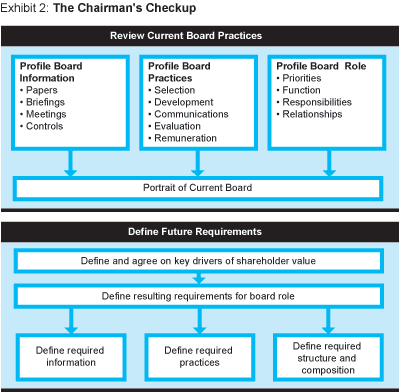
This “Chairman’s Checkup” should begin with a rigorous exploration of the firm’s earnings drivers, and lead toward an analysis of the risks the company faces in those areas. (See Exhibit 2.) Because boards are essential risk management mechanisms, the earnings and risk analysis can help guide the company toward the specific types of knowledge and skills its directors should have, the practices in which the board should engage, and the information directors require to perform their duties. Understanding the board’s composition, information, and process requirements will in turn help define the metrics needed to ensure continuously high performance. (See “Enterprise Resilience: Managing Risk in the Networked Economy.” )
Strategy and Oversight
A shared understanding of ethical behavior is one of the critical elements that bind a society together. But good corporate governance transcends ethics: It is a crucial operating system for companies in complex, competitive, fast-moving industries, and thus an important component of economic stability and growth.
Legislation can stiffen penalties for directors, executives, and firms straying from the path of good governance, and exchanges can tighten listing requirements, but only the chief executive officer, the chairman, and their board of directors can choose to govern well. To do that, they must master the soft art of balancing power, nurturing a collegial culture, promoting continuous improvement, and educating and informing each other. Although these behaviors have always been noble goals, they are now a shareholder requirement in a newly chastened marketplace. 
Reprint No. 03106
|
The Seven Principles of Soft Governance |
|
1. Select the right people. Recruit directors with the courage to challenge the CEO. Look for self-confident CEO-level candidates who can engage in real debate without dragging in their egos. 2. Train, train, train. Orient new directors by arranging face-to-face meetings with all the top executives. Provide briefing books, arrange site visits, and factor in time to build relationships. Remember ongoing education for all directors. 3. Inform and communicate. Deliver relevant information early and in multiple formats. Leave time on the agenda for open discussion. Don’t skimp on site visits and retreats; they can yield give-and-take. 4. Balance the CEO’s power. Make sure only independent directors recruit new directors, control the committees’ chairmanships, hold meetings without the CEO, and control succession. Remember that committees can appropriate power. 5. Establish new behaviors. Hire CEOs who value teamwork and want full feedback. Establish a tone of collegiality and “constructive skepticism.” CEOs and directors must nurture a culture of listening. 6. Devote the time. Board membership requires time to prepare, time to discuss, time to develop relationships. All directors must open up their schedules to absorb information and make decisions. 7. Evaluate and improve. Establish a tradition of continual improvement. Directors should examine and refine practices as do other professional teams. Evaluate the CEO, evaluate the board as a whole, and evaluate individuals. |
Also contributing to this article were Bruce A. Pasternack (pasternack_bruce@bah.com), a senior vice president of Booz Allen Hamilton in San Francisco; Gary Ahlquist (ahlquist_gary@bah.com), a senior vice president of Booz Allen in Chicago; and Wolter Mannerfelt (mannerfelt_wolter@bah.com), a vice president of Booz Allen in London.
| Authors
Paul F. Kocourek, kocourek_paul@bah.com is a senior vice president with Booz Allen Hamilton in New York. He focuses on strategic transformation of companies facing changes in the competitive landscape or the regulatory environment. Christian Burger, burger_christian@bah.com Christian Burger is a vice president with Booz Allen Hamilton in Munich. His principal areas of activity include telecommunications and technology, and the related consumer goods space. He focuses on strategic change and management control issues. Bill Birchard, bbirchard@aol.com Bill Birchard is a writer in Amherst, N.H., whose work has appeared in Fast Company, CFO, and other publications. He is coauthor, with David A. Nichol, M.D., of The One-Minute Meditator: Relieving Stress and Finding Meaning in Everyday Life (Perseus Publishing, 2001) and, with Marc J. Epstein, of Counting What Counts: Turning Corporate Accountability to Competitive Advantage (Perseus Publishing, 1999). |