

Shifting Competition in the Brokerage Industry: New Imperatives for Full-Service Firms
Wall Street brokerage firms have been enjoying a robust business climate in recent years. Braced by a seemingly inexhaustible bull market and heavy trading volumes, full-service firms -- the traditional Wall Street powerhouses -- are, by and large, consistently reporting increased profits. Assets in mutual funds have soared as well, as more baby boomers have become concerned about the financial needs of retirement.
But these heady market conditions, while seemingly a recipe for continued success, mask looming problems for the full-service firms. That is because they are losing a significant portion of their business to discount brokers, mutual fund companies and other specialized providers, a group that has already captured 25 percent of the retail market with its generally lower prices and more enterprising use of technology. In particular, new entrants have been quick to capitalize on the growth of direct channels, e.g., discounters now moving to the Internet.
All of which has left the full-service firms with a bottom line that is bigger but is also under siege. To fight back, the firms need to play to their strengths and shore up their weaknesses. On the strength side, they need to aggressively market their product breadth, personalized service and "one-stop shopping" convenience. As for their weaknesses, they need to focus on costs and operating efficiency, and pass on as much of the savings as possible to their customers. And they need to proactively manage their key client relationships through superior service and attractive customer loyalty programs.
A New Breed of Competitor
The competitive environment has changed dramatically for full-service brokerage firms. Until the mid-1980's, these firms dominated the landscape. Their product offerings were primarily stocks and bonds, and their customers were usually affluent. Securities regulations mandated a level playing field that gave firms little beyond their image and reputation to differentiate themselves. As a result, customer turnover was typically low.
But price deregulation and technological advances dramatically changed that paradigm. A new breed of specialized firms and discount brokers appeared on the scene, offering services at vastly lower costs.
Exhibit I
Unbundling the Offerings: The Old Guard vs. the New Wave

Source: Booz-Allen & Hamilton
These firms unbundled the offerings of the full-service providers and concentrated on specific sources of value to investors. (See Exhibit I.) They also developed direct channels to circumvent the physical footprint advantage of the established players at a time when consumer adoption of electronic and other forms of direct access was increasingly replacing the need for face-to-face dealings. Paced by technological advances that made "self-service" a reality, as well as by a rising level of investor sophistication, the trend toward specialization gained momentum.
At the same time, the ranks of individual investors swelled, sparking tremendous growth in mutual funds and employer-sponsored 401(k) plans. Recognizing that growth, the specialized firms focused more and more on specific sources of value to address targeted customer needs, fostering the perception that their services are "cheaper" (although, given fair comparison, that is not always the case).
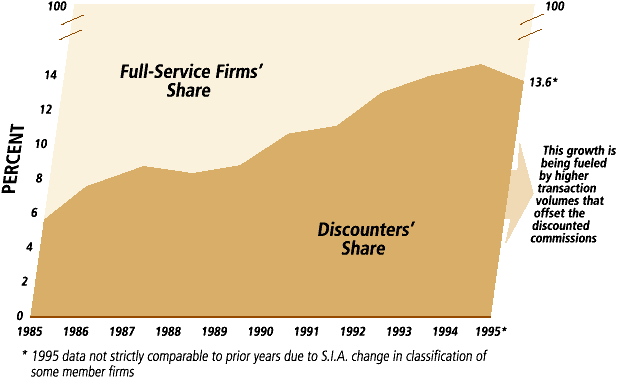
These specialized providers have enjoyed significant growth at the expense of the full-service firms. In the 10 years since 1985, the discounters' share of retail equity trading commissions nearly tripled. Clearly, investors perceive significant value from the discounters' price and convenience advantages. (See Exhibit II.)
Exhibit II
A Growing Competition for Retail Commissions
Sources: S.I.A. Factbook and Booz-Allen & Hamilton analysis
Unbundling to Appeal to Specific Investor Types
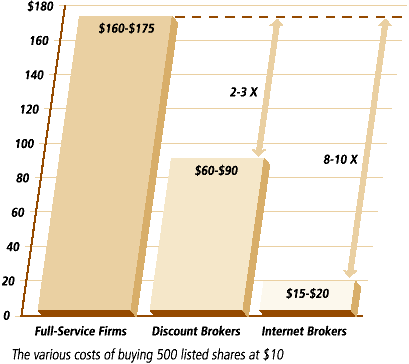
By unbundling brokerage services, specialized providers have been able to appeal to specific investor groups, particularly the self-directed investors. In using specialized providers, these customers can reduce their overall cost of investing by accessing only the services they need, primarily transaction execution. To obtain investment selection advice, this group pays directly for financial periodicals and research material. Such advice is usually available at no additional charge as part of a full-service firm's package of services. But the price differential for transaction execution makes the specialized provider a much more cost-efficient choice for the self-directed investor than a traditional full-service broker -- by as much as 8 to 10 times. (See Exhibit III.)
Exhibit III
Comparing Transaction Costs
Source: Booz-Allen & Hamilton analysis
Further increasing their allure to the more sophisticated investor, specialized providers have aggressively expanded the use of technology for distribution of, and access to, their products and services. Phone-based services and on-line trading, for example, have been utilized most effectively by these providers to gain market share among active, savvy customers.
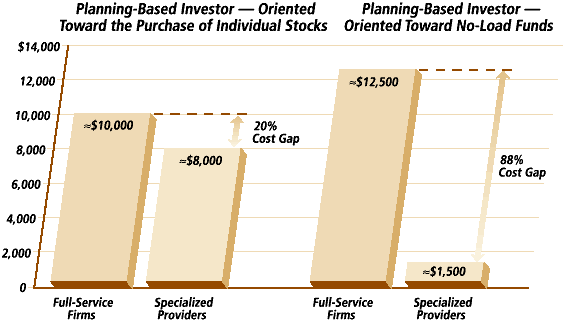
Investors who are less self-directed and more concerned with developing and executing an in-depth financial plan are more likely to realize value from a full-service provider. The costs of preparing a financial plan and obtaining asset allocation and investment selection advice on an "unbundled" basis quickly level the playing field between specialized and full-service providers if the customer invests largely in "load" mutual funds. (See Exhibit IV.) However, if that planning-based investor is oriented toward the purchase of individual stocks, the cost gap between specialized and full-service providers begins to reappear in the value equation. Even more ominous for full-service firms is the growth of the cost gap if the planning-oriented investor uses no-load mutual funds. (See Exhibit V.)
Exhibit IV
A Level Playing Field

Source: Booz-Allen & Hamilton analysis
Exhibit V
The Cost Gap by Investor Type for $350,000 Portfolio
Source: Booz-Allen & Hamilton analysis
How Full-Service Firms Have Responded
The response of full-service firms to the rise of specialized providers has been reactive at best.
Many of these firms have broadened their product offerings by providing financial planning that addresses a totality of needs, including credit, risk management and wealth transfer. They are also working to close the technology-based access and price/value gaps so apparent to today's most active brokerage consumers.
While the broker-client relationship continues to be the focus of the full-service firms' customer interface, several firms now offer on-line account access (but not trading) and expanded automatic-response phone information systems. In addition, the most aggressive full-service firms are responding to the proliferation and popularity of no-load funds by incorporating these fund families into their product offerings.
Specialized Providers Integrate Services
But using technology more effectively and neutralizing the no-load competition are only part of the challenge facing full-service providers. A more significant threat is the increasing ability of specialized providers to seamlessly integrate their offerings, enhancing their appeal to traditional full-service customers. (See Exhibit VI.) Providers of financial software, like Intuit, could potentially expand their capabilities to include portfolio planning and execution services, thereby combining profiling and asset-allocation capabilities with discounted transaction execution.
Exhibit VI
Potential Threat to Full-Service Firms from Specialized Providers

Sources: S.I.A. Factbook and Booz-Allen & Hamilton analysis
Alliances among specialized providers could further blur competitive distinctions. On-line brokerages could team with research providers to offer investment selection advice along with capabilities for discounted transaction execution. And the discounters could offer full-service value by aligning with both research providers and financial planners while still retaining the ability to offer transaction execution.
As the needs and delivery preferences of the specialized providers' customer bases change (because of aging and life-stage transitions, as well as shifting attitudes toward remote access), these enhanced value-added elements will prevent the migration of accounts to the full-service firms. Charles Schwab & Company and Fidelity Investments have been especially active in this area, and other providers can only be expected to follow suit.
Competing in This Brave New World -- A New Approach
Whether through unbundling services or combining services cost-effectively, specialized firms are poised to continue to gain significant market share.
The challenge for full-service brokerages will be to identify customer segments best suited to their strengths, and focus on understanding the needs, goals and delivery preferences of these groups. Developing and marketing their ability to help customers meet their goals with a suite of products and services will cement their relationships over the long term and will be the hallmark of successful firms in the future.
For the full-service firms, logical target customers include planning-based investors who are attracted to packaged products, as well as those who are more oriented toward individual stocks. A further subset of planning-based investors -- people who invest in no-load mutual funds -- also should be considered a viable and valuable customer group.
To appeal to these investor groups, full-service firms should aggressively market the value they can add as a total-service provider. Understanding a client's goals and risk tolerance, developing investment strategies consistent with those goals and measuring performance against the goals will be critical to delivering on the full-service promise. In addition, the value of personalized service and individual attention, the convenience of bundling products together and the availability of research material are strengths and capabilities that should be actively promoted.
Enhancing product breadth, including offerings in the no-load mutual fund category and goal-oriented programs, is also critical. Most importantly, full-service firms must proactively manage client relationships to ensure that the value of their complete range of capabilities is being utilized and appreciated. These firms need to establish and deliver high service standards, and also initiate loyalty programs to help retain key customers.
Ongoing cost management is imperative, too, as customers become increasingly aware of the more cost-effective alternatives. Thus, full-service firms are faced with the challenge of reducing costs while enhancing operating efficiencies. They must pass these improved economics on to customers in the form of lower commissions or discounted fees in order to reduce the visible price disadvantage with specialized providers.
Superior service is now a basic requirement for all brokerage firms. Customers expect access to investment and account information 24 hours a day, 365 days a year, across a variety of channels. The full-service firms have to enhance their direct channels to offer these service levels. In addition, customer expectations will continue to become more demanding regarding transaction execution cycle times and the time it takes to resolve problems, as well as the rate at which those problems occur.
In conclusion, full-service firms must aggressively focus and manage their business to remain competitive in the coming years. As investor sophistication and expectations grow, customers will demand more from their investment service providers. The key for brokerage firms will be to respond to those types of investors who can benefit and derive value from the firms' core strengths, leading to profitable and sustainable customer relationships. 
Reprint No. 97102
