
Can You Support Your Successor?
Frances Hesselbein, author of Hesselbein on Leadership, introduces a lesson on one of the many pitfalls that leaders must avoid as they prepare to hand over the reins from Succession, by Marshall Goldsmith.
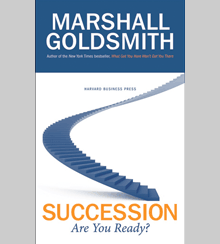
When it comes to choosing and preparing your successor, one of the best things you can do, as executive advisor Marshall Goldsmith says, is to “look in the mirror.” In this excerpt from Succession: Are You Ready? a CEO hires Goldsmith to coach the company’s CFO, teaching him to build the interpersonal skills and self-awareness he will need to take on the CEO’s job. But the CEO refuses to acknowledge a hard truth: He does not want the CFO to get the top job.
If a CEO can look in the mirror and see authentic commitment to a course of action in his or her reflection, the enterprise is in good hands. But if that hard look instead reveals the message “You are going through the motions,” then the CEO must stop whatever he or she is doing in order to avoid a costly charade.
As you’ll see, Goldsmith is sorry he accepted this assignment. The CFO clearly benefited from a year with the world’s best executive coach, but the company lost out in the end. As for the CEO, if he had learned to honestly and accurately plumb his own intentions before acting, he could have reached a more profound level of self-knowledge and achieved greater success for his company. The same may be true for readers who take the time to think through passages like this.
— Frances Hesselbein
Excerpted from chapter 4 of Succession: Are You Ready?
A major CEO asked me to coach his CFO — and potential successor. After a few minutes I had the distinct feeling that the CEO just didn’t like the CFO — and didn’t really want him to get the job.
“I don’t think that you like this guy,” I said to the CEO.
“He may not be my favorite person, but I guess that I like him OK.” The CEO’s reply didn’t come with a great deal of conviction.
“Look, it’s just you and me talking here. There is no reason to play games with me,” I challenged. “I don’t think you like the CFO. If you really don’t want him to get this job, why are we even having this conversation? I don’t even know this guy. I don’t care if he becomes the CEO or not. Why would you want me to coach him — or to work on developing him as your successor — if you really don’t want him to have the job?”
“You are right!” he grunted. “I don’t like this guy. I think that he is kind of a jerk. I have never liked him very much — even though I’ve tried.”
“Then why are we having this conversation?” I asked.
He replied, “I don’t like him much, but I have to admit, he has made a tremendous contribution in helping our company. We have done a fantastic turnaround — and without him it would have been impossible. If your coaching process can really help him improve his interpersonal skills, he deserves to be the CEO of the company.”
“Are you sure?” I enquired skeptically.
“I think so — no, I am positive,” he replied.
When I heard, “I think so,” my gut said, “Leave now!” Unfortunately, I didn’t.
“If he makes great improvement in the interpersonal areas that we discussed, are you going to recommend him to be your successor?” I asked. “Are there any other reasons he may not get the job, such as a lack of technical or functional skills?”
“No, along with being great in finance, he is strong enough in all of the other functions to do a fine job as the chief executive,” the CEO concluded. “His only issues revolve around interpersonal behavior.”
I worked with the CFO for more than a year. At the end of my assignment, he was seen as making great improvements in all his targeted areas for interpersonal change — by fifteen out of sixteen raters. Only one person saw “no change.” Guess who that was? The CEO.
After the CFO confronted the CEO with his obvious improvement in interpersonal relationships, the CEO still did not recommend him for the job. While the CEO reluctantly admitted that the CFO had made great improvement in interpersonal behavior — which was clearly documented and hard to dispute — he now concluded that the CFO lacked “adequate marketing skills.” This was the same CEO who had told me the CFO’s marketing skills were just fine one year earlier.
Needless to say, the CFO was incensed. He pointed out that he had been assured that he would get the “big job” if he improved his interpersonal skills. He mentioned that he had turned down other, lucrative offers since he had assumed he would get the CEO position. He went to the board, pointed out what happened, and basically said, “Either make me the new CEO — or write me an extremely large check.”
He was paid off by the board — which cost the company millions of dollars. Since he had clearly improved, I was paid for my work as his coach. I still wished that I hadn’t taken the assignment. In hindsight, I feel that I was used as a pawn in a political game. The CEO believed that the CFO would not improve, and then he could say, “Well, we tried to help him. We got him the best coach we could find. He still didn’t improve; therefore, he is not ready for the job.”
When the CFO did improve, the CEO had to play the embarrassing “lacks marketing skills” card. My work — and the CFO’s great effort — ended up costing the company lots of money. At least the CFO was grateful to me — and felt he could use what he had learned in our work together in future roles.
Since that event, I have had other experiences that have reinforced my belief that if you, as the CEO, really don’t want a potential successor to get the job, you aren’t going to be helpful in coaching.
What is the learning point from this story for you, as a CEO? Look in the mirror. If you really don’t want your potential successor to get the job, don’t kid yourself. There is a very strong probability that this person will never get the job. You will just look for problems until you find a reason to disqualify him.
Don’t jerk around potential successors. This is not fair to them or to the company. If, in your heart, you don’t want the person to be your successor, don’t pretend to be interested in developing him for the job. Just work with someone you can support. If you cannot find a successor who you can sincerely support, go to the outside immediately and start recruiting some new talent!
— Marshall Goldsmith
Reprinted by permission of Harvard Business Press. Excerpt from Succession: Are You Ready? by Marshall Goldsmith. Copyright 2009, All Rights Reserved.