
Big Pharma’s Uncertain Future
The business model that drove the major drugmakers’ success isn’t working anymore. The survivors will be those that make smart strategic bets supported by winning capabilities.

Illustration by Oliver Burston
In the pharmaceutical industry, nothing is quite as exciting as a new molecule in the pipeline — especially one that has a chance of solving some major human health problem. In the last few decades, pharma companies have consistently developed and launched new proprietary drugs, bringing hope to sick or at-risk patients, and providing enviable financial returns for the companies’ shareholders. Indeed, global pharmaceutical companies have been built around the idea of discovering blockbuster drugs that solve medical problems common to tens of millions of people. They have supported that approach with huge investments in their innovation programs and marketing and sales operations.
But the era of the blockbuster drug is nearing an end. In the U.S. alone, branded pharmaceuticals accounting for some US$120 billion in annual revenues (including Lipitor, Zyprexa, Plavix, and Seroquel) will be coming off patent in the next few years, opening the way to generics and eroding a major source of the industry’s profits. To be sure, there is still plenty of room for improvement in the medications people take, and no shortage of human suffering to alleviate. But it is doubtful whether big pharmaceutical companies will be able to pursue these goals within the old model of developing exclusive new pills that they can sell under patent protection. For one thing, pharma companies in the past were able to develop drugs for health problems that had never before been addressed. When anti-cholesterol drugs were first launched, for example, they created entirely new, multibillion-dollar markets. Today, in contrast, few such unaddressed categories remain, meaning most newly developed drugs will be competing with existing ones.
In addition, the pharma companies are feeling pressure from every direction — from regulators setting the rules for drug effectiveness and safety, from managed care organizations and employers pushing back on prescription drug costs and reimbursement, from competitors coming to market with alternative brands or generics, and from disgruntled shareholders. Internally, the number of molecules in pharmaceutical company pipelines is shrinking, and the risk/reward ratio for research and development outlays is worsening. Overall, these trends have resulted in lower revenue, reduced profitability, and declining P/E valuation ratios for most major pharmaceutical companies.
The question, however, is more fundamental than what pharma companies will do for an encore in the post-blockbuster era: The question is whether they can survive at all in their present form. There is no consensus about what comes next, as evidenced by the different strategic moves the major companies have made with mergers, acquisitions, and divestitures in recent years. A few have chosen to double down on branded pharmaceuticals, betting that the bad times won’t last and that by adding new therapeutic areas or becoming more adept at using technology they can continue to generate large profits from formulations they own exclusively. Many others are looking elsewhere, and have expanded into such sectors as diagnostics, consumer health, generic drugs, biosimilars, nutrition, and wellness.
“I don’t think there’s been a time in recent history where the industry has had a more divergent approach to the future,” says Cavan Redmond, group president of corporate strategy at Pfizer Inc. “It means that we’ll have different ways of dealing with healthcare, especially on the pharmaceutical side, and less homogeneity.”
The next decade for the pharmaceutical industry is shaping up to be not only a period in which the leading companies don’t know what’s going to happen, but one in which they can’t know what’s going to happen, because so many of the conditions under which they operate are in such an unusual state of flux.
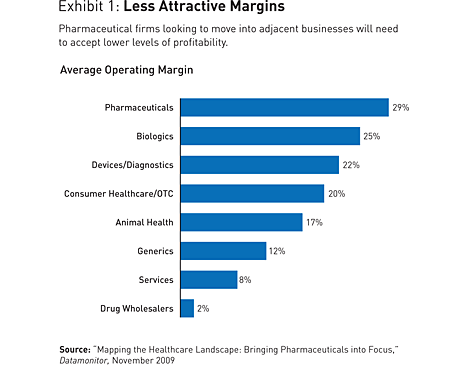
None of the new businesses into which the pharmaceutical companies are expanding have the same margins as branded drugs, and that raises doubts about whether pharmaceutical companies will be able to maintain their past levels of profitability. (See Exhibit 1.) “Some will, some won’t, because there won’t be as big a proprietary market to go around in the near term,” says Miles D. White, the chief executive of Abbott Laboratories, which is in the process of separating into two companies, one focused on diagnostics and medical devices, the other on prescription drugs.
To survive — and perhaps thrive — in this unpredictable future, pharmaceutical companies need to make some bets about the way the future of the industry will unfold, and design their diversification strategies to position them for success in one or more of the scenarios they envision. We think these need to be strategic bets, which mesh with the companies’ key capabilities systems — the things each company does with distinction that provide its competitive advantage. We recommend that companies begin that journey with a five-step process for identifying the best opportunities.
Multiple Unknowns
Just how uncertain a time has Big Pharma entered? Consider a balloon in different weather conditions. Release the balloon into a light sea breeze, and it may bounce a little from side to side, but it will inevitably and predictably fly in the direction of the wind. Repeat this experiment and the results will be almost identical to those of the first try. This is an example of a deterministic process, meaning you can predict the balloon’s behavior and ultimate location with a high degree of accuracy by knowing its aerodynamics and the speed and direction of the wind.
Now try to predict what will happen with a balloon in an unstable weather condition like a tornado, with the wind gusting in different directions. Even if you let two balloons go at the same time, they will end up in totally different places. You can’t predict the outcome of this experiment any more than you could predict that Dorothy and Toto would end up in a brilliantly colorful place called Oz. A balloon in a tornado is an example of a stochastic process — the outcome is inherently unpredictable.
Most industries go through periods of both deterministic and stochastic development. For instance, the computer industry in the 1960s and 1970s had all the characteristics of a deterministic process. IBM, Burroughs, Cray, and others pursued similar strategies, selling giant data processing machines known as mainframes. The personal computer changed the dynamics of the industry, triggering a turbulent stochastic period. It became impossible to predict where the computer industry was going, and in the early 1980s the incumbent players’ strategies diverged significantly. Some bet that the old mainframe paradigm would prevail; others expanded to new product and service areas. The outcome was stark: Many companies didn’t survive (case in point: Cray), and others (such as IBM) survived only by making significant changes to their business models and product portfolios.
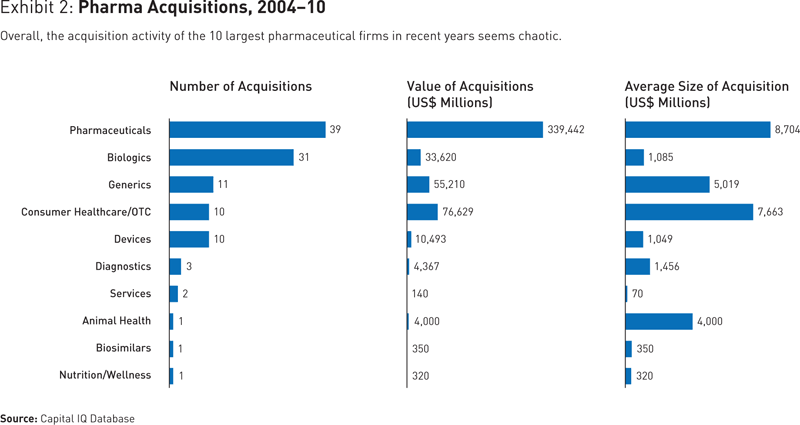
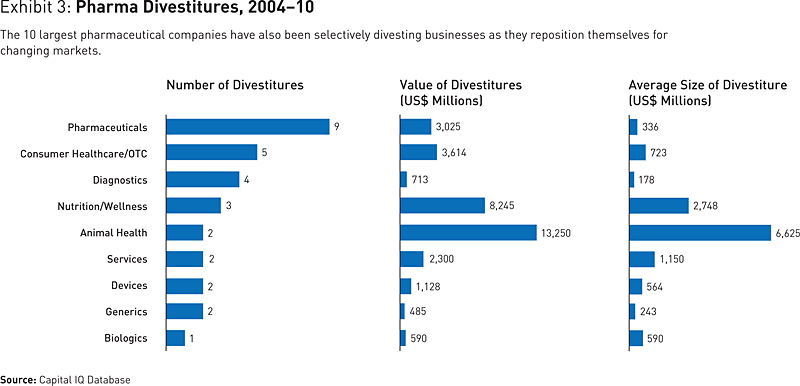
After years of steady and predictable growth, the pharmaceutical industry is entering a stochastic period of its own. That pharmaceutical companies have divergent views of how the future will evolve is evident in what they’ve done in the area of mergers and acquisitions. On an aggregate basis, M&A activity involving the 10 largest pharmaceutical companies looks pretty chaotic — no clear pattern is visible in their behavior from 2004 through 2010. (See Exhibits 2 and 3.) Capital transactions in animal health, consumer health, devices, generic drugs, and branded pharmaceuticals all accounted for tens of billions of dollars in acquisitions, divestitures, or both. The one exception is biologics, a type of medicine that everyone seems to agree will be important in the future.
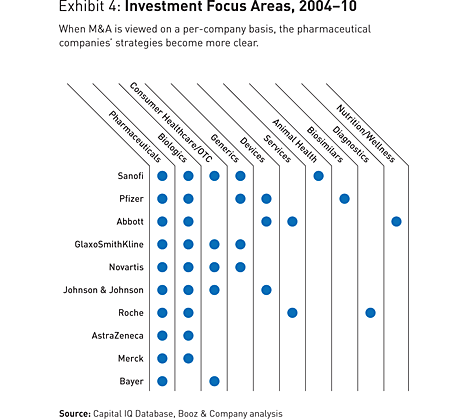
When you look at M&A activity on an individual company basis, however, the pharma companies’ behavior looks considerably less chaotic. Most of them have used deals to narrow their focus to two or three areas besides core pharmaceuticals and biologics. (See Exhibit 4.) The other focuses they’ve selected are the result of an assessment by each company of where it might succeed, and the amount of diversification it can support.
Value of Strategic Bets
The diversification moves that pharmaceutical companies have made may look like they meet our definition of strategic bets: Bets designed to position the company for success in one or more specific business scenarios, that are either aligned with the company’s existing key capabilities systems or that include a plan for developing or acquiring other capabilities that will be needed for success. Instead, in many cases, pharma companies seem to be merely adding new lines of business designed to broaden their portfolios and reduce the volatility of revenue and earnings. “The baseline is they have to stand alone,” says one pharmaceutical company CEO, describing his company’s diverse businesses, which he has fine-tuned with the help of almost a dozen acquisitions in recent years. “I expect them to actually be able to succeed independently of that extra opportunity afforded by some linkage” with other units, he says.
This is still the common mind-set in the industry, and the underlying assumption — that business units should be managed separately, and their individual profits maximized — makes perfect sense in a deterministic environment. But in a stochastic environment, in which no company can know how the future will evolve, we believe this stand-alone pieces-of-a-portfolio approach is insufficient to position a company to adapt successfully. This does not imply that diversification in a stand-alone business cannot be successful. Often pharmaceutical companies build successful businesses and create significant value by entering adjacent spaces. However, if these businesses are not linked with the core pharmaceutical business, they won’t help the company prepare, or reposition itself, for the future. In such cases, it may make sense to split the successful independent business from the core pharmaceutical operation to realize the created value, as Abbott recently decided to do, splitting its drugs and medical products businesses into separate publicly traded companies.
This is where the approach of strategic bets comes in. As we’re defining them, strategic bets give pharmaceutical companies — or any company that finds itself in a stochastic environment — flexibility in terms of the directions in which they can move, and have implications for the companies’ market positions, their operating models, and the evolution of their capabilities. Without question, strategic bets should have the potential to enhance the core drug business, the source of every pharmaceutical company’s greatest potential profits. However, implicit in the idea of a bet is that it may not be a winner. This explains both why it is essential to make several bets as opposed to banking on one, and why the company must be willing to move quickly, doubling down or lightening up, after it sees how the bet is faring.
A strategic bet begins with some hypotheses about the future and an attempt by a pharmaceutical company to position itself to take advantage of that future. (See “Scenarios for Success,” below.) The hypothesis might be that disease management will gradually have less to do with prescription drugs and physician oversight, instead becoming more the responsibility of the patient. In that scenario, the company may want to have a consumer healthcare business — not necessarily for the stand-alone profits the business can generate, but in the belief that a consumer healthcare unit will become an essential partner with pharmaceuticals in a changing disease-management landscape. If the scenario it has built about the future comes true, the company will already have the platform in place to make its overall business more successful. If the scenario doesn’t materialize, the company making the strategic bet can alter its treatment of the unit — managing it for profit or selling it off.
Another scenario might be that diagnostics will be among the essential pieces of the pharmaceutical tool kit in the future, a way of identifying patients who can be helped by particular drugs (and patients who cannot) and helping scientists aggregate data much more quickly. If this scenario develops in such a way that diagnostics services become proprietary, highly differentiated, and profitable, it will be essential for major pharmaceutical companies to develop advanced diagnostics capabilities. In that scenario, the combination of the diagnostics and pharma businesses would become an essential way to improve R&D effectiveness and clinical outcomes of disease treatment, and could become a profitable area of activity for the company. If, however, diagnostics becomes a commodity service offering that is readily available from multiple third parties, it will not be necessary to have these capabilities in-house, and expansion in diagnostics may not be necessary.
To date, most of the shuffling of parts in the pharmaceutical industry has involved portfolio diversification, not strategic bets. Consider Johnson & Johnson (J&J). This company, which has more than $60 billion in revenue and more than 250 global subsidiaries, has traditionally operated under the philosophy that business unit autonomy is the best way to ensure good decision making and accountability and to drive financial results. That philosophy has served it well in a deterministic environment. Recently, however, closer collaboration between J&J’s diagnostics and pharmaceutical businesses, as well as between its pharmaceutical and consumer businesses, suggests that J&J may be reexamining the strategic bets it is making to succeed in a stochastic environment.
A few companies’ M&A moves certainly come close to meeting our definition of strategic bets. One is the development of a generics business by Novartis AG, to coexist alongside a branded pharmaceutical business that has developed leading drugs in areas like heart disease and cancer. “Fundamentally, we are pro-patent,” says Joseph Jimenez, chief executive of Novartis. “But we believe that when those patents expire, it is our obligation to offer low-cost, high-quality generics to help lower total healthcare costs.”
Another move that has the look of a strategic bet is the focus on diagnostics at Roche Holding Ltd. In addition to now representing more than a fifth of Roche’s revenue, Roche says, its diagnostics technology has made its core pharmaceutical business more successful by identifying new therapeutic targets and screening out poor drug candidates.
How Pharma Can Move Forward
Strategic bets in pharmaceuticals, as in any other industry, must take into account what a company already does well. In other words, the bets should leverage the company’s capabilities system, made up of the three to six activities that truly differentiate the company and allow it to compete effectively both in the market position it has staked out and with the products and services in its portfolio. In our experience, companies that exhibit a high degree of coherence in these three elements (their capabilities system, market positioning, and product/service portfolio) tend to thrive in their industry sector; companies that exhibit lower degrees of coherence tend to have trouble keeping up. Coherence is an especially important discipline in stochastic times, because without it, companies tend to make unrelated investments and spread themselves too thin. (See “The Right to Win,” by Cesare Mainardi with Art Kleiner, s+b, Winter 2010.)
Hence, companies need to have the judgment to focus their strategic bets on areas that use capabilities that they already have — or that they could develop. A company that has a world-class system for communicating with doctors, for example, would want to make sure that its strategic bets take advantage of that capability (the generic drug business as a strategic bet would benefit greatly from this capability). A company that had world-class expertise in cancer therapy, with its many challenges, would want to make sure that its strategic bets took advantage of that expertise (as it might if the strategic bet were a nutrition line optimized for the needs of cancer patients). If a strategic bet suggests that new capabilities will be needed, they should be developed or acquired in such a way that the company’s overall capability system remains coherent. If the system is not coherent, the strategic bet will have a high chance of failure.
Identifying the right strategic bets should be the highest strategic priority for the company, and the effort should be led by the CEO or a committee that includes the CEO, because in most cases these steps will lead to a different or substantially modified strategic direction for the company. We suggest a five-step process:
1. Embrace change as inevitable. The current “blockbuster” model, defined as relying on traditional capabilities, faces extinction. The issue here is changing the mentality of senior management. For companies where this attitude prevails and new capabilities are not developed, survival is a real question mark.
2. Develop a vision for several potential future scenarios. The stochastic environment and people’s inability to predict the future do not mean that every outcome is equally possible. A dynamic evaluation of potential future states (wargaming) can help companies develop views of, for example, how disease management will evolve.
3. Understand the inherent capabilities that the company possesses. Although turbulent times bring inevitable change, and doing what you have always done is unlikely to be effective, it is vital to have a clear sense of what is differentiating about your capabilities system. With this knowledge, a company can determine which new capabilities it should be adding.
4. Identify strategic bets that can position the company as a winner. No matter which future scenario materializes, companies need to determine the capability sets that are required to win for each of the strategic bets and, most important, that will support the new strategic direction.
5. Develop an organizational and business model that most effectively supports the new strategic direction and identified coherent capability set. Companies need a plan for evolving their corporate culture, creating a new business model and building new capabilities as future scenarios unfold and the external environment changes.
Survival Comes First
If anything, the challenges that pharmaceutical companies face seem to be mounting, especially in the U.S., the biggest market for prescription drugs. Generics now account for upward of three-quarters of all prescriptions in the U.S., versus 56 percent in 2005. Pharmaceutical companies have fewer resources, having shed 150,000 jobs, many of them in sales. In the U.S., the Food and Drug Administration has become much more zealous about safety. And some of the specialized drug treatments that are coming to market — priced at $30,000 a year and higher — face resistance from insurers who are questioning their value and refusing to pay.
Ticking off these challenges, Abbott CEO Miles White, who has run the company for the last 12 years, and who will head up the medical devices company once Abbott’s split is complete, says, “My sense is there are several models that will ultimately succeed.”
And therein lies the opportunity. As industries evolve, stochastic periods such as the one the pharmaceutical industry is entering don’t last forever; deterministic periods return, allowing companies to move away from multiple strategic bets and pursue a new strategy. For pharmaceutical companies, the challenge will be to make strategic bets both to survive today and to position themselves for the next period of deterministic growth. By the time that happens, they’ll be very different companies than they are today.
Scenarios for Success
The positioning needed for pharmaceutical firms to succeed will evolve in ways that are still unknown. Some possibilities:
Pharma + diagnostics. In this scenario, the success of a company’s patented pharmaceutical business depends on its diagnostics business. The idea stems from the likelihood that payors and customers will eventually reward proprietary and differentiated clinically effective diagnostic services rather than simply paying for readily available commodity services. In such a world, the ability to stratify patient populations via diagnostics — to match the right patient with the right treatment at the right dose — would create significant value and essentially enable a personalized approach to patient care. In this case, pharma businesses will derive significant advantages from offering both diagnostics and medicines. The diagnostics will also give drug companies better insights about what molecules to pursue. Human Genome Sciences Inc.’s lupus medication Benlysta has benefited from patient stratification; early trials suggest Benlysta works well with certain patient populations, but not with African-Americans, who have a high incidence of the disease.
Pharma + consumer. This scenario assumes that a more holistic approach to health — embracing such approaches as preventive medicine, wellness services, and nonprescription drugs to treat mild symptoms or side effects — is here to stay, and could both strengthen a company’s prescription drug business and leverage that business’s research breakthroughs. The shift toward consumer-centric healthcare is already reflected in some pharmaceutical companies’ moves, such as Sanofi’s effort to extend the life of Allegra, an antihistamine, by selling it over the counter, and Pfizer Inc.’s reported interest in doing the same with its cholesterol drug Lipitor.
A holistic consumer focus can take forms other than over-the-counter versions of prescription drugs. Consumer businesses bring a unique capability for understanding consumers and their behavior, and this understanding can significantly improve patient compliance. For instance, Novartis AG, in collaboration with several regional payors in Europe, is using new technologies to remotely monitor hypertension patients’ key health indicators. By improving compliance, Novartis says, it hopes to help improve patient outcomes and drive down costs.
Pure pharma + a focus on therapeutic areas. In this scenario, success is a matter of slowing the last few years’ decline in R&D productivity, and potentially reversing it. Companies looking to do this would concentrate their capital on therapeutic areas that offer the greatest chance for technical and commercial success. That is what Novartis has been doing in eye care; it purchased Alcon, an eye-care company, for US$51.6 billion in April 2011 and is now a global leader. As the world’s population ages, Novartis sees eye disease as an increasingly widespread problem and therefore a lucrative area of focus.
In general, Novartis has bucked the trend toward declining R&D productivity. That has enabled it to continue to invest heavily in new drug development. “We have a highly competitive and robust pipeline with 63 NMEs [new molecular entities], and higher success rates at every stage of development than our competitors,” says Chief Executive Joseph Jimenez.
—A.K. and V.G.
Pharma’s Common Commitment to Emerging Markets
For all the things that are unclear about pharmaceutical companies, one thing is certain: More of their future profits will come from emerging markets.
To be sure, drug markets outside North America and Europe have very different characteristics. For instance, in potentially huge pharmaceutical markets such as India and China, consumers are gravitating toward so-called branded generics — generic versions of drugs that are no longer patent protected but that carry the imprimatur of a trusted manufacturer, such as GlaxoSmithKline PLC or Abbott Laboratories.
“It’s important for us to be in the top five in branded generics in some emerging markets,” says Miles White, CEO of Abbott, who spearheaded the company’s 2010 acquisitions in this area, of Solvay Pharmaceuticals and Piramal Healthcare of India, and who will cede the management of them to another Abbott executive, Richard Gonzalez, when Abbott’s planned split becomes effective in 2012. White adds that Abbott’s investment in emerging markets is a long-term play, and that it will take “a decade or two” for those markets, as a whole, to “reach a scale and size” similar to that of the United States.
Novartis AG is building a vaccine plant in Brazil and a pharmaceutical and generics plant in Russia, says its chief executive, Joseph Jimenez. In addition, the company is setting up a biomedical research center in China in the belief that local R&D work will give its scientists better insights into local patient needs.
“The incidence of chronic diseases like diabetes, obesity, and cardiovascular disease is rising dramatically in China,” Jimenez says. “I’ve seen this firsthand from my own travels and talking with government officials.
“The work we’re doing in China,” he adds, “is going to give us a strong lead in enabling us to address the population’s rising demand for healthcare and significant unmet medical needs.”
—A.K. and V.G.
Reprint No. 00095
Author profiles:
- Alex Kandybin is a partner with Booz & Company in New York who works with clients in the consumer healthcare and life sciences industries to develop strategies and capabilities that help them achieve competitive advantage.
- Vessela Genova is a senior associate with Booz & Company in Los Angeles. She works with clients in the consumer healthcare, life sciences, and media industries to help them develop capabilities-driven strategies to grow competitively and enter global markets.
- Also contributing to this article was consulting editor Robert Hertzberg.