
Toward a Better-Informed Cynicism
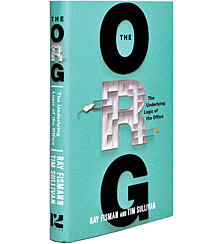
A review of The Org: The Underlying Logic of the Office, by Ray Fisman and Tim Sullivan.
(originally published by Booz & Company)The Org: The Underlying Logic of the Office
by Ray Fisman and Tim Sullivan,
Twelve, 2013
In ancient China, a business experienced a 20 percent jump in sales, and the abacus man could not keep up. So the business owner consulted the village sage, who advised him to have the abacus man grow a sixth finger on each hand—upping his capacity 20 percent. But the business owner hesitated, reluctant to challenge authority. “Oh, Wise One,” he said at last, “how am I to do that?”
“Ah,” came the reply, “my job is solving the problem. The implementation is entirely up to you.”
I remembered this story while reading The Org: The Underlying Logic of the Office, a wonderfully entertaining rocket ride to what is for me a new galaxy called “organizational economics.” I love this book. Unlike most management books, this one promises no advice and delivers splendidly. It is eclectic, unpredictable, and idiosyncratic, and it is as factual and ambiguous and sane and irrational as the diverse orgs it surveys. I even love the word org. One pithy, concrete syllable replaces five that make your eyes glaze over. On top of that, I find that the book’s myriad examples validate my experiences trying to fix orgs over the last 50 years. Everything works. Nothing works. Sometimes.
Noting that people spend a third of their lives working, authors Ray Fisman, a Columbia Business School professor, and Tim Sullivan, editorial director of Harvard Business Review Press, do not criticize, lament, praise, or pontificate. They simply describe in vivid detail “how and why orgs do what they do—how the parts fit together, how the rules get made, and what happens when you change the rules.” In short, if org life tilts you toward cynicism regarding Dilbertian absurdities and six-fingered abacus men, “a clearer understanding of how orgs work” enables you to “descend into better-informed cynicism.”
Toward that end, the writers seek to illuminate the workings of the black box that stands between input and output. They humanize the arcane math of economics with stories. They decode academic management research to explain “why the highly imperfect office of today may nonetheless represent the least dysfunctional of all possible worlds, however depressing the idea of ‘least dysfunctional’ may be.” Organizational economists recognize that orgs succeed or fail on “a set of compromises that result from trade-offs among many competing interests and objectives.”
I support the authors in seeking to redefine cynicism and dysfunction as normal, though retaining the pejorative terms strikes me as a mixed message. (I dropped “resistance” and “denial” from my org vocabulary long ago. Labels put no one in the mood to change.) Fisman and Sullivan show that life in orgs can be heaven or hell, sequentially or simultaneously. Hence, they include many examples of effective work, creativity, and idealism that defy cost-benefit analysis. This stretches the boundaries of organizational economics to recognize that everything counts even when it can’t be counted. There are value-based bottom lines beyond net profit.
As I read, I would look up and say to my wife, “Did you know that Zappos offers new hires $2,000 to quit after one week?” Or, “These guys have turned up an al Qaeda leader’s memo berating a subordinate for misusing his travel allowance!” I told her how a McDonald’s franchisee almost wrecked the model by serving prime roast beef and that ministers can earn more money stealing souls from nearby congregations than enrolling their own. I recounted the story of how Digital Equipment (where I once consulted) parlayed its informal network ofinnovators to win a much-needed Kodak contract, only to abandon it when the financial folks left out of the proposal process found a fatal economic flaw.
“You really find that book interesting,” Dorothy said.
Indeed, this may be the most relentlessly realistic, wide-ranging book on orgs I have ever read. To reveal the “underlying logic of the office,” the authors visit Mumbai’s textile mills, West Point’s classrooms, the Hewlett-Packard garage, Baltimore’s mean streets, and a Carnegie Mellon computer lab. They use the word office as a metaphor for any setting where snowballing complexity propels people to make trade-offs (the least onerous selections from a menu of fraught options) and every choice conceals unforeseen outcomes. When competitors began poaching the best and brightest from employee-friendly Google, for example, the company refused to make counteroffers. After the brain drain became intolerable, however, Google reversed its stance. Problem solved, right? Not quite. The company “was also setting up clear signals to its entire staff: if you want a big raise, get a Facebook offer and we’ll counter. Google was paying for trolling and disloyalty.”
It’s fitting that the authors conclude the book with a variation on the Serenity Prayer. In org life, we need to accept what we cannot change, and to change what we can. The wisdom is in realizing that few changes will ever be wholly satisfying because they always require trade-offs. 
Author profile:
- Marvin Weisbord is codirector of Future Search Network and a visiting scholar in the University of Pennsylvania’s Organizational Dynamics program. He is the author of the 25th anniversary edition of Productive Workplaces: Dignity, Meaning, and Community in the 21st Century (Jossey-Bass, 2012), s+b’s pick for best business book on organizational culture in 2012.