
The Voice of the Stakeholder
Is sustainability sustainable? Twelve works argue there is value in “corporate values.”
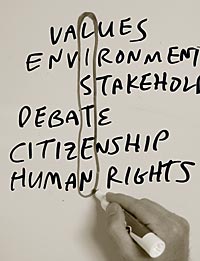 |
|
Photograph by Opto |
What he meant was that in the mid-1990s, Monsanto managers weren’t listening to outsiders who had strong views and a definite stake in the sustainability debate. Environmental groups such as Greenpeace vilified the company for its programs to develop genetically modified crops, and many farmers, especially Europeans, shunned its seed. Mr. Elkington introduced Monsanto executives to concerned farmers, food processors, retailers, and nongovernmental organizations (NGOs). But Monsanto seemingly dismissed their concerns, and sold its genetically modified seed anyway.
For his book, Mr. Elkington interviewed former Monsanto CEO Robert Shapiro, who led the company during its diversification into biotech agriculture, and who bore the brunt of the criticism from concerned stakeholders. Mr. Shapiro admitted that Monsanto had a tin ear at the time, and said if the company had listened better and been better prepared for the criticism when it entered this controversial market, it would be in a better position today. “If there was a next time, I’d have much earlier dialogue with a wide range of interested parties in the scientific, academic, governmental, and NGO communities,” he said. “It would have taken unusually candid and innovative discussions between ourselves and Greenpeace to create a win/win, but that might not have been impossible.”
In the 1980s, Total Quality Management experts told companies to listen closely to customers. Market power was then just beginning to shift away from producers to customers, and insular companies were quickly becoming less competitive. Market power is still shifting, but it is not just toward customers; communities, employees, regulators, politicians, suppliers, investors, and even the media are also gaining influence over corporations. A raft of new books, articles, and Web sites exploring the roles of business in society affirm what executives like Mr. Shapiro have learned on the job: The ability to listen to corporate stakeholders is not merely a useful management skill; it is a competitive necessity.
Listening to stakeholders, as Mr. Elkington shows in The Chrysalis Economy, is a critical component of a larger trend: companies’ taking more responsibility for the ways their business decisions affect the quality of people’s lives. Although discussions about competitive positioning and cost reduction are routine, until recently, it hasn’t been common to find executives analyzing the implications of their actions for employees, the surrounding community, or other constituencies.
How corporations address societal welfare issues has been variously called corporate citizenship, corporate social responsibility, and corporate sustainable development. The Aspen Institute’s Business and Society Program — of which one of this review’s authors is executive director — prefers social impact management to corporate social responsibility, because the term more deliberately positions social matters within the business domains where strategic, operational, and investment decisions are made. For corporations, listening, understanding, and responding to the interests of different stakeholders is not just about being charitable or responsible; it is part of thinking about business activities in a way that recognizes the interdependence of commercial and social objectives, and it encourages executives to address them together.
Consider how a lack of understanding of this reality blindsided Royal Dutch/Shell Group of Companies two years in a row in the 1990s. In 1995, when Shell sought to dispose of its Brent Spar oil storage buoy by sinking it in deep water in the North Atlantic, it certainly did not anticipate the public outrage that ensued. A year later, Shell executives again did not see how external stakeholders perceived Shell’s actions when it failed to intercede as the government of Nigeria, where Shell operates, executed Nigerian human-rights activist Ken Saro-Wiwa and eight other Ogoni people. The chorus of disapproval was global.
Citizens, activists, and the press didn’t care that Shell was trying to do what it believed was right, in the Brent Spar case by following its scientists’ advice and in the Saro-Wiwa case by hewing to a long-standing policy to stay out of host-country politics. What mattered was that Shell was doing something contrary to the public’s perception of the right thing to do. Shell’s image, as a result, was tarnished. More important, it lost the opportunity to gather input from communities and other affected parties that would have been useful in making future decisions about its operations.
The level of public scrutiny and consumer reactions to these incidents was a wake-up call not just for Shell, but for corporations worldwide. A number of the world’s largest companies (and biggest targets for public criticism) started convening to see how they could more effectively listen and respond to stakeholder views. One of these groups was the World Business Council for Sustainable Development (www.wbcsd.org), a think tank composed of chief executives from around the world. In 2002, the organization published Walking the Talk: The Business Case for Sustainable Development, a book that provides the broad perspective required of a chief executive.
The book’s three authors, DuPont CEO Charles O. Holliday, Jr., Anova Holding CEO Stephan Schmidheiny, and Shell Chairman Philip Watts, laid out an astonishingly far-reaching plan for changing corporate mind-sets, markets, and management systems. Of particular note is a passage quoting Shell’s chief of sustainable development (a position created after the incidents of the 1990s) describing what’s wrong with big firms: “Every single multinational in the world has a tendency to become too introspective, too internally focused, take things too much for granted. And one day you hit a brick wall and find out the world is moving much faster than you thought.”
There is no unified theory of corporate social responsibility or agreement on what it means to achieve sustainability, any more than there is a single term to refer to it. But nearly all the experts stress this one common principle: Companies must be active listeners. That means listening to all their stakeholders, even if companies don’t always respond, actively seeking external views, and, when appropriate, engaging with stakeholders in dialogues.
Whereas listening to customers was elemental to helping companies compete in a customer-driven marketplace, listening to stakeholders has become elemental to succeeding in a marketplace in which companies are expected to serve not only customers and shareholders, but many other interest groups as well. In mastering this new management discipline, executives and managers face about a half-dozen particularly tricky challenges in realizing a vision of social responsibility.
The first challenge is convincing managers and executives that the social impact of a business decision matters. Is the contemplated action really a competitive requirement? What’s the business case? Many line executives remain unconvinced that companies should be trying to be moral actors on a corporate stage. Even more, they are not convinced — despite recent bloody global protests — that society has the right or power to strong-arm corporations into taking on more social responsibilities. What’s more, social action doesn’t always offer a financial return on investment — despite the many studies that make this claim. In People and Profits? The Search for a Link Between a Company’s Social and Financial Performance, Harvard Business School’s Joshua Daniel Margolis and the University of Michigan’s James Patrick Walsh found 95 studies investigating the social–financial link, dating from 1972 to 2001 (the professors have since identified a total of 122 such studies). Although the majority of the 122 studies (71 percent) point to a positive relationship between corporate financial performance and social performance, the examples analyzed are too disparate (ranging from returns on supporting local charities to savings from pollution prevention programs in manufacturing) to tell a coherent story to business executives looking for definite data. As Professor Walsh noted in a recent interview, “a closer look at the research opens as many questions as it answers about the role of the firm in society.”
In Value Shift: Why Companies Must Merge Social and Financial Imperatives to Achieve Superior Performance, Lynn Sharp Paine, another Harvard Business School professor, argues that “attention to ethics can be essential for economic success,” but “ignoring ethics can be quite profitable” sometimes. “Certainly,” she writes, “ethical scruples can sometimes be an economic handicap.” (See “Lynn Sharp Paine: The Thought Leader Interview,” by Ann Graham, s+b, Summer 2003.)
Many company bosses have moved to make moot the question about whether to pursue social or ethical goals. Consider the World Economic Forum (WEF) publication Responding to the Leadership Challenge: Findings of a CEO Survey on Global Corporate Citizenship, published in early 2003, which outlines an action plan for implementing corporate social responsibility. It also includes a pledge signed by 46 chiefs of global corporate giants that commits their companies to act as global citizens. Among the signers were chairmen or CEOs of multinational companies, including ABB, Abbott Labs, Anglovaal Mining, Coca-Cola, Deutsche Bank, Diageo, Empresas Polar, ING, McDonald’s, Merck, Renault, Rio Tinto, Siemens, and UBS.
These company chiefs promised their actions would reflect prevailing values on issues ranging from the environment to human rights; that they would identify and work with key stakeholders; and that they would personally lead the corporate citizenship charge. The WEF survey lists the business reasons CEOs want their companies to be better citizens, including protecting brand equity, corporate reputation, and license to operate.
These corporate leaders aren’t the only ones embracing the corporate citizen challenge. As of May 2003, more than 1,000 corporations worldwide have signed the United Nations’ Global Compact, which promotes adherence to global environmental, labor, and human-rights principles for doing business. And this past April, the Forum for Corporate Conscience (www.forumforcorporateconscience.com), cofounded and chaired by Hugh McColl, former chairman and CEO of Nations Bank (now part of Bank of America), held its first conference. An advisory board of CEOs from 22 U.S. corporations planned and ran the conference, which was the kickoff event for a variety of Forum-supported change initiatives and partnerships that will focus on societal concerns, including the state of the family, the environment, and the corporation, and will involve business schools, corporations, advocacy groups, and individual management thought leaders.
A second challenge in relating to stakeholders is how to change corporate behavior. In the WEF report, CEOs identified three tools — internal communication of values, the establishment of performance measures, and dialogue with external stakeholders — as most critical to changing behaviors and embedding in their companies sensitivity to citizenship issues. In Redefining the Corporation: Stakeholder Management and Organizational Wealth, management scholars and professors James E. Post, Lee E. Preston, and Sybille Sachs go so far as to assert: “Stakeholder management is an expression of the shared values and humanistic commitments of the corporation.”
However, successful dialogue requires a company to clearly articulate its core values and business purposes before it starts to engage with stakeholders. Mary Gentile, a consultant to the Aspen Institute who also taught at Harvard University and works with business faculties, defines a framework for effective social impact management in a paper written for the Institute’s Business and Society Program Web site (www.AspenBSP.org). Her paper considers three business aspects: purpose, social context, and metrics. This framework invites executives to explicitly ask such questions as: What is the purpose, in both societal and business terms, of the business or a specific activity? Is a proposed strategy being evaluated in terms of both business outcomes and broader social impacts? How should performance and profitability be measured?
A third challenge is choosing the stakeholder groups with which to engage in dialogue. Business for Social Responsibility (BSR) has published a Guide to Engaging with NGOs, which gives practical tips for understanding the interests of and differences among the thousands of NGOs around the world. True to the stakeholder model, BSR, a global nonprofit membership organization founded in 1992 by corporations, connects its members to a global network of business and industry peers, stakeholder groups, and thought leaders.
To judge whether an NGO is a suitable candidate for a dialogue or some other form of engagement, the BSR Guide suggests companies start by looking at some basic criteria: the NGO’s mission, track record, resources, and experience. A key consideration for the company is also the kind of relationship it seeks — simple outreach, information exchange, or a deeper, mutually beneficial, strategic partnership. Companies need to get to know individual NGO personalities and investigate their funding and staffing. And they should not underestimate the distrust that exists between social advocacy groups and corporations. Even the most corporate-friendly NGOs are guarded; their reputations are at stake, too.
Understanding each other must go farther than merely identifying the right group. Companies and NGOs both need to recognize biases, which often stem from stereotypical views of one another, and appreciate the differences in the cultures and purposes of for-profit and nonprofit advocacy organizations.
Hidden Agendas: Stereotypes and Cultural Barriers to Corporate-Community Partnerships, a report published in August 2003 by Laufer Green Isaac, a Los Angeles–based communications firm, shows that hidden agendas, linguistic barriers, and cultural stereotypes can undermine productive collaboration between business executives and nonprofit or community-based organizations. BSR suggests managers visit each other’s turf before forging a formal alliance to “dispel stereotypes and establish a bond of trust.”
A technique called “appreciative inquiry” may be useful to companies and stakeholders that have been building bonds of trust and avenues of communication. It is a formula for dialogue that asks people to identify and build on the positive elements of an existing relationship. Used since the 1980s by organizational development experts, appreciative inquiry begins with a round of dialogue to elicit what’s right with a relationship, what people value, and what contributions people have already made. In a second round, people choose specific topics and map exciting future scenarios. A wealth of guidance on appreciative inquiry by Case Western Reserve University’s Weatherhead School of Management professor David Cooperrider and others appears on the “The Appreciative Inquiry Commons” Web site (http://appreciativeinquiry.cwru.edu/).
It may be good for a company to be more broadminded and inclusive in its interactions with different stakeholders, but how does it set boundaries with respect to the groups it speaks to? Simon Zadek, a corporate citizenship expert from the U.K., highlights the problem in his book The Civil Corporation: The New Economy of Corporate Citizenship. He quotes a missive sent to him from the executive of a water company: “We are a major landowner. We have been approached by representatives from the anti-hunting league and asked to stop renting out a parcel of land for use by sports hunters. To be honest, we don’t have a corporate view on hunting, and do not particularly want to have one. Where does this all end? If there is a church but no mosque on our land, will we eventually have to have a view on God?”
A fourth challenge for companies is choosing partners for deeper alliances. Such partners share a firm’s social goals and have the expertise to become close advisors on how to apply social impact strategies to business strategy — in product development, operations, public relations, finance, and so on.
Harvard Business School professor James E. Austin, author of The Collaboration Challenge: How Nonprofits and Businesses Succeed Through Strategic Alliances, offers a chapter of advice on ensuring strategic fit. Among the kinds of questions he encourages managers to ask: How will the collaboration contribute to your overall strategy? What concerns do you and your potential partner share? Are you drawn to an NGO because it has expertise that could help your company combine social improvements with better financial performance?
New York–based Environmental Defense (ED) brings to corporate partnerships experts in science, law, and economics. ED and the McDonald’s Corporation have joined together on many environmentally advantageous business projects that saved the company millions of dollars and improved its environmental performance, from recycling and reducing paper use, to creating new sourcing guidelines for fish, to supporting an ED campaign against overuse of antibiotics in chicken production. Another recent ED corporate win: a three-year effort to help the FedEx Corporation design a hybrid-electric vehicle, which is expected to cut company vehicles’ particulate emissions by 90 percent and smog-causing emissions by 75 percent, and to increase fuel economy by 50 percent.
Professor Austin describes other innovative partnerships between companies and NGOs. Among them are a land-management deal between the Nature Conservancy and the Georgia-Pacific Corporation, and a philanthropic and consulting partnership between the Starbucks Corporation and the aid agency CARE. Professor Austin distills his advice on managing partnerships into what he calls the “seven Cs of strategic collaboration”: connection with purpose and people; clarity of purpose; congruency of mission, strategy, and values; creation of value; communication between partners; continual learning; and commitment to partnership.
A fifth challenge is infusing the spirit and substance of stakeholder dialogue into traditional corporate conversations. This needs to be done by applying decision-making tools for existing management systems (e.g., in finance, marketing, compensation, leadership development, operations, strategic planning, and performance measurement) to the issues that surface in stakeholder dialogues. Integrating stakeholder engagement is a matter of rolling the voice of the stakeholder into these core processes.
Of course, that’s not so simple. But an excellent outline for initiating this process is Business for Social Responsibility’s Designing a CSR Structure: A Step-by-Step Guide Including Leadership Examples and Decision-Making Tools. And an excellent study of the process is Harvard Business School professor Jane Wei-Skillern’s case, “Sustainable Development at Shell (A).”
Professor Wei-Skillern’s case study says Shell’s stakeholder engagement process was unprecedented. Spending millions of dollars, the company talked with stakeholder groups in 14 countries through 20 roundtable discussions. It followed up with a survey of more than 7,500 members of the public in 10 countries, 1,300 opinion leaders in 25 countries, and 600 Shell employees in 55 countries.
Shell found that a vocal minority believed the company was not handling environmental and human rights issues well. The company responded in 1997 by naming a board of directors committee to oversee social responsibility, which eventually drove the company to revamp its management control systems at all levels. As Shell redrew the picture of its organizational systems, it made stakeholder engagement the outer ring holding everything else together.
As much as the message and practices of stakeholder listening, and, more broadly, socially responsible management, have made inroads into major corporations, the progress in business schools has been slow. In a 2002 survey by the Aspen Institute of 1,700 MBA students in 12 leading business schools in the U.S., Canada, and Europe, students indicated that they wanted more discussion of social and environmental issues in their business classes. Fifty-two percent of students said they expect during the course of their careers to have to make decisions that conflict with their values. But only 22 percent of respondents said their schools are doing “a lot” to prepare them to manage value conflicts. One in five respondents felt they were not being prepared at all. And Net Impact (www.net-impact.org), an association of MBA students with 70 chapters at business-school campuses, drew more than 1,000 students to its most recent annual conference on sustainability and social innovation in business.
The evidence is that company leaders and business-school faculty need to make consideration of social impact innovations a part of their daily work. Students today learn the financial and operational ropes. They need to learn the social ones, too. An Aspen Institute Web site, www.CasePlace.org, which is being used by business schools, features a library of cases and teaching aids illustrating how managers can make change happen.
Listening to today’s social signals and learning how to analyze and understand them are critical skills for business success. If there is any doubt that these are new business requirements, just review the cases of Monsanto and Shell, what they learned, and how they’re doing things differently today.
But if you’re thinking about entering into a stakeholder dialogue or partnership only to do damage control or buff up the company corporate image — beware. This is a low-impact, low-return strategy. Those who truly benefit from engaging in stakeholder dialogue are the ones who are ultimately changed by it. Consider Monsanto. Resistance to genetically modified foods, especially in Europe, has unavoidably slowed new product introductions in this market. However, Monsanto, of its own accord, has also slowed the development cycle with some products so it can integrate stakeholder views into its strategy. For Roundup-Ready Wheat, which awaits FDA approval in the U.S., Monsanto created a Wheat Advisory Council of stakeholders, taking 18 months to listen to and incorporate their feedback. The result is a six-point list of conditions supported by the Council (one being FDA approval) that must be met before Monsanto will go to market with the wheat. 
Reprint No. 03311
Knowledge Review/Books in Brief
by David K. Hurst
Calculated Risks: How to Know When Numbers Deceive You
By Gerd Gigerenzer
Simon & Schuster, 2002
310 pages, $25
You are a healthy 45-year-old woman with no symptoms of illness, but your mammogram for breast cancer is positive. Your doctor tells you that the incidence of breast cancer in your age group is 0.8 percent, and that, if you have breast cancer, there’s a 90 percent chance that your scan will be positive. If you don’t have breast cancer, the probability that your scan will be positive is 7 percent. What are the chances that you have breast cancer?
If a mind-numbing cloud of confusion descends upon you almost immediately when posed this question, then you are in good company. Gerd Gigerenzer, director of the Center for Adaptive Behavior and Cognition at the Max Planck Institute for Human Development in Berlin and author of Calculated Risks: How to Know When Numbers Deceive You, found that when the problem was presented in this way, few physicians could come up with the right answer: Most of them settled for a probability of cancer somewhere between 70 and 80 percent. Similar results were obtained for other professional groups, such as lawyers.
The correct answer is that the probability that you have breast cancer is about 9 percent! How can we arrive at that figure? By turning the probabilities into frequencies, says Professor Gigerenzer; in other words, think of the actual number of people involved. The 0.8 percent incidence of breast cancer in the 40- to 50-year-old age category means that out of 1,000 women, just eight can be expected to have the disease. Of these eight, only seven will test positive (the 90 percent positive number). Of the 1,000 women scanned, however, 70 will produce false positives (the 7 percent false-positive number). So the chances that you have breast cancer are seven out of 77 (seven true positives plus 70 false positives), or about 9 percent. There, doesn’t that feel better?
In Calculated Risks, Professor Gigerenzer argues that the way in which statistical issues are presented determines the ease with which they are understood. When presented as probabilities, they are inherently difficult to understand; when they are presented as frequencies, the problems often solve themselves. For instance, in the paragraph above you learned Bayes’s Rule, a statistical procedure, using the frequency approach, to update the probability of some hypothesis in the light of new evidence. The problem is that the procedure is usually taught in its almost incomprehensible, eye-glazing probability format, a format that Professor Gigerenzer shows students have trouble both understanding and retaining. This in turn results in widespread professional innumeracy.
His examples — like that of breast cancer diagnoses — are so compelling that one might wonder why anyone uses probabilities rather than frequencies to represent statistical problems. But Professor Gigerenzer makes it clear that there are numerous situations in which advocates have an interest in manipulating our conclusions on everything from the efficacy of drugs to the guilt of criminal suspects. Given the burgeoning advertising of prescription drugs to consumers and the widespread use of DNA testing for criminal cases, this is a timely insight.
Take the connection between cholesterol and heart disease. A drug company promoting its cholesterol-reducing drug might say in an advertisement that men with high cholesterol have a 50 percent higher chance of having a heart attack than those with normal levels. But where does the 50 percent number come from? Out of 100 50-year-old men with normal cholesterol levels, four can expect to have a heart attack within 10 years. In a sample of 100 men with high cholesterol levels, six (50 percent more than four) can expect a heart attack over the same period. The absolute risk of heart attack in the population increases by only 2 percent with high cholesterol, but the relative risk does indeed go up by 50 percent. If you are a drug company with a medication to sell, which number are you going to use? It’s no contest. The relative rate wins every time.
Professor Gigerenzer makes it clear that we almost never have choices between certainty and risk, only choices between different risks. And the way in which these different risks are expressed makes a huge difference in the decisions we make. He has performed a valuable service in helping nonspecialist users of statistics understand for themselves exactly what these risks entail.
Judith Samuelson (jsamuelson@aspeninstitute.org) is the executive director of the Aspen Institute’s Business and Society Program. Ms. Samuelson was previously with the Ford Foundation and helped launch its Corporate Involvement Initiative.
Bill Birchard (bbirchard@aol.com) is a business writer in Amherst, N.H. His work has appeared in strategy+business, Fast Company, CFO, and other publications. He is coauthor, with Marc J. Epstein, of Counting What Counts: Turning Corporate Accountability to Competitive Advantage (Perseus Publishing, 1999).