
The Era of the Inclusive Leader
As turnover levels off, our annual CEO succession study shows chief executives and their boards adopting new survival strategies.
Welcome to the era of the inclusive chief executive officer — a very different species from the “imperial” CEOs who roamed the corporate landscape not so long ago. Whereas imperial CEOs answered only to themselves, the power of today’s CEO is not as absolute: Boards of directors are becoming more critical and more closely involved in setting strategy, and are far more likely to insist that CEOs deliver acceptable shareholder returns (as well as demonstrate ethical conduct). Indeed, the data indicates that boards are increasingly prepared to replace CEOs in anticipation of disappointing future performance, instead of merely as punishment for poor past performance. At the same time, large shareholders like hedge funds and private equity firms are taking a more active role in decisions that were once the sole purview of the CEO.
 |
|
Photograph by Frederik Broden |
To succeed in this new era, CEOs are finding that they must embrace and reflect the concerns of board members, investors, and other constituencies, including employees and government. Those who ignore the new rules do so at their peril. Case in point: Robert Nardelli. Despite achieving respectable operational results as chief executive of Home Depot, Nardelli lost his job amid criticism of the company’s poor stock performance and his unseemly pay package. The last gasp of the old CEO imperium, in fact, may have been Nardelli’s final annual meeting, on May 25, 2006, where he presided without any other directors present, declined to discuss the company’s performance or his own compensation, and refused to answer shareholder questions.
The new era will require new skill sets and impose new responsibilities on both chief executives and board members. Today’s inclusive CEOs must be willing to engage in dialogue with investors, employees, and government; to surround themselves with managers and advisors who complement their own capabilities; and to maintain transparency in their communications about financial results and compensation. Boards of directors will need to encourage constructive disagreement and debate, abandoning consensus habit as a vestige of the imperial age. They must also be proactive in grooming and retaining a sufficient bench of candidates for the chief executive position, and be creative and adaptable in searching for outside CEO candidates when necessary. In addition, they’ll have to address such new-era governance challenges as balancing the interests of active institutional shareholders — hedge funds and buyout firms, for example — against those of other investors.
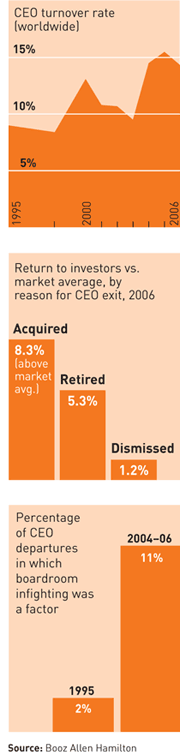 For the last six years, Booz Allen Hamilton’s study of CEO turnover has charted the emergence of this more demanding environment. Annual turnover of CEOs across the globe increased by 59 percent between 1995 and 2006. In those same years, performance-related turnover — cases in which CEOs were fired or pushed out — increased by 318 percent. In 1995, only one in eight departing CEOs was forced from office. In 2006, nearly one in three left involuntarily. And although tales of embattled CEOs and boardroom intrigues dominated the business headlines in 2006, CEO turnover in fact receded slightly from its high in 2005. We believe this reflects the “new normal” state of CEO turnover that we identified in last year’s study.
Among the specific findings for 2006:
-
The CEO turnover rate has leveled off at a high plateau. Total turnover fell to 14.3 percent, slightly lower than the 2005 total. Both regular and forced succession rates have stabilized since 2004 at 6.6 percent and 4.6 percent, respectively, significantly higher than the levels of the late 1990s and early 2000s.
-
CEOs are more likely to leave prematurely than reach their expected retirement. Only 46 percent of CEOs leaving office in 2006 did so under “normal” circumstances, the lowest proportion in the nine years we have studied.
-
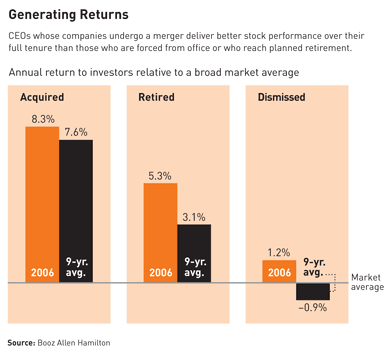
CEOs who exit via a merger or buyout deliver the best performance for investors. In 2006, CEOs whose companies were acquired delivered returns to investors that were 8.3 percentage points per year better than a broad stock market average. CEOs who retired normally performed 5.3 percentage points better, and those dismissed from office delivered returns 1.2 percentage points better.
-
Boardroom infighting is taking a higher toll on CEOs. The proportion of CEOs leaving because of conflicts within the board increased from 2 percent in 1995 to 11 percent in 2004–06.
-
Boards are looking at future performance. Whereas boards in the past dismissed CEOs for proven underperformance, they are now removing chief executives more frequently because of concerns over poor current performance or if they expect future underperformance.
-
Boards are planning better for high turnover. As the succession rates climbed earlier in the decade, boards turned to such expedients as hiring “outsider” CEOs, appointing interim chiefs, and opting for candidates with previous experience running a public company. But these trends have waned as boards have become better at grooming in-house candidates.
-
Independent chairmen are best. In 2006, all of the underperforming North American CEOs with long tenure had either held the additional title of company chairman or served under a chairman who was the former CEO.
-
Mergers and buyouts are driving turnover. After a dormant period from 2002 through 2004, the market for corporate control, including buyouts by private equity firms and hedge funds, rebounded in the last two years, causing record levels of merger-related turnover in North America and particularly in Europe, where such activity is fundamentally altering the corporate landscape. The proportion of departing CEOs worldwide who left because of a change of control was 18 percent in 2005 and 22 percent in 2006, compared with 11 percent in 2003. (See “Mergers and CEO Turnover,” below.)
The New Normal
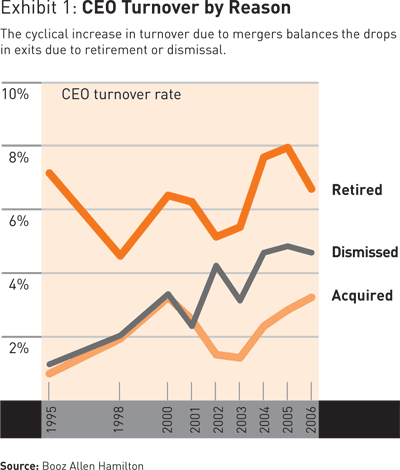
In last year’s CEO succession survey, we hypothesized that turnover at the 2,500 largest companies in the world had reached the crest of the wave that had gathered force in the 1990s, and suggested that both total turnover and performance-related turnover would recede slightly from 2005 levels, while average CEO tenure would increase. All three predictions proved correct. Total CEO turnover did fall, with the cyclical increase in merger-driven turnover almost offsetting the declines in other types of turnover. (See Exhibit 1.) Performance-related turnover fell slightly, to 4.6 percent. Globally, the average CEO tenure increased to 7.8 years, slightly higher than the average across the nine years we’ve studied.
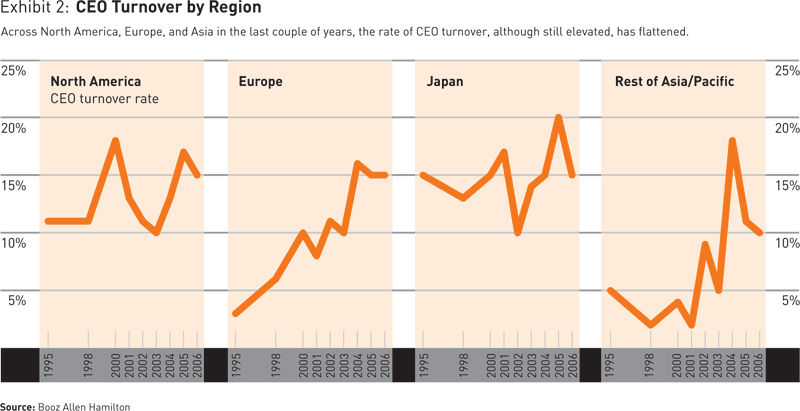
The turnover wave has crested in every region of the world. In 2006, total turnover in Japan and the Asia/Pacific region fell below the levels of the previous two years. (See Exhibit 2.) Turnover in North America declined from the 2005 level. Although Europe experienced a slight increase over 2005, CEO turnover remained well below its 2004 peak.
In 2006, performance-related departures declined in North America and Europe. Although performance-related turnover increased in both Japan and the rest of the Asia/Pacific region, the level remained below the 2002 peak. North America, Japan, and Asia/Pacific all saw increases in CEO tenure, with Asia/Pacific reaching its longest-ever average at 9.5 years and North America hitting 9.8 years — the longest average tenure since 1995. Only Europe experienced a decline in tenure, to 5.7 years, despite record returns to shareholders. Furthermore, the mean age of outgoing CEOs dropped to a record low in Europe, suggesting that chief executives in that region are still under tremendous pressure.
The stability from 2004 through 2006 contrasts with the previous decade’s rapid increases in both total turnover and forced turnover, and with the decline in tenure during those years. We’ve reached a new normal.
From the overall perspective of corporate governance, the new level of turnover is very reasonable: The 7.8-year average tenure for CEOs provides them enough time to implement their initial strategy, and the rates of mergers and performance-related terminations are high enough to allow for timely removal of both poorly performing CEOs and those engaged in illegal or unethical behavior.
Boards Are Adapting
Looking back at the nine years’ worth of data in our study, we have identified two fundamental shifts in the ways corporate boards address CEO selection and oversight: They are becoming less tolerant of poor performance, and they are increasingly splitting the roles of CEO and chairman.
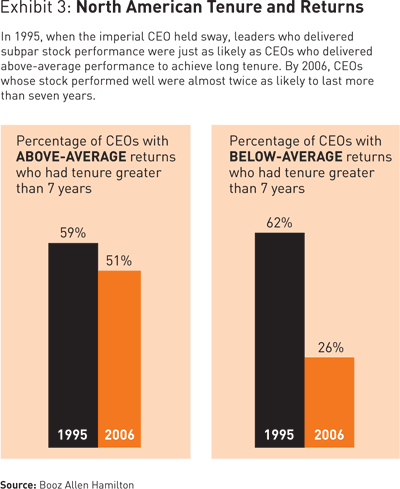
Our study reveals that CEOs who deliver below-average returns to investors don’t remain in office for long. Exhibit 3 shows the proportion of North American CEOs leaving office in 1995 and 2006 after seven years or longer. Notice that in 2006, a CEO who delivered above-average returns to investors was almost twice as likely as one delivering subpar returns to remain CEO for more than seven years. In contrast, in 1995, CEOs who delivered substandard returns to investors were just as likely to achieve long tenure — a perverse situation that reflected the durability of the imperial CEO. The likelihood of surviving to seven years declined for good and bad performers alike between 1995 and 2006, but the decline was modest for good performers, whereas CEOs who performed badly for investors were removed far more quickly.
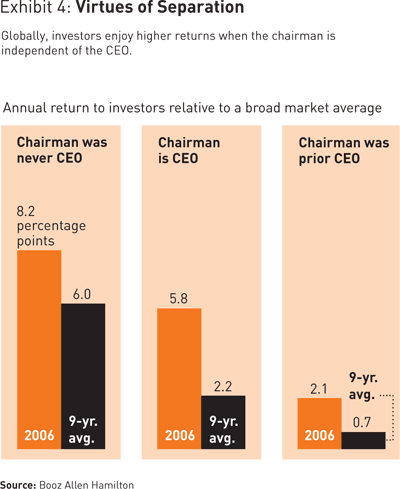
The other major trend has been in governance, with both a shift toward separation of the roles of chairman and CEO and a shift toward chairmen who haven’t previously served as a company’s CEO. (See Exhibit 4.) In North America, the dominant dynamic is the doubling from 1995 to 2006 of the proportion of chief executive officers who have never held the title of chairman, with only a modest reduction in the proportion of chairmen who had previously served as CEO.
In Europe, separation of the roles had already occurred in 78 percent of companies by 1995; thus, the increase in role separation after that year was small. The dominant dynamic in Europe was the decline from 61 percent of chairmen who had previously served as CEO in 1995 to only 23 percent in 2006, with a concomitant rise in the proportion of chairmen who had never been CEO. In Germany, the system of two-tier boards with a managing board that “should” be controlled by a supervisory board is under particular pressure to reform. In Japan, however, there was little change, with CEOs continuing to become chairman of the board.
Governance relationships have important implications for company performance. Non-chairman CEOs enjoyed a tenure of only 5.8 years, compared with 10.3 years when the roles were combined. In North America and Europe, 58 percent of the CEOs who were also chairman reached a planned retirement, compared with only 35 percent of CEOs who weren’t chairman. Investors benefit when the roles are split.
Investors also benefit when the chairman isn’t the previous CEO. Splitting the roles of CEO and chairman while the former CEO stays on as chairman (an arrangement we call the “apprentice CEO”) is a bad idea for three reasons: First, knowing that the former CEO will remain involved as chairman sometimes leads the board to embrace a candidate who was a great number two, but who’s unlikely to become an effective CEO; second, most chairmen who were CEO protect their protégés, reducing the likelihood that the new CEO will be fired for poor performance; and third, some chairmen who weren’t really ready to give up their executive responsibilities go to the opposite extreme, firing their successor at the first sign of trouble and reassuming the chief executive position. CEOs who served while the previous CEO was chairman performed significantly worse for investors both during 2006 and across the nine years we studied. All the underperforming North American CEOs with long tenure who departed in 2006 either held both titles or served under a chairman who was a former CEO.
In addition to the two major board trends, we can identify three expedients that boards commonly adopted as they coped with the rapid increase in CEO turnover that began in the 1990s — expedients that are no longer necessary because boards have adapted to the new normal. The first expedient was the willingness of boards to look outside the company for new chief executives. Globally, the proportion of outsiders departing as CEO grew from 14 percent in 1995 to 30 percent in 2003, and then declined to 18 percent in 2006. Since the average tenure of outsiders is 5.8 years, the hiring of outsiders as CEOs peaked in 1997, when the outsiders who departed in 2003 were hired. In retrospect, it’s clear that the rise in CEO turnover caught many boards without adequate succession plans. We hypothesize that by strengthening their focus on succession, boards have nurtured leadership bench strength, enabling them to return to the internal candidates they traditionally prefer.
The second expedient was the appointment of interim CEOs, a choice boards fell back on when a CEO left abruptly without a viable successor in place. Interim CEOs lead a company for about six months, on average, while a CEO search is conducted. The proportion of interim CEOs increased globally from 3 percent in 1995 to 6 percent in 2005 and then declined in 2006. Interims are most common in North America and Europe, where their numbers reached a peak of 19 percent of CEOs departing via planned succession in 2005. (In Japan, with its strong tradition of insider successions and its relatively low proportion of performance-related departures, interim CEOs are rare.) As in the case with outsiders, boards turned to interim CEOs because of the rise of unexpected CEO departures, and we believe the recent decrease reflects improving CEO succession processes: Most boards today have at least one internal candidate who is ready to take the helm, so no interim CEO is required.
The third boardroom expedient was to select a CEO who had previously served as the CEO of a publicly traded company. The proportion of experienced CEOs increased from about 4 percent in 1995 to about 6 percent in 2004 through 2006. The theory is that prior CEOs bring experience in dealing with investors and other stakeholders, giving them a head start. However, these CEOs delivered slightly worse returns to investors in eight of the nine years we studied; the advantages of experience must not be very great. We hypothesize that as boards observe that experience as a CEO doesn’t confer significant advantages, the proportion of prior CEOs will drop off. One piece of evidence consistent with our hypothesis is that the incidence of hiring a CEO from another large publicly traded corporation (one important subcategory of prior CEOs) declined significantly in 2006, after hitting highs in 2004 and 2005.
Forward-Looking Investors
Today, aided by sweeping changes in governance law and regulation, boards do a good job of replacing CEOs who deliver poor returns to investors. The average tenure of chief executives forced from office over the nine years of our study was 7.1 years in North America and 5.2 years in Europe — long enough to develop and execute a strategy.
During the past three years, however, major investors have begun to demand more than accountability — they have been pushing for removal not only of CEOs who have been performing poorly but also of CEOs who aren’t expected to perform well in the future. In North America, several CEOs who had created above-average returns for investors in the past were forced out in 2006 because of concerns about their strategies or ability to deliver future returns. These included Jay Sidhu at Sovereign Bancorp and Martin McGuinn at the Mellon Financial Corporation.
This new activism fundamentally changes board dynamics. Boards and investors can assess past performance objectively, without a deep understanding of the company’s customers, technologies, and operations; five to seven years of poor performance is time enough to form a consensus about the need to replace the CEO. In contrast, assessing the company’s likely future performance is inherently subjective.
That subjectivity triggers increasing conflict within boards. Hedge funds and activist investment firms, as well as old-fashioned raiders like Carl Icahn, demand board seats, launch proxy battles, and mobilize shareholders to force strategic changes or oppose specific transactions. Private equity buyout firms offer a spike of immediate returns to current stockholders while capturing the long-term upside for themselves. Directors champion different strategies, sometimes provoking disagreements, such as the messy contretemps at Hewlett-Packard. And in some cases, especially in European companies in which unions hold seats on the supervisory board or government owns a major stake, other stakeholders are pushing back at strategies focused narrowly on increasing near-term shareholder value.
Globally, the proportion of CEOs leaving because of power struggles on the board increased from 2 percent in 1995 to 11 percent in 2004–06. In Europe, boardroom power struggles drove an extraordinary 22 percent of CEO departures in 2006. For example, Volkswagen CEO Bernd Pischetsrieder left amid conflict with supervisory board Chairman Ferdinand Piech and unions opposed to cost reduction initiatives. Jens Alder left Swisscom when the Swiss government hampered his efforts to use acquisitions to compensate for declining revenues in the home market. Autostrade CEO Vito Gamberale first supported, then opposed a merger with Abertis that was negotiated by Autostrade’s largest shareholder, the Benetton family. Autostrade and Gamberale parted ways in May 2006. Werner Seifert left Deutsche Borse after major shareholders repudiated his plan to merge with the London Stock Exchange.
Inclusiveness, Engagement, and Involvement
With the board of directors more deeply engaged and owners actively involved in governance and strategy, inclusiveness is the most critical new attribute for the CEO, starting with the ability to take into account the concerns and suggestions of investors, employees, and government. Given the unrelenting pace of change in global business today, stakeholders may see threats and opportunities sooner than the board and management team do. Listening to stakeholders increases the likelihood that a company will act quickly and effectively. Fortunately, most stakeholders care primarily that their concerns be heard and addressed, not that their specific suggestions be followed. Investors, for example, are satisfied with business improvements that significantly increase a company’s value and generate attractive returns even if they had suggested different means to increase value.
Bob Nardelli’s dismissal from Home Depot, for example, was driven by his failure to hear and respond to investors’ concerns — very much the actions of an imperial CEO. These concerns included the erosion of the company’s competitive position against its chief rival, Lowe’s (culminating in Nardelli’s refusal to even publish same-store sales comparisons), and his strategy of expanding into a lower-margin, nonretail business, as well as his refusal to answer shareholder questions. In contrast, Temple-Inland CEO Kenneth Jastrow listened to the concerns and suggestions expressed by Carl Icahn and other investors, and, in response, crafted a transformation plan that breaks the corporation into three focused companies (manufacturing, financial services, and real estate). The restructuring should not only strengthen each of the three businesses, but also create better opportunities for employees. It is already generating higher returns to investors.
Transparency about results is an indispensable element of inclusiveness. Several CEOs have been dismissed in the last four years in the U.S. because of inadequate transparency — with regard to both the board and shareholders — about their compensation. During 2006, the primary compensation transparency issue was backdated stock options, which resulted in the dismissal of 0.7 percent of the CEOs of North American companies, including such long-term successes as William McGuire of UnitedHealth Group and Bruce Karatz of KB Homes.
Inclusiveness is valuable only if a CEO can effectively mobilize his or her company to identify and seize the best opportunities wherever they appear. Inclusive CEOs recognize their own strong points and limitations, and then surround themselves with a highly qualified management team and with trusted advisors whose skills round out their own. Opportunities can present themselves as operational improvements, new technologies, sales or marketing improvements, major transactions, cost reductions, and prospects for growth — and no CEO is equally effective in all these areas. Restricting themselves to actions in their comfort zone means that CEOs will remain effective only as long as the best opportunities fall there.
Including board members in the development of strategy — not merely asking them to approve a strategy developed by management — is the best way to gain the board’s confidence and buy-in. It’s an effort well worth making: Board backing is invaluable to CEOs who may face investor challenges while waiting to see if a new strategy will pay off. GM’s Rick Wagoner, for example, benefited from such support when Kirk Kerkorian and Jerry York challenged the pace of GM’s transformation. But CEOs need to understand that such support can come only after meaningful debate among board members who may have different perspectives on the facts and different judgments. Conflict in these moments will be increasingly common; inclusive CEOs will welcome the debate.
The board of directors, in turn, must embrace deeper engagement. Because of intensifying global competition and ever-higher expectations about corporate performance, companies now need the board of directors to proactively offer suggestions, to debate threats and opportunities, to push back aggressively if management is heading in the wrong direction, and to make informed judgments. Deep engagement requires directors to participate in dialogues with customers, channel partners, suppliers, and employees — not different in concept from the traditional role of the ideal director, but completely different from the usual practice. These dialogues in turn require directors to devote time beyond the quarterly board meetings, probably earning compensation greater than what they receive today.
Involved investors are also becoming the norm. Imperial CEOs survived because investors weren’t actively involved in the governance of publicly traded corporations, limiting themselves to selling off stock when they lost confidence in a company’s CEO. Today’s involved investors include not only members of family-controlled businesses, but also private equity buyout firms, raiders, and hedge funds that take a stronger hand in the actual running of the companies they’ve invested in. Notice that “involved” investors are different from the traditional category of “active” investors. Active investors pick stocks that they expect to outperform the market, whereas passive investors go for index funds and exchange-traded funds that track the market. Involved investors are active investors who try to outperform the market by driving companies to change their behavior, whether by stimulating the removal of the CEO, suggesting a change in strategy, or triggering the sale of the company.
This new age of corporate governance is still taking shape. Sometimes, old battles from the transition period will be re-fought, like the current debate about softening or repealing some of the provisions of the Sarbanes-Oxley Act. Other battles haven’t yet been waged. How responsive, for example, should boards be to the demands of one large shareholder, especially if that shareholder’s suggestions hurt smaller shareholders? Should the board be more responsive to long-term investors than to hedge funds focused on making a quick buck? Now that investors are better able to enforce their preferences, should boards assume a greater role in securing the interests of other stakeholders? Many of the rules of the new era aren’t clear; some probably have yet to be written.
What is clear is that all the constituencies interested in the health and welfare of the corporation — CEOs, boards of directors, investors, consultants, regulators, legislators, and the business press — should say goodbye to the era of the imperial CEO and prepare for change. We shouldn’t expect a continuation of the patterns of CEO turnover and tenure that held sway in the transitional period. Instead, we should hope that a clearer answer emerges in future years to the fundamental questions of corporate governance: What is the best governance structure to stimulate the creative destruction that’s the hallmark of capitalist economies, and how can it produce the greatest benefits for all stakeholders? 
Reprint No. 07205
|
Announcement Effects: Does Changing the CEO Move the Market? |
|
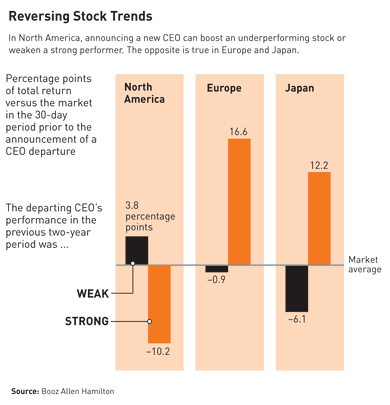
This year, we investigated whether the announcement that a CEO will be replaced has a significant immediate effect on stock price, analogous to the jump that almost always occurs when a merger is announced. Because succession news can leak in the days before the announcement — as is often the case with mergers — we estimated the announcement effect as the returns to investors relative to a broad stock market average over a 30-day period extending through the day of the announcement. The announcement effect of merger-related succession is clear. In the 30 days before a change in CEO is announced, annualized returns to investors for merger-related successions are 117 percent greater than average. But the announcement effects of non-merger-related changes are less dramatic: Returns are 0.8 percent below average for planned successions, and 12.6 percent below average for forced successions. Furthermore, the change in stock price during the announcement period is entirely unrelated to how well the newly appointed CEO performs during his or her full tenure. Apparently, the stock market is no better at anticipating the ultimate performance of a CEO than is the board of directors. It’s how well the CEO does in improving a company’s performance, not the CEO’s characteristics coming into the job, that drives returns to investors. In North America, announcing the replacement of the CEO produces a positive effect (3.8 percentage points better than the average return) when a company has been performing poorly for two years and a negative effect (10.2 percentage points worse than average) when the company has been doing well — exactly the pattern one would expect if investors believe that the new CEO will deliver average results. In Europe and Japan, the announcement produces the opposite effect. Perhaps the difficulty of bringing about significant immediate change in Europe and Japan is the cause: In North America, the normally negative returns during the announcement month at a poorly performing company are more than offset by the expectation that a new CEO will make changes that produce a big upside, whereas in Europe and Japan the normally negative returns balance the expected upside from change. The one consistent announcement effect is that selection of an outsider produces a big downtick in stock price; selection of an insider triggers an uptick. This probably reflects investors’ assumptions that the outsider is taking over a poorly performing company, or that an insider will generally produce better returns for investors — assumptions that have been consistent throughout our study. The pattern for outsiders brought in from other industries — typically the CEOs most expected to shake up a company — is consistent with our hypothesis. Industry outsiders enjoy a positive announcement effect (outsiders from within the industry have an extremely negative effect) and a positive effect during the 30 days following the announcement, as expectations continue to rise that they will bring beneficial change. However, because of the difficulty outsiders face in driving growth and changing the culture, industry outsiders produce very negative returns in the month before they are replaced (whereas outsiders from within the industry enjoy positive returns).
— C.L., S.W., and R.H. |
|
One of the strongest recent trends affecting CEO succession has been the cyclical increase of activity in mergers, acquisitions, and buyouts (all classified as “merger-related successions” in our study). Overall, the percentage of CEOs who left because of a merger was 2.8 percent in 2005 and 3.2 percent in 2006, up from a nadir of 0.8 percent in 1995. CEOs who leave for merger-related reasons, however, make up a much larger proportion of departing CEOs — 18 percent in 2005 and 22 percent in 2006. This is because every merger triggers a departure, but departures occur at only about one-tenth of nonmerging companies each year. Merger activity varies widely. Merger frequency varies by geographic region, with the highest rates in North America and the lowest rates in Japan (only 0.7 percent of companies per year) and the rest of Asia/Pacific (only 1.1 percent). The frequency of mergers also varies cyclically. Among the years we have conducted the study, in North America, the annual rate of merger activity fluctuated from a low of 0.9 percent to a high of 4.6 percent. North America and Europe both experienced their highest level of merger activity in 2006. Over the full nine years of our study, an average of 2.9 percent of North American companies and 2.3 percent of European companies in our sample disappeared each year following a merger; CEOs who left for merger-related reasons made up 22 percent of all departing CEOs in both regions.
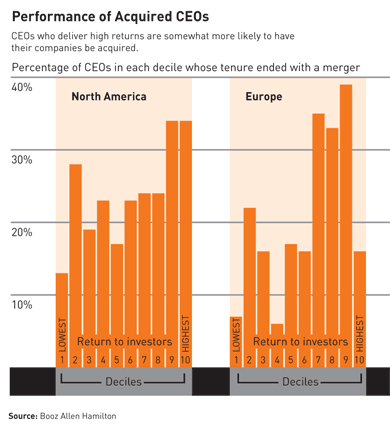
Our data shows that, on average, CEOs whose companies are acquired or taken private generate returns to investors greater than those of CEOs who reach planned retirement or are dismissed for poor performance. The same pattern appears in every region of the world. Thirty-one percent of the North American CEOs and 33 percent of the European CEOs who created above-average returns for investors left the companies they’d led for merger-related reasons. We call this phenomenon the merger multiplier. Mergers generate such attractive returns not only because of acquisition premiums, but also because companies are usually acquired after several years of good performance. For example, from the time the final CEO takes over until 30 days before the merger is announced (before word leaks out and the stock price starts to increase), companies that are acquired produce annual returns to investors 6.3 percentage points per year higher than the average. Only 6 percent of companies merge that had taken a restructuring charge within three years of the end of a CEO’s tenure, compared with 21 percent of companies that hadn’t taken a restructuring charge. In the exhibit below, we sort CEOs into deciles based on the returns investors earn during their tenure relative to a broad market average. For each decile, we report the proportion of CEOs who ended their tenure with a merger. The horizontal lines show the average proportion of mergers in North America and Europe. Notice that mergers were extremely common among the better-performing CEOs in the higher-numbered deciles, and uncommon among the poorer-performing CEOs in the lower-numbered deciles. (The spike in the second decile probably represents poorly performing companies acquired at a premium.)
Because being acquired at a premium is such a common and effective strategy, investors demand that CEOs and boards embrace the possibility of merger. We’re not saying that investors demand that companies try to be acquired or even demand that they accept any offer to be acquired at a premium. But boards and CEOs have to embrace the possibility that being acquired offers the best strategic opportunity for the company and for creating above-average returns to investors. There’s no doubt that some CEOs who create great returns for investors do it the old-fashioned way — by keeping their companies independent and building them into much larger and more valuable businesses: think of Fujio Cho and Tatsuro Toyoda at Toyota, Bill Gates at Microsoft, David Fuente at Office Depot, or Peter Johnson at Inchcape. But for nearly one-third of chief executives, selling the company is an element of a strategy to create great returns. For outsiders brought in to turn companies around, exiting via a merger is a great strategy — creating superior returns by combining the benefits of the restructuring with the acquisition premium. Globally, only 17 percent of insider tenures end in a merger, but 27 percent of outsider tenures end this way. Similar patterns are observed in all geographic regions. For example, in North America, 22 percent of insiders end their time at a company by being part of an acquisition, compared with 32 percent of outsiders. Excluding mergers, insiders and outsiders deliver similar levels of performance for investors. But because outsiders are more likely to sell the company and because selling the company enhances returns, outsiders generate better returns to investors when mergers are considered. Exiting via a merger is an especially attractive strategy for an outsider with strong restructuring skills. Although exiting underperforming businesses, significantly reducing costs, and forcing change in a corporation’s culture are all critical tasks during the first two years of a turnaround, they’re much less relevant to stimulating rapid growth and evolving the organization’s culture in later years. As a result, outsider CEOs whose businesses aren’t acquired usually deliver great returns to investors (much better than insiders) during the first few years of their tenure, and substandard performance in their remaining years. Selling the company once the turnaround is successful is a choice that takes full advantage of a CEO’s up-front restructuring skills without requiring the CEO to be equally effective in driving long-term growth. Some outsiders skilled in restructuring are serial acquirees, repeatedly turning around large companies and then selling them. Jim Kilts (Nabisco and Gillette), Michael Capellas (Compaq and MCI), Rainer Beaujean (T-Online and Terra Networks), and Jackson Moore (Regions Financial and Union Planters) are all serial acquirees. At least in our database, all outsider CEOs who sold a company they led sold any additional companies where they became CEO. Boards should recognize that by hiring an outsider turnaround specialist (especially if he or she has sold companies in the past), they are starting a process likely to result in the sale of the company. — C.L., S.W., and R.H. |
|
Methodology |
|
This study required the identification of the world’s 2,500 largest public companies, defined by their market capitalization on January 1, 2006. We use market capitalization rather than revenues because of the different ways financial companies recognize and account for revenues. Thomson Financial Datastream provided the market capitalization of the top companies in each global region on December 31, 2005. For analytical purposes, we divided the global market into six regions: North America (including the U.S. and Canada), Europe, Japan, Rest of Asia/Pacific (including Australia and New Zealand), Latin America (including Mexico), and Middle East/Africa. To identify the companies among the top 2,500 that had experienced a chief executive succession event, we used a variety of printed and electronic sources, including Corporate Yellow Book and Financial Yellow Book (both published by Leadership Directories, N.Y.); Fortune; the Financial Times; the Wall Street Journal; and several Web sites containing information on CEO changes (www.ceogo.com, www.executive-select.com, www.hoovers.com, and www.spencerstuart.com). Additionally, we conducted electronic searches using Factiva, Nexis, and general search engines for any announcements of retirements or new appointments of chief executives, presidents, managing directors, and chairmen; results of these searches were compared to the list of the top 2,500 companies. For a listing of companies that had been acquired or merged in 2006, we used Bloomberg. Finally, marketing personnel in Booz Allen Hamilton offices outside the United States added any CEO changes in their regions that had not been identified. Each company that appeared to have experienced a CEO change was then investigated for confirmation that a change had occurred in 2006 and for identification of the outgoing executive: name, title(s) upon accession and succession, starting and ending dates of tenure as chief executive, the announcement date of both appointment and exit, age, whether he or she was an insider or outsider immediately prior to the start of tenure (and, if an outsider, whether he or she was an industry outsider), whether he or she had served as a CEO of a public company elsewhere prior to this tenure, whether the CEO had been chairman (and, if so, for how long), identity of the chairman at the start of the CEO’s tenure (if different) and whether that individual had been the CEO of the company, and the true reason for the succession event. Company-provided information was acceptable for each of these data elements except the reason for the succession; an outside press report was necessary to confirm the true reason for an executive’s departure. We used a variety of online sources to collect this information on each CEO’s tenure, including company Web sites, the Factiva database, www.transnationale.org, and proxy statements available on the U.S. Securities and Exchange Commission’s EDGAR database (for U.S.-traded securities). In some cases, when the online sources were unproductive, we contacted the individual companies by e-mail and telephone to confirm the tenure information. We also enlisted the assistance of Booz Allen offices worldwide as part of this effort to learn the reasons for specific CEO changes in their regions. We then calculated regionally adjusted average growth rates (AGRs) of total shareholder returns (TSRs), including the reinvestment of dividends, if any, for each executive’s tenure. We did this for the total tenure, the first and second halves of the tenure, the first two years, and the final year. TSR data for each company and corresponding region was provided by Thomson Financial Datastream and Morgan Stanley. To assess the company’s health prior to each CEO’s tenure, we collected company and regional TSRs for the three years prior to each CEO’s start date and calculated AGRs. |
Author profiles:
Chuck Lucier (chuck@chucklucier.com) is senior vice president emeritus of Booz Allen Hamilton. He is currently writing a book and consulting on strategy issues with selected clients. For his latest publications, see www.chucklucier.com.
Steven Wheeler (wheeler_steven@bah.com) is a senior vice president with Booz Allen based in Cleveland, Ohio. He leads the firm’s business focused on strategic leadership and has served multiple industries with a focus on consumer packaged goods and durables.
Rolf Habbel (habbel_rolf@bah.com) is a senior vice president with Booz Allen in Zurich, and author of The Human Factor: Management Culture in a Changing World (Palgrave Macmillan, 2002). He focuses on the leadership and performance issues of large corporations.
Also contributing to this article was Julien Beresford, president of Beresford Research.