
Partners at the Point of Sale
With “shelf-centered collaboration,” manufacturers and retailers can finally put the right product on the right shelf at the right time for the right consumer.
Nearly every aspect of retailing, from distribution to promotion, has changed dramatically during the last 20 years. And yet the focal point of consumer purchases is still the same: the “moment of truth” when a consumer chooses a product. The point of sale (POS), whether physical (such as a retail store shelf) or electronic (such as a Web site), represents the true center of the manufacturing–retailing universe. It is time for manufacturers and retailers to recognize the full power of the shelf: the potential that they can realize only together.
|
|
|
Photograph by Holly Lindem |

We call this new approach shelf-centered collaboration (SCC). It begins with the choice to work together with carefully selected partners in manufacturing and retail to build a systematic, analytic, and responsive infrastructure based on point-of-sale data. There are many reasons for companies to be interested, starting with new opportunities for growth and profitability. Long gone are the days of mass marketing, when a cosmetics, food, or cleaning products company could build big brands, promote them to large audiences, easily take advantage of economies of scale, and watch products leap off the shelves. Instead, thousands of products vie for space in the store aisles of retailers who are fighting one another to attract consumers’ attention and loyalty. The value chain itself struggles to manage this complexity. For example, “shelf out-of-stocks” (desired products that are not available) are at historically high levels, while a positive return on investment for marketing promotions remains a 50-50 proposition at best. SCC addresses these opportunities by enabling manufacturers and retailers to operate in partnership, creating and responding to demand more effectively than they could alone.
SCC also addresses the unforgiving nature of today’s shoppers. After years of widespread Internet use, consumers of all ages are smart, keenly demanding, and highly differentiated. They are skeptical of brands; aware of their health, personal care, and nutritional needs; thoroughly fashion-conscious; and impatient with high prices and shoddy quality. They increasingly prefer products that fulfill more than one need, such as vitamin-enriched beverages or multimedia players. They lose interest or go elsewhere when their desires are not immediately gratified. And they are diverse in their tastes, expecting that some clothes, toys, and foods will be fashionable for a few months and then rapidly disappear, while others last indefinitely. In short, consumers are demanding the right product in the right place at the right time for the right price. To meet that demand, manufacturers and retailers must master staggering levels of business complexity — not just in mature markets like Milwaukee and Madrid, but also in emerging markets like Mumbai and Mexico City.
Manufacturers and retailers are both inspired and exhausted by this opportunity. The most forward-thinking of them are ready to move beyond today’s fragmented marketing and manufacturing approaches. To accomplish this, they will need to learn to work together in new ways. They will need to stop negotiating their purchasing arrangements as a zero-sum game, in which every retailer’s gain is a manufacturer’s loss (and vice versa); instead, they’ll need to start clearing away their organizational and operational roadblocks, and start building new types of managerial and technological links in their value chain. Finally, they will need to shift their focus from the “mean” to the “meaningful.” In other words, they must pay less attention to the aggregated sales figures that most marketers and retailers use today — by category, by region, and by week — and develop instead a granular understanding of consumer demand, tracking and analyzing purchases by item, by store, and by day.
Building a Better Network
Imagine, for a moment, that you could design a consumer value chain from scratch. In other words, you have a free hand to rethink the network of supply, manufacturing, distribution, and retail enterprises that collectively move your product from raw materials to a finished item ready for consumers. Your goal: to provide consumers with the products they want most in the most compelling way, with an appropriately attractive margin for the manufacturers and retailers involved. What would that value chain look like?
To start with, it would be a selectively inclusive network. Building on established practices and industry standards for business-to-business partnership, it would embrace a large enough group of retailers and manufacturers for all the key players to gain benefits of scope and scale. It would differentiate the offers and assortments of the conventional retail mix, providing varied product categories to diverse retail outlets, so that consumers immediately perceive those shopping experiences as distinct from each other. And it would support the large logistics infrastructure needed for efficient, rapid delivery to all these outlets in their varied locations.
A shelf-centered collaboration network would operate “shelf-forward.” It would anticipate and generate demand with innovative products, assortments, promotions, and displays that recognize consumers’ diverse needs. For example, store displays and shelf mixes would routinely change at certain times of the week, to accommodate the ebb and flow of commuters, stay-at-home parents, young adults, and weekend shoppers through the stores. Stores a mile apart would routinely stock different product mixes tailored to their varied demographics. Displays and products would appear just at the moment that consumers sought them out. It would be rare to find a product out of stock; perennial staples would continually become easier to shelve and less costly to purchase, in part because the range of offerings at any single store would be less complex. New information technology — some of it installed in the shopping cart or accessed through cell phones and personal digital assistants — would enable product promotions tailored not just to neighborhood demographics but to the specific shopper, whose past buying habits would have been meticulously tracked and analyzed. Even advertising would be timed more closely to distribution flow, with POS data used to gain robust insights into the consumer demand patterns for different items, days, and stores.
The network would also operate “shelf-back,” responding immediately to information about consumer purchase patterns and demand with real-time changes in shelf-stocking decisions, displays, supply chain execution, and even product design. Although this general concept may sound familiar to those in the industry — for example, as “demand-driven supply networks” (DDSN) — current practices are often limited to the rapid replenishment of standard merchandise, without tailoring of the product mix or timing to consumer demand patterns. Nor do current practices incorporate the kind of robust analytics that can predict changes in consumer demand. SCC would help manufacturers, along with store and category managers, make far better use of POS data and analytics.
If you wanted to make the most of the network, you would design a way for your marketing, sales, supply chain, and retail infrastructures to meet at the point of sale using their common pool of timely day-by-day sales data, combined with other relevant factors, to generate a statistical signal of predictive demand. You would focus not just on the recent past (as portrayed in category, regional, and weekly statistics) but on the prospective sales of the near future (again, tracked by item, by store, and by day). And unlike many retail marketing programs, this would all be implemented with full transparency for the total value chain costs of each new promotion and sales effort, including the otherwise invisible costs that accrue when one product inadvertently cannibalizes another.
When consumer products companies and retailers design programs and networks to simultaneously operate shelf-forward and shelf-back, they can achieve the integrated capabilities that comprise the full potential for shelf-centered collaboration. (See Exhibit 1.) Rather than pitting them against one another as adversaries, SCC positions them as allies. Working together, they can focus on efficiency for some standard items and differentiate others through promotion and innovation, making the distinction on the basis of actual sales performance, rather than brand share. And they can repeatedly expand their integrated capabilities through continuous improvement based on common data.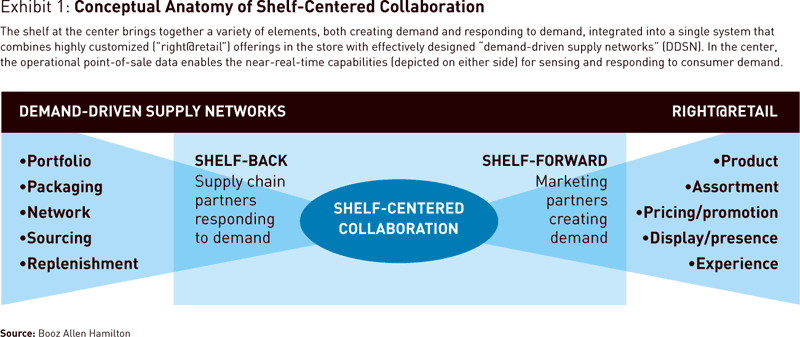
Cultivating Moments of Truth
The purpose of shelf-centered collaboration is not just to increase near-term sales, but to build consumer loyalty over time to both manufacturers’ and retailers’ brands. To understand this, consider the “moment of truth” mantra championed by Procter & Gamble, one of the world’s great brand-building manufacturers. As the CEO of P&G, A.G. Lafley, has described it, success depends on two moments of truth: when consumers choose products at the shelf, and when they use them. The consumer’s choice at the first moment of truth, from among the thousands of products the retailer offers, is affected by myriad factors, including product availability, brand appeal, consumer needs, package attractiveness, and the product’s essential value. There is also its fit with other products or services around it, the way it is promoted, and the experience of buying it. The second moment of truth occurs when a consumer uses the product and decides whether he or she is satisfied. As Lafley put it in his 2002 address to P&G shareholders, “Leading brands, billion-dollar brands are built on the trust and loyalty we earn when we win both moments of truth.”
SCC provides capabilities aimed at winning the first moment of truth — the moment at the shelf. It provides the category or retail store manager with an unprecedented number of tools for efficiently and effectively connecting with the consumer at that moment.
The impact is easiest to see in a single product — say, a bottle of over-the-counter major-brand allergy medicine. In today’s fragmented value chain, operating without shelf-centered capabilities, a retail store or category manager might order a display of that brand based on historical sales patterns for a group of stores in that region, specifying a date for future delivery. The size of the order would be based on historical sales patterns.
Under shelf-centered collaboration, by contrast, the delivery dates and the amount sent to each store would be influenced by more timely sources of information. If the pollen count is rising quickly or if a nearby store has been closed for remodeling, the order would be increased to compensate for the additional demand, with deliveries the next day. The network would deploy the right amount of allergy medicine to the right stores at the right time, rather than stocking excessive inventories to hedge against seasonal variability.
Admittedly, it’s rare to see such capabilities deployed by most consumer packaged goods companies today. But they are evident in businesses with shorter product life cycles, such as prerecorded entertainment media and fashion apparel. One well-known example is Zara, a fashion retail division of Spain’s Inditex Group. Zara divides its clothing into three categories. “Classic” garments change infrequently, with manufacturing outsourced to low-cost producers in countries like Sri Lanka and Malaysia; “fashion” clothes change seasonally, produced by Zara’s own factories and suppliers in Europe; and “trend” clothes change rapidly in response to the latest styles. This last apparel group, produced in Zara’s high-speed factories or by vendor partners, accounts for about half of Zara’s volume. Trend apparel may stay in the retail stores for only a few weeks.
For the fashion and trend categories, the production cycle is kept short and intensely responsive to information gathered from retail stores — about which products shoppers buy, what they try on, whether they have problems with zippers or fit, and what they ask for. Zara’s rapid-fire designers can produce a new garment in response to consumer demand within a few weeks, put it out in the “trend” line, and then — if consumer interest so dictates — move it to one of the other, slowermoving product lines. Because its clothes match consumer tastes so closely, Zara can sell some 80 percent of its products at full price — about twice the industry average. (See Exhibit 2.) That ability to avoid markdowns more than compensates for any added manufacturing and distribution costs, and the company benefits from the way that consumer-responsive attentiveness allows it to continuously improve its processes.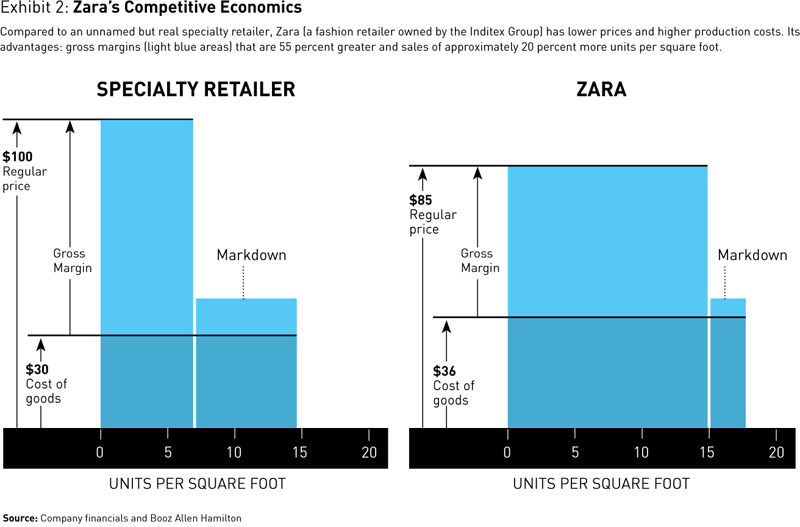
Zara accomplishes all this by tightly linking demand signals at the stores with a highly responsive supply chain. It relies on a very limited number of closely managed manufacturing suppliers, plus its own manufacturing facilities and a chain of closely managed retail stores. Shelf-centered collaboration seeks to achieve the same results through a much broader (albeit still carefully selected) integrated network of manufacturers and retailers. This kind of “collaborative virtual integration” yields the scale, scope, and responsiveness of a vertically integrated operation without its limitations, costs, and capital requirements.
Prerequisites and Prototypes
To be sure, realizing these benefits across the boundaries of many companies in a collaborative network is not simple. It requires a shift of mind-set and many changes in day-to-day practices. Those changes take place simultaneously across three levels of shared activity.
• Collaborative Strategy. Shelf-centered collaboration begins at the corporate leadership level. Retailers, manufacturers, and other partners set common strategic goals, define priorities over a three- to five-year horizon, establish communication channels across the boundaries among them, and manage the value chain through cross-enterprise and cross-functional teams, using shared measures of success.
The overarching goal is for each function and each business in the value chain to think end-to-end about the entire network of participants, from first supplier to end consumer. Instead of seeing their job as simply creating demand or supplying the shelf, they can now contribute to making the entire value chain more effective and responsive. This requires building enough trust among strategic partners (within and among organizations) to overcome any long-standing biases against sharing information, analysis, and metrics. And it requires a collaborative understanding of the costs, speed, waste, and economic trade-offs in the flow of goods, information, and cash.
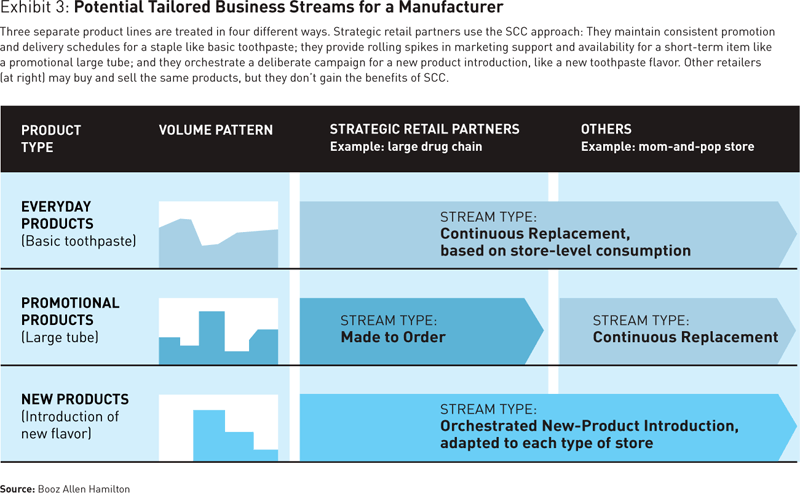
• Tailored Business Streams. Shelf-centered collaboration helps companies overcome the ingrained (but increasingly ineffective and unprofitable) habits of one-size-fits-all mass production. Built into the SCC value chain design are a variety of business streams, differentiated according to price (premium versus base products), consumer demand (aligned to various demographics and networks), demand variability (stable versus promotion-driven), and other factors. Some of these streams turn over rapidly; others change slowly; and each has supply and distribution policies and innovation, sales, and marketing models designed accordingly. Manufacturers and retailers might send large assortment packs to supermarkets on weekends, specific varieties to midsized stores on weekdays, and single-serving packs to convenience stores. They might replenish the same product in some stores through customized promotion units, direct from the manufacturing plant; in other stores through the retailer’s distribution network; and in small, remote locations through commercial parcel delivery services. Manufacturers and retailers would participate broadly across channels and categories, but they would focus their best efforts on differentiating for profitable growth with key strategic partners. (See Exhibit 3.)
• Integrated Capabilities. Innovation and alignment in three domains make it possible to achieve real integration across value-chain participants. The first domain focuses on people: reframing incentives and organizational structures to integrate teams along the value chain. Team performance and scorecards are coordinated across company boundaries, tracking an agreed-upon set of key performance metrics — for example, sales growth, inventory turns, and shelf out-of-stocks — that provide retailers and manufacturers with common incentives for cooperation. Ultimately, these teams would be accountable for joint manufacturer–retailer P&L results.
The second domain enables the improvement of processes: applying lean production techniques not just among suppliers, but throughout the production–distribution system, following the example of a few well-known retail chains such as Tesco. Retail stores would be clustered and organized in new ways, in tune with consumer demographics and preferences as well as with opportunities to streamline the supply chain.
The third domain involves the integration of maturing forms of information technology. Using enhanced applications and data storage, SCC tracks and analyzes POS data in real time (again, broken down by item, by store, and by day). Unlike many companies’ past IT investments, which tended to result in information silos — data trapped or warehoused in ways that made it difficult for other applications and systems to access it — SCC establishes repositories for a variety of demand signals: retail receipts, inventory and sales levels, related POS data such as pricing and display, and other external factors that influence demand (such as the day of the week, local events, and the weather). The ability to analyze such data, recognize patterns, and respond quickly will become critical.
Because these innovations are still emerging and are currently seen primarily in projects that involve single categories or trading partners, the full capabilities of SCC have not yet been realized across most consumer product categories. Nor have they been adopted across the geographies and product lines of most large-scale manufacturers and retailers. Fortunately, however, there have been enough pilots and prototypes that we now know these shelf-centered capabilities are possible, and we can see how beneficial they will be.
For example, Procter & Gamble’s “consumer-driven supply network” (CDSN) uses point-of-sale data to inform manufacturing and distribution decisions. With this network in place, P&G can monitor its promotions more easily, and it has updated its supply chain scorecard to include such measures of on-shelf performance as mean time to replenishment and shelf-level quality. As a result, out-of-stock rates have been reduced significantly in one-quarter of the company’s product categories.
Another pioneer is the Giant Eagle retail chain, which has partnered with manufacturers to develop joint metrics (based on POS data) for planning promotions, inventory, and delivery, often with dramatic reductions in out-of-stock rates. Giant Eagle recently collaborated with Kraft in a “rapid replenishment” project intended to increase the velocity of product flow between them. Elsewhere, providers like Market6 and VeriSign are demonstrating the potential for improving store-level assortment, promotion, and replenishment in individual pilot initiatives. These examples have yielded benefits to companies’ top and bottom lines, but because they are typically limited to a few participating companies or product categories, they are not yet achieving the degree of differentiation, growth, or efficiency that a fully integrated system could provide.
Getting in the Mood
It could take manufacturers and retailers, working closely together, as long as five years to bring these capabilities to scale. Fortunately, they will experience many gains along the way. The short-term results include increased volume and higher margins from better management of assortments, promotions, and customization, with improved in-stock performance on the shelf. The long-term results go further: giving companies greater capabilities for differentiating their offerings, increasing consumer loyalty and enabling above-market sales and profit growth.
To be sure, some experienced manufacturers and retailers are skeptical of the shelf-centered collaboration concept. It brings up memories of past solutions that failed to live up to their promises: collaborative planning, forecasting, and replenishment (CPFR); efficient customer response (ECR); vendor managed inventory (VMI); and others. In some cases, the projected benefits didn’t materialize because improvements were only partially or temporarily implemented. Other initiatives may have been conceptually or economically flawed, or just poorly executed. It’s reasonable for companies to ask why they should expect efforts to succeed now when similar initiatives have failed in the past.
It’s also reasonable to wonder why major retailers and manufacturers would agree to extensive cooperation with each other, instead of trying to use their proprietary data and brand cachet to gain advantage. Indeed, there are examples of manufacturers and retailers treating one another as adversaries, wrestling for control over their own portions of the value chain. Some manufacturers have aggressively introduced new products, seeking to force retailers to reallocate precious shelf space. Some retailers have tried to beat down manufacturers’ prices while imposing unique, customized, and expensive supply logistics and keeping valuable point-of-sale data to themselves.
But those tactics are increasingly recognized as counterproductive; they simply haven’t been profitable. More and more, leading manufacturers and retailers understand that engaging their value chain partners can help them manage the complexity of today’s product categories and retail channels — not by limiting diversification, but by matching product and retail opportunities more effectively. For example, a company might focus on new product innovation with some partners, for whom assortment is essential. With other partners, who see the lowest possible net landed cost as the primary measure of success (the net landed cost includes the product cost plus transportation and handling), the same company would pay more attention to supply chain efficiency.
Two big trends are making it easier than ever before to collaborate. The first, as we’ve noted, is the recent maturity of effective new technologies and processes. The second, equally important, is the growing number of manufacturing and retailing companies who are interested in becoming global or regional leaders, and who now recognize the value of having true partners at the point of sale.
Some companies will continue to ignore the opportunity. They’ll say, “We already have strategic trading partners” or “We already analyze consumption data,” while they continue to manage traditional supply chain relationships and to allocate resources based on historical averages of weekly regional performance. But they will fall behind those competitors who build more collaborative relationships.
The most successful early adopters will start with a few strategic value chain partners and gradually open their “preferred partner” opportunities to more and more manufacturers and retailers. In the end, some companies will find their dance cards full of exciting partnerships, while others are left standing on the periphery. To a large extent, what will make one player more desirable than a competitor will be its systems, capabilities, and performance. How open and committed is your company to strategic collaboration and partnership — to working across internal and external boundaries to win the battle of the shelf? The winners of this capability contest will get to play a major role in rewriting the rules of consumer goods manufacturing and retailing.
We generally advise the following first steps for companies who wish to pursue this transformation.
-
Develop Your Strategic Road Map. Identify priorities and expected benefits. Outline required changes to your current operating model. Seek out some initial partners among the retailers or manufacturers that you trust most and with which you have the most to gain.
-
Drive Collaborative Change. Conduct in-depth workshops with your selected strategic partners, designed to build understanding and to demonstrate and pursue opportunities.
-
Design and Build Integrated Capabilities. Plan and implement the process, analytic, organizational, and IT innovations needed to operate shelf-centered value chains. (See Exhibit 4.)
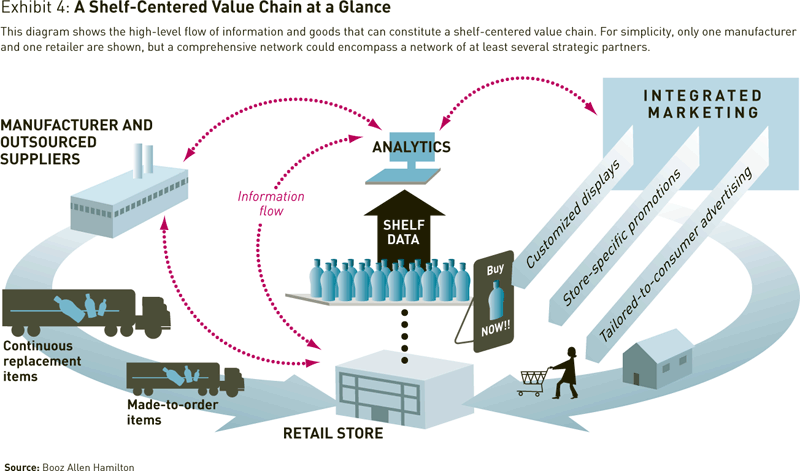
Those who start early will be less likely to get left behind as shelf-centered collaboration systems become more sophisticated. The ability to sift and combine numerous signals of consumer demand — from next-day point-of-sale data to shopper card transaction data to store and warehouse orders to shipment information — will improve gradually with experience. So will the ability to act on those signals in a more automated and granular fashion. Some applications of SCC may incorporate online purchases, or use Web-based media from home to connect people with particular face-to-face shelf-based promotions. Gradually, the entire system will become more attuned to its diversified markets. Like mass online video games that automatically adjust their story lines in response to the moves of their players, the entire system of analytically abetted human decision makers will become smarter and smarter about the real needs and desires of its manifold consumers. Those needs and desires, in turn, will be more expertly and individually reflected in the retail environment. Every store may one day be rife with the real-world equivalent of Amazon.com’s pop-up windows, programmed to associate its offers with the consumer’s previous purchases.
At heart, shelf-centered collaboration is a learning system. The pioneers who invest first — and who focus their attention on targeting their value chains by item, by store, and by day — are the ones who will thrive together. The others may well hang separately.
|
A Checklist for Shelf-Centered Collaboration |
|
Reprint No. 07305
Rich Kauffeld (kauffeld_richard@bah.com) is a vice president of Booz Allen Hamilton based in New York. He has more than 20 years of consulting and senior consumer packaged-goods experience, and specializes in strategy, transformation programs, and supply chain management.
Johan Sauer (sauer_johan@bah.com) is a principal in Booz Allen’s Chicago office. He has more than 25 years of experience in the consumer and industrial products industries, with a specific focus on value chain optimization and developing next-generation supply chain capabilities.
Sara Bergson (sara.bergson@pepsico.com), is director of corporate strategy at PepsiCo in Purchase, N.Y. She was formerly a senior associate at Booz Allen, working with consumer products companies on growth and value chain strategies.