
The Talent Innovation Imperative
Any company that competes on the global stage must, in light of today’s changing workforce, rethink the way it manages people.

Illustration by Noma Bar
Too many companies are wasting their resources— their people and their financial leverage — by perpetuating outdated approaches to talent management. They structure jobs rigidly, forcing many people to work a 9 a.m. to 5 p.m., Monday through Friday, workweek. They focus their training on functional skills, not on aligning employees’ capabilities with the strategic objectives of the business. For leadership development and career advancement, they rely on long-standing training courses that don’t reflect the contributions that people can make in today’s flat, flexible, and entrepreneurial organizations. And their compensation systems do not adequately link to performance or hold managers accountable for developing the talent of their staff and their direct reports. In short, the talent management in these companies is not arming them with the decisive, experienced, globally minded visionaries that they need at every level.
It’s not that talent is unimportant to corporate leaders. Many of them see that people are the only asset that innovates, and that innovation is the only path to sustained breakthrough performance. As these leaders read about companies such as Google and Patagonia that are known for their creative and attractive work environments, they would like to provide the same. And they know, from these examples and others, that the investment needed to improve is relatively small, and the paybacks are relatively high.
But they are held back by an old model of talent management. This model, which is so pervasive it is almost unseen, is grounded in 20th-century assumptions about people and the workplace. It hasn’t adapted to demographic changes, to shifting attitudes among employees (knowledge workers in particular), or to the new priorities of global corporations. It needs to be changed, and the needed reform will come about only through deliberate changes in policies and practices.
To be sure, many executives are prone to postponing talent management innovation in the wake of the global economic crisis. Employees are so grateful to have their jobs, the thinking goes, that they can be relied on to deliver 100 percent. But the crisis has added urgency to the talent problem; the commitment of employees is most needed in a crunch, and that commitment is all too easy to lose. Surveys conducted by the Center for Work–Life Policy (CWLP) show that between June 2007 and December 2008, the number of employees expressing loyalty to employers plunged from 95 percent to 39 percent. The number trusting their employers fell just as dramatically, from 79 percent to 22 percent over the same time period. Surveys in mid-2009 continued to report similar disenchantment and mistrust. Another recent study, published in the Academy of Management Journal, found that after a round of layoffs, voluntary attrition spikes by as much as 31 percent, and precisely the wrong people — those who have the strongest track records and brightest employment prospects even in a recession — are most likely to leave. Companies that react to the crisis with across-the-board talent cuts are not just missing an opportunity to compete; they’re making themselves weaker.
By contrast, some companies have been steadily innovating their talent models, and the results are showing up in breakthrough performance, superior competitive advantage, and significantly enhanced global reach. No single company has all the answers, but it is possible to chart — using the experiences of many companies before and after the recession began, as well as research conducted by Booz & Company and the CWLP — the parameters of an effective approach to global talent innovation. As we’ll see, this approach has four main priorities: differentiated capabilities, performance acceleration, leadership development, and the fostering of a talent culture.
Toward a New Talent Model
The economic crisis has created a complex challenge for corporate leaders with respect to talent. They must stem the leakage of the highest-quality people even as they reduce overhead. They must reinspire employees and reinvigorate morale. Most urgently, they must realign the company’s talent practices with its strategic priorities — which, in many cases, the recession will have forced them to refocus. And they must revamp their talent model to reflect changing demographic trends; as companies begin to recruit and train people again, they will find a very different talent pool than they have had in the past.
Demographers have long foreseen dramatic shifts that would affect the makeup, location, preparedness, and expectations of every company’s workforce. Now those trends are here, and many companies are unprepared. Combined with the economic downturn, these shifts have created a perfect storm of workforce pressures on companies around the world.
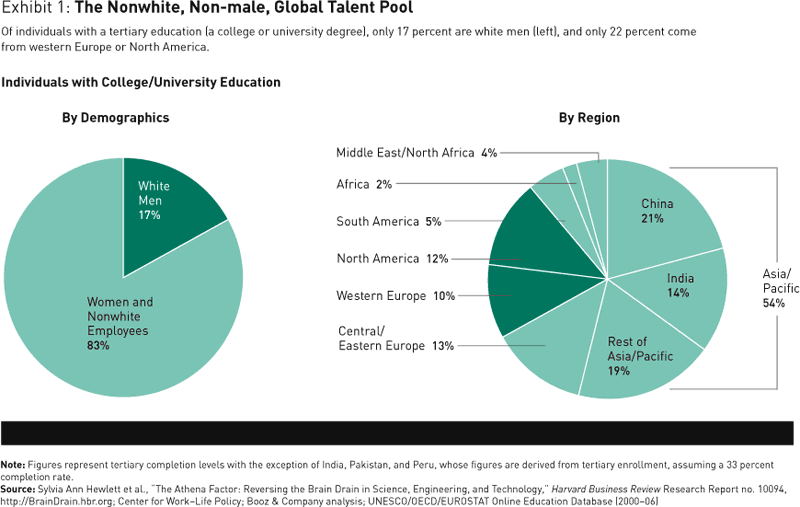
One shift involves the growing numbers of Chinese and Indian people in the global talent marketplace; another is the expanding achievement gap between women and men. In many countries, more women than men graduate from colleges and universities, and women, barely present on corporate payrolls 30 years ago, now make up more than half of the global educated workforce. White men now make up less than 20 percent of the “tertiary” educated population (defined as those with a college or university degree), from which most corporate employees are drawn, and potential managers from North America and western Europe are outnumbered more than three-to-one by their counterparts from the rest of the world. (See Exhibit 1.) As a result, leading companies are already finding that they cannot simply passively bring women and people of color into the workplace; they must prepare them for greater positions of responsibility.
One company directly addressing this challenge is Johnson & Johnson (J&J), which has identified high-performing women of color as a pivotal group and successfully piloted an initiative aimed at accelerating their career development. Called Crossing the Finish Line, this program for director-level women of color and their direct supervisors consists of a four-day session: two and a half days for the high-potential women, and one and a half days for their (mostly male) supervisors. The two groups overlap for half a day in the middle, during which the women share what they have learned, their supervisors respond, and together they create action plans for career acceleration — which are rolled out upon completion of the program. Company data shows that women who participate in the program are more likely to get promoted than those who do not. It has since been expanded to include men of color.
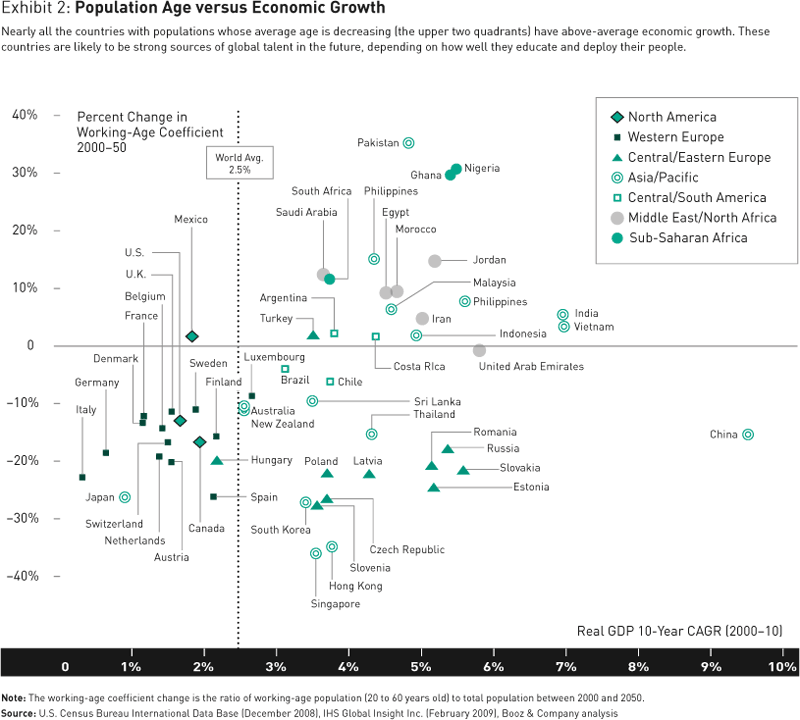
“This program helps us capitalize on talent that is reflective of the global environment and different from the traditional mold,” says JoAnn Heffernan Heisen, chief diversity officer of J&J. Companies are similarly adapting to generational shifts, which vary by region. In the mature economies of Europe, Japan, and North America, the “demographic bulge” of the baby boom generation (born between 1946 and 1964, currently ages 45 to 63) is beginning to move out of the workforce. The swelling ranks of retirees, low birth rates (particularly among the college educated), and caps on immigration are all factors that will fuel a reduction of between 20 and 40 percent in the working-age population over the next few decades. Meanwhile, in transitional economies such as China, India, Brazil, and Russia, talent markets vary widely. India benefits from both high GDP growth and a young, highly skilled workforce, whereas China and Russia both confront a shrinking pipeline of young workers. All these countries need better-educated entry-level talent to sustain strong growth. (See Exhibit 2.)
Within global companies, three generations coexist in the workforce, each with a distinct demographic profile. Baby boomers expect to retire later than previous generations did (on average, four years later), because of increased life expectancies and decreased savings, especially after the global recession. The baby boomers are followed by a much smaller cohort: Generation X (born between 1965 and 1978, currently ages 31 to 44). Members of this group, who would ordinarily represent the corporate bench strength for leadership, are in short supply and, at the same time, are finished with “paying their dues” and ready to step into leadership positions. Finally, the millennial generation, also known as Generation Y (born between 1979 and 1994, currently ages 15 to 30) is entering the workforce. This generation outnumbers even the baby boomers; by 2025 it will make up 60 to 75 percent of the global workforce. Members of Generation Y are drawn to companies that demonstrate social responsibility and offer service-oriented sabbaticals and eco-friendly workplaces.
All three cohorts have made clear their desire for greater flexibility. They no longer want (or have given up hope of finding) the “organization man” model of lifetime employment and rigid hierarchies. They are interested in striking “talent deals” with their employers to balance their work obligations and private lives. They thus seek modularized work arrangements such as seasonal leave and flexible time. But they also expect to be part of high-impact teams that generate meaningful and valued results — within their companies and, if possible, in the world at large.
By contrast, the old prevailing talent model, still in place at many companies, assumes lockstep career progression for high-potential people (whose ranks are still quietly filled mostly by white men from North America or Europe). In these companies, it is assumed that people are motivated primarily by money and that the environment within the company should be stable and predictable. Employees are expected to move in linear fashion up the ladder of a vertical function or business line. They are mentored through, and learn through, face-to-face interaction, and get only one chance to enter a fast-track progression, generally in their 30s. From there, work obligations override all other personal interests and priorities, including family.
A more appropriate, 21st-century talent model assumes a workforce that is global, diverse, and gender-balanced, with discontinuous career progressions, in which high-potential employees may take time off or work for different types of organizations along the way. Under this model, companies value functional and leadership skills, embrace new employment structures (such as highly responsible part-time work), encourage virtual workplaces (in which people work together across long distances, communicating electronically), and offer nonmonetary rewards alongside financial rewards as a way to attract people. Family, community, and work are intertwined in a variety of ways, and the result is a more flexible, dynamic, and unpredictable workplace in which people feel they are continually building their skills and learning from the enterprise.
This new talent management model allows a much broader group of people to assume positions of responsibility. It promotes innovation, growth, and breakthrough performance by integrating the needs of the business with those of individuals. And when aligned with a clear and focused corporate strategy, it allows top management to optimize compensation, training, and other expenses; maximize the productivity and performance of the workforce; and gain competitive advantage.
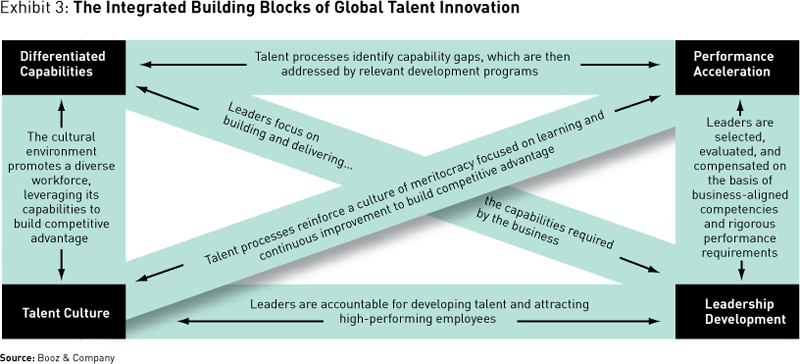
But it takes a CEO to put such a model in place. The highest-performing organizations don’t leave talent performance acceleration to HR alone; they make leaders at all levels directly accountable for improving the capability and performance of their people. HR provides the necessary tools and program support; leaders oversee the process and determine the outcomes. Chief executives need to declare talent a priority, and to lead change in the four building blocks of global talent innovation: differentiated capabilities, performance acceleration, leadership development, and a talent culture. (See Exhibit 3.)
Differentiated Capabilities
Business success relies heavily on establishing the right capabilities — an interconnected set of systems, tools, processes, and knowledge that can be put in place to reach the most critical groups of customers. The differentiated capabilities that distinguish each company from its competitors vary widely among and within industries. The differentiated capabilities of a fashion retailer might include the ability to dramatically shorten time-to-market for cutting-edge designs, whereas those of a high-tech company might include best-in-class product customization. A capability is not the same as a functional capacity, such as forecasting, inventory planning, or R&D. It’s cross-functional, conceivably extending from manufacturing to marketing to finance, and across multiple regions and lines of business.
People are the key to differentiated capabilities. To create and sustain such capabilities at a world-class level, companies need to take the following steps:
• Understand and prioritize the critical capabilities required for competitive advantage. Companies should conduct an executive review of their business strategy and capability requirements. Then they should take inventory of their current skills, profiles, performance, and potential, identifying the high-priority gaps and developing talent strategies to close them.
• Identify key talent segments. Most employees will fall into one of four general categories, based on their ability to provide the needed capabilities: (1) Pivotal employees, those with specialized skills, knowledge, and abilities that contribute directly to fulfilling a company’s strategic objectives, are the most crucial group. In a consumer products company, for example, this group might include product development managers and marketing directors. (2) Core employees are people critical to executing the strategy. (3) Support employees are people whose value is real but whose duties could be delivered through alternative means, including outsourcing. (4) Noncore segments are those with easy-to-duplicate skills that do not serve capability requirements. Companies that segment the workforce in this way can more easily see how to tailor talent strategies and allocate talent investments more effectively.
• Develop tailored value propositions. To attract and hold the best people from all three of the most-desired cohorts — the pivotal, core, and support employees — companies need new and diverse attraction and retention drivers: competitive compensation and benefits packages, innovative job designs, flexible schedules, well-crafted career development opportunities, strong leadership and succession planning practices, a distinctive culture, and a welcoming work environment. Tailored value propositions might include socially oriented initiatives that deliberately engage the passion and potential of Gen Y, or “off-ramp and on-ramp” career paths that allow highly qualified women to take time off for family obligations without sidelining their opportunities for promotion and greater responsibility. These propositions will vary by company; the factors that motivate a pivotal employee in the pharmaceutical industry might be very different from those that are relevant to his or her counterpart in high tech.
Late in 2008, pharmaceutical giant Pfizer Inc. sought to engage employees by launching the Global Access initiative, partnering with Grameen Health (an affiliate of Grameen Bank) in Bangladesh to improve access to health care through rural clinics. As soon as the initiative was announced, project leader Ponni Subbiah was swamped with expressions of interest. “Employees wrote to me from all functional divisions within Pfizer — research, marketing, manufacturing, operations, auditing — telling me how happy they were to see Pfizer involved in this area and how it made them proud to be part of this company,” he says. Employees were so eager to contribute that many offered to volunteer after working hours or on weekends.
Performance Acceleration
Organizational success hinges on the collective daily decisions and actions of hundreds, perhaps thousands, of individual employees. The ability to engage and motivate them is the essence of performance acceleration. Accelerated performance is shaped by the company’s assessment and feedback processes, compensation and incentive structures, and development and advancement models. To rethink and redesign these elements, which have traditionally been in the domain of the human resources department, the following steps are needed.
• Reinforce meritocratic pay and promotion decisions. Recognize and reward merit rather than mediocrity. Set up well-defined competencies and standards, so that individuals who excel when measured against them are consistently developed, promoted, and compensated accordingly. Align the performance acceleration process with career planning and learning and development, so that employee capabilities and outcomes are continuously improved.
The health-care products company Novartis AG tracks 14,000 high-potential individuals through its Organization and Talent Review (OTR) system, which rates each person’s potential, learning agility, people skills, and ability to drive results and change. The OTR system enables business leaders to assess individuals on a company-wide basis, illuminates gaps in skills and experience, and provides a list of qualified internal candidates for every critical position in the company. Where bench strength is lacking, the generalizability of OTR benchmarks makes it easier to identify individuals from the outside who might be recruited. (For some jobs, where specialized scientific expertise is required, only 20 people in the world may be qualified.) This rigorous and forward-looking system helps Novartis maintain a distinct competitive edge.
• Measure outcomes. Companies can’t accelerate what they don’t measure. Capture performance through well-targeted metrics based on relevant results rather than activities (for example, tracking the percentage of people “ready now” to succeed their bosses, rather than the number of people trained). Other useful measures might be promotion rates, retention statistics for top performers versus average performers, and performance rating distributions by gender or ethnicity.
Leadership Development
The qualities and requirements that define a world-class senior executive have evolved significantly over the last 10 years. Some traditional leadership characteristics, such as a strong sense of vision and the ability to inspire others, are still important. But leaders today must first and foremost be able to master enormous complexity. They must appreciate and accommodate different perspectives and interpersonal dynamics, integrate multiple disciplines, work across cultures, and interpret diverse and multiple streams of information.
Too few leaders have the right combination of skills and experiences. Companies that want to improve their leadership development practices should take the following steps.
• Evolve the executive leadership competencies model. Most organizations have established fairly narrow and nondifferentiated checklists of executive competence. A broader set of leadership competencies, taking into account the goals of the enterprise and the capabilities of the individuals, makes it easier to cultivate senior leaders who can both navigate fast-breaking crises and serve the longer-term best interests of shareholders, boards, and employees.
• Promote and develop people who match those competencies. Even when they profess to support broad leadership, many companies continue to select leaders almost solely on the basis of technical and professional capability. Executives should stop moving people to the senior ranks of an organization simply because they hit revenue or other financial performance targets; they should instead take into account such factors as the performance of those candidates’ direct reports.
• Build the leadership bench. Senior management, including the CEO, needs to help conceptualize, craft, and deliver leadership programs. These should be carefully integrated with the business strategy and grounded in a business case. High-potential leaders should receive a variety of developmental experiences: general management experience, cross-functional opportunities, global assignments, and opportunities to manage change and develop other talent themselves.
At the global bank HSBC Holdings, HSBC Chief Executive Michael Geoghegan holds his group management board accountable for leadership development; each member oversees the talent pools of a region, customer group, or product line. Business unit leaders collaborate with local human resources coordinators to identify and assess promising candidates from local talent pools. High performers are given new assignments in their region or line of business; they then cross boundaries to take on new positions in other functions or business areas. The local managers recommend individuals for the corporate talent pool, which is overseen centrally. These individuals are expected to work in at least two very different cultural environments before ascending to the highest levels of management, and this expectation is clearly communicated.
Talent Culture
A talent culture is made up of the values, beliefs, behaviors, and environment required to attract, engage, and retain committed and competent employees. Companies that develop this type of culture as a key element of their corporate brand consistently outperform companies that do not. Great cultures are not created by accident; they are the result of specific and deliberate practices and strategies, beginning with the following:
• Build engagement. More than 100 studies have demonstrated the correlation between employee engagement and business performance. Engaged employees are far more productive and committed. They are more likely to make progress toward company goals, as well as the goals of their own group. But only one in four employees, on average, is “engaged.” Although the drivers of engagement vary from one organization to the next, four factors predominate: (1) whether employees feel respected, valued, and recognized; (2) whether they perceive their job to be important to the success of the enterprise; (3) how much pride they feel about the company and what it stands for; and (4) how much trust and confidence they have in company leadership. Improving these factors can represent a substantial and cost-effective opportunity for forward-looking companies.
A good place to start is with more direct communication from the top. In any turbulent period, when leaders don’t provide accurate and timely information, people start to assume the worst. Time Warner Inc. broke this pattern as part of its response to the economic crisis of 2008. The company organized a series of “skip-level” lunches where CEO Jeff Bewkes hosted groups of high-potential employees several layers down in the organization. The targeted employees were high performers, and although they did not have regular access to top leadership, they were network “connectors” (people who communicated directly with many others) and “influencers” (people whom others turned to for advice and clarity). Both the employees and the CEO stressed the value of the lunches.
• Rethink organizational and career designs. Companies should develop talent models with 21st-century assumptions built in: tailored to their organization, with greater variation in roles, more efficient training, and more flexible career advancement opportunities.
• Enhance the talent brand. Critical to attracting and retaining pivotal talent is a company’s ability to build (and protect) a differentiated employer brand to present to prospective employees, recruiters, customers, and others. If a company doesn’t do this well, it will be noted on Internet sites where employees and high-potential recruits share their impressions. The company’s culture should thus be visible to the outside; the brand should reflect and embrace the values of the company, emphasize its focus on talent, and differentiate it from its competitors.
Cisco Systems Inc. has deliberately built a talent brand based on innovation through collaboration. For example, it has set up a series of action learning forums. In each, a 10-person team, with members recruited across every conceivable line — rank, function, generation, geography, and gender — works together for three months with the assistance of a coach to further one of the company’s top strategic priorities. Venture capital prize money is awarded to winning teams, guaranteeing that the best business plans are funded and will get off the ground.
An immense amount of new value creation has been generated by these action learning forums. One idea, a set of network-based standards, protocols, and technologies for the nation’s emerging smart grid electric power generation infrastructure, is expected to deliver billions of dollars to Cisco over the next five years. Additionally, 20 percent of those who participated in these teams have been promoted, and only 2 percent of these high-potential employees have left the company. The forums are a powerful and defining element of Cisco’s talent culture.
The Road Ahead
Crafting an effective approach to talent management is as challenging and complex as any other C-suite mandate. The global talent innovation model described here can move companies beyond cookie-cutter best practices and standard tool kits. Each building block — differentiated capabilities, performance acceleration, leadership development, and talent culture — is essential. All four elements work in concert within the context of an organization’s business strategy. Following this systematic approach, companies can move beyond the best practices of their competitors to best-in-class innovation and performance. And that, in turn, will pay off in sustained talent advantage on a global scale.
The GLOW Network at Siemens
by Peter Löscher and Jill Lee
On March 19, 2009, Siemens AG launched the Global Leadership Organization of Women (GLOW), a network dedicated to enlarging the contribution of women to our business. The launch event, held in Munich, drew the 100 most senior women from across the company and from all parts of the world. It marked the first step in the rollout of an ambitious change agenda that encompasses mentoring, establishing flexible working conditions, on- and off-ramping for parental leave, and developing ways to expand the external visibility of women in the company.
We created GLOW because we want to proactively recruit and retain highly qualified women. We believe this will greatly enhance our talent pool. Throughout the world, women deliver outstanding academic and professional performance, and they represent an important resource for companies. Against the backdrop of demographic change and globalization, companies cannot afford to leave this resource untapped.
GLOW is not an isolated initiative. It is part of the ongoing development of our corporate culture. In the future, we want our management to reflect the diversity of our customers. This is the only way we can satisfy the needs and requirements of more than 2 million customers, with whom we are in contact every day. We experience the benefits of diversity again and again. For example, Japanese, Chinese, or Arab customers prefer to talk to us in their own language. If decision makers in our company speak that language, it gives us a real competitive advantage.
Having a diverse group of senior leaders in place will help us all develop a better understanding of customer needs. The potential for networking is enormous: Innovative ideas can be channeled back to our R&D centers in Germany or used in different parts of the world. Take, for example, the entry-level CT scan device called the Somatom Spirit. It was originally designed, engineered, and manufactured in China exclusively for Chinese hospitals. But because our teams are increasingly global, we soon realized that this product has potential outside China, as well. It’s ideally suited for community hospitals in the United States that can’t afford more expensive high-end models. Today, 75 percent of the Somatom Spirits are sold outside China.
Approximately 80 percent of Siemens’s revenues are generated outside Germany; we operate in 190 countries. Yet the representation of women and many nationalities, ethnic groups, and cultures within our management ranks could be stronger. For example, currently only slightly more than one-third of our top management is non-German and only 7 percent are women.
Our diversity initiative reflects the commitments and beliefs of senior executives and the management board, and it has the highest priority within the company. However, we are not using diversity to “rainbow wash” the company, nor are we interested in establishing rigid quotas for gender, nationality, and ethnicity. Rather, we want to unleash the enormous potential of our employees — their cultural and personal backgrounds, their broad range of experience, their special skills — for their benefit and for the benefit of the company. We know that diverse teams are more creative and that creativity drives innovation. And innovation has been our lifeblood for 162 years. All of us at Siemens benefit if every employee can fully live up to her or his potential.
- Peter Löscher is the president and chief executive officer of Siemens AG.
- Jill Lee is the chief diversity officer at Siemens and the director of the GLOW network.
Reprint No. 09304
Author profiles:
- DeAnne Aguirre is a senior partner with Booz & Company based in San Diego. She is an expert in organizational and talent effectiveness and change leadership, and has led transformations in both U.S. and global corporations.
- Laird Post is a principal with Booz & Company based in San Francisco. He advises organizations in the U.S. and globally on people, leadership, and change effectiveness.
- Sylvia Ann Hewlett is the CEO of Sylvia Ann Hewlett Associates and the founding president of the Center for Work–Life Policy, a think tank based in New York. She is the author of Top Talent: Keeping Performance Up When Business Is Down (Harvard Business Press, 2009) and eight other books.
- This article draws on research and practice developed through Global Talent Innovation, a joint service offering from Booz & Company and the Center for Work–Life Policy (CWLP). Also contributing were, from Booz & Company, Principal Ilona Steffen and Associates Emily Kao and Claudia Onofrio; from CWLP, Vice President Ripa Rashid; and s+b contributing editor Sally Helgesen.