
Charles Landry Knows What Makes Cities Great: Distinction, Variety, and Flow
From Amsterdam to Adelaide, this unorthodox thinker has divined the connections between economic prosperity and creative achievement, and their implications for the future of the city.
(originally published by Booz & Company)What sustains great organizations over time? Great talent. And what do talented people want? Most want influence, money, personal fulfillment, and the chance to make a difference. But more and more, talented people also want a great place to live.
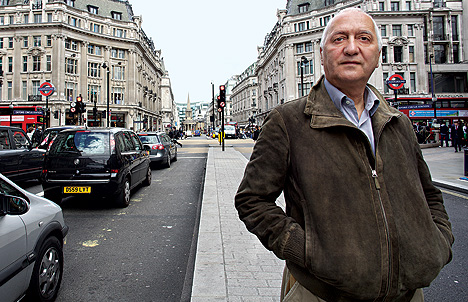
Charles Landry in London. Photographs by Julian Anderson
The answer seems obvious, but the phenomenon is fairly recent. In the past, the attractions of working for the right company often trumped the desire to live in a great place. No longer: A landmark study by the Chicago-based CEOs for Cities released in 2008 found that 64 percent of highly mobile global knowledge workers said they were more likely to choose a job because of where an organization was located than because of the organization itself.
The reason is not surprising. Talented knowledge workers — people who have choices — know that companies can no longer guarantee their own survival, much less offer their employees a safe harbor in an unpredictable economic environment. To secure a prosperous future, individuals need to put themselves in settings that enhance their ability to build both the relationships and the skills they will need to support themselves over the course of a lifetime. Less dependent on companies than they were in the past, knowledge workers have increasingly come to recognize that putting place first works to their advantage.
Business leaders have been slow to recognize the key role of place in attracting talent and stirring its innovative potential. As a result, many companies continue to over-focus on building internal capacity rather than seeking to strengthen the regions to which they need to attract skilled people. Given the shift in what top people are looking for, leaders who follow the conventional strategy may end up shortchanging themselves in the talent sweepstakes and also undermining the long-term economic viability of their resource base.
But what exactly constitutes a great place in today’s environment? What precisely is it that 64 percent of knowledge workers seek? Charles Landry, an independent consultant, writer, and thinker based outside Oxford, England, has spent his life considering the complex blend of elements that most effectively draw talented people to specific cities and regions. Landry also studies the myriad ways in which place can provide the emotional and sensory stimulation required to stir creative thought and translate it into action.
As founder of the consultancy Comedia, and as an author and peripatetic speaker, Landry works with regional authorities and private-sector clients around the globe to identify and build the systems of support that knowledge-based global capitalism both demands and rewards. He sees his mission as nothing less than to help develop the physical and civic infrastructures that can powerfully support innovative practice.
Landry’s encyclopedic books, such as The Art of City-Making (Earthscan Publications, 2006), The Creative City: A Toolkit for Urban Innovators (2nd ed., Earthscan Publications, 2008), and The Intercultural City: Planning for Diversity Advantage (with Phil Wood; Earthscan Publications, 2008), offer powerful insights about the role place can play in attracting, retaining, developing, and inspiring world-class people in today’s fast-changing global business environment. The highly original and often spellbinding lectures that Landry delivers in venues ranging from Bali to Abu Dhabi to Bilbao provide a crash course for business and civic leaders seeking to create a regional advantage. He shows them how to align an understanding of what spurs creative effort with relentlessly practical insights about what talented people consider when choosing where to live — the down and dirty basics of transport, livability, and connection to the global grid.
Landry’s own unique career trajectory exemplifies the practices he advocates. Starting in his 20s, he pioneered intellectual entrepreneurship, making a living by moving unexpected and highly original contributions from the margins into the mainstream. Some of the practices for which he is a passionate advocate are innovation rooted in a strong European intellectual tradition, wealth creation balanced with social cohesion, and local distinction reconciled with a global context. By pursuing his self-invented path and ignoring the conventional boundaries that separate culture and economics, Landry has developed a fresh and powerful understanding of what spurs talent to be creative.
The Intellectual Wildcatter
Landry was born in bleak postwar London in 1948 to parents who had fled Germany in the 1930s. His father, Harald Landry, had been a professional philosopher, a cohort of Ludwig Wittgenstein and Friedrich Nietzsche; his political activities against the Nazi regime made staying in his native Berlin dangerous. Although Harald managed to secure asylum in Britain, he came under suspicion as a German national, Britons being skeptical about how to regard refugees from that country who were not Jewish. When the war came, he was sent to an internment camp as a suspected spy, an experience that his son believes broke his spirit.
After Harald Landry’s release, the family struggled in north London, supported primarily by Landry’s mother, who ran a toy factory. Then in the early 1960s, the German government began offering restitution to citizens forced to flee, and the family decided to return to its home country to stake a claim. Charles went from being a German boy in English schools to being an English boy in German schools, which gave him both the outsider’s perspective that a writer’s life seems to require and a deeply pan-European outlook. This was intensified when his parents decided to relocate to Italy, to a seaside village near Genoa, where the restitution paid out in strong German marks would go further.
Charles matriculated at Johns Hopkins University’s Paul H. Nitze School of Advanced International Studies in Bologna, where he would also do his postgraduate work in political economy. Inspired by his polyglot experience, he developed an intellectual curiosity about how Europe was changing and what the political and economic future of a united continent might look like. Living in Bologna and traveling around the great central Italian cities of the Renaissance also stirred in him a passion for culture and aesthetics — art, architecture, great music, and other monuments of creative achievement. But this passion seemed at the time a side interest, unrelated to the field of economic development upon which his academic course work focused.
While in Bologna, Landry served as an assistant to Robert Skidelsky, the economic historian whose biography of John Maynard Keynes is recognized as a classic. Skidelsky hired him to help identify the emerging problems of postindustrial society, a charge that by Landry’s account mostly involved “arguing with the master — arguing in the best sense — while also playing a lot of chess.” Though a skilled player, Landry came to dislike the game, which struck him as epitomizing a world view that admitted only black and white, whereas his interest was in exploring the subtleties of gray. In a similar vein, he began to develop a belief that economic challenges could not be addressed except in a cultural context — a belief with which Skidelsky’s great biographical subject would certainly have concurred.
Landry’s work with Skidelsky brought him unusual prominence as a graduate student, and upon receiving his degree he was hired by Lord Kennet, one of Britain’s envoys to the European Economic Community (EEC), now the European Union. The year was 1973. Kennet wanted him to coordinate a massive study aimed at determining what Europe would look like 30 years in the future. The opportunity put Landry on the fast track to influence and success, and also landed him a comfortable sinecure in Brussels.
But Landry, still in his mid-20s, quickly perceived that life in a structured bureaucracy would not suit his restless imagination. “The job was extremely well paid, very prestigious, with a huge expense account,” he says, “but I felt trapped in the layers of the organization. Every idea I had seemed to get reduced or compromised. I knew if I stayed inside that kind of structure I would be frustrated for the rest of my life.”
He was particularly frustrated by the distinction the EEC made between economic and cultural activity. Influenced by the rich entrepreneurial history of the towns around Bologna, and deeply inspired by the cultural ferment that dominated university towns in the early 1970s, Landry was coming to view economic prosperity and creative achievement as strongly linked. Although excited by what he thought a more integrated Europe could do in fostering open markets, Landry also believed that markets were social and cultural vehicles that offered people a means of creative expression, which he saw as the true engine of prosperity. He longed for work that would enable him to connect the dots between economic development and creativity, a pursuit the EEC then had no structure to support.
Deciding to follow his own path, he horrified friends and family by not accepting a new contract with the EEC when it was offered. As one of his classmates at Johns Hopkins, American journalist Elizabeth Bailey, observes, “It was the early ’70s, when there wasn’t much potential in being a free agent. But even then Charles was a wildcatter, an intellectual entrepreneur. I also think his passion to explore the role of creativity in cities and regions evolved because creative freedom was so important in his own life.”
Landry’s tenure in the EEC convinced him, he later recalled, that “the single biggest problem in the world is not finding great ideas but getting great ideas to move, to flow. New ideas need decentralized channels so that people who might implement them can find them and create the kind of systems needed to put them into practice. In the early ’70s, there were lots of brilliant ideas, but they had no way to capture the world’s attention or move from the margins into the mainstream. So everything felt kind of stuck.”
Trying to address this problem, Landry helped to found a distribution service for the many innovative small journals, studies, and manifestos that were being published in the U.K. and Europe at the time. He particularly sought out work that blurred boundaries between culture, economy, and governance. His goal was to disseminate the commodity he loved and understood best — new ideas — with maximum exposure and minimal filtering. His interest in distribution was fueled by the same kind of “open source” enthusiasm then spurring proponents of computers as community billboards in Berkeley and Boston. Landry stuck with his venture through the ’70s, and although it would ultimately prove a detour for him, it served his evolution by giving him hands-on experience in creating a market for new ideas. It also put him in touch with cultural innovators across Europe, in whose work he saw untapped economic potential. At the end of the decade, he decided he wanted to exercise the practical talents he had developed by helping cities and regions apply the kind of creative ideas he had been involved in distributing.
A Platform and a Haven
In 1978, Landry applied for a grant from a British foundation focused on strengthening regional and community development. With money in hand, he founded Comedia, a cultural planning consultancy that would provide him with a platform for writing, consulting, and setting up collaborative ventures over the next 30 years. At the same time, he moved to the Cotswolds area of west-central England. Magnificently set with mellow stone churches, tightly hedged fields, fantastical topiary, and roaming sheep, the Cotswolds region had historically been a center of industry and commerce, but it fell by the wayside during the Industrial Revolution. More recently, the region has undergone a resurgence, offering global citizens who can work where they please a pastoral experience of deeply rooted community life, along with close proximity to London and Bristol and easy access to Heathrow. By every criterion, it qualifies as a great place to live.
When he’s home, Landry works from the busy kitchen office of a rambling 17th-century farmhouse set amid well-designed gardens. But he has spent most of the 30 years since he founded Comedia on the road:lecturing, persuading, informing, researching, hustling up work, spinning value from the thin air of original thought. Working with all manner of public and private enterprises — infrastructure providers, civic groups, mall developers, and design firms — he has found many novel ways to pursue his central quest of helping to identify and develop the infrastructures that enable creative people to put the best of what they imagine into practice.
And so one year finds him taking up the post of thinker in residence in Adelaide, Australia, helping the city address the talent leakage that has traditionally plagued it, by positioning itself as an incubator for innovative ventures in the wine trade. The next year he’s working with a Japanese retailer trying to inject a sense of life into a massive new shopping and residential complex in Seoul by attracting the sort of one-of-a-kind shops that typically avoid such developments. Then he’s on to Dubai to host a session aimed at bringing together the highly compartmentalized baronies that control life in that city-state, provoking controversy as he demonstrates how the physical and civic infrastructures they have put in place are choking the possibility of creative development.
Landry’s work is often identified with the creative cities movement, which is perhaps best known through the work of Richard Florida, a professor at the University of Tampa and author of The Rise of the Creative Class: And How It’s Transforming Work, Leisure, Community and Everyday Life (Basic Books, 2002). Yet Landry differs from many colleagues in that field because he defines creativity more broadly. Creative cities proponents have tended to advocate strengthening urban and regional centers by attracting artists, designers, filmmakers, writers, and performers. The operative assumption is that those groups constitute a kind of advance guard whose mere presence acts as a spur to enterprise.
Landry sees the focus on a specific “creative class” as a manifestation of industrial-era thinking — an outdated, siloed approach to evaluating human assets that misunderstands the comprehensive role talent plays in today’s economy. He notes that creativity is needed at every point in the value chain, because fast product cycles and global competition vest ever-greater value in innovation. He defines creativity as “imagination allied to tangible expression.” Imagination that remains unexpressed is sterile, he argues, while expression devoid of imagination is lifeless and dull. And so instead of distinguishing specific professions or subgroups as creative, he advocates cultivating conditions that enable people to express imagination even in occupations that have traditionally been considered mundane.
Creative Bureaucracy
Landry’s conviction that creativity must be broadly vested was influenced by Comedia’s involvement throughout the 1980s in helping European cities such as Helsinki and Glasgow reinvent themselves as cultural centers. Glasgow, for example, had been known for its rotting industrial base, desolate stretches of abandoned housing, and persistent talent flight; then, in the late 1980s, it secured status as a European City of Culture, an official E.U. designation. Comedia was hired to help the city attract arts festivals, but Landry’s work on the project convinced him that a vibrant entrepreneurial base was the key to maintaining a sustainable cultural environment. If this base were to develop, political and commercial interests had to be engaged.
“Glasgow showed me that you can’t support creativity just by supporting creative professions,” Landry says. “People in the arts provide content, of course, but content is just one aspect of what makes a place attractive and prosperous. The right infrastructures are the real key.” Landry notes that this kind of infrastructure is rarely controlled by people who have what is conventionally defined as creative talent. “If content is to have any effect, you need creative logistics analysts, creative engineers, creative educators. Above all, you need creative bureaucrats.”
Creative bureaucrats, in Landry’s lexicon, are high-level functionaries skilled at countering rigidities in their organizations and opening them up to more information. They are thus important points in the infrastructure, performing the essential if unglamorous work of distribution — and so reflecting Landry’s belief that great content means little if it has no way to flow. Although people tend to use the word bureaucracies in a pejorative sense, they are necessary for coordinating efficient action across complex systems. Landry points out that bureaucracies have gotten a bad name because they have a tendency to become self-reinforcing, reliant on compartmentalized expertise and unable to accommodate fresh information. This rigidity can be broken up only by creative individuals who know how to operate inside the structure; finding ways to support them has become one of Landry’s defining missions.
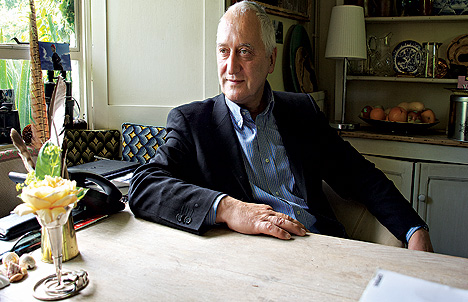
Charles Landry at his home in the Cotswolds.
It’s ironic, given that his original impulse was to flee the legendary bureaucracies of Brussels, that Landry should end up advocating for the potential of such systems, to the point where his work has become widely associated with the phrase creative bureaucracy (it’s the name of a Comedia blog). He notes that he tends to gravitate toward concepts “that have a certain tension, seem paradoxical, give people a subtle jolt by confounding expectations.” The paradoxical notion of creative bureaucracy came to him when he himself received a subtle jolt while working on a project in Calgary.
Calgary is a big, diverse city that retains its frontier flavor; above all, it is an oil town, subject to the booms and busts of any resource economy. It first caught the world’s attention with the hugely successful Winter Games of 1988, for which the city, with great fanfare, had built a handsome Olympic plaza at the heart of downtown, adjacent to a large Olympic park. Unlike, for example, Atlanta, which tore down most of its Olympic facilities the minute the games were over, Calgary wanted to use the large spaces so proudly erected at its symbolic heart to improve the quality of life in the city. To help it do so, the city hired Comedia.
Landry was asked to begin the project in what seemed to him a very bureaucratic way, by meeting with its director of bylaws. He says, “When the guy — his name was Bill Bruce — showed up, he was wearing a brown suit, and we were meeting in this restaurant that also seemed very brown. I thought, this is going to be incredibly boring. But the guy turned out to be the most creative person in Calgary.”
Bruce had assumed his position some years before, at a time when the city had 14 volumes of regulations, rendering any decision making dauntingly complex. He decided that at 62, he had little to lose if he ignored the web of regulations. He began by inviting civic and business leaders to articulate the city’s major objectives, focusing on general principles rather than codified rules. The result was a simple, commonsense list of intentions: In general, we’re interested in less noise; in general, we want less garbage; in general, we want people to use alternative transportation.
Working from these principles, Bruce experimented with hundreds of small-scale innovations involving everything from bicycle bells to traffic routes. His goal was to assist people who wanted to solve civic problems rather than imposing solutions on them. He especially sought to involve citizens in decisions that affected them directly, for example, by assisting the park patrol along bike paths. One result of involving citizens in decisions was that Calgary developed a creative and progressive tradition.
This tradition of citizen involvement proved useful when Landry argued that paving over swaths of open space in order to expand traffic would do nothing to improve Calgary’s livability. His point of view, he says, would have been “an easy sell in Toronto, but Calgary is an oil town, a city full of engineers. It’s always going to be partial to metrics and to solutions that look efficient on paper.” And so Landry developed a process for calculating the economic costs of ugliness in terms of talent leakage, diminished quality of life, the discouragement factor for local shops, even depression.
He says, “Rather than accept the idea that the impact of ugliness or homogeneity can’t be measured, we tried to figure the cost of not considering culture, creativity, and design in any given project — we called it the asphalt currency.” And so attributes like beauty, ease of access, flexibility of use, and the promotion of civic involvement became criteria for developing the former Olympic space into a rich landscape that provided parkland, athletic fields, grounds for festivals and gatherings, support for innovative local shops, and a hub for multiple modes of transport that helped link the downtown with the residential community.
Landry is pleased that the city has continued to take aesthetics into account. He learned recently that one of the groups he worked with has been instrumental in an effort to replace the dull and unsightly traffic bridge adjacent to the parkland with a commission from architect Santiago Calatrava, known for designing the most beautiful bridges in the world. “This is a sign of a resource city being aspirational,” Landry says.
The city’s oil-town heritage is clearly being transformed as the region seeks to expand its economy beyond petroleum. Like Arab city-states with similar goals, Calgary is recognizing the vital role that cultural icons play in branding a region. But because of a networked culture put in place by a creative bureaucrat, the push to attract such icons does not necessarily need to come from the top. The symbiosis between an active citizenry and a bureaucracy able to accommodate new ideas exemplifies the systemic creativity that Landry seeks to promote.
What Makes a Hub
Landry believes that innovation flourishes in places and in organizations that provide people with multiple means of connecting. Just as the psychological state known as flow heightens an individual’s ability to generate new ideas, so do infrastructures that facilitate flow across boundaries enable people to bring forth new products, ideas, and services. Since Calgary, Landry has begun to evaluate the success of a given project in part on the basis of how many new links or connections within a community have been forged in the process of working on the project.
He points to a highly successful venture in Mantua, Italy, where he was charged with helping the city recapture its sense of history and distinctiveness. Since the town had ancient roots as a publishing center, Landry advised the civic leaders to begin by supporting a series of book festivals. Involving a wide network of people in the effort resulted in an unusual number of entrepreneurial ventures linked to books, with the result that Mantua has emerged as a center for quality book publishers, printers, designers, editors, and dealers. As a hub, the town now serves as a place where people seeking to establish themselves in the field can access a global network of professionals who share their interest.
Becoming a hub for this industry has made Mantua far more attractive to talent. Carol Coletta, president of CEOs for Cities, notes that talented people today gravitate to places that they perceive to be hubs. Coletta defines hubs — organizational as well as civic — as sharing four key characteristics. They facilitate a robust talent churn, they offer tangible support for innovative ventures, they provide the physical ground where people can connect across divisions and cultures, and they offer an undeniable sense of distinctiveness.
Landry’s work is aimed at augmenting each of these characteristics, with a special emphasis on claiming distinction. “People don’t feel rooted — in an organization or a region — unless they have a clear sense of what makes it different,” he observes. This is the underlying reason, he feels, that culture must play a defining role in regions that are intent on drawing talent. Culture is a richly symbolic means of establishing distinctiveness in a complex interconnected system. It’s precisely the desire for distinction that leads a city like Calgary to commission a Calatrava.
Of course, creative individuals have always gravitated toward hubs in search of sufficient scope to exercise their talents. Successful hubs historically have been either great trading centers (London, Amsterdam, Hong Kong, New York) or vibrant frontier outposts (Sydney, San Francisco, Mumbai) that throw diverse people together in an open market. By providing a common ground for interactions that would never occur in more bounded circumstances, hubs offer a mechanism for generating, distributing, and leveraging wealth in the service of fulfilling evolving forms of human need. Although the primary market for many enterprises has now moved into virtual space, people still seek out physical harbors that they perceive will support their ability to make connections, access resources, and make a mark. As creativity becomes more broadly vested, more and more contributors will seek to establish their value in hubs.
Landry also notes that as the mainstream global economy expands to include more cultures, more cultural zones claim centrality by organizing around hubs. This is why such cities as Shanghai, Guangzhou, Mumbai, Abu Dhabi, Dubai, and Sao Paolo gain ever more importance in the global system, even as established cultural centers such as New York, Moscow, Paris, San Francisco, Frankfurt, and London remain viable and vital. All these hubs dominate communications and commerce within their cultural zones, and help integrate smaller cities into the global system. Because their importance serves a cultural role, Landry says, “They do not increase their value by becoming more like other hubs, but by emphasizing what is unique about them.”
But distinctiveness requires constant refinement. As Landry points out, “Regions in the global economy must constantly move higher on the value chain if they are to remain economically attractive. A manufacturing center such as Taiwan tries to move from mass production to inventing goods and services that provide a larger knowledge component. Oil producers in the Middle East use sovereign wealth funds to invest oil revenues in research centers so they can keep their best people and develop their talents. Third-tier cities today — Dubai is a good example — recognize they can’t remain in place but need to keep honing their strength as a travel and entertainment hub that links East and West. A second-tier city, like Paris has become, knows it must seek a higher rung or risk becoming a museum — a great place to visit but of declining economic importance. A first-tier city like London has to constantly maintain its edge or it will lose talent to places that offer greater livability along with cultural power.” Although this competitive jockeying can be reduced to caricature in website lists of continually changing “cool places,” the imperative behind it reflects real concerns.
Landry maintains that hubs thrive when social and physical infrastructures are fluid enough to support experiment, serendipity, and invention; they decline when infrastructures become rigid. Rigidity occurs when cultural or legal restrictions hamper development (consider the decline of New York shipping), when diverse populations are pushed out (think of African cities expelling Indian traders in the 1970s and ’80s), or when the physical environment becomes so cumbersome that people no longer wish to negotiate it (think of traffic in Cairo). To sustain energy, urban hubs must attract a broad mix of players: investors, entrepreneurs, culture-makers, patrons, developers, researchers, shoppers, support professionals, visitors. Hubs cannot flourish (nor can they really be hubs) if they draw from a limited pool. This, Landry believes, is why a creative class strategy often fails to spur sustained development, as do master plans that look to technology parks or giant shopping arenas to inject economic juice.
The Basic Unit
But how is a physical infrastructure created? Where does it start? For Landry it all starts with the street. I catch up with him one morning in central London, where he has come to preach to an eclectic mix of retailers, company heads, cultural entrepreneurs, and city officials. The venue is a hard-to-find storefront gallery in an elegant back alley filled with inviting shops and pubs behind Old Bond Street, and the title of his talk is “Reimagining Commerce, Reinventing the Commercial Street.” Landry paces the floor as he delivers a steady stream of insights accompanied by spontaneous observations and philosophical asides, his lecturing style providing a demonstration of flow in action. He speaks in a hushed, dramatic tone that compels attention, his crisp British articulation infused with the excitement of high purpose. His intellectual pyrotechnics are brought down to earth by the homemade quality of his slides, assembled from snapshots he takes in far-flung parts of the globe.
The importance of the street is one of Landry’s great passions. He sees it as the basic infrastructural unit, and notes that people are drawn to (or repelled by) places according to their physical, aesthetic, and emotional experience of the street. The street is how we process place, and it provides the image we carry with us. If we think of ourselves in Rome, we see ourselves in the Via Condotti — we don’t envision the abstract entity of “Rome.” If we think of ourselves in Sydney, we remember the view of the Opera House as we walked along George Street, the central artery that winds through the Rocks. The street provides the central building block of our place memory, reconciling a larger entity with the scale of human perception.
And just as talent is drawn to hubs and the patterns of links they enable, so are hubs in essence a great collection of streets. For a hub to succeed at drawing the best people and unleashing their talents, therefore, its collection of streets must be aspirational, world-beating, irresistible — a draw. London, he tells his audience, cannot maintain its status in the first rank of the world’s hubs unless it becomes more skillful and intentional about managing and improving the experience that its streets provide.
Landry recognizes that cyber-commerce is changing how people buy their goods, expanding consumer choice while reducing and homogenizing the experience of transaction. Yet he insists this only makes it more important that commercial streets provide a compelling experience and also fulfill their traditional function of bringing people together. If we feel at home in the streets, we will feel at home in the local culture, and if we feel at home in the culture, we will aspire to participate by investing our time or money in its precincts.
But what makes a street desirable? What makes people feel culturally at home? What constitutes a positive experience at the most basic unit of place? Landry describes the three characteristics that distinguish great collections of streets: distinction, variety, and flow.
Distinction means avoiding sameness, offering an experience that cannot be had somewhere else. Most places accomplish this by means of an iconography that lets you know that here is not the same as there. This is the problem with global brands, Landry says; although the streets that welcome such brands may aspire to exclusivity, the brands’ ubiquity undermines that principle. As soon as a great street like rue Saint-Honoré or Calle de la Reina becomes colonized by global retailers, people looking for an individual experience start to avoid it. Sameness creates boredom, and a hub cannot afford to be boring: It exists in order to stimulate.
Variety means creating a way for the small and large to exist together, a well-known company next to a quirky enterprise, a café alongside an art store adjoining a market. Variety exists when an extraordinary, remarkable destination is webbed within an ordinary, expected urban environment. Zoning codes kill variety, Landry reminds his listeners, as does the constant turnover that results from a focus on maximizing rents; the demise of a beloved institution will undermine every business on the street.
Flow, the key concept of the hub, is also essential to the street, being manifested in a particular and idiosyncratic way. Flow results from giving people the ability to control their pace and to stop at will to consider what might be available. “This is what flow does not look like!” Landry cries, showing a flurry of pictures taken around the corner on Oxford Street, where a cavalcade of signage supplemented by concrete barriers attempts to direct pedestrians along a specific route. “People resist directions that attempt to control their movements,” he points out. “And the smarter they are, the more they resent it. Urban engineers who come up with signage like this are just trying to keep things moving. They work from a traffic metaphor — the goal is to move people along and out.”
Landry points out that some cities dominated by old-line industries, such as Glasgow, Perth, and Boise, have reinvented themselves in a dramatic fashion by focusing on cultural strengths rooted in their own historical uniqueness and by building on the distinctiveness of their streets. Other regions can make this leap if they stop focusing on generic livability indexes based on quantitative measures, like the number of hospital beds per resident or the frequency of trash pickup. He explains that great talent magnet cities of the world — London, New York, and Shanghai, for example — routinely come up short by these livability measures. But they claim status as vital hubs because people flock to their streets.
“Distinction, variety, and flow — these are the physical manifestations of best talent practice,” Landry declares, his voice dropping to a hush. “Any company or region serious about talent must create infrastructures that reflect these qualities. This is what’s required to support the evolution of knowledge-based global capitalism. You can’t control the system, you can only open it up. The street provides the logical starting point.”
Landry’s consulting work is in great demand today, as cities and regions compete for talent and dollars by committing ever-greater resources to cultural and physical renewal. It’s significant that Landry’s first job out of school in 1978 was to think about what Europe might look like 30 years down the road, because today his ideas are helping to shape Europe’s future. Cities such as Copenhagen, Madrid, Amsterdam, and Barcelona — global talent draws — have brought him in to share his gospel of distinction, variety, and flow, and to find ways to implement these concepts at the level of the street. Smaller hubs such as Mantua and Savannah are applying his lessons about the cultural rewards of entrepreneurial efforts. By finding a way to address the future of place that links wealth creation to culture, Landry has created a body of work with startling relevance for the decades still to come. 
Reprint No. 10306
Author profile:
- Sally Helgesen is an author and leadership development consultant. Her books include Thriving in 24/7: Six Strategies for Taming the New World of Work (Free Press, 2001) and The Female Vision: Women’s Real Power at Work (with Julie Johnson; Berrett-Koehler, 2010).