

Your Brain on the Internet
A review of The Shallows, by Nicholas G. Carr.
(originally published by Booz & Company)The Shallows: What the Internet Is Doing to Our Brains
By Nicholas G. Carr
W.W. Norton, 2010
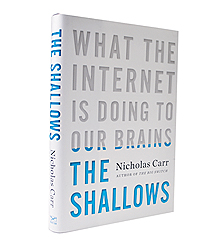
The Shallows: What the Internet Is Doing to Our Brains is an expanded version of writer and polemicist Nicholas Carr’s 2008 cover story in the Atlantic, “Is Google Making Us Stupid?” In it and the book, he applies Marshall McLuhan’s most famous aphorism, “the medium is the message,” to the Internet.
The effect of this medium, argues Carr (an s+b contributing editor), is to alter our patterns of perception, spreading our flickering attention across the broad surface of knowledge at the expense of our ability to plumb its depths. Spurred on by his own introspective conclusions (and the conclusions of a variety of other people) that the Internet itself is making it more and more difficult for people to read in a meditative way and concentrate their minds, the author surveys the hard evidence that might support these conclusions.
Carr finds that the brain and its connections are indeed plastic and can be changed by our experiences; he cites psychologist Donald Hebb’s well-known rule: “Cells that fire together wire together.” But plasticity does not equal elasticity and bad habits can be learned as easily as good ones. Carr thinks this is what is happening with digital technology: It is expanding our power and control over the world, but in the process it is changing the way our minds work.
The extent to which this happens is hotly debated, with determinists like McLuhan insisting that we are like bees, pollinating the reproduction of machines (until they can do it themselves and dispense with us), and the instrumentalists, perhaps like techno-evangelist Don Tapscott, arguing that these are just more tools for us to use and that we are completely in charge. The author comes down firmly on the side of the determinists, even suggesting that “deep reading” might become the province of a small elite.
Although many commentators agree that something has been lost with the advent of the Web, most argue that its benefits far exceed its drawbacks. Certainly, at least one primary enabler of creativity — the ability to make connections across many fields — is greatly enhanced by the Internet.
Carr criticizes millennial visions of the Internet, especially Google’s, for their assumption that our brains function like computers, when they clearly don’t. But his argument is also skewed. Our brains have evolved to make sense of what William James called the “great blooming, buzzing confusion” that is reality. Doing this requires both depth and breadth in thinking, and Carr’s suggestion that one is better than the other distracts us from the question of how they are best used and integrated for a purpose. It is purpose that cuts through the confusion, allowing us to distinguish springboards from obstacles and to separate both from irrelevance. If we lack that powerful sense of purpose, then both the shallows and the depths of knowledge are just perennial distractions. 
Author profile:
- David K. Hurst is a contributing editor of strategy+business. His writing has also appeared in Harvard Business Review, the Financial Times, and other leading business publications. Hurst is the author of Crisis & Renewal: Meeting the Challenge of Organizational Change (Harvard Business School Press, 2002).
