

The Next Winning Move in Private Equity
To outperform their rivals, private equity firms will need to enhance their ability to spur organic growth in the companies they own. (And public companies will need to follow.)

Illustration by Kate Edwards
Where does private equity go from here?
Now that the business has bounced off its lows of 2008 and 2009, it seems like the right time to ask that question. Looking at the strategic shifts that the biggest private equity (PE) firms have been making since early 2010, it’s clear that they are searching for an answer.
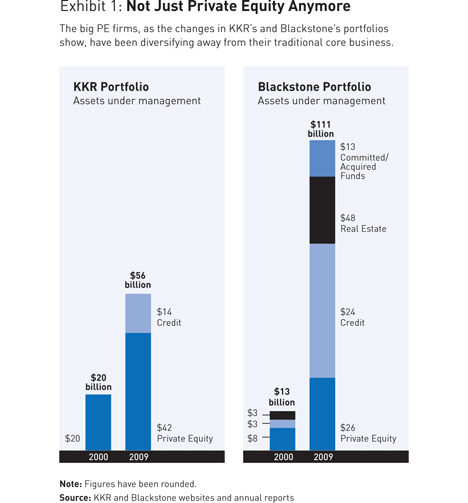
There is the shift in the way fund raising is being handled, especially at a time when many of the limited partners who invest in private equity firms have “maxed out” their PE allocations — and the few who haven’t are being courted by every major firm. There is the shift toward public ownership of the PE firms, led by Blackstone, KKR, and, most recently, Apollo Management. And there is the firms’ shift toward diversifying revenues away from their core business, the leveraged buyout (LBO), with many firms getting into credit investing, real estate, advisory services, proprietary trading, and other areas. (See Exhibit 1.) As Stephen Murray, the chief executive of CCMP Capital Advisors, put it, “The LBO business has become just another asset class for many firms.”
What’s more, private equity firms are going through this process of reinvention at a time when they’re facing plenty of other issues: bad press about fees, bad press about the practice of secondary buyouts (in which one PE firm sells a portfolio company to another PE firm rather than to investors via an initial public offering or to a corporation), turnover among limited partners, and the question of succession planning at the biggest firms (where at least some of the founders are getting on in years, and their peers are wondering how long they will stay in the game).
All these things are distractions, however. The real issue for private equity is whether — and how — the general partners who manage PE firms can revitalize the leveraged buyout.
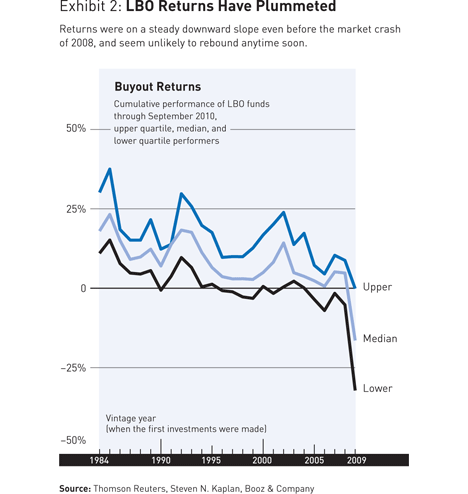
The reality is that buyout returns are down — notwithstanding the occasional home run, like KKR and Bain Capital’s US$3.8 billion IPO of hospital operator HCA in March and the Carlyle Group and Goldman Sachs’s $2.9 billion IPO of Kinder Morgan in February. (See Exhibit 2.) For a long time, the top tier of LBO firms were returning in excess of 20 percent, but much of that was attributable to the exuberant public markets that prevailed in the 20 years leading up to 2008. Cheap debt helped too, allowing firms to do things like dividend recapitalizations (after which they were, essentially, playing with house money). Those days are gone, and PE executives don’t expect them to return soon, if ever. “You cannot just bet on interest returns and multiples going up,” says Gilbert Saada, an executive at Eurazeo, a mid-market private equity firm in Paris. “It doesn’t work anymore.”
Having been forced to write down the value of many of their portfolio companies in recent years, the general partners of private equity firms have taken steps to implement cost savings across those companies. In some cases they have used the same tactics that corporations use to drive down costs during a downturn, such as centralized sourcing and the replacement of people with technology.
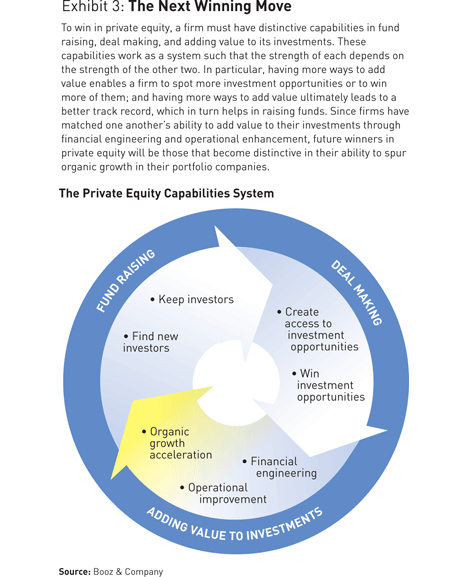
These improvements, however, aren’t sufficient to salvage investments that may be deeply underwater. Nor are they enough to restore the LBO to its former position as a driver of superior returns. Instead, PE firms need to find a new approach to creating value, much as they did at previous stages of their evolution — such as in the 1980s, when private equity began to harness the power of financial engineering, and in the 1990s, when PE firms mastered the art of driving operational enhancement at their portfolio companies. Today, all the best firms are highly skilled at financial and operational value creation, and these are thus no longer ways to outperform one’s rivals. A third wave of innovation in private equity’s value creation model is needed, and we believe it will be “organic growth enhancement,” or the ability to systematically increase the top line of portfolio companies organically. This will require adding new capabilities at the PE firms themselves, rebalancing their engagement with portfolio companies toward organic growth, and making organic growth “net free” (meaning that it’s funded out of each portfolio company’s own current costs and investment, with no hit to the firm’s short-term earnings). (See Exhibit 3.)
Some experienced PE players have already reached similar conclusions about the need for organic growth. The kind of cost cutting that firms initiated in the aftermath of the 2008 crash, says Henry Silverman, chief operating officer of Apollo Management, “is great, but it’s not really an outcome-driver. It’s not even the icing on top of the cake; it’s the candles on top of the icing on top of the cake. The cake really is that you have to generate revenue growth — top-line growth — somehow.”
The math of organic growth may not be as instantly gratifying as the math of financial engineering, which boils down to, in Silverman’s words: “If I have 10 cents, borrow 90 cents, buy your tie for a dollar, and sell it to Joe for $1.05, I didn’t make a nickel; I made a 50 percent return on my investment.” It may not be as straightforward as removing head count and expenses to drive up EBITDA, with the automatic value increase that produces. The playbook for organic growth includes many more pages and is much more complicated. Still, the best private equity firms already recognize the importance of driving organic growth in their portfolio companies and are looking for ways to do it more systematically. This is a story about how they will get there.
Private equity’s new impetus for organic growth will ripple through not only the corporate sector but national and regional economies. Private equity has long been a pace setter in value creation, leading the corporate restructuring charge in the 1980s and the drive for operational efficiency in the 1990s. As the PE firms learn to enhance the organic growth of their portfolio businesses, managers at public companies — both those that may see an LBO in their future and those that will be competing with PE-owned companies — may need to rethink their own ability to spur the organic growth of their businesses. And from an economy-wide point of view, any rebalancing of capital-market incentives toward organic growth will change the economic landscape — and could help counter the concerns about “putting profits over growth and jobs” voiced by many observers of the business world in recent years.
The Third Innovation
The role that organic growth can play for private equity is perhaps best understood by looking back at how the buyout industry has evolved. Since private equity’s emergence as a high-profile asset class in the 1980s, the industry has profited from two major innovations. The first was financial engineering — specifically, using debt to buy companies and take them private, with the expectation of being able to resell them later at a leverage-enhanced rate of return. Some of the earliest private equity successes — including the 1982 acquisition of Gibson Greetings, a greeting card company, by onetime U.S. Treasury secretary William Simon — were examples of this. (Simon and his co-investors purchased Gibson Greetings from RCA in 1982 for $58 million in cash and the assumption of $22.6 million in liabilities, and sold it in a May 1983 IPO for $330 million.) Then there was KKR’s $30 billion+ acquisition of RJR Nabisco in 1989, the deal that really put PE on the map. “The people who understood the workout process made terrific profits,” says Paul Levy, who worked at Drexel Burnham Lambert in the 1980s, when it funded many hostile takeovers, and is now managing director of JLL Partners, a mid-market private equity firm.
By the 1990s, however, private equity firms were so well versed in the practice of financial engineering that the benefit was going primarily to sellers as increased competition among buyers — the private equity firms themselves — drove up bid prices. It was in that decade when private equity firms seized on a second big innovation: increasing the value of their portfolio companies through operational changes. The changes took many forms — process improvements, outsourcing, restructurings — but the goal typically could be summed up in three words: Take out cost. The results were impressive, and increasingly, public companies have begun their own improvement efforts by asking, “What changes would a PE firm drive?” This question puts them in the right frame of mind for taking aggressive action.
Although not all private equity firms may yet recognize the focus on organic growth as their industry’s third major innovation, some have already been moving in this direction. “A lot of the guys I know [in PE firms] have been thinking about the growth and the strategy” of their portfolio companies, says Steven Neil Kaplan, the Neubauer Family Professor of Entrepreneurship and Finance at the University of Chicago’s Booth School of Business, singling out TPG, KKR, and Bain Capital. “They are all trying to [address] it in different ways.”
TPG is a good example of a private equity firm that’s leading the way. Like many other firms, TPG looks to its portfolio companies’ top executives, whether those it has inherited or those it has installed, to drive organic growth. However, its 60-person operations team includes experts in the areas of pricing and sales-force effectiveness, two disciplines that can have a big impact on revenues. In addition, the many TPG operations personnel whose backgrounds are in “lean” — an approach to reducing costs that focuses on process improvements, using customer benefits as the compass — occasionally help TPG’s portfolio companies grow, albeit indirectly.
For instance, after TPG bought a piece of Motorola’s semiconductor business, its operating group consulted with the new chip company’s R&D function, in hopes of getting its engineers to improve the efficiency of the product development process. By the time the improvement program was finished, TPG’s portfolio company, ON Semiconductor, had greatly reduced the time it took to bring a new product from conception to market — from 500 days to fewer than 250. “The important thing was that we didn’t have to actually be technically strong in semiconductor design,” says Dick Boyce, the partner who heads TPG’s operating group. “We had to have very strong process capability, which we do in product development. You sort of have to pick your spots.”
Indeed, one big caveat attached to the idea that private equity firms need to find ways to spur organic growth is that spotting a growth opportunity usually requires an innate grasp of how a specific group of customers in a particular industry behave, and what those customers want. “You don’t understand how to create value unless you deeply understand an industry,” the University of Chicago’s Kaplan says. Most private equity firms do organize themselves by so-called industry verticals (health, consumer, retail, and technology are some common ones), but the expertise in those verticals is primarily for purposes of sourcing and making deals. If a firm has operating personnel, they are typically positioned as generalists — which makes sense since private equity firms can’t predict which of their industry sectors are going to need help in any given year and which (from the perspective of operating-group involvement) may be dormant. As TPG’s Boyce puts it, “We have to be able to flex people across various sectors.”
The critical question for private equity firms, therefore, is how they can get better at engineering organic growth within their portfolio companies without changing their firm’s structure and limiting their flexibility. The answer is that they will need to do three things: add new growth capabilities, rebalance the engagement with their portfolio companies in favor of growth, and find ways to make growth net free.
Adding Growth Capabilities
Of course, it’s always best, and simplest, if one has capable, growth-oriented executives running a portfolio company and the divisions within it — but this ideal isn’t always met, given private equity’s predilection for investing in companies that are underperforming and not fully realizing their potential. (Moreover, when target companies do have first-rate management, that fact is usually reflected in the buyout price.) Where the right people aren’t already running, say, product development or marketing, private equity may need to provide external support for those functions.
An infusion of organic growth capabilities can take several forms, and which one is best probably depends on the specifics of the private equity firm — including its size and the industries in which it operates. Only a handful of growth-enabling capabilities apply across portfolio companies. One is better pricing ability. Another is improved sales-force practices, since the direct sales forces of acquired companies often have faulty structures or incentives, or aren’t disciplined about getting rid of underperformers. “There’s almost always, in a company that has a direct sales force, a sales-force redesign — always some kind of broad commonality there,” says one private equity executive, declining to be identified because he doesn’t want to disparage the management teams with which he works.
Yet even with growth capabilities like these, many private equity firms don’t build them internally. “It’s unrealistic for a firm that is not enormous,” says Eddie Misrahi, chief executive of Apax Partners, a Paris-based private equity firm that focuses on mid-market companies in France. “The average PE firm is 10, 15, or 20 people, so it’s impossible.”
Bigger firms, such as TPG, have the option of handling these needs more directly. “When there is enough work to do that’s permanent, we hire it [in-house],” says TPG’s Boyce. “That’s the short answer.”
KKR’s experience with Dollar General, a chain of variety stores in which it invested in 2007, illustrates how a growth capability that resides within a private equity firm can sometimes bolster returns. From the beginning, only a small portion of the work that KKR’s operating group did with Dollar General — work related to forcing vendors into competitive bid situations — was cost-related. KKR’s other initiatives all had to do with increasing Dollar General’s revenue.
When KKR first acquired the chain, Dollar General’s management was basing its decisions about product assortments and which products to stock on the profit margins of individual SKUs — A.1. Steak Sauce, for instance. KKR believed it made more sense to look at dollars of margin per linear foot, a common measure in food retailing that takes into account not only how much profit a given product generates per dollar of sales, but how quickly the product sells. The application of the new metric was part of a broader analysis in which Dollar General — usually a place where customers go to pick up a few small items in between major shopping trips to Kroger or Walmart — sought to make sure it had the right products to maximize foot traffic. “We took the Nielsen data and said, ‘OK, what’s the $12 basket at a grocery store?’” says Dean Nelson, the head of KKR Capstone, the firm’s internal consulting group.
That question led Dollar General to start carrying milk and other basic products. It’s why the company — which had previously carried only Pepsi, as part of an exclusive supplier arrangement that allowed Dollar General to offer the beverage at rock-bottom prices — started offering Coke as well. “We lost a few margin points, but we put Coke on the shelf too,” Nelson says. “That’s driven a lot of extra baskets, a lot more visits.”
The category reevaluation, and other growth initiatives, such as the extension of Dollar General’s private-label brand, were driven by a KKR Capstone marketing specialist who spent the better part of two years working at the Goodlettsville, Tenn.–based company. Dollar General is now public and has an enterprise value of more than $12 billion, versus $7.3 billion at the time KKR helped take it private. “It has been a home run for us,” says Nelson. “And 80 percent of that was growth; it wasn’t getting better terms from P&G or Kraft.”
Rebalancing the Engagement
PE firms need to make organic growth the primary focus of their engagement with their portfolio companies, so that it’s not crowded out by attention to costs. One way to do this is to introduce the concept of headroom as a framework for thinking about the growth available in a market. Headroom is a simple concept: It is the market share that a company doesn’t have minus the market share it won’t get. This framework has the advantage of breaking down the growth challenge into two binary questions. First, there is the question about who the potential switchers are — the customers in the market that aren’t 100 percent loyal to a rival. Second, there is the question of what it would take to get these less-than-loyal customers to switch. These are the needs-offer gaps.
Headroom is particularly valuable as a tool for identifying organic growth opportunities in mature, highly competitive markets, which are the ones in which private equity firms’ portfolios companies often play. In many of these markets, there is no pixie dust that will triple or quadruple a portfolio company’s organic growth rate — but that may not be necessary. Some of these markets are so big that a two or three percentage-point increase in market share, courtesy of a headroom initiative, could mean a game changer in additional revenue growth. Coupled with an improved flow-through of profit, which most private equity–owned firms are adept at generating, such an improvement could make a big difference in the outcome of an investment. “If we had a company that had 2 percent to 3 percent growth, and we grew it to 5 percent, and then we managed the costs well, that might be enough to actually drive the business,” says KKR Capstone’s Nelson.
For many companies, the other valuable outcome of a headroom approach is that it exposes areas of activity that can’t produce growth (for example, activities aimed at customers who are too loyal to other providers). So it isn’t only the way a company’s best prospects light up as a result of a headroom analysis that is valuable: It’s also the way everything else gets grayed out.
At their best, headroom initiatives make companies much more coordinated. The companies’ strategic planners, customer research experts, sales staff, and product developers all know they must focus on the same things — the switchers and the needs-offer gaps.
Of course, headroom initiatives are only one example of how private equity firms can work with their portfolio companies to get them to think more explicitly about organic growth. Centerview Partners, for example, a private equity firm formed in 2006, relies on its focus and credibility to influence its management teams’ thinking and help those teams grow. Centerview invests in only a few companies at a time, all of them in consumer goods and services, and benefits from the clout that its trio of partners, including former Gillette chief executive James Kilts, have in that industry. It isn’t only the connections of Kilts and of Centerview’s other operating partner, Joseph Schena (a former VP at Nabisco and Kraft Foods), that help Centerview’s portfolio companies, such as Nielsen and Del Monte. It is also the partners’ extensive market experience and knowledge. “We are very focused on increasing our portfolio companies’ top lines, in part by helping them expand distribution and enter new channels,” says David Hooper, the partner who runs Centerview’s private equity business. Indeed, Hooper says, Centerview won’t invest if it senses the stakeholders with whom it will be partnering aren’t “open-minded to letting us help make a difference.”
Making Growth Net Free
Investing in organic growth often creates tension with the model of PE, which necessarily pushes general partners to be mindful of the debt they’ve taken on and the covenants they’ve signed. For this reason, it’s usually important that the funding for portfolio companies’ growth initiatives be net free, meaning the cash to invest must come from savings realized elsewhere within the portfolio company or from an “organic growth investment charge” that’s taken when the buyout is made. (See “A Different Way of Funding Organic Growth.”)
Headroom can help with this, too. At the very least — even with private equity owners that aren’t willing to increase the cash they’ve committed — a focus on headroom can make companies smarter about the organic growth initiatives they have in place. Take product development: A company looking to increase its market share would make sure that its product development efforts were aimed at customers that were likely to switch, and were built around needs-offer gaps that really needed to be closed. Or sales-force redesign: Although it wouldn’t necessarily spend more on its sales force, a headroom-conscious company would make sure that its salespeople were going after prospects that might actually switch.
Headroom can also help companies identify which costs they can cut in non-promising areas in order to reallocate them somewhere else. Here, the concept of “return on effort” is important.
Reinforcing PE’s Baseline Capabilities
Even as organic growth becomes a more explicit part of the private equity compact, the means of value creation that existed previously will remain important. Private equity firms will have to be best in class at financial and operational engineering; the organic growth imperative doesn’t change those requirements. It is, rather, a new way of gaining competitive advantage in an era when many private equity firms are still trying to utilize tactics that have become commoditized.
Indeed, part of the promise of organic growth enhancement, as a PE innovation, is the impact it will have on the two capabilities that most general partners would say are as important as adding value to their portfolio investments — fund raising and deal making.
Despite a few recent improvements, the fund-raising environment has deteriorated, and will likely remain depressed for the foreseeable future. There are several reasons for this. One is that limited partners of every kind have seen their non–private equity investments, including real estate, tank in the last few years, says one general partner. As a result, this partner says, “the denominator has gotten smaller.” U.S. state pension funds in particular — traditionally among the biggest backers of private equity — are facing “huge shortfalls in funding versus liabilities,” he adds.
The reduced pool of available capital is forcing senior managers of many private equity firms — including the firms’ boldface names — to spend more and more of their time on the road meeting with accounts and prospects. “Basically, you’re out there selling the brand,” says Apollo’s Silverman. “That’s a different step from traditional fund raising, which is actually asking for the order. The point is to make sure when you ask for the order — when you say, ‘We’ve got this great deal; why don’t you put up $400 million?’ — that it’s the 16th meeting, not the first.”
In the future, having demonstrable organic growth capabilities will be part of what general partners sell, and something that reinforces their fund-raising ability.
Likewise, having a successful approach to engineering organic growth will give firms an advantage in deal making. Just as private equity firms that were one step ahead in financial engineering in the 1980s or ahead in operational engineering in the late 1990s were able to pay more for available assets and still earn rich returns for their limited partners, so will the firms that master organic growth enhancement today succeed at winning more deals. That will cause the money to flow their way, bringing them more fee revenue and more opportunities for capital gains.
The bottom line is that without a strategy for expanding organic, top-line growth at their portfolio companies, private equity firms will become less competitive at raising investor funds and making deals. “You’d better have a strategy,” says Misrahi of Apax, “or else you’re a me-too product. And if you’re a me-too product, in the next five years, you’re nowhere.” CCMP’s Murray offers an even more fundamental perspective: “Most of the industry doesn’t recognize the problem. The private equity business has always been about providing a solution for a company’s orphans or an entrepreneur’s needs; we make professional businesses more entrepreneurial and entrepreneurial businesses more professional. We need to go back to being in the solutions business and not just another asset class for investors.”
By embracing private equity’s third innovation of enhancing organic growth — adding new growth capabilities, changing the dialogue with portfolio companies, and making organic growth net free — the most innovative PE firms will enrich their “solutions business,” and gain market share and improve their overall profitability in the process. As they succeed, they will ensure that their core business continues to be a vital force in the capital markets, and at the same time will help promote a more productive, growth-oriented perspective throughout the corporate sector. 
Might the Contract Change?
In a world where private equity returns will depend to a greater extent on portfolio companies’ ability to grow organically, there may be an argument for lengthening the life of certain funds. The typical seven- to 10-year cycle of fund raising, acquisition, and exit may not make sense with investments that are generating good returns. After all, engineering organic growth can take more time to show results than financial and operational engineering; it may be that after five years in the portfolio, the portfolio company is at the very beginning of what may be a decades-long rise in revenue and profits.
When that is the case, “Why rush to get out?” asks Paul Levy, managing director of JLL Partners, speaking of both the private equity firms and their limited partners. The power of compounding, Levy points out, really kicks in during the “out” years. Twelve percent for five years — no argument; that’s nice. Twelve percent for 30 years — that starts to be real money, Levy says.
Of course, most of the limited partners with whom Levy has broached the topic want to know what would happen, under these circumstances, to the fees they pay. A private equity firm may initially create a lot of value by identifying promising investments, improving company operations, and setting the company (per the philosophy of this article) on more successful organic growth trajectories. Eventually, though, the private equity firm’s contributions should be mostly complete. At that point, from the limited partners’ perspective, shouldn’t the fee structure change?
“Maybe you do something whereby instead of 80–20, after a certain point in time, it becomes I own 20, you own 80, and you can do what you want with your 80,” Levy says, describing the conversations he has had on the topic with limited partners.
Theoretically, lengthening private equity holding periods might also address some of the more contentious issues surrounding secondary buyouts, in which one private equity firm sells a portfolio company to another private equity firm, in order to close the fund and return money to its limited partners at the agreed-upon time.
With the IPO market largely closed off in 2009 and 2010, “secondaries” — an escape hatch for private equity firms looking to exit their investments — became common. Problems arise, however, when a limited partner ends up owning the same company as before, but through a different private equity firm — and having paid transaction fees coming and going. “That really creates tensions,” notes Eddie Misrahi, the managing partner of Apax Partners.
Yet changing the contract may be an idea whose time has not yet come. Private equity executives say most of their limited partners aren’t looking to rearrange things so that a portion of the capital they commit is “permanent.” On the contrary, says one private equity executive, limited partners “are always pushing to get out of investments, to get their money back.
“We’ve seen a couple of big investors that have been going through a broader bid process saying, ‘Is there a way to build a different partnership?’” adds the executive. But those inquiries, he says, have been less about changing the terms of private equity deals than about investing in other asset classes now under some equity firms’ roofs, like mezzanine funding and debt financing.
— K.F., J.N.
A Different Way of Funding Organic Growth
Investments in organic growth are often in R&D, sales-force expansion or restructuring, marketing, and advertising. These investments are often called revex (revenue expenditures) because they hit the income statement, whereas capex (capital expenditures) hit only the balance sheet.
In the chase for bottom-line growth, revex creates a dilemma for most companies: The more they invest in revex to grow the top line, the more their bottom line suffers in the short term (other things being equal). Conversely, the more they skimp on revex, the more their top-line growth will eventually suffer.
No company is ever perfectly efficient, so there are almost always ways to take out costs and reduce other investments in order to fund more productive revex. Often, however, these opportunities are difficult to see, and companies are thus faced with real tension.
Many leaders of public companies, such as Robert Walter when he was CEO of Cardinal Health, have addressed this tension by setting up a corporate investment account that their company’s business units could tap into to fund organic growth investments. In Walter’s case, this was a way of not letting the accounting for organic growth get in the way of the need to invest in growth.
PE firms face the same tension, even though they are privately held, which makes us think they may have to do something similar in the future. Perhaps an “organic growth investment charge” could be taken when the investment is made, creating a cash account that could be drawn upon over time for investing in organic growth with less short-term accounting impact on the bottom line.
— K.F., J.N.
Reprint No. 11208
Author profiles:
- Ken Favaro is a senior partner with Booz & Company based in New York. He leads the firm’s work in enterprise strategy and finance.
- J. Neely is a Booz & Company partner based in Cleveland. He specializes in mergers and restructurings in the consumer products, retail, and industrial sectors.
- Also contributing to this article was s+b contributing writer Rob Hertzberg.
- For a podcast on this subject, in which author J. Neely explores the private equity industry in light of Carlyle Group's recent IPO announcement. visit: www.booz.com/global/home/what_we_think/multimedia/podcasts/mm-podcast_display/49841952.
