
Creating Chaos for Fun and Profit
In a turbulent industry environment, make your way to the eye of the hurricane.
 |
|
Illustration by Lars Leetaru |
Traditional management strategies — hunkering down behind a few defensible competitive barriers, or avoiding the regions of frequent storms — are blown away by this hurricane. Major companies fail with increasing frequency, eliminating workers’ jobs and often their retirement savings. Of the 1,000 companies with the highest stock market value in 1992, 380 fell from the list a decade later because of bankruptcy, acquisition, or declining market value. In the 1,000 largest companies in North America, the frequency of CEO turnover increased from 10 percent per year in 1995 to 16 percent per year in 2000 and 2001. (See “Why CEOs Fall: The Causes and Consequences of Turnover at the Top,” by Chuck Lucier, Eric Spiegel, and Rob Schuyt, s+b, Third Quarter 2002.) The increase in CEO turnover was even more rapid in Europe and Australia. Such departures are often preceded by significant and painful losses for investors, the firing of senior executives, and employee layoffs. People are frequently left without the support of mentors because many experienced personnel lose their jobs.
Does this turmoil mean that the upward pressure on performance has gone too far? We don’t think so. Fifteen years ago, complacent CEOs could be satisfied with delivering the market’s expectations, confident that a friendly board of directors would allow them to remain in office. For example, in 1987 the CEO of a then leading (now bankrupt) steel company told us that he wouldn’t launch an aggressive counterattack on the Nucor Corporation because it was too risky. “I play golf every weekend with the three former CEOs of my company, and I couldn’t look them in the eye if we tried something like that and it failed,” he said.
Today, because of the power of the investor, complacent CEOs presiding over the steady decline of public corporations are an endangered species. Between better-performing companies taking over weaker firms and boards of directors exercising their fiduciary responsibility to investors, CEOs unable to improve their company’s performance have no place to hide. That a few CEOs cheat because they can’t meet the market’s exacting demands shouldn’t surprise us any more than the fact that some students cheat on tough exams. Cheating by a few companies shouldn’t blind us to the extraordinary efforts and success of the people at the vast majority of companies who are creating superior returns for their shareholders.
So how are these companies avoiding the turbulence and achieving better and better performance? They are placing themselves in the eye of the storm, both sheltered from and managing the creative destruction in their industries. In the computer industry, Hewlett-Packard Company and Gateway Inc. are buffeted by the tumultuous conditions created by the Dell Computer Corporation. The post–September 11, 2001, downturn in the airline industry, which has already pushed United Airlines Inc. into Chapter 11, threatens American Airlines Inc. far more than Southwest Airlines Company.
The Storm Is Here to Stay
Defending the limited role the Federal Reserve Board played during the irrational exuberance of the dot boom–dot bomb bubble, Chairman Alan Greenspan observed that the United States made the choice “between economic growth with associated potential instability and a more civil … way of life with a lower standard of living and chose the former.” In short, collectively, we understand we’re better off with higher returns despite the greater risks because we benefit from increasing productivity, more rapid growth, faster creation of new jobs, and a better standard of living.
No one likes risk. However, increased risk is integral to the higher level of performance that all of a company’s stakeholders — investors, workers, customers, and business partners — demand, and many companies are delivering. During the decade from 1992 to 2001, including the current recession and the bear market, the median above-average performer (75th percentile) grew earnings by 18.3 percent per year and revenue by 11.7 percent. Exhibit 1 shows the earnings and revenue growth rates of each quintile of the S&P 1000 during this period. To estimate the impact of improper accounting, we eliminated the companies that have subsequently made very large adjustments to their earnings and revenue, including Adelphia Communications, CMS Energy, Enron, Qwest Communications, Tyco, and WorldCom. The adjustment reduced the growth rate of earnings of the above-average performers by only one percentage point.
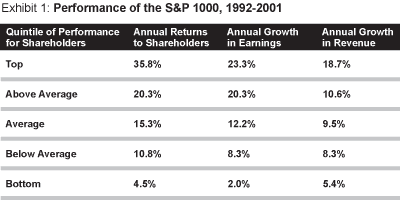
Since the annual growth rate of the U.S. economy during the 1992-to-2001 period was only 5.4 percent and the global economy 5.1 percent, companies with above-average performance for shareholders grew revenue more than twice as fast as the economy and earnings more than three times as fast. These extraordinary rates of growth aren’t the anomalous result of the long expansion during the 1990s, the bull market, or accounting irregularities: Above-average performers have grown both earnings and revenue much faster than the economy since at least the mid-1980s.
Companies that are top performers for investors also create superior value for customers and employees. Dell, pioneer in affordable computers and among the top 1 percent of performers for shareholders during the 1992-to-2001 period despite a slowdown in computer sales, grew its revenues by 43 percent, its earnings by 38 percent, and the number of employees by 30 percent. Michael Dell, CEO since he founded the company in 1984, is one of the longest-tenured CEOs of a major publicly traded corporation, and one of the richest men in the United States. Lowe’s Companies Inc., the building products retailer that lost its industry leadership to The Home Depot Inc. a decade ago, is now growing faster. Led by 39-year veteran Robert Tillman, Lowe’s was in the top 5 percent of performers for shareholders from 1992 to 2001, growing earnings by 65 percent per year, and revenue and number of employees by 22 percent.
The growth of the public equity markets and the expansion of private equity markets linked to the public markets (e.g., leveraged buyout and venture-capital investments that are cashed out in the public markets) drive extraordinary business performance because equity investors breed improvements in performance like oceans breed hurricanes. Since the price that an investor pays reflects a company’s expected future performance, a company that merely meets the market’s expectations yields average or below-average returns for its investors. To produce above-average returns for shareholders, companies must surprise the market with better performance. Each improvement is quickly reflected in the stock price, so above-average returns require an additional improvement in performance for tomorrow’s shareholders, and another for investors who purchase the stock next week, and so forth. This ratcheting up of company performance, replicated across the economy, increases the expectations of stakeholders and raises the bar of performance for all companies.
The breadth of the investor constituency in the United States ensures the ascendance of the investor view. And as long as regulations ensure a fair game for small investors and fraud is punished, a Marxist class war between owners and workers is unlikely. Politically, “investors” include the American middle class and most elected officials. For example, in a 1998 survey (its most recently published), the Federal Reserve found that 48.8 percent of households are equity investors, either directly through stock or mutual fund ownership or indirectly through individually directed retirement accounts like IRAs or Keoghs. Stock ownership extends broadly across income distribution, including 52.7 percent of families with annual incomes of only $25,000 to $50,000.
The Eye Strategy
The best returns for investors, with only moderate risk attached, are found in the companies that combine operational excellence — consistently outstanding performance for customers that’s brought to the bottom line — with sustained rapid growth. Operational excellence is a necessity today. Investors mercilessly punish companies that fail to meet these expectations. Deal makers and industry visionaries (like Tyco’s Dennis Kozlowski and Vivendi’s Jean-Marie Messier) don’t deliver results to shareholders. It’s the great operators who do.
But operational excellence isn’t enough. From 1992 to 2001, for example, U.S. companies Sara Lee, Masco, Genuine Parts, and Sonoco Products all sustained attractive returns on assets and economic value added and grew with their industry, but they produced below-average returns for investors since they only met the market’s expectations. Above-average performers must also sustain double-digit revenue growth.
Companies that sustain double-digit growth in earnings and revenue are found across the economy: in low-growth industries (General Dynamics, Harley-Davidson, and Lowe’s) and high-growth ones (Intel, Medtronic, and Oracle); in low-margin industries (consider Cardinal Health, Devry, and Gentex) and high-margin ones (think of Citigroup, Microsoft, and Starbucks). Building upon a 30 to 50 percent advantage in the performance that matters most to customers, these companies face only moderate risks because they control their future. They have to “merely” sustain their performance advantage and find sufficient market opportunities to sustain their extraordinary growth.
Most of these high-return, moderate-risk companies are in the eye of Schumpeter’s hurricane, reshaping not only their own industry, but also adjacent industries. For example, the success of Home Depot and Lowe’s has transformed the formerly fragmented $100 billion home improvement retail industry, eliminated the home center retail industry, collapsed the lumberyard channel, and forced every building-products manufacturer to change its marketing strategy. Similarly, Dell continues to drive its superior direct-to-the-customer approach into contiguous product segments such as networked storage systems (together with the EMC Corporation), printers (including private labeling of Lexmark International Inc.), and resale of hardware and software branded by other companies (including Apple Computer Inc.’s iPod). Threatened by Dell’s expansion, Hewlett-Packard Company, Cisco Systems Inc., and the 3Com Corporation all recently terminated their resale arrangements. The next rounds of this competition will reshape the printer and network equipment industries.
Although an eye-of-the-hurricane strategy carries only moderate risk once it’s successful, how many companies are destroyed in their attempt to move inside and create superior operational performance and rapid growth? Because it’s so much easier to identify companies that succeeded than those that failed, it’s impossible to pinpoint the risk of an eye-of-the-hurricane strategy. However, our best judgment is that the risks are much less than they appear. First, our research suggests that few successful “eye strategies” are risky ideas that are new to the world: Most companies prosper by applying successful ideas taken from other industries to their own industry. Power retailing is a great example. Developed by Toys “R” Us Inc. in the 1950s, power retailing has transformed at least 15 other industries. Forty years later, during the 1992-to-2001 decade, three of the companies in the top 5 percent of performance for shareholders were power retailers (Bed Bath & Beyond Inc., Best Buy Co. Inc., and Lowe’s).
Second, even when they err, eye-of-the-hurricane strategies still create superior long-term returns for investors. Despite the failure of its effort to sell through retailers, Dell has been a superior investment in every decade since the company was founded. Oxford Health Plans Inc. was in the top 10 percent of companies in returns to shareholders during the 1992-to-2001 period, despite losing control of its business in the mid-1990s, despite the retirement of its founder, and despite a painful restructuring that eventually reestablished Oxford as a top performer.
Finally, since investors reward improvements, a company creates superior returns immediately as it moves toward the eye of the hurricane. IBM under Louis V. Gerstner is an outstanding case. Mr. Gerstner’s “solutions thrust” (another idea that’s provided the strategic platform for companies in more than a dozen industries) gave instant benefits to customers struggling with systems integration, connected IBM’s businesses to a series of growth markets, produced earnings growth of 14 percent per year between 1994 and 2001, and generated above-average returns for its shareholders.
Does an eye-of-the-hurricane strategy offer the best combination of return and risk? It may. We know the strategy of large acquisitions is clearly worse: On average it yields poor returns for the acquiring company’s investors and has high risks. For an established company, a strategy focused just on operational excellence has a poor return/risk profile. Operational excellence can be a successful strategy in only about one-third of industries where a favorable industry environment (e.g., a long bull market for investment firms) so increases the revenue and earnings growth of excellent operators that they can earn above-average returns for shareholders, longer tenure for CEOs, and greater opportunities for workers. In a second third of industries, an unfavorable industry environment causes the performance of even excellent operators to be unacceptably low and stimulates the replacement of the CEO. In the final third of industries, the performance that investors expect results in average or below-average returns to shareholders. Unfortunately, since it’s impossible to predict whether the industry environment will be favorable or unfavorable, an operational excellence strategy has a two-thirds chance of producing substandard returns for investors.
Furthermore, with a strategy of operational excellence, companies, employees, and, increasingly, managers consign their fate to factors beyond their control, such as interest rates, the stock market, and oil prices. With an eye-of-the-hurricane strategy, a company can retain control. 
Reprint No. 03101
| Authors
Chuck Lucier, chuck@chucklucier.com Chuck Lucier is senior vice president emeritus of Booz Allen Hamilton. He is currently writing a book and consulting on strategy and knowledge issues with selected clients. For Mr. Lucier’s latest publications, see www.chucklucier.com. Jan Dyer, janet.dyer@ptsem.edu Jan Dyer spent the last 11 years at Booz Allen Hamilton, where she served as the firm’s director of intellectual capital and worked with corporations in a variety of industries. She specializes in the strategic application of knowledge and learning. |