
The Paradox of Corporate Entrepreneurship
Post-Enron principles for encouraging creativity without crossing the line.
(originally published by Booz & Company)
 |
|
Illustration by John Kachik |
Now that Enron has collapsed, are we required to write off the idea that companies should encourage entrepreneurship, stretch goals, and risk taking, on the grounds that they will ultimately lead to disaster? Must we accept the logic of journalist Malcolm Gladwell, who, assaying Enron’s demise, asked rhetorically in The New Yorker magazine, “What if Enron failed not in spite of its talent mind-set but because of it? What if smart people are overrated?”
No, we do not have to reverse our thinking. As with any corporate failure, the challenge is to separate the actions that led to the problems from those that continued to work well despite them. Or, stated more positively, we need to understand the enormous benefits of internal entrepreneurship and how it can drive corporate innovation and growth, while not neglecting the costs and risks that are associated with it.
This article provides a framework for thinking through the paradox of entrepreneurship: Every company needs to embrace it, while understanding that, if taken too far, entrepreneurship has the ability to undermine its own power. Building on extensive research in more than a dozen multinational companies (see “About the Research,” at the end of this article), this article describes a model of corporate entrepreneurship and the four typical problems that may arise if it is carelessly implemented. It also suggests ways to avoid each of those problems. Additionally, the research illuminates the promise and the pitfalls of some of today’s celebrated organizational concepts, in particular the challenges of encouraging an unconstrained free-market environment for managing people and ideas inside companies.
An Entrepreneurial Framework
The concept of corporate entrepreneurship has been around for at least 20 years. Broadly speaking, it refers to the development of new business ideas and opportunities within large and established corporations. Within this broad definition, there are at least four schools of thought, each with its own assumptions and objectives. The four basic schools are corporate venturing, intrapreneurship, entrepreneurial transformation, and “bringing the market inside.” (See “The Four Schools of Thought on Corporate Entrepreneurship,” at the end of this article.)
This article centers on the entrepreneurial transformation school of thought. According to this view of corporate organization, entrepreneurship is an individual behavior that is shaped by the systems and culture of the firm. To bring about lasting change in an established company, the job of senior executives is to develop a set of corporate systems and processes that promote such entrepreneurship throughout the organization.
Our approach is to take the model of entrepreneurial transformation that BP PLC has developed and add our own conceptual twist to it, to show that when it is taken too far, entrepreneurialism can be detrimental to the enterprise. BP is a rare example of a giant company that has radically, and beneficially, transformed itself from within. Close to collapse at the end of the 1980s, BP is now recognized as a leader in the restructuring of the global oil and gas industry and a highly innovative, forward-looking company that, in its pursuit of sustainable energy solutions, is effectively managing the difficult task of balancing growth, profitability, and social responsibility.
At the heart of BP’s transformation is a management philosophy that places responsibility for delivering results deep down in the organization. “Contracts,” as they are known within BP, are set between the top executives, Chief Executive Lord John Browne and Deputy Group Chief Executive Rodney Chase, and those running BP’s business units. Then those individuals are given free rein to deliver on their contract in whatever way they see fit, within a set of identified constraints. Call it empowerment or call it entrepreneurship, the essence of the model is that successful business performance comes from a dispersed and high level of ownership of, and commitment to, an agreed-upon objective.
According to Mr. Chase, the BP management model rests on four components that help guide and control entrepreneurial action. These are direction, space, boundaries, and support.
- Direction essentially is the company’s strategy. It is a statement of the goals of the company, the markets in which it competes, and its overall positioning in those markets. BP sees itself as an integrated energy company, but it also defines itself in terms of its commitment to social responsibility, to act as a “force for good.”
- Space identifies the degrees of freedom provided to business unit managers to deliver on their commitments. It manifests itself in terms of physical space — that is, freedom from constant interruption, close oversight, and supervision — and the time managers need to experiment and refine their ideas.
- Boundaries are the legal, regulatory, and moral limits within which the company operates. These boundaries can be explicit, recorded in policy documents and codes of conduct, or they can be implicitly understood.
- Support denotes the systems and programs provided by the company to help business unit managers do their job. These include information systems, processes for knowledge sharing, training and development activities, and work/life balance services.
The beauty of this model is that, together, these four elements create an organizational environment of controlled freedom in which senior executives do their jobs by getting out of the way of those they empower to execute strategy. The point is that for positive, strategically predicated change to occur, the company needs all four components. If any one is missing or out of balance, the model breaks down and the ability of people in the organization to act as effective entrepreneurs is compromised. (See Exhibit 1.)
Exhibit 1: Finding Balance Between Constraint and Chaos
|
|
Constraint | Balance | Chaos |
| Direction | Corporate strategy is tightly defined by senior executives. Frontline managers have little or no input into the development of strategy. Senior executives are involved in both developing goals for businesses and working with managers on how those goals will be achieved. All new product and market ideas are reviewed by senior executives. |
Corporate strategy is broadly defined by senior executives. A clear direction is set from the top, but managers have considerable scope to develop strategy for their business in line with that direction. Senior executives focus on identifying and measuring goals for the businesses, rather than on how those goals will be achieved. | Corporate strategy is defined extremely broadly by senior executives, in such a way that virtually nothing is excluded. Frontline managers are encouraged to seek out new product and market opportunities wherever they arise. |
| Space | Employee roles are clearly defined. Employees are monitored both in terms of what they achieve (output) and in terms of how they do it (behavior). Doing anything that lies beyond the formal job description requires the approval of the boss. | Employee roles are defined by outcomes rather than by behaviors. Some slack is built into the system, to allow employees to spend 5 to 10 percent of their time on things that are not formally part of their job description. Employees are encouraged to take initiative. |
Employee roles are defined in only the loosest terms. Employees are expected to create their own jobs Ñ to spend as much time as it takes to carve out a role for themselves. If a new opportunity comes along, it should be pursued. |
| Boundaries | Boundaries are tightly defined, to ensure that everything the employee does conforms to legal, regulatory, financial, ethical, behavioral, and moral demands on the company. Failure to stay within these boundaries results in immediate dismissal. | Boundaries are tightly defined around anything that could threaten the viability of the company. Failure to work within these boundaries results in dismissal. Other boundaries are managed in a more implicit way, by promoting compliance through the creation of shared values. | Boundaries exist and are monitored, but the control systems are not well managed, and for the innovative employee there are ways of circumventing those systems. If caught, the employee may or may not be dismissed. |
| Support | The company provides a wealth of systems and programs for supporting employees. Training, development, and career planning are all managed on a centralized basis. Top-down systems are created to promote sharing and collaboration between business units. Information systems are comprehensive and managed centrally. |
Training and career planning are coordinated on a top-down basis, but business units and individuals are expected to choose whether to take part or not. Systems are developed to encourage — but not require — business units to collaborate and share knowledge. Some information systems are managed on a centralized basis. |
Individuals are responsible for their own careers and their own training and development. Business units are highly autonomous, and few if any attempts are made at a corporate level to encourage those units to collaborate or share knowledge. The system is run as a free market. |
The BP model is a disarmingly simple approach to entrepreneurial transformation, but it is far from unique. The U.S. brokerage firm Edward Jones has become one of the fastest-growing companies in its industry by applying a BP-style model of entrepreneurial transformation, despite its conservative approach to financial services (historically, for example, it has not sold options or commodities). Managing Partner John Bachman says, “I give my people the canvas and the paints they have to use [direction, boundaries]. After that, it’s up to them to decide what they paint and how [space]. As long as they stay on the canvas, and use only the paints I give them, I am happy.” 3M Company is renowned for its corporate maxims articulating the management methods that sustain its entrepreneurial culture and decentralized structure through good and bad times. For example, there’s the “15 Percent Rule,” which enables employees to spend 15 percent of their time on pet projects (space), encourages the use of cross-functional and cross-country teams (support), and still adheres rigorously to the broader growth objectives and values of the company (direction, boundaries).
The entreprenurial model also applies to other sorts of endeavors, including sports and the arts, that are perhaps better known as bastions of command-and-control leadership. Sven Goran Eriksson, a Swede who is the coach of England’s national soccer team, has become famous for his hands-off approach. Essentially, he keeps the tactics and the team selection simple and gives his players the space to play their natural game. He provides feedback and coaching, but he keeps his interventions to a minimum, a highly unusual approach in the pressured world of professional soccer. In theater, Philip Slater, an academic who became a novelist and playwright, has observed that inexperienced playwrights who direct their own plays (for fear that others will not understand their vision) frequently end up with sterile, even disastrous productions. If the playwright’s vision comes through in the writing, the director will see creative ways of enhancing that vision. And so will the actors, designers, and composers.
What Goes Wrong
The BP model serves another purpose. It helps to shed light on what might happen when entrepreneurship is allowed to go too far. Our novel angle here is essentially to ask what would happen if the BP model were taken to its extremes. Enron provides a ready set of examples. (See Exhibit 2.)
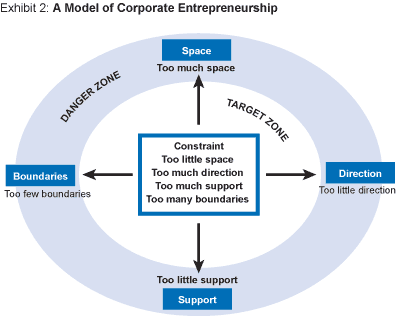
Too Little Direction. Without a clear overarching sense of where the company is going, or what it stands for, entrepreneurship becomes a random set of initiatives. Although each initiative on its own may be perfectly rational, when you put them together, the result is a mélange that stakeholders are likely to denounce as incoherent, vague, or chaotic.
Enron fell into this trap. In the early days of its transformation, under the leadership of the former CEO Kenneth Lay, the company embarked on a number of growth initiatives, but they were all clearly within the natural-gas sector. By the late 1990s, however, the premise behind the choice of new business initiatives was diluted, as the company moved into electricity trading, online trading, weather derivatives, and broadband networks. Mr. Lay and his successor as CEO, Jeffrey Skilling, in effect acknowledged this drift as they gradually began to publicly shift the vision of the company. Starting out with the goal of being the “best gas distribution company,” they began to speak of Enron as “the world’s best energy company.” By 2001, Enron executives were citing as peers such companies as GE Capital, Goldman Sachs, and Merrill Lynch, and they talked of becoming simply “the world’s best company.” Although Mr. Lay and Mr. Skilling may have understood the logic that unified these diverse initiatives, it’s not clear the executives beneath them did.
Indeed, Enron executives increasingly viewed the company’s lack of direction as a strength. The individuals who developed new businesses in Enron were encouraged “to go in whichever direction they wanted to go,” Ken Rice, the former head of Enron Capital & Trade Resources, is quoted by Gary Hamel in Leading the Revolution (Harvard Business School Press, 2000).
Enron is far from alone in allowing entrepreneurship to take it off course. Back in the late 1980s, Hewlett-Packard Company lost direction as it allowed country operations to invest in their own pet development projects — a policy that kept local customers very happy, but detracted enormously from HP’s ability to focus resources on big new opportunities. Following a review by ex-chairman David Packard, this funding model was stopped, and the divisions were given sole responsibility for development.
More recently, many companies allowed the Internet revolution to derail them. For example, Emap PLC, a London-based media company, created a separate division, Emap Digital, for its Internet activities. Traditional funding rules were temporarily thrown out the window as the division invested large sums in dozens of new digital offerings, many of which were far from the company’s core business of magazines and radio stations. Eighteen months and tens of millions of dollars later, the division was closed down, and the company refocused on its core business.
Too much rigidity in direction setting, however, is equally dangerous. Consider the case of one U.S. minicomputer manufacturer we studied, which we will call Datakom (a fictitious name). Despite the emergence of PCs and networked computing, Datakom was continuing to push its minicomputer hardware well into the 1990s because its strategic direction was stated internally in terms of “selling boxes.” Despite repeated attempts in several of its European subsidiaries to get into the services and maintenance business, Datakom stuck with its traditional strategy. Even when faced with outright revolt by its Swedish operation (which began selling a competitor’s machines in order to generate a base for a service business), senior executives chose to turn a blind eye rather than investigate the cause of the insurrection. After 10 years, Datakom finally created a services and solutions business, but it took many losses and three CEOs to achieve this shift in strategy. Essentially, Datakom’s direction choked off many potentially lucrative initiatives.
How does one get the balance right in direction setting? Looking at companies that got it right and companies that have struggled suggests several guidelines for senior executives:
- First, set broad direction, and then reevaluate it periodically as new information comes to light about changes in the business environment and the products and markets in which the firm is competing. Datakom had a very clear direction, but failed to reevaluate even when faced with strong evidence that its approach was no longer working. The Intel Corporation famously went through such a reevaluation process in the late 1980s, when it finally exited the memory chip business and focused its full energies on microprocessors.
- Second, reinforce efforts across the company that fit within the existing direction. Senior executives are constantly iterating strategy, making continual adjustments based on their beliefs about where the company should be going and the feedback they receive from business units experimenting with a variety of new products and services. So a central role for senior executives is to magnify and reinforce those business unit initiatives that most clearly fit their stated goals.
Consider how executives at the Oracle Corporation lead. They avoid too much formalization, but still give people aggressive targets and a clear idea of objectives. Indeed, the business works in a surprisingly centralized way, with CEO Larry Ellison very quick to throw extra resources behind promising opportunities that he sees in the business units. The software company’s sense of direction comes unambiguously from Mr. Ellison, but at the same time, he recognizes the importance of devolving responsibility to ensure that things happen quickly. As one executive commented during my research, “Moving at this high rate of speed makes it impossible to maintain formal processes. Instead, a lot of people are making unilateral decisions.”
Too Much Space. Another problem that can arise with the entrepreneurial approach is that if employees are given too much space and time to pursue their entrepreneurial ideas, they can easily lose focus on the day-to-day details of their existing job. This can have a number of negative consequences.
At Enron, individuals were given enormous latitude to pursue new opportunities. “We need a thousand ideas a day boiling up through the organization,” one executive told us. To fuel the incessant need for new ideas, the company gave individuals a very high degree of freedom. For example, Louise Kitchin, a gas trader in Europe, took the initiative in early 1999 to start an online trading business (EnronOnline) while continuing to work in her existing role. By summer of that year, she had some 250 people working with her on an ad hoc basis — before then-president Mr. Skilling was even aware of the unit’s existence.
The space afforded to individual employees was reinforced by a laissez-faire philosophy among top management. Of EnronOnline, Mr. Skilling has been quoted as observing, “I was never asked for any capital, or any people. They had already purchased the servers and started legal reviews in 22 countries by the time I heard about it.” He quickly became a strong supporter of the project, in part because of Ms. Kitchin’s entrepreneurial zeal. This is “exactly the kind of behavior that will continue to drive this company forward,” he said. Mr. Skilling and Mr. Lay were often approached by journalists who asked them about new Enron business ventures about which they knew little or nothing. These leaders saw this as a good thing, not as a problem.
It is easy to see the benefits of giving employees a lot of space in which to act: Many highly innovative companies, including Johnson & Johnson, 3M, and Ericsson SpA, have succeeded at least in part by giving operating units and individuals a great deal of autonomy. But when too much space is given, as it was at Enron, the approach has nasty side effects. By encouraging employees to continually flock to new opportunities, executives take attention away from existing businesses. At Enron, the best people gravitated quickly toward the high-growth opportunities and away from the traditional businesses. Not a bad way to go, one might argue, except that the traditional businesses were the ones with secure franchises and positive cash flows.
The second problem with an overabundance of entrepreneurial space is that, when combined with an aggressive risk–reward mentality, it creates a vicious cycle in which the highest rewards go to people who jump continually from one initiative to the next. Fast-track executives at Enron got few plaudits for managing and sticking with the businesses they created, whereas they would at 3M, for example, a company that is known for balancing its creativity with relatively conservative checks on funding and project management responsibility. In contrast, some people at Enron were encouraged to take on new challenges and leave the day-to-day management to others.
Too much space can present another, completely different problem: waste. In the case of a university or research institute, it is an article of faith that research should not be rushed to accommodate short-term commercial interests. These researchers have enormous freedom, but because their objective is to advance knowledge, rather than to make money, university researchers typically fritter away valuable time and money on pet projects, most of which never deliver results. Understanding the potential for lack of productivity, most business organizations are increasingly applying R&D investments to particular projects that have specific deliverables. GlaxoSmithKline PLC, for example, recently split its R&D organization into six “Centres of Excellence for Drug Discovery” to encourage a more commercial and responsive mind-set among its scientists.
Providing employees with more space than they need, in other words, can result in poorly planned or wasteful initiatives. But too little space can be constraining and frustrating. These guidelines can help senior executives achieve a better balance between openness and control:
- First, distinguish between setting goals and deciding how those goals should be achieved. Goal setting should be a “low space” activity that is carefully managed and highly specific. It should include short-term deliverables as well as growth and innovation targets. Goal achievement should be a “high space” activity, in which the individual is given great freedom. Enron’s problem was that employees were given too much freedom in setting their own goals. Mr. Lay and Mr. Skilling were so keen to encourage entrepreneurship that rewards were focused on creating new businesses, not on managing existing businesses. In the world of R&D, a similar line of reasoning can be applied. Scientists need to be given objectives for project completion, papers written, and patents filed. Then they need the resources and the time to deliver on those objectives.
- Second, allow individuals to learn from their own mistakes. Enron’s philosophy here was probably about right. Jeffrey Skilling’s attitude was that to maintain entrepreneurial spirit, the company had to give contract originators “enough rope to hang themselves with.” Fair enough, but Enron failed to react appropriately once mistakes had been made.
Charles Handy, the British management scholar, offers an interesting perspective on this point. In his most recent book, The Elephant and the Flea: Reflections of a Reluctant Capitalist (Harvard Business School Press, 2002), he recounts his experiences working for Shell Oil in Kuala Lumpur 40 years ago, and the pleasure of being so far away from the head office that he had plenty of time to correct mistakes before they were noticed. Today, he observes, he would not get that same freedom because of advances in communication technology. Technology adds value in many ways, but it also makes mistakes much more visible, which can provoke companies to restrict employees’ entrepreneurial space.
Too Few Boundaries. Boundaries are essential in any business organization, but even if a company explicitly identifies boundaries, it will still end up leaving many of them, such as those that concern legal, ethical, or moral behaviors, implicit. The result is that the committed entrepreneur (or worse, the committed rogue) can often find a way of getting around the system.
Surprisingly, Enron had a relatively sophisticated control system. The so-called Risk Assessment and Control unit was responsible for reviewing all investments of $5 million or more. Proposed investments were analyzed in terms of political, economic, and financial risk factors, and capital allocation decisions were carefully scrutinized. Unfortunately, this was not enough. Insiders have commented that Enron’s controls were far less strict than those in the banking sector, despite the fact that much of the company’s trading activity was directly comparable to that of banks.
Moreover, the explicit rules regarding capital allocation and risk did not stop many entrepreneurial individuals from breaking unstated rules, for example, by creating new subsidiary companies and financing activities off-balance-sheet. As is now widely known, ex-Enron CFO Andrew Fastow established a number of off-the-books operations between 1997 and 2000 as a way of hiding debt and overstating profits. Even though Arthur Andersen LLP, the company’s auditor, should have picked up on these dubious operations, the original problem clearly lay with Enron’s corporate governance practices and policing of its boundaries.
But the rules themselves are far less important than how those rules are interpreted and enforced. Here, too, Enron can be faulted. Many incidents were recorded in which Enron employees broke the rules, but, instead of being fired, were allowed a second chance. From Mr. Lay’s and Mr. Skilling’s perspectives, this was a deliberate policy, to avoid choking the entrepreneurial culture. But it also sent a very clear and dangerous message: It is OK to break the rules. In addition, arrogance among Enron executives led many of them to believe they were above the rules. One executive was quoted in U.S. News and World Report as saying about the company’s recruits from the top business schools, “These were privileged, smart, cocky kids. … We put them on pedestals so they would develop a sense of superiority.”
The net result of having too few boundaries — or of not policing existing boundaries — can be disaster. Lax controls have allowed individuals to destroy, or nearly destroy, entire companies. (Recall Nick Leeson at Barings Bank, Joseph Jett at Kidder Peabody, and John Rusnak at Allied Irish Banks.)
The need for defined boundaries (e.g., regulatory and financial controls) is obvious, even though they are sometimes absent. In the Allied Irish Banks case, Mr. Rusnak reportedly kept a file on his computer called “fake documents” because the monitoring systems were so slipshod that he believed he would never get caught.
But even when boundaries are clear, policing them presents thorny issues. An established body of thought in social psychology shows that companies induce their employees to act in a certain way by virtue of the control systems they create. For example, if travel expenses are tightly controlled, employees will delight in finding ways to contravene the expense rules. If employees are instead asked to claim what they think is reasonable, they will generally be honest. From this, guidelines can be suggested to help establish boundaries that are respected.
- First, identify mission-critical boundaries, the ones that can destroy the business if crossed. It almost goes without saying that these boundaries must be carefully controlled, and anyone who fails to respect them should be fired. Such dismissals are one of the most important tools for reinforcing how seriously these boundaries are viewed.
- Second, identify other boundaries that are no less important but that can be controlled less intrusively, in order to maintain the spirit of initiative. Most companies today, for example, have codes of conduct or values statements. These typically represent important boundaries, but they are managed in a noninvasive way: They are built into recruiting and training programs and emphasized in internal communications; even more important, visibility is given to people who uphold them. Paradoxically, boundaries of the moral and ethical type can actually be better managed by not being policed too heavily.
Too Little Support. Support covers the wealth of services companies provide to individuals and business units to enable them to do their jobs well, from information about what others are doing, to forums and committees to share experiences, to training and development programs. With too much support, even with the best intentions, the organization can become bureaucratic and complex. But with too little support, a real risk arises that individual managers will start to act like lone entrepreneurs, taking initiative without any regard for what is happening around them. Organizationally, this results in duplication — lots of overlapping projects, as well as different business units chasing the same customers. For individuals, it results in burnout, confusion, and disillusionment.
Enron again offers some insights into the extremes of entrepreneurial management. For Enron, too little support was manifest in its almost unfettered internal labor market. The typical recruit came from a top U.S. business school, and was given a compensation package on par with an investment banker’s. These new hires were given a series of six-month assignments with different business units through an “associate” program, but after they completed these rotations all further career steps were their own responsibility. Some individuals created their own opportunities by proposing new business ideas. Some sought out opportunities in exciting new growth areas. For example, Gary Hamel observes in Leading the Revolution that when Ken Rice announced he was starting Enron Communications, he had 64 volunteers within a week, all of whom were free to leave their existing jobs. The risk–reward mentality in the company meant that the highest-paid individuals were those starting new businesses. The “rank and yank” evaluation system, which forced people out of the company, also favored the most aggressive people. Enron’s personal development program, in other words, was almost entirely the responsibility of the individual.
The consequences of this model were fairly predictable. Pushy individuals did well, often at the expense of equally smart but less assertive colleagues. Long hours were expected; family life was given little attention. Several of the top executives ended up divorced. Business units in high-growth areas attracted talent, but the more established businesses, even if they were profitable, struggled to keep their good people.
Taken together, these problems might not be fatal. Indeed, there are many successful companies with similar management models. Oracle, for example, is single-minded in its efforts to hire highly motivated people and weed out those who can’t cope with a high-pressure environment. As an executive from Oracle commented during the research, the organization is like “the engine of a Ferrari, which revs at very high RPMs, but can burn out at any minute.”
But such “support light” organizations run several risks. One issue is sustainability. The model relies on continuing growth — and a buoyant stock market — to keep everyone motivated. When the market turns down, there is a real risk that the Ferrari engine will burn out, or explode. Second, this model favors the highflyer at the expense of the steady performer who is content to do the same job year after year. Ultimately, a successful company needs both. Without an effective support structure, Enron lost many of these steady performers.
At the organization level, lack of support typically results in business units doing their own thing and often reinventing the wheel or duplicating effort. This sacrifices productivity and adds needlessly to a company’s costs. For example, a few years ago, executives in Ericsson’s central research and development organization discovered no less than five separate development teams in different countries all working on their version of a “screen phone” — a telephone with a small TV screen for Internet access. Steps were quickly taken to bring these teams together and to encourage a more coordinated effort. But the problem also highlighted just how difficult it is to develop the necessary levels of communication and coordination in an R&D organization as large and complex as Ericsson’s.
Support systems are an essential means for large organizations to help individuals and business units perform to their highest potential. But at the same time, such systems can become oppressive if they are too numerous or are forced on individuals from above. The free-market model Enron developed is excellent in many respects, but in a large organization, such a model typically needs to be balanced with certain top-down controls. Here, appropriate balance between the extremes can be found by following some basic principles:
- Put in place enough support systems to help individuals and make sure they know where to go for help. Individuals probably should take responsibility for managing their own careers, but the company can facilitate their efforts through an internal labor-market system that is structured to optimize the placement of people in jobs based on the person’s talents and the needs of the business. It can provide different career tracks for different types of people, and it can make training and development programs available, rather than mandate them.
- Support systems should encourage business units to collaborate on their own. The underlying logic here is that well-intentioned business units will likely collaborate with their peers if they see value in doing so. Corporate management’s role is to put in place systems or forums to facilitate rather than enforce collaboration.
BP’s well-regarded “peer review” program is a case in point. Business units are clustered into peer groups, and the executives responsible for them are told that their rewards will be based in part on the performance of those peer groups. This then encourages the groups to share best practices and collaborate where possible, but it does not mandate any particular behaviors. In a similar vein, Ericsson has instituted a variety of informal cross-unit forums for sharing research plans to avoid the duplication of effort that has occurred in the past.
Getting the Balance Right
For corporate entrepreneurship to be effective, all the elements have to fit together. Enron’s demise was ultimately a failure of control and governance, but the seeds of that failure lay in a system that ratcheted up the risk–reward payoffs for individuals to such an extent that people were prepared to lie, steal, and cheat rather than miss their performance targets. Using the framework in this article, we can identify the elements that led to failure: a lack of strategic focus, employees with far too much space, boundaries that were not carefully managed, and a lack of support systems.
Seeing these elements as part of an integrated system is even more important than examining them individually. For example, too little direction and too much space can result in a lack of focused effort, but as long as boundaries are carefully managed, the downside risk can be controlled. Equally, boundary management can be relatively relaxed if individuals have limited space in which to act and support systems that encourage cooperation and social integration. Enron failed primarily because it took all four of these dimensions to the limit. Other companies with more enduring entrepreneurial models have been more careful. 3M, for example, is famous for providing personal space and defining its direction in very broad terms, but it does so within a system that provides a great deal of lateral support and with strong normative values of integrity and collegiality.
Interestingly, most companies lie close to the area of “constraint” shown in Exhibit 2, where direction is defined too tightly, there’s too little space for initiative, the boundaries are tight, and there are overly complex support structures. So although it is clearly not good to encourage entrepreneurialism to the extent that Enron did, it is equally important not to get sucked into a model of constraint and complexity. Much of what Enron did was commendable and worthy of emulation. As recently as 1996, Enron was an exemplary, innovative high-growth company, with the right balance between entrepreneurship and control. But over the next five years the company’s innovative management model was taken to its limit, and beyond. The whole system spiraled out of control, and in the words of one former executive, “people just got greedy.”
One additional insight emerges from this discussion. Enron was, in the words of a former employee, “the embodiment of the free market” within a corporate setting. Free markets work through creative destruction, by allowing unproductive activities to be killed off and replaced with others that are more productive. This works well in true markets like Silicon Valley because creative destruction selects the winners and the losers. But letting the market system run riot inside Enron meant that trouble, when it became a threat to the organization, simply could not be contained. As a public company, Enron as a whole was held responsible for any and all liabilities that were accrued in subsidiary units. Insolvency in one part quickly caused the whole house to fall down, despite the fact that plenty of viable businesses still existed within the Enron empire.
There is an important moral here. You can’t just bring the freewheeling character of an open market inside the firm without imposing some regulation. As with the external marketplace, the value that is created inside corporations depends on linkages and interdependencies that must be controlled to some extent. Certainly, marketlike systems create benefits up to a point, but there is also a need and an obligation to take internal controls seriously. 
Reprint No. 03105
|
The Four Schools of Thought on Corporate Entrepreneurship |
|
Although a large and growing literature on corporate entrepreneurship exists, there is no consensus on what it means, or at what level of analysis it should be studied. Four basic schools of thought can be identified. 1. Corporate Venturing. This body of thinking argues that new business ventures need to be managed separately from the mainstream business, or they will not survive long enough to deliver benefit to the sponsoring company. It examines the organizational arrangements that new ventures need and the processes of aligning them with the company’s existing activities. This line of thinking includes work by Galbraith (1982), Burgelman (1983), and Drucker (1985). In recent years, it has gained prominence through studies of the different forms of corporate venturing units (Chesbrough, 2002) and through Christensen’s (1997) insights into how companies should manage disruptive technologies. 2. Intrapreneurship. This approach focuses on the individual employee and his or her propensity to act in an entrepreneurial way. It works on the basic assumption that all large firms put in place systems and structures that inhibit initiative, so individuals have to be prepared to actively challenge those systems. It examines the often subversive tactics these corporate entrepreneurs adopt, and the things executives can do to make their lives easier or harder. It also considers the personalities and styles of individuals who make good corporate entrepreneurs. The term intrapreneurship was introduced by Pinchot (1985), but this line of thinking has also been discussed by Kanter (1982) and Birkinshaw (1997). 3. Entrepreneurial Transformation. Premised on the assumption that large firms can and should adapt to an ever-changing environment, entrepreneurial transformation suggests that such adaptation can best be achieved by manipulating the firm’s culture and organization systems, thereby inducing individuals to act in a more entrepreneurial way. This line of thinking includes studies by Peters and Waterman (1982), Ghoshal and Bartlett (1997), Kanter (1989), and Tushman and O’Reilly (1996). 4. Bringing the Market Inside. This school of thought also operates at the firm level, but it focuses more on the structural changes that can be made to encourage entrepreneurial behavior. It uses the metaphor of the marketplace to suggest how large firms should manage their resource allocation and people management systems, and it argues for greater use of such market techniques as spin-offs and corporate venture capital operations. Inspired by the seminal ideas of Joseph Schumpeter, its recent adherents include Hamel (1999) and Foster and Kaplan (2001). — J.B. |
|
About the Research |
|
This article draws from the author’s ongoing research into the antecedents and consequences of corporate entrepreneurship. The first phase of this research, reported in Entrepreneurship in the Global Firm (Sage, 2000), “Subsidiary Initiatives to Develop New Markets” (Sloan Management Review, 1998), and “Unleash Innovation in Foreign Subsidiaries” (Harvard Business Review, 2001), focused on specific entrepreneurial initiatives pursued by managers in overseas subsidiaries. The second phase focused on the nature of corporate entrepreneurship as a firmwide phenomenon, and the role of head office executives. Companies involved in this phase included ABB, BP, “Datakom,” Diageo, Enron, Ericsson, HP, Oracle, Pharmacia, Sara Lee, and Spirent. The third phase of research is focusing on corporate venturing as a specific activity that many large firms undertake to enhance their entrepreneurial capability. Companies involved in this study include BT Group, GlaxoSmithKline, Intel, Johnson & Johnson, Lucent, Nokia, Philips, Reuters, Shell, and Unilever. |
| Authors
Julian Birkinshaw, jbirkinshaw@london.edu Julian Birkinshaw is an associate professor of strategic and international management at the London Business School. His research and consulting focuses on the internal dynamics of large organizations; in particular, on their approaches to becoming more entrepreneurial. He is the author of five books, including the forthcoming Inventuring: Why Big Companies Must Think Small (McGraw-Hill, March 2003). |