

Noel M. Tichy: The Thought Leader Interview
The University of Michigan leadership teacher says leadership is about teaching.
(originally published by Booz & Company)
 |
|
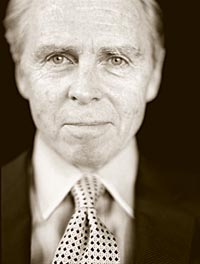
Photograph by Joe Vaughn |
Note the plural. Mr. Welch’s insight, which was not widely shared in business at the time, was that leadership was not the province solely of the CEO and his or her senior executive team, but had to be institutionalized throughout the company. A globalizing economy meant that a business world long characterized by stability, autocracy, and strictly bounded processes would have to become more change-embracing, which would require the development of nimble, adaptable leaders up and down company hierarchies. That, in turn, meant building the capacity for teaching men and women not only how to manage change, but how to create it.
Educationally, Dr. Tichy was well suited for the task; he had written his Columbia University Ph.D. dissertation on change agents. But by blending what he saw at the GE revolution with his experience both before and after Crotonville, he has transformed himself into one of the world’s foremost educators on management education, both at the University of Michigan, where today he is professor of organizational behavior and human resource management and director of the Global Leadership Program at the business school, and for corporate clients, which have included Best Buy Co. Inc., Royal Dutch/Shell, and Ford Motor Company.
Dr. Tichy’s approach to “change agenting” has itself been a journey of sorts. From his earliest management book, The Transformational Leader: The Key to Global Competitiveness (with Mary Anne Devanna, John Wiley & Sons) in 1986, through 1993’s Control Your Destiny or Someone Else Will: How Jack Welch Is Making General Electric the World’s Most Competitive Company (with Stratford Sherman, Currency Doubleday), he concentrated on processes by which leaders manage change. But in his recent book, The Leadership Engine: How Winning Companies Build Leaders at Every Level (with Eli Cohen, HarperBusiness, 1997), and his newest, The Cycle of Leadership: How Great Leaders Teach Their Companies to Win (with Nancy Cardwell, HarperBusiness, 2002), he has trained his sights on the mechanics of teaching leadership. His most controversial admonition: Teaching must be interactive — the boss has got to learn as much as the staff, a construct the 56-year-old Dr. Tichy calls a “virtuous teaching cycle.”
“People need to be smarter every day,” Dr. Tichy told strategy+business over a buffet lunch in the cafeteria of the University of Michigan Business School’s executive education building. “Well, what’s the mechanism for making you smarter? It’s some kind of interactive teaching. It’s as simple as that.”
S+B: Your early passion was effecting broad social change. How did you transition from that goal to the objective of helping companies manage change?
TICHY: I was never antibusiness. I always felt that the free-enterprise system was the right system, and that businesses were the wealth-producing institutions of society. But when the opportunity came to do graduate work and teach at the Columbia Business School, I was very ambivalent because I wanted to change the world. I had my long hair and boots. I went to the business school thinking, I only want to work with doctoral students.
I did most of my work in the ’70s with areas underserved by health care. That’s how I worked through my ambivalence: I felt that I could bring behavioral sciences and business to the Dr. Martin Luther King Jr. Health Center in the South Bronx. The first book I did was Organizations Designed for Primary Health Care. I then went off and ran the Hazard Family Health Service in Kentucky for a year in 1977-78, worked with Montefiore [Medical Center] in their residency program in social medicine.
S+B: You got your undergraduate degree from Colgate in ’68?
TICHY: It was that famous class of ’68, where you had Martin Luther King’s death —
S+B: — Bobby Kennedy’s murder.
TICHY: And then I came to Columbia to do my graduate work. It was an incredible time on the Columbia University campus, a real inflection point for me. My first research project was a project with the Bureau of Applied Social Research, with sociologists Allen Barton and Charles Kadushin, studying the impact of the Columbia uprising on faculty, students, and community, doing surveys. I couldn’t have parachuted into a better place.
And it almost didn’t happen. In October 1967, Warren Bennis was starting a new doctoral program at the State University of New York at Buffalo. Even then, he was the pinnacle of what I wanted to be because he had written a lot of the most important organizational development books. The SUNY program read like my dream program. I was a senior at Colgate, I went up for the interview, I met with Warren. At the end of the interview he said, “Don’t bother applying. You don’t have a chance of getting into the program.” Today, he denies it. He says, “You rejected us.” I say, “No way.” Warren tells me it didn’t happen, but it did happen. And thank God I didn’t go there. If I hadn’t gone to Columbia, I would not be sitting here.
S+B: So many of the folks who came through the cauldron of the ’60s at some point began to see the business organization as the best place for social change.
TICHY: I saw a real bridge. I wanted to study different kinds of change agents. I wanted to know what their cognitive map was for diagnosing their systems, what their values were, and what their tools were, and how all of that fit together. I broadly defined a change agent as anyone who was interested in purposeful change. So I had Minutemen, I had Black Panthers, I had radical anarchists, I had McKinsey consultants. I had 133 change agents. I had some of the wildest interviews. I went to a cocktail party in 1971 in New York City. There were Black Panthers there, and there were white Minutemen. They said, “Look, we agree on the means, we disagree on the ends.” It was Looney Toon time.
S+B: Were there other inflection points that led you to your current interests?
TICHY: The other one was going to GE’s Leadership Development Center at Crotonville. My life changed. I went in April of ’85. I was teaching at the University of Michigan at the time. I actually showed up right after Jack Welch had done a session the night before. It was the worst day of teaching I had ever done. I was finishing the transformational leadership book. What I didn’t know at the time was, in 1985 — I don’t know if you’ve seen the Control Your Destiny or Someone Else Will book, page 1.
S+B: There’s a story you tell of a session in which GE executives are discussing Welch among themselves, and they put up on a board two thoughts.
TICHY: “Jack Welch is the greatest CEO GE has ever had” and “Jack Welch is an —
S+B: — Is an asshole.”
TICHY: That’s exactly how people were feeling. He’d only been there a few years. These were the “Neutron Jack” years, right? So I go into a group the next day after Welch has taught. Half the people hate him. Others love him. And I’m trying to teach leadership. I got slaughtered. I go to Jim Baughman, who was running Crotonville at the time, and he says, “Jack and I want to know whether you would consider leaving the University of Michigan and coming to run our center.” And I replied, “Jim, thanks, but no thanks. But tell me a little bit about what you have in mind.”
He said, “Well, Jack really wants to use this place to make change happen, and we want someone who is a change agent.” I said, “I’m going to INSEAD next year. Then I’ve got a U.S./Japan Fellowship.” But I thought about it. I started talking to people. I didn’t know Welch very well. What was his value system going to be? I talked to a lot of people who knew him, and to make a long story short, about six weeks later I’m picking up my family and moving to Old Greenwich.
S+B: That’s a big, sudden kind of change.
TICHY: I teach this when I do career planning. It’s called “planful opportunism.” The “planful” things you can do in life are know your skill set, know your values, know who you are. You don’t know when an opportunity is going to pop up. But if you’ve done your personal homework, you can make the yes/no decision quickly.
S+B: Crotonville is where many of your ideas about “teaching organizations” first gelled. Many executives have heard of “learning organizations,” but the teaching organization may be a new concept to them. How does it grow out of the earlier work?
TICHY: Here’s where I think the emphasis on the learning organization becomes limiting. I went through every sensitivity encounter group. And it’s nice, but it doesn’t get you a winning business. And if Digital Equipment — a great learning organization — goes bankrupt or gets sold to Compaq, what good have we done?
S+B: You believe there’s been an overemphasis on organizational values, to the exclusion of results?
TICHY: You need a performance/values matrix. Jeff Immelt says it very well: Performance, performance, and values. Without performance — I mean, that’s what the game is about. But it’s got to be values helping you to perform. Self-absorbed learning is different from taking my learning and feeling a sense of responsibility to bring it to you. You talk to a Navy Seal, one of the first things he does is teach his buddy because it will save his own life. I want that mentality. If I learn something about a customer, do I run back and teach people? Then can I do that on a large scale? That’s the trick.
S+B: You’re saying that the teaching organization is really the bridge between speed and scale, allowing a company to adapt continuously to changes in economies and markets, at the scale necessary to sustain a global enterprise.
TICHY: Exactly. Look at pure knowledge industries, which are selling nothing but people’s brains. For a consulting firm, or Microsoft, or any of these companies that are cutting-edge now, people need to be smarter every day. Well, what’s the mechanism for making you smarter? It’s some kind of interactive teaching. It’s as simple as that.
S+B: Before discussing who does the teaching, let’s talk about what gets taught. Teaching implies standards, beliefs, systems, a set of organizational goals that transcend individual goals. How do you balance this with the increasing trend toward “bottom-up” collaboration at companies?
TICHY: Bottom-up is junk. The top has to take step number one. The CEO must have an objective — “that’s where we’re going” — have a teachable point of view and get a top team aligned before he or she can cascade it to the rest of the organization. That said, culturally, that can be very difficult to navigate, because in a large company, you have lots of people who run their little empires.
S+B: How do you make change happen in those situations?
TICHY: For successful leaders, the way you manage is much more Machiavellian than is conventionally perceived today. There’s a whole set of fun rules for the successful leaders. They do things like make history by volunteering to keep the notes. There’s also something called the “garbage can theory” of decision making. The skillful Machiavellian leader creates a garbage can and everyone throws their stuff into it, but [the leader makes] the real decisions over here.
S+B: You said that a leader must have a “teachable point of view.” Is that the same as a “belief system”?
TICHY: No. Let me explain it by example. Imagine you’re a tennis coach. Fifty people show up at your five-day tennis camp. You better have a teachable point of view on tennis. You’ve got to have more than a set of rules about what your students should do on the court: You have to have a set of ideas about how you teach the backhand, the forehand, the serve, the rules of tennis. If you’re a good coach, there’s an intellectual framing; you have a set of values, because values support the ideas. If ideas are all I have, I can hand out a brochure to these 50 people and say, “Read it.” I ain’t going to get you to sweat eight hours a day if I don’t have a teachable point of view about emotional energy. I’ve got to get you excited about those ideas and values. And then if I’m a good coach, I have to make the yes/no decision about people after I’ve coached them, about who’s on the team and off the team. That’s a teachable point of view. To run a company, you have to have the same thing.
S+B: Your new book, The Cycle of Leadership, is in large part about developing and using a teachable point of view. Your goal, as you put it, is to create a “virtuous teaching cycle” in a company. What is that?
TICHY: That’s the core DNA of this thing. If we think back about the lousy teachers we’ve had, either they didn’t care, or the teaching was one-way, or it was autocratic.
S+B: You criticize Eckhard Pfeiffer, the former CEO of Compaq computers, as an example of the one-way teacher.
TICHY: Yes. The one-way leader is someone who just turns the megaphone on. It’s the CEO coming in with the teleprompter and the speech, or the autocrat who doesn’t learn. It turned out that that style worked at Compaq during the turnaround. But the world got more complicated. And if you don’t engage your people, you can’t align them. The way people get aligned is by having ownership together — we work some stuff out, now I’m committed to it.
That’s the virtuous teaching cycle. When you think about good teachers and teaching experiences, you would describe these as experiences where the teacher and learner both learned, both gained, both improved. I really think that is the guts of what we’re talking about.
S+B: That’s simultaneously bottom-up and top-down.
TICHY: But the conditions for doing it have to be controlled by the people in power. The fact that Welch, and now Jeff Immelt, can go to Crotonville and engage in a virtuous teaching cycle is not just because they have the plant and equipment. Jack, and now Jeff, show up with an agenda, and with a teachable point of view. And you should be doing it with your customers, and with your suppliers, as well.
S+B: Presumably, that’s more necessary now than ever, for in a world of managed alliances and services provision, one needs to learn to lead people over whom one has no authority. You’d argue that that happens through teaching/learning?
TICHY: Absolutely.
S+B: You say it’s important to build teaching into various corporate processes, for strategy and for operations, for example. Can you explain?
TICHY: There are three processes every company has to have: Somehow you’ve got to set strategies; you’ve got to have a budget, so you need an annual operating plan; and somehow you’ve got to do succession and people planning. All these can be done by the entrepreneur in his head, or they could be very formal processes. But there is a process, and left to their own devices, every one of these processes tends to become quite bureaucratic.
So I say, look at the process as a flow. There’s preparation, face-to-face, and follow-up. If things break in the preparation phase, I don’t know how you’re going to fix it afterward, when you go face-to-face to make decisions and do follow-ups. Or you could have a great prep phase: Your department got all pumped up; you have great plans, and then you go and meet with the CEO. He hasn’t done his homework. He gives you a hard time. The meeting is defensive. So next year you say, “Why bother with all that again?” and you put the thing on the shelf. So it’s very important to get people to make these processes really interactive, where there is teaching and learning going on by both the leader and the team.
S+B: Welch did a process change like that at GE.
TICHY: With the Corporate Executive Committee, the CEC. What he inherited was a monthly show-and-tell where everyone was defensive. U-shaped table, 35mm slides. You couldn’t care less about the other guy. You couldn’t wait to get out. Nobody was learning anything. Welch was constantly experimenting with the CEC to make the process and results better. Get them out of the physical setting of headquarters. Go to Crotonville. Roll up your sleeves. You had to spend the night. If you were caught going home at night — no, no, no, even if you lived 10 minutes away. Why? He wanted you to socialize, be at the bar, sharing ideas.
S+B: How else can you make strategy and planning processes interactive?
TICHY: One of the best practices I saw was introduced by Gary Wendt when he was head of GE Capital. He had this insight that by the time people came in to give their strategy review, it was a defensive meeting. They had worked for two months, so by the time they came to him for the presentation, all they wanted to do was sell him on the results. He couldn’t add a hell of a lot of value. So he changed his calendar and committed to 29 days, a couple of months ahead of the final face-to-face, to go to each business unit for a half-day or a full-day meeting — the top team, no presentation, no flip charts, let’s brainstorm. That gave executives time to rethink their paradigms.
There are all sorts of ways a leader can foster interactive teaching and learning if he starts thinking, Where do I socially architect myself? Like Larry Bossidy and the follow-up letters he writes to his senior people after meetings. Think about what that does. That’s a contract. And it’s not some staff weenie doing it. It is a personal contract between the CEO and an executive, in very down-to-earth language.
S+B: One of the teaching methodologies you do not like is the case-study approach.
TICHY: I’ve long criticized the case method. It’s one of the ways so many of my academic colleagues become disconnected from practice. At Crotonville, where we brought in many outside teachers, most case teachers couldn’t add any value.
One story from when I was at Crotonville. They were reading a Corning Glass sourcing case. I’m sitting there watching them work the case, and I realize the faculty member doesn’t know anything about sourcing. He went out once to Corning, sent a researcher, and wrote this case. And we’re sitting here with guys from GE Power Systems who just laid off 10,000 people in Schenectady, reading a case about a company that is a popcorn stand compared to GE. And I’ve got guys in the classroom who’re living with bomb threats because they are trying to make change happen. So I figured, let’s bring the people who actually have to work the problem to class for a day and a half. We’ll wrestle with their sourcing issues, and make the decisions the next day.
S+B: You emphasize that leaders should use narrative and storytelling in teaching.
TICHY: Howard Gardner’s book Leading Minds was the big “aha” for me. It helped me understand that there are three stories the leader needs to communicate: Who am I, who are we, where are we going. That kind of narrative puts flesh on the teachable point of view, which on its own might only be a PowerPoint presentation. That’s pretty boring. But put it into a real, true narrative — that can be powerful.
Martin Luther King’s “I Have a Dream” is an example. Where black children and white children are holding hands. Where we’re judged by the content of our character, not the color of our skin. It paints a clear picture. Nobody questions this “who am I” story. You run into problems with leaders when they pronounce something, and then they live this other life. So when I run my three-day “building the leadership engine” workshop, one of the things we do is put your teachable point of view together in a story. We make you write a journalistic story, write a Fortune article, you on the cover with what you’ve accomplished, and you’ve got to write a narrative. And then we put people on video — you have five minutes to give the business equivalent of your “I Have a Dream” speech. And then we sit down in groups of six and watch six videos and critique them. You write for an hour. That’s a very powerful exercise.
S+B: Let me ask you a very practical question about that. How could you do that without seeming pompous or overly self-confident? In a real business setting, if I were to go in front of a team or a group and do something like that, it would be very difficult.
TICHY: But not really because the mind-set we put you in is, Monday morning you’re up in front of your marketing group. Give us the five-minute vision speech, and there are three elements to it: The case for change, where we’re going, and how we’re getting there. I don’t care who you are, you’ve got to be able to do it — every day, in every setting. In the elevator. That’s what Jack Welch did for 20 years. “My God, we’re in a deflationary environment, margins are coming down. We’ve got to be a global service organization. Here’s how we’re going to get there. We’re going to start by acquisition, dah, dah, dah.” Jeff Immelt has got the same challenge. A successful leader has got to make the case for change every day. You have to get up in front of the group.
S+B: Great storytellers are often thought of as charismatic. But charisma is out of fashion these days. Both Jim Collins, in Good to Great, and Rakesh Khurana, in his new book, Searching for a Corporate Savior, say that companies have gone wrong by placing too much emphasis on finding charismatic CEOs. Their research indicates that humility may be a more valuable character trait.
TICHY: I think we’ve held up charisma as a stereotype, and we’ve kind of loaded on it the notion that it means arrogant, out of touch. We need to be more sophisticated about this. Gandhi was charismatic. Too many people are confusing charisma with autocrat, fat cat. So I think we have to be a little more sophisticated when we hold up or tear down these stereotypes. Whether we call it charisma or not, a leader cannot be self-effacing to the point of being wimpy. You’ve got to take “humble” with a grain of salt. Effective leaders are willing to use power and authority, but they’re doing it in the service of the collective good, as opposed to self-aggrandizement.
S+B: In their book Geeks and Geezers, Warren Bennis and Robert Thomas say that good leaders are really shaped by a transformative event, a fundamental part of their personal narrative, which they call “the crucible.” That made me wonder whether baby boom managers aren’t fundamentally disadvantaged relative to older ones because our crucibles haven’t been that serious.
TICHY: When compared with World War II.
S+B: Compared with World War II and the Depression.
TICHY: Generationally, we had a little bit with Vietnam and the civil rights movement. But Vietnam was so funky — to this day I don’t know how to sort it out. It’s a good point. I don’t know. Warren and I are doing a book together that may allow us to address some of this. It’s on leadership judgment calls, making the gut calls. I want to interview politicians, military leaders, and business leaders.
S+B: Taken together, all these principles — creating a teachable point of view, learning how to communicate, building interactive teaching into major corporate processes — create, in your words, a “virtuous teaching cycle pipeline.”
TICHY: The VTC pipeline means identifying the key developmental stages people go through in your organization, and understanding what you can do to maximize the learning/teaching, with high-impact virtuous teaching opportunities, at each level. The best practice I could find was Trilogy Software.
S+B: The story you tell in the book about Trilogy Software’s leadership “boot camp” for new hires concerned me a bit. There seemed to be “drinking the Kool-Aid” elements working there. For example, you tell one story about new recruits essentially being goaded into risking $2,000 on a roulette wheel bet that only one of them would win. I saw that as mindless risk taking — a pure gamble, with nothing that seemed relevant to team building.
TICHY: It sits right on the edge. CEO Joe Liemandt’s point of view on that would be, look, logically these recruits have been trained as computer engineers, so they know damn well what the odds are. It really psychologically forces them to face into it. And, by the way, the winner can give the money back to his or her colleagues, and some of them do. It leads to all kinds of interesting self-reflection.
S+B: Has Trilogy done well?
TICHY: Yes. Some of it is serendipity. The advice Liemandt got from Bill Gates 12 years ago when he was starting the company was, “If you want to build a great company, get the hell out of Silicon Valley.” And secondly, Gates said, “I went public too soon. Stay private as long as you can.” So Liemandt went to Austin, and he delayed going public, and good for him — because had he gone public, he’d be struggling like a lot of the others. He’s actually doing quite well. He’s changed the business model to make it more customer-centric. He’s measuring it. And he’ll do okay.
S+B: Our conversation has been largely about CEOs institutionalizing leadership in their companies through teaching. If you’re a leader in the middle of a company, can you build a teaching organization?
TICHY: I’ve seen it at all levels. That doesn’t mean being soft and fuzzy about it. But that’s part of my contribution here at Michigan. I am not the dean. I run orientation for 450 MBA students, a weeklong program. It includes community service, business ethics. We do the exercises detailed in Cycle of Leadership. We set up six tents. We do workshops, bring executives in. It has a huge impact on the students.
We’re also designing a three-day leadership transition workshop for graduating MBAs, to help them on the next leg of their life journey. We’re renting out the Hyatt Regency, doing life planning, career planning, bringing alumni in from prestigious companies. And we’re going to spend the last day going to Focus Hope, a civil rights organization, where we are going to do community service together.
S+B: Hmmm … that seems to go back to the ambivalence you felt earlier in your career about locating yourself at a business school.
TICHY: I spend 20 percent of my time right now doing pro bono stuff and engaging the business school in global citizenship. I don’t work with any clients that don’t include community service as part of leadership development.
S+B: A very good idea.
TICHY: You watch the rankings. 
Reprint No. 03109
| Authors
Randall Rothenberg, rothenberg_randall@strategy-business.com |
