
How Much Is Enough?
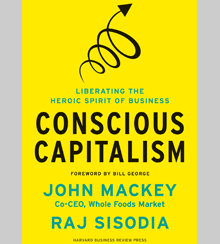
James A. Ogilvy, author of Creating Better Futures: Scenario Planning as a Tool for a Better Tomorrow, introduces a passage on the limits of executive compensation from Conscious Capitalism: Liberating the Heroic Spirit of Business, by John Mackey and Raj Sisodia.
Getting your compensation system right is no easy thing. When does a big paycheck become too big? How do you balance the interests of shareholders, customers, and employees?
Whole Foods Market has taken some radical steps to get compensation right, including total transparency and capping executive salaries at 19 times the employee average. Other companies allow this ratio to soar into the hundreds. But, as you’ll read in the following excerpt by John Mackey and Raj Sisodia, the grocery chain has never lost a senior executive it wanted to retain.
Mackey and Sisodia show us a version of capitalism at odds with the assumption that employees and their managers are engaged in a constant tug-of-war over who gets how much. In many ways, managers reap what they sow. If they assume greed, secrecy, and selfishness, they will get greed, secrecy, and selfishness. But if they practice generosity, transparency, trust, and teamwork…
Conscious capitalism is a refreshing vision of economics that assumes people want more than just money. It’s also a vision that supplements the narrow interests of investors with the broader interests of employees, managers, customers, and the larger community. As the success of Whole Foods demonstrates, it works.— James A. Ogilvy
An excerpt from chapter 6 of Conscious Capitalism: Liberating the Heroic Spirit of Business
In any workplace, team members pay a great deal of attention to how the compensation system works. No matter what an organization says about its values and its purpose, how it compensates is a form of “walking the talk.” Nothing saps motivation more quickly than the perception that the compensation system is unfair and rigged. If an organization talks about higher purpose, exemplary customer service, and other ideals but its compensation system is inconsistent with those ideals, it’s not going to be very successful.
At Whole Foods Market, we have adopted certain compensation policies that have been quite effective. Perhaps the most radical one has been to have total transparency on compensation; everyone who works at the company can know what everyone else is paid. This transparency is an essential part of our culture, and it ensures that the compensation system is fair. Because it is transparent, team members can give feedback on what they find to be unfair, giving the company an opportunity to change and evolve it.
Some type of team compensation is helpful to reinforce the nature and cohesion of the teams. At Whole Foods Market, we use a protocol called gain-sharing. When a team increases its labor productivity, everyone on the team shares in the bonuses, which are paid in proportion to the individual’s hours worked. This reinforces solidarity within the team by aligning the interests of individuals together. In our experience, this type of team compensation doesn’t undermine intrinsic motivation, because it is intrinsically rewarding to be part of a successful and winning team.
Everyone in our executive leadership team (the seven top executives) is paid exactly the same salary, bonus, and stock options. There is great solidarity and a high degree of trust within the group, and we want that to continue. You could make the case that some leaders are a little more valuable than others. But small differences in compensation can, over the years, stoke envy and erode trust in people. Our leaders also have a strong sense of calling, which supersedes the need to have their relative self-worth validated by money.
Related to the issue of fairness, we have also adopted a policy at Whole Foods Market that caps the total cash compensation, including bonuses, for any team member at nineteen times the average pay of all team members. In publicly traded companies of a similar size, this ratio, including equity awards and other incentives, can be four hundred to five hundred times.
In setting compensation, companies consider internal equity (where the compensation system is perceived internally to be fair) and external equity (where the compensation for any particular position is competitive with the external market). Most companies focus primarily on external equity when it comes to executive pay. If they find that a competitor is paying its CEO or chief financial officer a certain amount, they think their pay has to be comparable or higher. Few companies are content to be average; many strive to be at the 75th percentile or beyond. This has created a ratchet effect that has led to rapidly rising executive compensation in recent decades.
If external equity is not tempered with internal equity, it can lead to a system that is perceived to be unfair internally, which is a huge de-motivator. At Whole Foods, our salary cap has been in place for about twenty-five years (the ratio has risen gradually over the years to its current nineteen-to-one level to stay reasonably competitive with the external market), and inadequate compensation has never caused us to lose any senior executives we wanted to retain.
There is another rationale for the salary cap. We want leaders who care more about the purpose and people of the company than they do about power or personal enrichment. Our senior executives are well compensated, but they are clearly not making the most money they could. If they simply want to maximize their personal compensation, they could certainly make more than they do at Whole Foods Market. Indeed, many of them routinely receive offers that are considerably larger. But our leaders believe that their compensation at Whole Foods is reasonable and fair compared with others within the company. Although most would not turn down more if offered more (human nature being what it is), by any reasonable standard they are wealthy and can do what they want in life.
This reflects a third reason we believe a salary cap is good: it attracts people with a higher degree of emotional and spiritual intelligence. At some point, people have enough money to have financial security, live a comfortable, adventuresome lifestyle, and fulfill most of their aspirations in life. It is a mark of emotional and spiritual maturity to be able to say, “I have enough.” Past a certain point, it is not healthy to want more; actually, it is a kind of sickness.Reprinted by permission of Harvard Business Review Press. Copyright 2013, Harvard Business School Publishing Corporation. All rights reserved.