
What’s Your Company’s Facebook LPM (Likes per Million)?
Every company can compare its brand value to that of its competitors based on a readily available scale: Facebook “likes,” adjusted for company revenue.
Measuring brand value has always been something of a dark art. Marketers have experimented with many combinations of financial metrics, consumer research, and gut feel, seeking a scale. But the data is typically inconclusive, difficult and expensive to gather, and almost impossible to use in comparing one company to another. Fortunately, there is now a very easy way to track the number of consumers who value your brand, by using one of Facebook’s simplest features: “likes.”
What’s the Value of a Facebook Like?
Every company can compare its brand value to that of its competitors based on a scale that really matters: the love of Facebook fans, adjusted for company size. Watch this video to find out how you can measure your brand’s value using Facebook’s “like” feature.
What is brand value? To marketers, it is the proportion of consumers who are actively engaged with a group of products or services. Marketers continually seek to track the number of engaged consumers (sometimes known as brand zealots), because they are willing either to pay more for the brand (earning the company a price premium) or to go out of their way to get it (leading to more volume). The more zealots you have, the stronger your brand loyalty and the more valuable your brand.
A company’s (or brand’s) Facebook page is an Internet destination tailored for those zealots. It’s where people come to get information about the brand and to engage in dialogue with the producers and others who care. Social network statistics, particularly the number of Facebook “likes,” are thus indicators of brand engagement.
However, when considered on their own, these statistics are unreliable. Since larger firms with more customers almost inevitably attract more followers, the raw number of “likes” that a page has earned may simply reflect the size of the company behind it. Recently, we hypothesized that a true indication of brand value would be the popularity of the brand’s Facebook page indexed to the size of its revenue stream. If you could track your Facebook LPM — your likes per million dollars of revenue — you’d have a pretty good proxy for the way people feel about your products and services.
To test this hypothesis, we collected Facebook “like” numbers (which are automatically made public) for a range of leading consumer-facing companies. We then divided that by the companies’ revenues. (See Exhibit 1.)
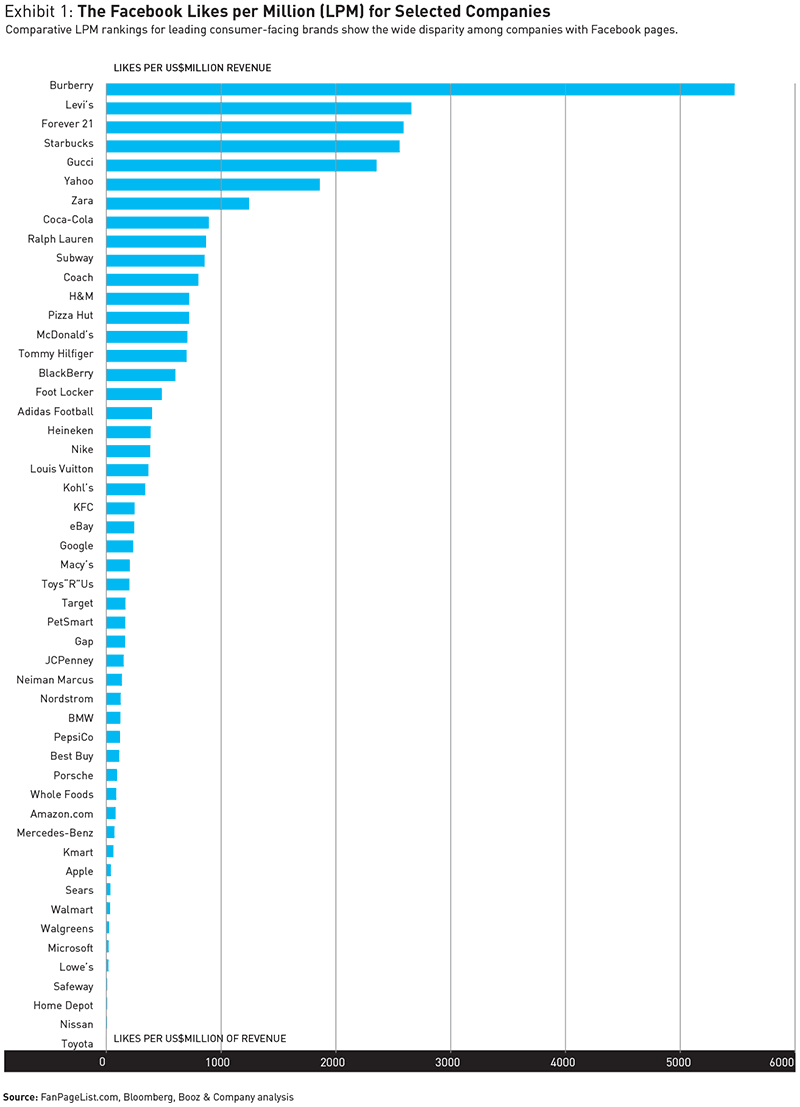
This preliminary LPM analysis is fascinating — who would have thought that Subway would out-engage eBay and Best Buy? It also confirms that scale is no guarantee of online brand engagement: Walmart garners 10.6 million Facebook “likes,” an impressive number at first glance. But set against the company’s US$400+ billion revenues, this translates to a much less impressive 25 likes per million of revenue, well below the LPM of Macy’s and Kohl’s.
For this small but distinctive sample of brands, and at this moment (holiday season 2011), the “best in class” LPM metric tended to be about 2,000. Admittedly, some of these brands are experimenting with campaigns to attract “likes” through artificial means, such as offering coupons or raffle entries to those who click the button. But anecdotal evidence suggests that these “purchased likes” are relatively small in number for an established brand. More importantly, marketers should be able to track the portion of their “likes” that were effectively bought this way and discount their scores accordingly.
The absolute stars of the chart were midsized apparel brands such as Forever 21 that cater to (Facebook-crazy) teenage girls. Does that mean the LPM metric is unfairly skewed to young, social-network-savvy audiences — or does the metric nonetheless serve as a generic proxy for brand engagement? To answer that question, we plotted LPM against other measures of brand value. For example, we gathered data from Interbrand’s annual survey of the world’s leading brands, indexed them to each firm’s revenue, and compared that number to their LPM. (See Exhibit 2.) (The comparison set changed slightly since we could use only firms that Interbrand surveyed.)
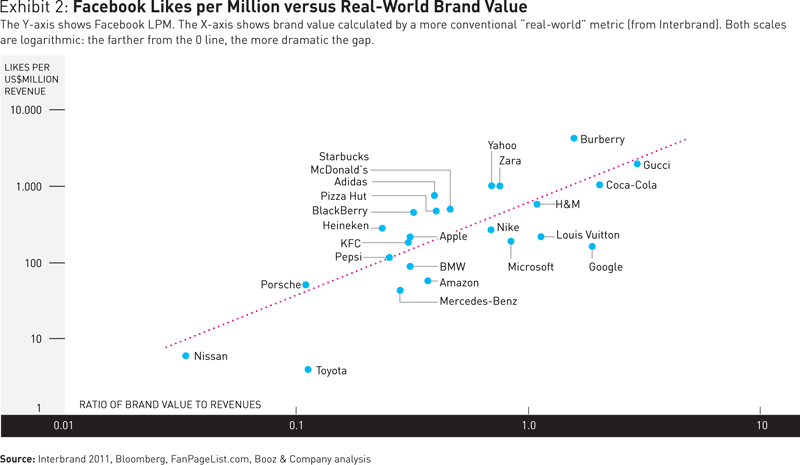
As Exhibit 2 shows, most companies have a Facebook followership that correlates fairly closely with their brand’s presence in the outside world. A few brands land farther above the line, most notably Starbucks, Adidas, Zara (the clothing line from Inditex), Yahoo, Burberry, and Heineken. This indicates a Facebook presence considerably in excess of their real-world brand engagement. These brands may well be poised to reap greater rewards as the Facebook generation moves into the mainstream of consumer demand. There were also some notable outliers below the line, including Louis Vuitton, Google, Microsoft, Amazon, and Toyota. Whether because they compete with Facebook in some way, because their customers are not likely to use Facebook, or for some other reason, these companies do not have a Facebook presence that mirrors their brand engagement elsewhere.
In general, however, the correlation makes us confident that metrics such as LPM are here to stay. To be sure, there is more analysis to come. For this round, we excluded some companies simply because of the complexity of their portfolio. For example, about 770,000 individuals are listed as “liking” Kraft Foods on Facebook — a paltry number compared to the 23 million who have “liked” the Kraft brand Oreo. (If you visit the Oreo page, you’ll see many of those fans swapping photos of their cookie-chomping offspring.) Since we didn’t have ready access to brand-by-brand revenues for Kraft and other large CPG companies, we excluded them. But with the right information, those companies could also be analyzed, one brand revenue stream at a time.
The Facebook LPM index offers companies at least two courses of action that they haven’t had before. First, they can gauge the success of their online activities. Some companies provide Facebook followers with special deals or other enticements; others have built communities of brand zealots through discussion forums and associated not-for-profit campaigns (for example, the collaboration between Starbucks and the Opportunity Finance Network on the Create Jobs for USA fund). If you use Facebook to create an engaging environment, where you monitor the market and shape the dialogue, your growth in likes per million can tell you how well you’re succeeding with the increasingly influential online audience — and whether your overall brand engagement, even if it seems strong, could be at risk.
Finally, unlike many other brand metrics, LPM can be collected as often as you wish. Facebook popularity changes rapidly, and although it’s unusual for people to remove themselves from a page (instead, they stop visiting), a sudden spike in “likes” (or a failure to spike after a promotion) can be a powerful real-time indicator, especially in comparison with competitors’ results. Your Facebook LPM could become one of the most valuable indicators you have of brand relevance: your own, and that of everyone else in your industry.
Author profiles:
- Nicholas Hodson is a partner in Booz & Company’s retail practice based in San Francisco.
- Umut Aytekin is a principal with Booz & Company’s retail and operations practices based in San Francisco.
- Jon Crawford is a principal with Booz & Company’s retail practice based in San Francisco.