
The Right Role for Top Teams
Analysis of informal networks offers a potent leadership model for the C-suite: Make top teams the hub of the enterprise, and watch performance improve.
Illustration by Camille Chisholm
Think of the top teams you’ve known that have had the greatest impact. Did their value come from the meetings they conducted and the decisions they made together? Or from something else? In most companies, the phrase top team is a misnomer. Senior executives throughout the company may clamor for a seat on the leadership committee because that is where the key strategic decisions are supposedly made. But in actuality, the group rarely conducts its work in unison, as a deliberative body or a source of command. Instead, its power comes from its members’ informal and social networks, their determination to make the most of those connections, and their ability to work well in subgroups formed to address specific issues. The most effective top teams are those that recognize this reality and set themselves up to function as the senior hub of the enterprise.
“If I consider what our top team needs to do well,” said the president of an investment bank in the wake of the financial crisis, “it is not so much about senior team building or planning for 10 years out. These are overly romanticized notions of what it means to be a good executive team. It’s more important to have different networks that execute quickly on crises or opportunities — combining our expertise and that of other groups in the company. Building this ability to solve big problems quickly is a big deal, because the pace of business keeps ramping up. Yet we don’t focus enough on this, in contrast to internal team building and individual coaching.”
Organizations that want to improve the effectiveness of their top team — and therefore the performance of the full organization — need to start by recognizing the true source of the top team’s value. They need to develop the kind of team in which each member is a recognized informal representative of larger networks of alliances; in which the top team knits together the collective expertise and accountability of a much broader group of people than the executives in the room; and in which subgroups can resolve issues and make rapid, incisive decisions that gain the commitment of the full senior leadership group, and the organization as a whole.
One source of this insight is social network analysis, the mapping and mathematical study of informal links in an organization, gathered through surveys and logs of meetings, phone calls, and e-mails over time. These analyses consistently show that as much as 90 percent of the information that the most senior executives of a company receive and take action on comes through their informal networks, and not from formal reports or databases. A typical senior executive committee or council functions formally as a central meeting point, a place where the most senior executives check in with one another, present performance results and other recent information, and ratify decisions that have already been made. Its value stems less from these formal activities than from its informal role as a collection of some of the most influential and experienced individuals in the company — and from its capacity to mobilize coordinated efforts through subgroups and network influence.
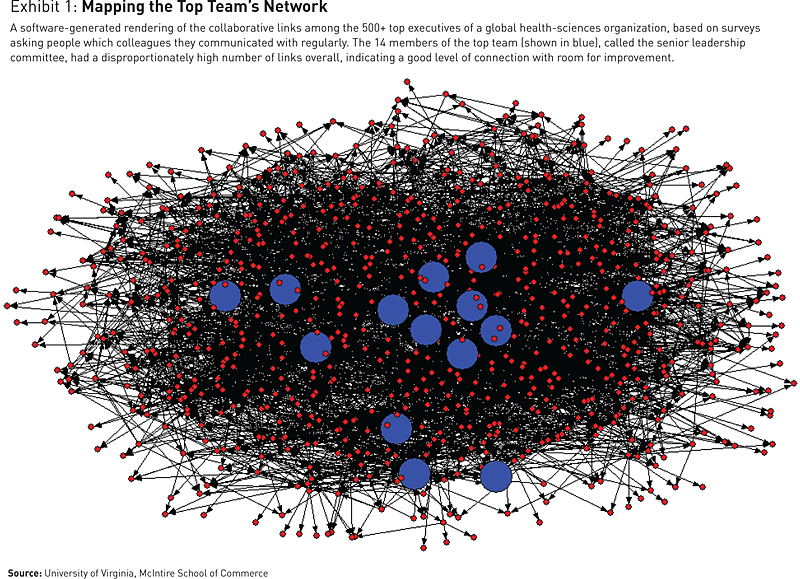
For example, in one global health-sciences organization with a reasonably well-functioning “senior leadership committee,” that top team — made up of 14 people — represented only 2 percent of more than 500 senior executives in the company. But they accounted for almost 15 percent of the collaborative and informal ties in the organization. (See Exhibit 1.) The robust ways in which these executives maintained working relationships through the company had a substantial impact on execution and performance.
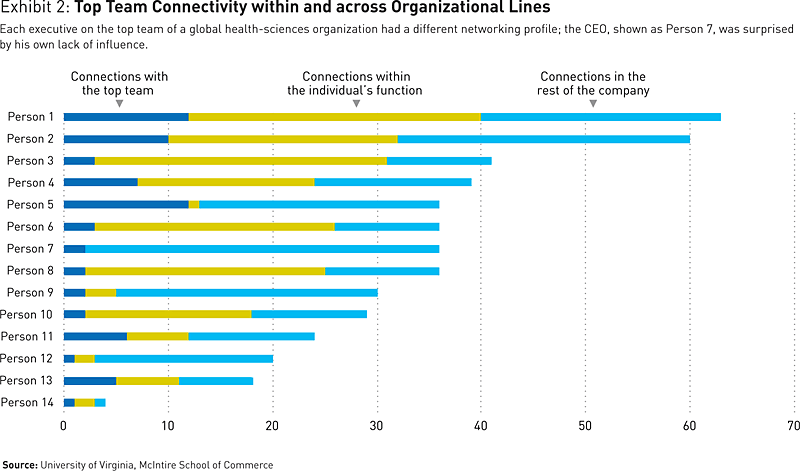
When the senior leadership committee conducted a network assessment to improve its performance, the CEO assumed the bulk of improvement would come from within the committee, through the strengthening of committee structures and decision-making processes among those 14 senior leaders. But those efforts led to only a few beneficial changes. There was much more leverage for improvement in the links between the senior group and the rest of the company. That was because although members of the senior leadership committee held a disproportionate share of collaborative ties, those ties were not distributed evenly. (See Exhibit 2.) One executive (“Person 1”) was a highly networked individual, with more than 60 people claiming her as a key information source, whereas another (“Person 14”) maintained only four connections. The CEO — in the middle of the pack, labeled “Person 7” — was shocked by his own relative lack of influence. He was also surprised by the prominence of a few executives he had not realized were so important in enabling others.
The network pattern also revealed a correlation between poor connections and some failed decisions in the company’s past, including unprofitable entries into certain markets and ill-advised acquisitions. Seeing the importance of the larger network prompted leaders to enrich their own networks, connecting with more employees throughout the hierarchy, not just with those who currently had their ear. It also prompted them to improve the way they operated, using subgroups of the senior leadership committee. One year later, the committee members credited this shift with generating ongoing improvement in innovation and business performance, along with more rapid decision making and execution.
If you’re interested in shifting the operating model of your company’s top team this way, there are three particularly good places to start:
1. Rather than focusing on improving the senior group’s interactions as a whole, design a group of smaller, more focused subgroups, drawing in others from around the company as needed.
2. Invest in the quality of links between top team members and the rest of the company.
3. Recognize that conflicts among top executives are often driven or exacerbated by broader tensions in the network, and deal with them at the constituent level first.
These three tenets seem simple, but they are hard to put into practice, because they require changing the conventional view of how a top team should operate. Together, however, they can help a top team move to a more balanced and integrated operational model — addressing diverse performance challenges, working together in more effective ways, and making more disciplined choices.
Harnessing the Power of Subgroups
When confronting the performance of the top group of executives, as in any other major change effort, CEOs and other senior leaders often leap to the role of architect. They move boxes and lines around on an organization chart, and redesign the formal incentive structures and workflow. Align the top executives around strategic objectives, they figure, and the business units and functions that report to them will naturally follow. If the top team proves difficult to align, the company may invest in team-building exercises. But exercises like these are often counterproductive. Not only are they costly, but they can lead to excessive consensus seeking, lengthy decision-making cycles, and isolation of the top team from the rest of the organization. Moreover, this approach assumes, erroneously, that there is only one way to operate as a team, and that when teams don’t function well, improving their group interactions is the only way to help.
The most effective senior leadership groups, whether they explicitly acknowledge it or not, have a different operating model. Instead of conducting their work as a single, autonomous unit, members of these groups divide into a shifting, relatively free-form, interconnected collection of subgroups, each oriented toward a particular issue, problem, or opportunity. Moreover, the best subgroups function in at least three different modes — as discussion groups, single-leader units, or real teams — switching among them as the circumstances require:
• When the subgroups function as discussion groups, the goal is information sharing. Executives compare notes and update one another on existing accomplishments. In this mode, teams do not make strategic decisions, and thus there is no great need for active leadership; the leader tends to simply “go around the room” and keep the conversation on track.
• In single-leader units, everyone understands that there is a single boss with authority over the subgroup for this task, and the other members all have clear, stable roles with individual accountability to the leader. This is a very useful operating model when speed and efficiency are called for.
• When innovative action, group insight, or breakthrough performance is needed, “real teams” are put into action. A real team is a small group of people with complementary skills, all of whom are committed to a common purpose. They share performance goals, adhere rigorously to a cohesive working approach, and operate with flexible leadership. Anyone on the team may step forward to articulate what the next challenge is and how to meet it; team members invest their time and reputation because of their common commitment.
Most executives have experienced discussion groups and single-leader units, but real teams are comparatively rare. Being on a real team can be challenging at first for some members, who may not be used to leadership roles that shift or to having mutual accountability for the team’s results.
A high-functioning subgroup in a top team of 20 senior executives might include three or four of those individuals, along with one or two specialists or high-potential people drawn in from the rest of the organization. Because it can operate in any form — as a discussion group, single-leader unit, or real team — this subgroup can solve a variety of difficult problems and make a number of decisions rapidly that might take months for the whole executive group to work through. (A dysfunctional subgroup, by contrast, tends to remain within one mode.) Developing this proficiency takes some time and effort. Top team members must learn to make disciplined choices about which subgroups to form, who the members should be, and which type of collaboration will be required.
One company that saw the benefits of disciplined subgroups was a US$1 billion provider of IT consulting services, with 10,000 employees spread across more than 70 offices around the world. In 2005, as part of a restructuring effort, the senior vice president of human resources conducted a network analysis of the top 250 executives and managers, mapping information flows and collaborations against the generation of revenue for the firm. The analysis revealed some unexpected discrepancies. First, many of the highest-revenue-producing account managers — who had critical expertise and key relationships with clients — operated with very few internal connections. As a result, their superior expertise was seldom brought to bear in client sales and project execution. Second, the senior leadership group, which had been together for many years, had grown contentious and unproductive. The CEO had hired a team-building facilitator, and the team adopted extensive consensus and feedback processes that improved the meeting atmosphere. But these new methods also bogged down the senior group; the process for reaching a decision often took longer than discussions about the decision itself. The CEO himself found the new consensus approach to be an impediment to progress. But he did not want to return to open hostility.
Third, there were problems with the senior leadership group members. A few habitually demanded that their colleagues support their positions; this habit had undermined the others’ trust in them. Some group members were so highly networked in the rest of the company — with dozens of people coming directly to them for information — that they had become significant bottlenecks; others couldn’t get information without going through them. This caused delays in decision making, projects, and sales efforts. Moreover, their actions solidified the influence of functional silos; only 5 percent of the company’s people managed 30 percent of the revenue-producing collaborations.
The top team addressed the problem by setting up subgroups to deal with a range of implementation issues, such as launching new services or addressing account penetration (expanding business with key clients). Each subgroup was given latitude to act and a defined process and time window for obtaining input from the top team; this meant that they could function either as single-leader units or as real teams when needed. The membership mix of each subgroup was deliberately designed to cross the silos, engage the disengaged, and break up the bottlenecks — even as the subgroups brought people together to work on issues they all cared about.
The senior leaders themselves used the same subgroup model to change the way their functions and divisions operated. The chief information officer set up flexible global solution teams, drawing on subject matter experts across regional boundaries. The chief financial officer redefined dollar thresholds to grant lower-level employees more autonomy in setting prices. Another leader, seeking to help people collaborate across regions, decided not to create formal committees. Instead, she identified people who were already highly connected within the regions, and then set up regular but informal calls among them to take full advantage of their networking capacity.
Within six months, many of the weaknesses in the network began to disappear. Links to the account managers who had previously been on the network’s periphery increased by 17 percent. Employee collaborations across functions increased by 13 percent and produced numerous examples of improved client service, sales, and best-practice transfers at these junctures. There was a 27 percent increase in collaborations on smaller sales (those with revenues of up to $500,000); 15 percent on medium-sized sales (between $500,000 and $2 million); and 9 percent on large sales (between $2 million and $10 million). The firm’s overall revenues rose by nearly 10 percent on an annualized basis.
As one VP put it, the senior leadership had realized “the degree to which the enemy was actually us.… [We were spending far] too much time finger-pointing.” Instead of “teaming” when team performance was not critical, they now focused on building high-performance subgroups, with the ability to act as real teams when it mattered most.
Making Networking More Productive
Most businesspeople accept the fact that a great deal of time must be spent on inconsequential interactions such as unnecessary e-mail, bureaucratic approvals, time-wasting meetings, and decisions about scheduling and other rote matters. Clearly, you can’t do away with all these interactions. But with a greater awareness of the way your behavior is magnified through more carefully designed informal networking, you can improve your efficiency by 10 or even 20 percent. The CEO and the top team can foster this efficiency by recognizing each member of the top group as the hub of a larger network; making disciplined choices about when and how to get the right people interconnected in the right way; supporting the maintenance of those links; and reinforcing the leadership of those who can maintain productive networks (and lead subgroups as needed).
In the mid-2000s, a network analysis in one of the world’s largest outsourcing and data processing organizations revealed the benefits of making networking more productive. Over the course of several decades, this organization had grown into a premier provider of employee services (payroll, benefits administration, tax-compliance management, and retirement services), with revenues of several billion dollars a year. Set up as part of an organic growth initiative, the analysis looked at the top four layers of leaders — 210 people in all — to diagnose where breakdowns in informal communication might have undermined the company’s ability to execute strategically.
The top team consisted of about 25 executives with varied backgrounds. Some had been partners in major consulting firms; others had been entrepreneurs. Although they often met in subgroups or “kitchen cabinet” gatherings that formed naturally, these seldom functioned with real-team rigor, because the emphasis was on company politics rather than the pursuit of shared performance goals. And although the full senior team conducted its formal sessions efficiently, it operated only as an information-sharing discussion group. Nonetheless, senior leaders spent 64 percent of their time, on average, in interactions with one another, rather than with their own direct reports, the broader employee base, or even key clients. The leadership team’s aloofness, from one another and from their direct reports, had resulted in an invisible but pervasive and costly level of anxiety throughout the company. Fearing public reprimand, private reprisal, and the career consequences of taking risks, employees directed routine questions and problems up the hierarchy. Peer-to-peer interactions were increasingly tense and constrained.
The analysis revealed ways to improve the top management group’s effectiveness by combining better networking with a relaxation of controls. It turned out that many people used an inordinate amount of time getting ready for formal reviews with higher-up teams — they often spent four or five hours preparing for every hour of meeting time. Releasing decision-making rights on routine matters (such as simple promotions and pay raises, travel approvals, and pricing) to lower levels in the hierarchy lightened the burden imposed on everyone. Intensifying the network contacts through carefully crafted informal problem-solving subgroups and other forums gave people the support and knowledge they needed to assume new accountability.
As one junior member of the top 210 put it: “The network results definitely showed that we are hierarchical in decision making and [the costs] have finally captured the attention of our leaders. Before, I think they thought it was grousing. Of course, they did not want to give up control — and neither would I, probably, if I were in their shoes. But this has forced the conversation [about decision rights] to the forefront.”
In another company, a software firm with about 700 employees, a network analysis of the organization showed that some departments were far more connected to the top team than others — and not in a way that represented the value of these departments to the company. Each department was mapped both for its perceived value to senior leadership committee members (the extent to which they felt energized by that contact) and for the department’s access to top executives (the extent to which department staff felt they had their ear). It turned out that the departments that commanded senior leaders’ attention did so in a way that felt draining for those in the top group. These departments were mired in problem-solving and firefighting interactions that precluded leaders from seeing and discussing important innovations. The study also showed broad differences in the feelings that employees in different departments had about the top team. (See Exhibit 3.)
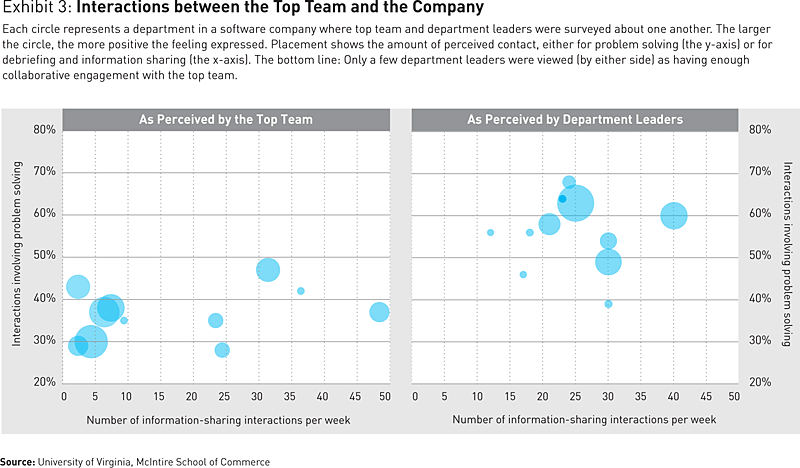
The analysis helped the senior leadership committee members see that some of them needed to be much more accessible to the broader organization. Each top team member saw, in customized reports, which departments drew energy from the direct informal connection to the committee and which did not. As a result, the senior leaders explicitly changed their behavior, strengthening contact with departments they had ignored, changing the way they worked with those “firefighting” departments (channeling more productive investments to them instead of simply helping manage their crises), and maintaining a much better balance of time and attention with the organization as a whole.
Defusing the Conflicts of Constituents
When interpersonal tensions or power struggles exist among the members of any senior leadership group, many chief executives respond either by ignoring these conflicts or promoting them as healthy competition. But few look at the reasons conflicts happen in the first place. Typically, even simple disagreements among senior leaders are based on hidden struggles between the constituents of their networks. Even when the top leaders agree on a change or new initiative, the conflicts in the broader organization — where people may have strong historical, political, or emotional reasons for opposition — can continue to fester, with an invisible but potentially devastating performance impact. Therefore, when an effective executive leadership group erupts with a sudden, seemingly inexplicable conflict, the CEO and members can best resolve it by looking at it from a network and subgroup perspective — and raising questions.
Not long ago, the senior leaders in the innovation function of a well-known food company were struggling with low R&D returns. The company’s innovation investment was not fully reflected in its ability to bring new products to market, and it had missed some significant competitive opportunities. To address this concern, the group put in place a six-month-long team-building effort for the R&D staff, relying on interviews, one-on-one feedback from the facilitator, and group sessions to create an atmosphere of candor and trust. This was intended to enable the staff to work more productively.
But the intervention did not succeed, and one of the recognized reasons was resistance: Skeptical members of the innovation team tended to discount the team-building consultant’s feedback as a “one-off” encounter that they could ignore. In other words, the company had fallen prey to a common fallacy, that having a team in place is always better than having individual leaders. In reality, as we’ve seen, the value of the team depends on the context and the mode in which it operates.
To understand this tension better, the food company turned to network mapping, analyzing information flow, decision making, trust, and people’s stated objectives. This analysis depersonalized the diagnosis; because it contained no comments on individual behavior or attitudes, all members could talk openly about what to do. The network analysis revealed that some people with high informal influence and expertise were particularly skeptical about the R&D initiative, even as they formally complied with it.
For example, one group of well-known nutritionists was central in the network and influenced many conversations outside the formal review process. They tended to be wary of exploring new and potentially disruptive ideas. They had dismissed some attractive product launch concepts in the past, including low-glycemic-index foods (foods beneficial to diabetics and people trying to lose weight). Several competitors were pursuing these foods. Moreover, these informal influencers did not voice their concerns in formal reviews (where objections could be considered in context), but rather in casual conversations and hallway interactions. Great ideas were often screened out before the top team even heard about them.
Because of their command of informal information channels compared with the rest of the organization, the nutritionists — and a few others — had more impact on key decisions, overall, than some people with higher positions in the formal hierarchy. Members of the top team unwittingly reinforced this imbalance by inviting only the people they knew and liked to brainstorming or problem-solving sessions. Nobody had ever taken the time to get the right people in the room at the right time to talk constructively in the right way about a given issue.
Meanwhile, people with other kinds of expertise, including sensory science and production quality, were not as well connected; their ideas were often overlooked except by one or two champions who occasionally raised their concerns at the senior team level. Had they been more directly involved in discussions of new product development, especially earlier in the process, their technical competencies could have yielded benefits. Instead, their voices were lost. Rather than being invited into problem-solving discussions, these employees were simply told what to do.
Now, alerted to all of these network dynamics, the top team began to build connections to other R&D professionals within the company. Team members worked on changing their own behavior, building relationships with those who had ideas about innovation. These new perspectives gave people on the top team a broader sense of the possibilities for new products. Some of them also saw that if they wanted the resistance to diminish, they would have to personally make themselves more accessible — especially to groups that had had little contact with them in the past. Within a year, the number of people who felt connected to the company’s strategy went up, the resistance among some informal professional groups began to wane, and the company invested more in new product launches — with less contentiousness among both the R&D staff and the top team members.
Renewal at the Top
Sometimes it takes a crisis to show just how effective the top team is — versus how effective it needs to be. In the mid-2000s, the Microsoft Corporation discovered its managerial mettle when the company faced antitrust suits from the U.S. Department of Justice and the European Union. A few senior executives seriously considered breaking the company in two — but ultimately Microsoft’s leaders decided to do whatever they could to remain whole. One of the most compelling factors in this decision was the recognition of the company’s long-standing management capability: focused informal networking within and across the firm. Everyone, from Chairman Bill Gates and CEO Steve Ballmer on down, paid a great deal of attention to clear communication with people throughout the company. Senior leaders at Microsoft were seldom isolated; they were always in touch with others throughout the company. And for that reason, breaking the company apart would have been risky and counterproductive. Fortunately, the regulators agreed.
Not every company has that caliber of teaming at the top. Having a powerful executive team is not just a matter of obtaining cohesive behavior and collaboration among the CEO’s direct reports. It also requires disciplined efforts to interact in ways that can seem counterintuitive at first: to make disciplined choices about when you need subgroups with real-team accountability and focus, and when the clarity and speed of a single-leader unit is better; when a focused network is better than a team; when to build network relationships among the senior executives and the rest of the company instead of fostering conventional team-building and leadership bonding efforts; and when to settle conflicts at the grassroots level rather than within the top team itself. Accomplishing this kind of integration requires great leadership instinct, good intent, and a series of deliberate choices about whom the senior leaders interact with, and how they work together. These factors will allow any executive leader to take the typical top team game to a much higher level.
Reprint No. 00103
Author profiles:
- Rob Cross is a faculty member at the McIntire School of Commerce at the University of Virginia and an expert on organizational network analysis. He is the coauthor, with Robert J. Thomas, of Driving Results through Social Networks: How Top Organizations Leverage Networks for Performance and Growth (Jossey-Bass, 2009).
- Jon Katzenbach is a senior partner with Booz & Company. Based in New York, he leads the Katzenbach Center, which focuses on leadership, organization, culture, and human capital. His most recent book is Leading Outside the Lines: How to Mobilize the (in)Formal Organization, Energize Your Team, and Get Better Results (with Zia Khan; Jossey-Bass, 2010).