The Thought Leader Interview: Douglas Conant
The coauthor of TouchPoints and former CEO of Campbell Soup Company explains how executives build their company’s capabilities by connecting with people more effectively.
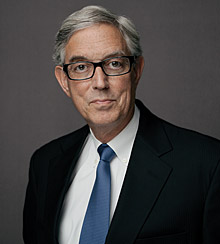
Photograph by Peter Gregoire
Campbell Soup Company has long been an iconic enterprise. Founded in 1869 in Camden, N.J., its basic logo and can design have not changed since 1898. Andy Warhol’s paintings of those cans, which began as an irreverent comment on their emblematic nature, are themselves half a century old. The company’s recent business history is also iconic, at least in the way it evokes the overall drama of the consumer products industry.
Like many other food companies, Campbell diversified its product lines to gain scale during the 1980s and early 1990s. Then, in the mid-1990s, its financial performance began to decline. It adopted a more coherent strategy in the 2000s, seeking global growth with a sharply reduced portfolio focused on three brand families: Campbell’s soup, V8 beverages, and Pepperidge Farm baked goods. Finally, in recent years, as is becoming common in the food business, it has had to meet two seemingly contradictory imperatives in its product line — the promotion of health and wellness, and a high level of appeal to customers craving comfort food.
Making these shifts takes a fair amount of sophistication — in technology and process, and in leadership and human management. Instead of trying to gain those capabilities through acquisition, Douglas Conant, CEO of Campbell from 2001 to 2011, sought to build them from within. Conant was hired as a turnaround artist after senior executive stints at General Mills, Kraft, and Nabisco, but his approach focused on investing in people, including paying deliberate attention to his own leadership style.
Jon Katzenbach, who writes regularly on organizational culture in this magazine, regards Conant as one of the few leaders who understand not just the importance of personal impact, but how to deploy it in practice. That’s the subject of Conant’s book TouchPoints: Creating Powerful Leadership Connections in the Smallest of Moments (Jossey-Bass, 2011), coauthored with executive coach Mette Norgaard. The book describes how to reframe interactions with people — even annoying interactions, like interruptions — as opportunities to raise the quality of a leader’s connection with people, and thus to further the purpose of the enterprise. (Conant’s successor as CEO, Denise Morrison, was formerly the executive champion of the company’s signature wellness initiative.)
We sought Doug Conant out because the Campbell story and the anecdotes in TouchPoints have particular relevance for one of our own ongoing inquiries: How can companies build the capabilities they need to distinguish themselves? The interview was conducted at the offices of Conant’s Philadelphia-based not-for-profit group DRC LLC, which is dedicated to raising the quality and impact of leadership among senior executives.
S+B: What are you trying to accomplish now, in your writing and your work with companies?
CONANT: My goal is to contribute to the conversation about leadership, from a practitioner’s point of view. For the first time, there are five “generations” of people in the workplace, with an unprecedented diversity of backgrounds and perspectives across the globe. Executives have to manage people connected through handhelds and broadband. Traditional hierarchical management structures that evolve at a glacial pace are being stress-tested in profound ways, and it’s taxing leaders.
But the real issue is community. I recently asked someone at a social media company to name one of the big management problems they have to deal with. “Well, so-and-so down the hall is not doing what he’s supposed to do.” OK, you think the world’s never dealt with that before?
Nonprofits and for-profit companies might look different on the surface, but they have the same challenge: trying to create high-performance communities that will make an impact on the world. And they both break down the same way: They fall short on bringing strategic thinking to life amid the day-to-day work of the enterprise.
S+B: Why is that?
CONANT: It begins with the aspirational nature of their strategies. Everywhere I’ve worked — at General Mills, Kraft, Nabisco, and Campbell — we have always talked about being the world’s best: the world’s best cookie company, snack company, and so on. People naturally aspire to be part of something bigger than they are, to not just draw a paycheck but find meaning in their work. Jon Katzenbach made that point in his book [Why Pride Matters More than Money: The Power of the World’s Greatest Motivational Force (Crown Business, 2003)].
I’ve been building aspirational strategies my whole life. At Campbell, one of my big moments came at the start of my third year, during our global leadership meeting. I realized that I had to raise our level of engagement and commitment, and I opened by saying, “Enough is enough. I hope all of you want to be part of this company going forward, but you have to lead in a way that’s going to build the world’s most extraordinary food company. If you don’t want to sign up for that, you shouldn’t be here.”
That spirited desire to do better resonates with employees. But over time, you run the risk of becoming too ambitious. Your reach exceeds your grasp. You create anxiety and stress in the system, and it compromises your ability to execute.
S+B: In other words, if your reach exceeds your grasp, you’ve got to improve your grasp.
CONANT: And vice versa. If your grasp exceeds your reach, you should be more ambitious. You need to search for that sweet spot where your company can grow and prosper and seek greatness, but in a well-executed way.
Ideally, you should find a job that lasts. My kids, who are 30, 28, and 25 years old, have heard all their lives that they live in a chaotic, entrepreneurial world, where they’ll probably work for seven or 10 companies during their career. I don’t think that’s their first choice…and it doesn’t have to be. They should be able to find a quality work experience in a company where they are appreciated, where they can learn and grow, and where there’s an enduring sense of contribution. I’ve worked for four companies during my career — about nine years each — and that worked out all right.
S+B: For those four companies, did their grasp exceed their reach or did their reach exceed their grasp?
CONANT: They were reasonably balanced, and their grasp exceeded their reach. That’s typical of the food industry. It’s a mature 150-year-old industry; its consumption grows with population, but individual people don’t appreciably eat more every year. So the businesses are managed in a conservative way. The brands and the competition don’t materially change from year to year.
S+B: And yet you were involved in turnarounds at every one of them. At Campbell, for instance, once you declared the goal of being extraordinary, you had to change the company to match.
CONANT: We followed Jim Collins’s hedgehog model from Good to Great: Why Some Companies Make the Leap…and Others Don’t [HarperBusiness, 2001]. Fundamentally, you choose to do only the things that you can do better than anyone else in the world, that you can make money at — that Collins says “drive your economic engine” — and that you can be passionate about. We set out to build that kind of business at Campbell, and the results are still playing out. We were coming from such a difficult starting point that it took 10 years to put the building blocks in place. We’ll see what happens in the next 10.
S+B: How was it that you came to join Campbell?
CONANT: The company was in a very tough spot in 1999. The world was changing; the food industry was consolidating. Campbell was a midsized, US$10 billion to $12 billion company, with the one thing food companies need most: several large and growing categories with the number one or two brand. But it was failing miserably in execution. Sales, earnings, market share, and employee engagement were waning, and the company was involved in several prickly legal situations.
In the year before I arrived, the company had lost half its market value; it had gone from $60 to $30 per share. The leadership team had tried to grow and diversify in unproductive ways; the board felt a change was clearly needed. I’d been director of strategy for Kraft, and I’d helped rebuild Nabisco. I think the board would have preferred someone who had been a CEO already, and who had done this before, but I had skills and experience that suggested I could figure it out.
We did a survey of employee engagement soon after I arrived, and Jim Clifton from Gallup said we had the worst levels of any Fortune 500 company they’d ever surveyed. It was a little less than two-to-one; for every two people engaged in the work, one was looking for another job. In other words, about 6,000 of our 20,000 employees were actively dissatisfied. I had been in toxic environments before; I had gone into Nabisco with Kohlberg Kravis Roberts just after the events described in Barbarians at the Gate [KKR’s 1989 leveraged buyout of Nabisco]. But that was nothing compared to what we encountered at Campbell.
S+B: How did it get that way?
CONANT: The company had fallen into what Jim Kilts, the former CEO of Gillette, calls “the circle of doom.” You overpromise and underdeliver, and in trying to make up the difference, you make bad short-term decisions that compromise your ability to continue to deliver. At Campbell, the executives had acquired a group of diverse companies to keep the growth track positive, but they didn’t adequately integrate [those companies], and they started to miss their numbers. So they raised prices in core categories like soup. Sales went up, but volume actually went down. This invited private-label competition, and enabled a virtually nonexistent brand, Progresso, to establish a foothold in the U.S.
Now they had to keep profits high in the face of competition, so they cut marketing spending, which is the lifeblood of a brand. Short-term earnings were maintained but volume slipped further, and then they went too far in raising productivity to a point where they compromised product quality. They literally began to take some of the chicken out of the chicken noodle soup. Not surprisingly, volume kept coming down, and they took their cost-reduction efforts to another level by cutting overhead. They fired 250 R&D people in one day.
With R&D cut, the product pipeline faltered. People kept getting let go. The best people left. Those who didn’t leave were discouraged. This went on for several years. The organization’s malaise was tragic.
S+B: What was your first year like?
CONANT: I came in with a few principles: a belief in the power of being a focused food company, and the belief that we needed about three years to become fully competitive and several more years to be in a position to drive quality growth in an enduring way. There were no silver bullets. I also knew that you can only win in the marketplace if you win in the workplace first. You’ve got to get “the right people on the bus,” as Jim Collins put it. They’ve all got to be sitting in the right seats, and they have to be highly engaged in the work. “You can’t talk your way out of something you behaved your way into,” I told the staff. “You have to behave your way out of it.”
To get the right people on board, we turned over 300 of the top 350 leaders in the first three years. This was unheard of in large consumer packaged goods companies, which typically have well-established cultures. We promoted 150 people from within and we hired 150 next-generation, high-performance leaders from outside; they’re running the company now, or out successfully running other companies.
Our next step was to establish a clearer, focused agenda. We were already the world’s largest soup maker — so we focused on expanding our soup capabilities into the broader simple meal category and on building out our healthy beverage platform with a focus on vegetable-based beverages. Vegetables came into the plant; we sent them in one direction to make soup and in another to make our best-selling V8 juices. We also owned a couple of tremendous baked-goods assets: Pepperidge Farm in North America and Arnott’s in Asia/Pacific. We built the number three position in baked snacks in the world. We shed everything else.
While we were downsizing and making these changes, the share price dropped almost to $19. But we were building for the future.
S+B: How did you do that?
CONANT: We reworked things on multiple fronts. For instance, we addressed the two biggest consumer issues with Campbell’s soup. To help people find the soup they were looking for, we developed an innovative shelving system. We also improved the healthfulness of our soups by reducing sodium without compromising on taste.
We revamped our executive compensation with longer-term goals. A major share of a leader’s salary was linked to long-term compensation, based on Campbell’s total shareholder returns versus a peer group of companies, over a rolling three-year period. That kept people sufficiently focused on the future. I think that kind of balance needs to find its way more fully into the corporate sector. Yes, people need to be rewarded in the short term; they have bills to pay. But they also need to be sufficiently dispassionate about everyday issues, so that they can build a greater company tomorrow as well.
Engagement was especially important to me in the leadership area. If your top people are not wildly engaged in the work, you can’t expect commitment from the people on the front lines. So we worked hard on getting the organization mobilized and self-directed. We built the engagement of our top 350 people up from that two-to-one ratio to 77-to-one. We did this while shedding assets and tightening the organization.
After it was clear we would recover, we made two big, long-term bets, which we could have delayed — and our near-term earnings performance would have been better as a result — but which we needed to do. First, around 2007, we invested $135 million in an enterprise resource planning (ERP) system. This, over time, would allow us to manage our cost structure as effectively as other large food and beverage companies. Second, in 2008, we opened offices in Russia and China, the two largest soup-consuming countries in the world. Neither country had a major commercial soup manufacturer; it was all homemade. But we believed that their growing number of middle-class consumers would soon want convenience foods. We invested $50 million to $60 million a year building our capabilities there. To justify the investment, only one of the two countries had to “work,” and after I left, Campbell Soup doubled down on China and pulled back on Russia.
S+B: How did you know that making this long-term investment was the right thing to do?
CONANT: All our analysis suggested that we couldn’t sustain our growth profile for the long term without these measures. I was willing to take the risk. While the decision has yet to be proven out completely, we delivered quality sales growth and 10 straight years of earnings-per-share growth. By the time I left in 2011, we had record high returns on invested capital. We had a good P&L, great cash flow, and a good balance sheet. And we were still building the business for the future; we had record high investment. Our stock price came back up, but not to $60 again; it reached $40 just before the economic crash, and it’s in the mid-$30s now, in 2012. We were also able to raise the shareholder dividend in each of the last 10 years.
S+B: What capabilities did you need to build back, and how did you do it?
CONANT: First of all, we made a major commitment to training and development, which was part of a philosophy we called “The Campbell Promise.” If you’re asking people to do extraordinary things, they have to see you leaning in to help them learn and grow. Otherwise, your message will fall on deaf ears over time. We had high expectations of people, and we couldn’t expect them to value the company’s agenda if we didn’t tangibly demonstrate that we valued their agenda as well.
Moreover, we had brought in many new executives with different backgrounds; we had people from Pepsi, Procter & Gamble, and General Mills, all speaking the language of their old businesses. There wasn’t a “Campbell way” to think about strategy. So we set up a strategy and management training curriculum, where we brought leaders together from around the world, to work in teams on real cases, from Campbell and elsewhere. They would tear apart the strategy issues, employ a common process approach with the same language, and present their observations to senior executives. Separately, I developed a program where I took 20 to 25 young, promising leaders and met regularly with them over two years, with homework focused on significantly lifting their leadership profile. I taught this course for three separate cohorts.
We also developed our own Campbell leadership model for managerial behavior. We had functional excellence programs targeting manufacturing, leveraging proven methods. We began to create common ways of doing things across all our functions — supply chain, IT, marketing, and sales — along with more disciplined HR and financial planning systems, so people knew what was expected of them. We had tight budgets, but every year we found ways to improve the learning opportunities for virtually everyone.
S+B: What other investments did you protect?
CONANT: We restored product quality. We put more chicken back into the soup, for instance. We started a continuous improvement program so we were making better products every year, not worse. Products are important to our employees. Neighbors would talk to them about their favorite soup, or what they liked about a new Pepperidge Farm product. We also restored our marketing spending to competitive levels — from about 16 percent of sales back up to 20 to 22 percent.
To pay for this, we shed underperforming or less-connected assets, including a very large food business in the U.K. and Ireland that went back 100 years. We sold Godiva Chocolatier, which was a magnificent brand but made no sense for our portfolio. We weren’t a confections or retail company.
We lowered some of our systems expenses. For instance, we realized that we had been overinvesting in transactional costs, so we outsourced processes to which we couldn’t add value. Although our new ERP system raised costs in the near term, it clearly positioned us to reduce costs in the mid- to long term.
In addition, we reduced our trade promotion profile and spent more on advertising directly to the consumer. We built our capabilities by leveraging our competencies across categories. For instance, we knew consumers were concerned about the amount of sodium in their diet. So we developed world-class sodium reduction capabilities in soup, and then applied them across our entire portfolio: juices, Prego pasta sauces, and even baked snacks. We also developed marketing insights around the world in the same way, and harvested global views of our customers that improved our ability to compete.
Then we incorporated a corporate social responsibility program into the Campbell success model. We had said we wanted to win first in the workplace, and then in the marketplace. Now, we said we would win in the community and that we would continue to bring a high level of integrity to everything we did.
S+B: Do you think of corporate social responsibility as a capability?
CONANT: Yes, and it’s a necessity. Companies are challenged by the public sector, by activist groups, and by consumers themselves. The best defense is a good offense, so you’d better shape your agenda and move it forward in a visible and committed way. Starting in 2007 at Campbell, we began measuring our efforts to help build a better world and reporting on it in the annual report. We also sought to improve our corporate citizenship as measured by the Ethisphere Institute, which publishes a list of the 100 best corporate citizens in the United States. After we were included on that list, we became more recognized as a high-integrity company. This, in turn, did wonders for our employee engagement, and that had a positive impact on our performance in the marketplace.
We put our arms around the city of Camden, N.J., where Campbell was founded. Camden is one of the poorest, most dangerous cities in the United States. It had nearly 40 murders in 2010, in a population of only 75,000. Most of the 23,000 kids in the public school system are obese but still hungry. The food they get is not conducive to a good, well-balanced diet. We launched a 10-year program to revitalize the city, starting with nutritional training in the schools. Campbell’s employees are involved; they’re promoting exercise and helping to attract quality supermarkets and other food sources to the center of the city.
S+B: How did you come to write TouchPoints?
CONANT: At the leadership course I taught, after a serene off-site session, the key program facilitator, Mette Norgaard, asked me, “How can you go back to all the buzz in your office — the phone, the people stopping by, the interruptions?”
“I don’t view them as interruptions,” I said. “They’re opportunities to help advance things. So I look forward to them.”
We started talking about the “interruption age,” as she called it — the fact that every four minutes, on average, a worker is likely to have his or her concentration broken by an encounter with someone else. But I was sincere; I liked those moments, because I actually had people coming to me, ready to engage on business issues. What a great time to deal with them in a quality way, as opposed to when I sought people out and they were not ready to talk. Mette and I came up with the “touchpoints” idea: that every contact is a chance to make a powerful leadership connection. The more we tested the idea with people, the more we found it resonated. So we wrote the book.
We developed a structure for managing those moments: Listen, frame, and advance. It takes some work ahead of time because you have to reflect on the kind of leader you want to be, what you aspire to do with your life, and how you’ll handle it when you’re interrupted next time. If you’re just buffeted by people, you tend to lose balance. But if you develop some perspective first, it’s amazing how powerful you can be in those moments. That’s how people make themselves into leaders.
It’s also how you bring strategies to life. As Campbell CEO, I sent 10 to 20 handwritten notes out a day. For example, I might have said, “I saw you did good work here. You got this line up and running on time.” Or maybe I said, “You helped us get into this test market ahead of schedule.” I avoided gratuitous compliments and focused on the business priorities; I had a part-time assistant who collected reports about what was going on in the company. Over my 10-year tenure, I wrote 30,000 notes. It got to the point where I felt something was missing if I didn’t have a chance to do it; I blocked out half an hour a day just to write the notes. I also deliberately wandered around the buildings, asking people about how things were going. It created a platform for candor: “Well, it’s not going very well.” Then I could ask, “Really? Is there something you need?”
People can have 200 or more interactions a day, if you count e-mail. Each is an opportunity to advance the company’s agenda. We found that many executives brush these interactions aside because they’re too busy trying to get the “real work” done. But this is the real work, and it ripples out around you. Someone will tell others, “I had a really good conversation with Doug in the lunch line,” instead of saying, “That jerk, he’s not giving me the time of day.”
You can’t manage every interaction well. There are times when you can’t talk to people; you have to discriminate. But if you manage three encounters better today than you did yesterday, every day, you can fundamentally change the trajectory of your leadership profile. And we’ve found that people who take on this discipline, just one interaction at a time, start to improve their ability to contribute.
Once you get good at paying attention to people on the fly, you learn to deal with people’s issues with empathy and efficiency. You raise your contribution profile and start to advance in the company. Ultimately, the way you show up in any given moment, moment after moment, is the behavior that defines your legacy. 
Reprint No. 00128