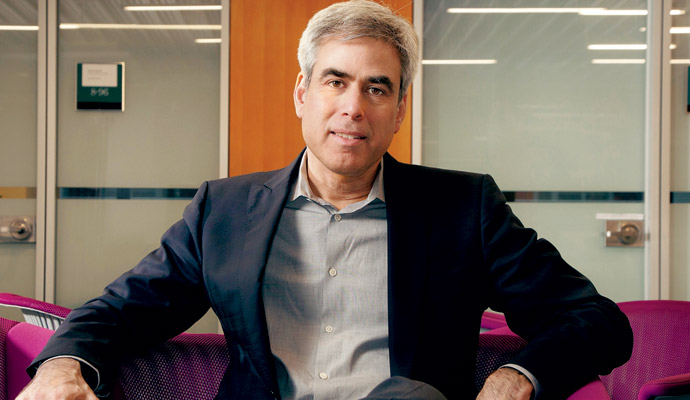
The Thought Leader Interview: David Kantor
An eminent systems therapist says that learning to recognize the hidden patterns in conversation is the first step toward more effective executive leadership.

Photograph by Peter Gregoire
Every once in a while, you meet someone who really knows how to “read a room.” This is the individual, often a seasoned executive leader, who can walk into a tense meeting and sense why two would-be collaborators are butting heads, why a third manager hardly speaks, and why a fourth seems to be protecting some unspoken priority. Then, with a few words, the individual can defuse the problem, get people back on track, and move the team to a new level of productivity. When this type of work is done with an executive team, it can have invaluable impact, cascading out to the rest of the organization as people practice and share their newfound skills. At all levels, the ability to read a room is considered by many to be a rare and special gift, innate and not teachable. Many people who have this gift admit that they don’t know how to teach it to others.
But one man has built his career around trying to help people track their conversational interactions, understand the hidden dynamics in them, and learn how to intervene effectively. By codifying these patterns, he has shown that the skills of insight can be taught. David Kantor was a family therapist based in Cambridge, Mass., when, in the 1980s, he began meeting regularly with a group of noted organizational thinkers at MIT’s Sloan School of Management. Kantor had the idea that the patterns he had seen in families—the recurring ways that people became stuck in groups, or fell into particular types of emotional turbulence when faced with a grave or urgent problem—might also apply to executive teams in businesses and other organizations.
Kantor began explicitly studying and coaching senior leaders. He took extensive notes on every interaction, trying to discover the combination of factors, as varied as an individual’s emotional and family history and the dynamics in the organization around him or her, that would lead some people to crack under pressure and others to thrive. Over the years, in part through working with such organizational learning experts as Peter Senge, Edgar Schein, and Chris Argyris, he’s become an influential theoretician of individual and group behavior.
His book Reading the Room: Group Dynamics for Coaches and Leaders (Jossey-Bass, 2012) assembles 40-plus years of organizational research and practice into a guide to conversational cues and meanings, with particular relevance for management interactions and executive teams. Kantor makes the case that being attuned to the signals of a conversational system—an approach he calls “structural dynamics”—is the first step toward becoming a far more prescient and effective leader. (He is currently launching a series of empirical studies on measuring and changing leadership behavior with the Massachusetts School of Professional Psychology.) He met with strategy+business at his Cambridge office to explain the way it works.
S+B: You suggest in your book that most leaders need a better model of human systems. Why is that?
KANTOR: In any situation, unseen, unspoken connections among people influence everything that happens. Leaders are typically not aware of these connections, and they can’t be, unless the right conceptual lens is available. The model I’ve developed over the years is a schema for understanding how people talk while they are making decisions together. It’s actually two models—one describing everyday situations, and one for high-stakes situations like crises and conflicts.
People behave differently under extreme conditions; there are breakdowns in communications, and things can move forward only if people can overcome those breakdowns. The decisions you make under that pressure are what define you as a leader.
The model is based on work I’ve done with groups—first with families, couples, and teenagers, and then with organizational teams and companies. I’ve been able to observe and track enough conversations in enough contexts that I think I have discovered a universal theory of the structure of communication. The theory suggests that communication can be deliberate; that leaders can measure and understand their impact (and everyone else’s impact) in any context where people make decisions. They can also design their own conversations to generate success or failure.
S+B: What do you mean by designing a conversation?
Kantor: Every conversation is made up of individual acts of speech: statements and questions. The speech act is my basic unit of analysis. Every speech act can be categorized as having one of four types of action (being a mover, opposer, follower, or bystander); one of three types of content (power, meaning, or affect); and one of three types of paradigms, or rules for establishing paradigmatic legitimacy (open, closed, or random). These categories combine into 36 kinds of speech acts, which are the building blocks of human interaction. They can be deliberately sequenced to set the direction of a conversation. Intervening with the right speech act at the right moment can catalyze a shift in thinking or action for everyone in the room.
I’ve worked with a number of organizational experts on this, and they’ve put the model under a lot of scrutiny during the past few years. There’s a basic skepticism, especially in the fields of economics and psychology, as to whether behavioral interventions actually produce results. This model allows us to test that question. You can train a team—let’s say a business executive and a group of direct reports—to explicitly shape their language according to this model. They can experiment with speech acts—deliberately trying out particular sequences—and see whether they produce higher performance or a change in the right direction.
S+B: What’s the difference between, say, a mover, an opposer, and a bystander?
KANTOR: First of all, they’re not categories of people. Although everyone has speech acts that they use more frequently than others, nobody is completely a mover, opposer, bystander, or follower. These are descriptions of vocal actions. Change your vocal action, and you can change how people perceive you. Change what people perceive, and you’ll change how they respond with their own vocal acts.
Let’s start with a single speech act: a statement you make. There are four basic roles you can play in a conversation. (I also call them action stances.) You can make a move: Start something new, like saying, “We need to spend less time in these meetings.” You can follow someone else’s move, by agreeing with it: “Yes, I’ve been concerned about the same thing.” You can oppose the move, raising objections or trying to stop it: “I don’t think that’s right. We need time to cover every topic on the agenda.” And then you can step back from the situation and stand by (or as I call it, “bystand”), reflecting on the actions being made, without agreeing or disagreeing: “Ian wants shorter meetings, Ralph wants to keep them the same length. What does everybody else think?”
A gifted communicator knows how to sequence these into compound actions. So if you’re dealing with fierce opposers, you don’t start off by opposing them. You bystand first. “I see how concerned you are about this decision, and it’s having an effect on the group.” Then you follow. “I think you have reason to be concerned.” Only then do you move. “It seems to me that we’ve got to change our decision and address your concerns, but we can’t lose the momentum of the original plan either.” Three different actions: bystand, follow, move.
The second dimension is called the communication domain; I also sometimes refer to it as the language people speak. Each domain is oriented toward a purpose, and you can see that purpose in the content of the speech act. Some acts of speech are in the affect domain; they involve words of feeling, seeking an increase in connection and intimacy. “This decision seems pretty heartless. I wonder how people will feel about it.”
Other speech acts are in the power domain, using words about getting things done, and their purpose is increasing competence and efficacy. “Who’s going to make sure that there’s follow-through here?”
Finally, there is the meaning domain: words about truth and reasoning, and content involving analytics and philosophy, with the goal of a higher understanding. “It is critical that the results reflect our standards for accuracy.”
S+B: And when one person talks in power while the other one speaks in affect, they can misread each other’s intentions.
KANTOR: That’s one of the most common reasons for breakdowns in communication. People also have preferences for specific communication domains; they do not honor ways of speaking other than their own, and this increases the likelihood that they’re going to speak at cross-purposes.
A third dimension is the paradigm about the rule of order: People have different views of the best way for human conduct to be regulated. All the governance structures in the world can be boiled down to three types. The open system is consensual and unregulated until it hits a point of action, and then an authority, chosen by the group, decides. A representative democracy is an open system. In the closed system, authority rests with position—the closer you are to the top of the hierarchy, the more authority you have. This system is highly regulated; a military regiment, for example, is a closed system. In a random system, authority remains with those who take and use it; the group continues to expand, experiment, and move.
Jazz bands are random systems, and so are most teams of innovators in an R&D department.
For most people, one of these three systems feels intuitively right. When a conversation doesn’t flow in the way they favor, they feel uncomfortable. I first saw that in my work with families—people intuitively sought out an open, closed, or random family—but I didn’t really grasp the difference until I learned about feedback mechanisms in systems theory. Closed systems rely on negative, or balancing, feedback; when something new happens, they instinctively move to regulate it and tamp it down. Random systems work through positive feedback; they reinforce novelty and make it stronger. Open systems combine the two forms of feedback; they are positive until they reach some point of dysfunction. Then the leader steps in….
S+B: “Let’s take a vote.”
KANTOR: Or, “We have to reach consensus.” Everybody must have a voice in the open system, even if it’s disruptive, but then it comes to a decision, a vote, a consensus. It shifts from a positive to a negative feedback loop.
S+B: How would I, as a leader, use all this to design a speech act?
KANTOR: Everything you say can be framed as a combination of these elements. Suppose you’re in a cold room. You could say, “Close that window now.” That’s a closed-system move in power. You could change it to an open-system statement by saying, “It occurs to me that people are wrapping their scarves around their necks. Will somebody near the window step over there and close it?” This speech act is still a move in power, but now you’re open. You’re giving people a choice; you’re looking for a volunteer. You could also switch it into affect, by saying, “It would be so much nicer if the room were warmer, and people felt more comfortable.” And you could move that into bystanding by saying, “I notice that people feel uncomfortable, but nobody seems to feel like closing the window.”
The goal of structural dynamics is to increase communicative competency, which means every member of the team becomes capable of reading the room. They know which interventions will improve the conversations. They ideally have full knowledge of the limits of their own repertoire so that when a speech action is called for, if they can’t do it themselves, they can call on someone else who is capable of the act.
S+B: Is there a person alive who can speak eloquently in all 36 speech act combinations?
KANTOR: I think so. And, by the way, this skill is the road to collective intelligence. The theory says that when a team is capable of communicative competency, there is an exponential leap to effectiveness. By becoming more competent, the team accelerates its ability to define new outcomes, new products, and so on.
It’s a bit like improvisational theater. In fact, when I first began putting this theory together, I read a lot about how actors study their craft, and how they are taught to improvise. The theater is fascinating, but it’s not effective by itself as a model for intervention, because it’s locked in to a very small group of activities.
S+B: In your book, you also describe a fourth dimension—the heroic modes, which come out only when there’s a crisis.
KANTOR: A perceived crisis. When the stakes are raised through stress or difficulty, people shift into more urgent, less thoughtful forms of conversation. Someone prone to affect shifts to being an advocate: from “I feel” to “we should,” arguing for passion’s sake. A power-oriented person becomes like a prosecutor: from “let’s do” to “you must do,” forcing others to perform. And a meaning-oriented person becomes an adjudicator: from “I think” to “I decide,” imposing a framework of logic.
If the stakes get raised even higher, these stances become even more pronounced; they turn into what I call “heroic modes.” The advocate is now a protector, doing whatever must be done to shield others from harm. The power-oriented prosecutor becomes a fixer, out to conquer all enemies and win at all costs. And the adjudicator retreats into being a survivor, intent only on manifesting the cause and getting through all the oppression and aggression.
Everyone unconsciously favors one of these heroic modes. They’re all morally neutral; none is more virtuous or vicious than the others. But they lead people, especially leaders, in directions that are counterproductive. At the start of a crisis, people enter the heroic modes in mild form, but they can gradually become more extreme: Fixers become aggressive, protectors feel wronged, survivors withdraw and endure. When left unchecked, they lead to the same basic attitude: The ends justify the means. And then the crisis accelerates. The fixers discover they can’t win, or can’t solve every problem; the survivors discover they can’t really withdraw; and the protectors find they can’t keep everyone from getting hurt. So they start to blame one another.
General George Patton was a classic fixer—and a hero until after World War II. Then all the stories about his vicious side emerged, about him slapping soldiers and so on.
S+B: What’s your advice for the leader—not the professional intervenor, but the person actually leading a group in a company?
KANTOR: There’s always a shadow side to human behavior. These shadows come from people’s childhood stories—from ways in which they weren’t loved. Greed is one kind of shadow, especially when it involves lack of care about anyone else. The crisis is often a manifestation of these shadows, and the enterprise and the industry will be threatened if the shadows are not contained. At that moment, a hero is called for: a leader who can find a way to transcend his or her own shadows, and also transcend the shadow-driven behavior of the systems around him or her.
Leaders are a special category, because what they do and say and the decisions they make affect many others. If shadow behavior is evident, and the leader is not willing to acknowledge it and take responsibility for it, he or she is a dangerous leader. He or she does not have control over the shadow side of the system.
On the other hand, if a leader becomes aware and conscious, in the moment, he or she can direct the system away from its shadow side, moving it in a far more powerful, and more beneficial, direction.
So, for example, a business team hits a crisis point, and the key members of the team are driving one another crazy. They are polar opposites. One is a fixer: “We have to move fast and cut 30 percent, with no nonsense about the damage to morale.” The other is a protector: “My God, do you really believe that? We’ll lose our best people, and the larger culture is going to suffer.” And then the survivor chimes in: “I’m going to keep our morale up, even if I have to do it all myself. I’ll work twice as hard, 24 hours a day. And we’ll get it back.”
If the leader of the team can read these moves in a high-stakes situation, he or she knows how to be a competent bystander. “If we listen to ourselves,” the leader might begin, “It’s clear we all want the same thing, but we’re going after it from different directions. Let’s focus on what we want to have come out of this mess.”
Given enough skill and experience at reading the room, a leader can make some moves that bridge the gap—that don’t just assuage the intuitive needs of the heroic modes of the individuals involved, but that make strategic sense. An individual who can do that well is obviously a superior leader. 
Reprint No. 00154