

The Innovator's Prescription: The Relevance of Brand Relevance
New product categories can subvert incumbent brands — or give them a new lease on life.
(originally published by Booz & Company)
 |
|
Illustration © Dan Page, 2004 |
To succeed in this fast-moving environment, management must pay attention to a new — and, for most, unfamiliar — attribute of the company’s products, services, and brands: their relevance.
Relevance is fundamentally different from the characteristics conventionally associated with a brand’s potency. All too often, a brand seems strong because tracking studies show that it retains a high level of trust, esteem, perceived quality, and maybe even perceived innovativeness. Customers remain satisfied and loyal. However, its market share may be slipping — perhaps significantly — and fewer customers, particularly new customers, are considering it. Conventional marketing theory and practice have difficulty explaining this paradox. Experience and research are now showing that a brand in decline often is in trouble not because of an intrinsic problem, but because the product category or subcategory with which it is associated is fading — undermined, augmented, replaced, or subsumed by a new, faster-growing category. Older brands may actually be inappropriate for the new category.
Brand management in the past focused on achieving preference on the basis of differentiation, benefits, and customer satisfaction within a set of brands under consideration for a given application. But in today’s environment, unless a brand can maintain its relevance as categories emerge, change, and fade, narrow application preference may not be sufficient. AOL faces a relevance challenge with seasoned Internet users in the broadband category because of its legacy as a friendly interface for new users in the dialup category. Hardware, paint, and flooring stores have struggled to remain relevant as The Home Depot and Lowe’s, with their broad selection of products and services, have subsumed existing categories and, in effect, created a new kind of brand.
The relevance problem is apparent in categories as “soft” as fashion and as “hard” as manufacturing. Imagine you were an automaker 15 years ago with a leading brand in the minivan category. As the category of sport utility vehicles (SUVs) emerged, it attracted a segment of buyers who previously might have considered buying a minivan. These potential SUV buyers still respected your minivan and believed it offered the best quality and value on the market; they may even have loved it and recommended it to friends interested in a minivan. But because this segment’s changing needs prompted its interest in an SUV, your brand, so identified with minivans, was irrelevant to it. This may have been true even if your company also made SUVs or had an SUV subbrand, because customers interested in the new category will not consider brands that have not developed interest and credibility within that category.
The challenge of brand relevance is akin to the challenge of innovation articulated by Clayton M. Christensen in The Innovator’s Dilemma: When New Technologies Cause Great Firms to Fail (Harvard Business School Press, 1997). Professor Christensen showed how industry leaders often are caught unawares by disruptive innovations precisely because they focus too closely on their most profitable customers and businesses, ignoring niche offerings for low-value subordinate segments that have the ability to grow in strength and value. Brand managers, likewise, are often blindsided by changing product categories precisely because they focus too closely on the traditional attributes of brands within their old categories. Their ultimate tragedy is to achieve brilliance in creating preference and differentiation, only to have that effort wasted because of a relevance problem.
“Brand relevance” is an oft-used phrase, but it generally has not been well defined or explained. Fortunately, there is a simple model that executives can use to assess their brands’ relevance, and to evaluate emerging product categories and subcategories. After presenting this model, this article will examine seven important product class dynamics that drive brand relevance. Finally, it will offer a framework by which companies can develop strategies for adapting their brands to changing trends in the marketplace. Companies have three options: to be trend neglecters, trend drivers, or trend responders. Neglecting trends is a risky road that often leads to oblivion; trend driving, with its huge upside, is certainly attractive, but rarely a real option. Most firms need to learn to be good trend responders, and build the organizational skills to detect, evaluate, and react to change, and to develop a well-conceived brand portfolio strategy.
Defining Relevance
Relevance for a brand occurs when three conditions are met:
-
A product or service category or subcategory — defined by some combination of attributes, applications, user groups, or other distinguishing characteristics — exists or emerges.
-
There is a perceived need or desire on the part of a customer segment for the category or subcategory.
-
The brand is in the set that segment considers to be material to the product category or subcategory.
To better understand relevance and the concept of product categories and subcategories, consider a simple model of customer–brand interaction. (See Exhibit 1.) Customer choice takes place in five stages. First, the customer is motivated by a problem, need, or opportunity — in this example, the need for personal transportation. Second, the customer selects a product category or subcategory perceived to be relevant to the problem or opportunity; he or she may decide to buy a luxury sports sedan rather than a compact or an SUV. Third, the customer determines which brands to consider — in this case, the choice might include Audi, BMW, Lexus, and Cadillac. In the fourth stage, perhaps after some evaluation, the consumer selects one brand from the consideration set. Finally, the product is acquired, and the process culminates in a usage experience that may influence the next cycle.
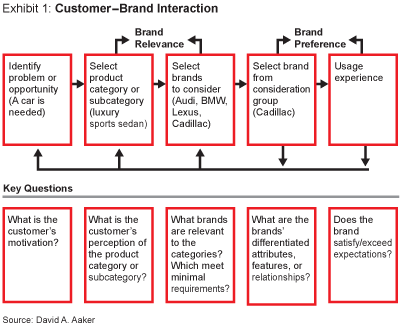
Brand relevance involves stages two and three of the framework — whether the product category or subcategory is deemed to meet the customer’s need, and whether a brand is associated with the particular product category or subcategory. A brand’s relevance depends on both. Although preference based on a differentiated offering and a positive use experience can help to enhance a brand’s relevance, if the need or category association is missing, the brand lacks relevance, and no differentiation, attitude, or relationship will help.
A distinction should be made between categories associated with a brand and brands associated with a category. Knowing which categories are associated with the brand is actually not very important. The key is determining which brands are associated with the product category or subcategory. Those are the brands that pass the relevance test. To be relevant, a brand should at least be recalled without aid. Simple recognition — when a customer identifies from a provided list brands associated with a particular product category or subcategory — is generally too weak a measure. (In fact, brands with high recognition and low recall are often termed graveyard brands.)
However prominent a brand might be, though, visibility is not enough to keep it relevant. Thanks to the rapid pace of global technology transfer, capital flows, and communications streams, product categories and subcategories can come into existence and disappear with startling speed. Because new categories can represent strategically important threats or opportunities, marketers have to be very attentive to the forces that drive their emergence. There are seven such dynamics.
1. A new product or service dimension expands the boundaries of an existing category. By personalizing and improving service, the Saturn and Lexus automotive brands changed the way customers interacted with car dealers, creating a new product subcategory that made other brands less relevant to a segment of consumers. In both cases, GM (Saturn’s owner) and Toyota (creator of Lexus) felt that new brand names were needed to support the novel dealer experience that in part defined the subcategory. In the yogurt business, the “eat-on-the-go” trend led Yoplait to develop Go-Gurt, delivered in a colorful nine-inch tube designed to enhance portability and to appeal to kids. Go-Gurt helped Yoplait forge ahead of Danone’s Dannon, a brand it had trailed for decades. A new subcategory had been created in which Dannon was not relevant.
2. A new product or set of products carves out a fresh niche in an existing category. The energy-bar market created by PowerBar ultimately fragmented into a variety of subcategories, including those directed at specific segments (e.g., Luna bars for women) and some possessing specific attributes (such as the protein-associated Balance and the calorie-control bar Pria). Each represented a subcategory for which the original PowerBar was not relevant. New subcategories can also be defined by new and distinct applications. Bayer Aspirin, for example, recognized a new application — heart-attack prevention — and created a subcategory with its Aspirin Regimen Bayer Adult Low Strength 81mg, which has an enteric safety coating to prevent stomach upset.
3. A new competitor devises a way to bundle existing categories into a supercategory. In the late 1990s, Siebel created Internet-based customer relationship management software by pulling together a host of applications, including customer loyalty programs, customer acquisition, call centers, customer service, customer contact, and sales force automation. In doing so, Siebel rendered irrelevant, for some customers, the more specialized application programs of competitors.
4. A new competitor repositions existing products or services to create an original category. Starbucks reshaped the coffee retail experience by positioning its outlets as the third place (after home and office) to define a person’s day. The use experience involved aroma, a break from routine, an affordable luxury, social interaction, and some self-expressive benefit from the appreciation of great coffee. In the U.K., Ford positioned its Galaxy minivan in relation to first-class air travel — comfortable enough to be suitable for busy executives. By highlighting attributes far different from those that would appeal to a buyer looking for a family vehicle, the automaker created a new minivan subcategory.
5. Customer needs propel a new product category or subcategory. Dual trends — wellness and the use of herbs and natural supplements — have supported a huge new beverage category, healthy refreshment beverages. It now contains a host of subcategories, including enhanced teas, fruit drinks, soy-based drinks, and specialty waters. The pioneer and category leader is SoBe, which started in 1996 with SoBe Black Tea 3G with ginseng, ginkgo, and guarna, and now has an extensive line of teas, juices, and energy drinks.
6. A new technology leads the development of a product category or subcategory. Asahi reshaped the Japanese beer market by introducing an innovative brewing process that reduced “body” and bitterness while increasing alcohol content. Its new product, Asahi Super Dry, had a very different taste from that of other Japanese lagers, and generated a new category, dry beer. As a result, Kirin, for decades the leading brand, with a dominant 60 percent share of market, suddenly was not relevant for the many customers attracted to the new category. Asahi’s market share — 8 percent when Super Dry was launched in 1986 — rose continually until it took share leadership in 1998.
7. A company exploits changing technologies to invent a new category. EBay Inc. created the online auction category by envisioning a service impossible until the advent of the World Wide Web — a national (and subsequently global) real-time auction market for myriad types of goods, from used guitars to new houses. Although imitators have cropped up, they have had difficulty positioning themselves as acceptable alternatives because of eBay’s operational performance, its critical mass of users, and its authenticity as the original category leader. TiVo Inc. created a new category for home television viewing by combining the personal video player, a computer hard drive, and an electronic program guide, changing the way people watch television. Any new entrant has to define itself with respect to TiVo.
Structuring Responses
How a firm responds to emerging categories and subcategories in its field of endeavor can be the difference among market dominance, continuing viability, and slow death. Experience and logic indicate that, when it comes to brand disruption, firms come in three flavors: trend neglecters, trend drivers, and trend responders.
Trend neglecters fall into three categories. “Stick to your knitting” firms are not motivated to stay informed about market trends. They are committed to and focused on their own model and believe that operational excellence will overcome market dynamics — or they lack the resources to change strategies. They also feel, sometimes with justification, that chasing apparent trends will waste resources. The “any color as long as it’s black” Ford strategy of the 1920s — which allowed General Motors to overtake permanently the pioneering automaker — is a legendary case. Tunnel vision may be defensible and may even result in superior performance for certain firms in specific markets, but it is risky. Trends tend eventually to overwhelm the static, inflexible firm. Such firms must make sure that they do what they do well, and that disappointing growth and financial strains do not lead to cost cutting that affects the customer experience, undercutting their position with the customer base for which they are still relevant.
The second type of trend neglecter mistakes trends for fads. In 1977, Ken Olson, founder and CEO of the Digital Equipment Corporation, then the leading maker of minicomputers, said, famously, “There is no reason anyone would want a computer in their home.” As PCs caught on, Digital rapidly went from market leader to struggling also-ran; eventually, it was acquired by Compaq. In addition to needing a periodic arrogance check, this type of company usually needs to improve its ability to understand competitor capabilities.
The final type of trend neglecter is the firm that wants to identify, evaluate, and respond to market dynamics, but is not very good at it. Such a firm is usually characterized by an inadequate external sensing system, executives who are not customer-driven, and an inflexible organization. Many corporate disaster stories can be traced to these organizational limitations. This sort of trend neglecter will benefit from investing in the missing capabilities.
Trend drivers participate in the creation of new product categories or subcategories — a terrific capability that, unfortunately, few firms have. Even companies that possess the requisite skills to drive trends have only occasional windows of opportunity. A premature effort to create a category can fail because the underlying technology is not ready or the potential market has not reached the tipping point. Witness Apple Computer Inc.’s failure to create the PDA category with its Newton organizer, only to see Palm Inc. succeed a few years later. (See “The Innovator's Prescription: The Art of Scale,” Summer 2004.)
To succeed as a trend driver, a company must have real ammunition; a breakthrough product wouldn’t hurt. Further, the firm needs to be capable of turning a first-mover advantage into a sustainable position by actively managing customers’ perceptions of the new category or subcategory and asserting a dominant brand position in the new arena. That requires not only resources and recognition of the expanded brand-building task, but also competence in brand building.
IBM was a trend driver during the latter half of the 1990s. At the time, many firms were attempting to show their relevance in the emerging world of networked business. Although terms such as “network computers” and “information superhighway” lacked the traction to create a new business category, IBM succeeded with “e-business.” After introducing it in late 1996, IBM ultimately spent more than $5 billion building the e-business label and positioning its business units within that context.
Trend responders closely track the emergence of trends and the evolution of subcategories, and take responsive action to keep their offerings current and relevant. Because neglecting a trend is risky and driving a trend is rarely an option, developing trend responsiveness capabilities is the best strategy for the majority of companies.
Learning to be a trend responder is feasible for most firms, but it is not easy. It involves two primary capabilities. The first is to recognize and evaluate trends. Organizations that do this well share several characteristics: an externally oriented, market-focused culture; an information system that captures and distills intelligence; top management concerned with market dynamics; and solid business strategists who are empowered to act. Evaluating a trend can be more difficult than identifying it. Will it represent a worthwhile opportunity, or are competitive intensity and overcapacity already predictable? Is it real and substantial, with a value proposition behind it? Can the firm realistically participate, given its strategy, assets, and competencies?
Trend responders must also be able to modify, reposition, and/or rebrand their offerings so they remain relevant despite the market’s evolution. Any repositioning or rebranding needs to be respectful of the brand’s heritage and compatible with the ability of the brand and the organization to deliver on the promise. The company needs to develop a point of difference from competitors, with a unique take on the new product category or subcategory.
The fast-food industry today is a good case study in trend response and relevance. McDonald’s, Wendy’s, Burger King, Pizza Hut, Round Table Pizza, Taco Bell, KFC, and others make up the “traditional” fast-food category. Customers of these chains value upbeat, familiar, convenient, economical offerings. In recent years, the industry has seen the rise and rapid growth of a “healthy fast-food” subcategory, populated by such brands as Subway, Souper Salad, and Sweet Tomato, attractive to customers who value the attributes of fast food but who also are interested in healthy eating. The subcategory is driven by an overall trend toward health consciousness, evidenced by such phenomena as increased interest in physical fitness, more health news coverage, legal attention to the problem of obesity, the popularity of diet plans, the growth of the organic foods industry, and the success of health-oriented food retailers.
Augmented by the healthy fast-food subcategory, which is drawing in customers for whom fast food previously was not relevant, the total fast-food market is now larger. There is thus an opportunity for the incumbents. But the new subcategory is also taking customer dollars away from traditional fast-food marketers, and transferring preference and spending to the newer, more relevant brands.
The relevance challenge for incumbents is to respond both to the threat the new subcategory poses and to the opportunity it represents. They must analyze the new category’s components and dynamics; they must also analyze the forces behind the emerging subcategory and the customer segments it is attracting, and determine which niches they themselves can exploit.
A variety of strategic responses is available to the traditional players. They could attempt to build sales and loyalty from their core customer group — by improving product quality, enhancing the customer experience, or attempting to inject energy into their brand marketing. In this strategy, growth might not necessarily be a priority. In fact, an “incumbent market” strategy could be accompanied by some downsizing and cost reduction to reflect the downward trend of the still substantial market.
Four other potential response options address the challenge more aggressively. In the fast-food industry, these are the ones the traditional chains, for the most part, are pursuing.
One is to use new products to alter the current brand image and make it acceptable to the new subcategory’s customers. McDonald’s modified its menu to appeal to consumers in search of healthy fast food. It developed a way to make its signature fries with dramatically reduced “bad” fat and eliminated some of its super-sized offerings; for several years it offered the (since discontinued) McLean Deluxe burger. Burger King introduced the BK Veggie Burger, and Taco Bell launched reduced-fat “Fresco Style” offerings. Such a strategy, however, is like turning an ocean liner; there is a lot of inertia to overcome. Overall, the traditional fast-food chains lack brand credibility in the new subcategory. They are too strongly associated with traditional offerings such as the Big Mac and the Whopper, which are not linked to healthy eating. Such brand strength can become a liability when a restaurant attempts to adapt or change an image. In addition, the loyalty of the traditional customer segment can be put at risk when the basic menu is altered.
A second trend-response option is to go beyond mere acceptance, and, through the creation of strong subbrands characterized by exceptional products, become a “destination brand” for the new consumer segment. In the fast-food industry, Wendy’s Garden Sensation Salads line has the potential to draw health-segment customers. It not only provides relevance for new customers but also protects the original brand from being contaminated by the new initiatives — no customer will confuse Wendy’s core offerings with the branded salad offerings. To create such a category, however, the company must hit a home run, creating a branded product or line that generates buzz and a following. It’s far from easy: A host of McDonald’s attempts, from McVeggie Flatbread to McPizza to Salad Shakers, have failed to gain acceptance.
A third option for trend responders is to partner or cobrand with firms that have credibility in the new category, sharing some of the upside in order to save the time, cost, and risks involved in creating a new brand. McDonald’s successfully introduced a line of premium salads complemented by “all natural” Newman’s Own dressings. The alliance with the actor Paul Newman’s flourishing line of food products provided a boost by generating interest, acceptance, and credibility.
Although cobranding is a powerful tool for responding to a relevance problem, it can be difficult to find the right cobrand, generate an exclusive arrangement, and develop a product that will deliver against the emerging subcategory. Starbucks and Barnes & Noble — which saw mutual benefits in linking the former’s “third place” coffee experience with the latter’s development of customer-friendly book superstores — went through several permutations of their relationship before settling on the simple supplier–buyer affiliation. Furthermore, managing the relationship between two organizations whose needs and priorities may change over time can be tricky; among other things, customers may develop a relationship with a cobrand whose long-term availability is uncertain.
A fourth option for trend responders is to create or buy an entirely new brand platform. Wendy’s has Baja Fresh, a Mexican chain; McDonald’s invested in Boston Market, the Pret A Manger sandwich chain, and the Chipotle chain of gourmet burrito restaurants. This option recognizes that success in the new subcategory requires a brand that is on-market, is relevant in the new category, has a sound value proposition, and requires no brand compromises. It is difficult, though, to find a concept that will resonate with customers and stand out from competitors in a cluttered marketplace, while being scalable enough to make the business significant. McDonald’s, for example, needs concepts that can support at least a thousand locations; anything smaller won’t deliver appropriate shareholder returns, fit with the firm’s operating skills, or benefit from its economies of scale.
The Relevance Challenge
Becoming a trend responder is within the range of most companies’ abilities. L.L. Bean has evolved its brand from its original base of hunters, fishermen, and campers to become relevant for hikers, mountain bikers, cross-country skiers, and water-sports enthusiasts. Fuji Film was quick to becoming a leading digital-imaging brand with its Super CCD high-quality sensor for digital cameras. AOL may face challenges adapting its brand to the broadband era, but its even older corporate sibling, Time Warner, has managed to become a top “broad brand” with its Road Runner high-speed Internet access service.
But trend responsiveness carries its own set of risks. The drive to maintain relevance can prompt a company to chase too many subcategories, both real and imagined, resulting in a diffused, ineffective, and expensive strategy. Response must be guided by serious analyses. Is the opportunity large enough to justify? Is it defensively necessary? Is the trend real, or is it a fad — is it MP3, or merely eight-track? Does the firm have the ability to develop the skills needed to compete? Does it have the brand assets needed?
Companies need capabilities beyond the detection and evaluation of emerging subcategories. They require creative, powerful new offerings; entering an emerging category without them is more likely to waste resources than to create relevance. A brand strategy may require developing a new brand, an endorsed brand, or a subbrand to carry the flag. If the necessary brand assets are not available, they need to be built or acquired. Finally, staying relevant in dynamic environments can require an organization to become more outward looking, customer focused, flexible, and nimble — perhaps the toughest challenge of all.
|
Focus: Charles Schwab — Five Times a Trend Driver |
|
Charles Schwab & Co. has been a “trend driver” — a firm that defines new product or service categories or subcategories — several times in its history. In the 1970s, Schwab was an early entrant in the discount broker category, which served to make full-service brokers less relevant to an important market segment. During the 1980s, Schwab expanded the boundaries of the discount broker category by repositioning itself as a discount broker that also had state-of-the-art computer systems, reliable execution and service, and exceptional reporting tools. In doing so, Schwab made many of its discount broker competitors — especially those competing more narrowly on price — less relevant. In 1992, Schwab again changed the boundaries of the category by offering, in addition to its discount brokerage service, an innovative vehicle for buying and managing a large variety of mutual funds with no transaction fees, under the subbrand OneSource. For investors, this meant there was now little motivation to search multiple brokerage firms for mutual fund options and do cross-firm analysis. Data on mutual funds was all conveniently packaged by Schwab and supported by a comprehensive information system. In 1997, Schwab, after several unsuccessful efforts at providing computer-based transaction options for customers, made a commitment to offer trading over the Internet, even though this meant risking much of the company’s commission income, which at the time came from telephone orders. As a result, the firm became one of the first brokerages to be defined as an “e-company” for securities trading. In the process, Schwab again helped define a new category in which it became a dominant brand. After 2000, Schwab again moved to create a new category by becoming a full-service brokerage that nonetheless lacked the investment banking business that many megamerged financial-services companies had — a conflation of interests giving rise to perceived, and sometimes real, conflicts at traditional brokers. The company’s aim was to offer advice that appeared objective, uncomplicated, and, importantly, not driven by commissions. The effort follows from the Schwab vision “to provide our clients with the most useful and ethical financial services in the world.” The new position was supported with a host of innovative branded products and services for individual and institutional investors, such as Schwab Advisor Network (a service that refers clients to fee-based independent advisors), Schwab Equity Ratings (an objective rating system for more than 3,000 publicly traded stocks), and Schwab Personal Choice (which matches resources, advice, and support to the needs, style, and goals of the investor). The Schwab experience suggests five lessons. 1. Instead of resulting from a distinct decision, business strategy often evolves. Schwab’s strategic position expanded over time and was not preplanned or deliberately executed. Each step was part of a process that only sometimes resulted in a watershed decision. 2. Creating a product category does not necessarily make the existing category irrelevant. Schwab’s strategic position as a discount broker was not eliminated or even scaled back when it stepped into new categories, but rather was augmented so the brand became richer and deeper rather than different. The firm remained true to its heritage as it expanded the scope of its brand. 3. A firm that attempts to create a new product category or subcategory without the support of a subbrand has a difficult branding task because the scope of the master brand is likely to be stretched. Subbrands such as OneSource and Schwab Equity Ratings provided a way for the Schwab brand to go to new places without damaging its original meaning. 4. A first-mover advantage will be short lived if it is not supported by resources and innovation, or actively managed over time. Schwab OneSource was a moving target for competitors. Mutual funds were added periodically. A method to screen funds was created. The Schwab Select List, a concise roster of the prescreened mutual fund picks by category, provided the ultimate aid. 5. Strength also creates vulnerability. As a firm’s position becomes stronger, it becomes harder to adapt to changing markets. At each evolution of its brand, Schwab has had to be mindful of its past. The evolution to a full-service firm may be the hardest of all because of Schwab’s legacy as a limited-service firm. — D.A.A. |
Reprint No. 04207
David A. Aaker (daaker@prophet.com) is vice chairman of Prophet Brand Strategy (www.prophet.com), a brand marketing consulting group, and professor emeritus of marketing strategy at the Haas School of Business, University of California, Berkeley. He is the author of 12 books, most recently Brand Portfolio Strategy: Creating Relevance, Differentiation, Energy, Leverage, and Clarity (Free Press, 2004).
This article is adapted from David A. Aaker’s latest book, Brand Portfolio Strategy: Creating Relevance, Differentiation, Energy, Leverage and Clarity (Free Press, 2004).

