
Building the Advantaged Supply Network
Working in tandem, buyers and suppliers can find better ways to cut costs and increase innovation.
To satisfy shareholder expectations for ever-improving returns on capital and to meet customer demands for lower prices, there’s nary a company on earth that isn’t on a crusade to control costs, especially in the supply chain. For manufacturers, that means doing whatever it takes, year in and year out, to keep a lid on the prices of raw materials and component parts purchased from suppliers. In the automotive industry, purchasing departments, which control 60 to 80 percent of the bill for parts and materials, are under the gun to strive for 4 to 6 percent annual reductions in these costs.
 |
|
Illustration by Red Nose Studio |
Facing such pressure, the paramount objective of the purchasing department of a typical original equipment manufacturer (OEM) is to negotiate a price that is lower than the market-based benchmark for that commodity or part. This causes buyers to solicit bids from their suppliers for every new program, and then award the contract to the supplier — new or existing — that agrees to deliver the right part with the right specs at the lowest price.
To be sure, bidding out every program and aggressively negotiating prices drives down manufacturing costs. Furthermore, the bidding process forces inefficient suppliers to understand why they lose bids and to make changes — or risk going out of business. This system also naturally imposes some pressure on producers to improve process technologies, to implement lean manufacturing, and to make more parts in countries where production costs are low. But in the end, purchasing executives of large companies with whom we have worked concede that the prices they’re paying for parts and materials still are not as low as they’d like, and they still are not satisfied with other costs throughout their supply chains. And most don’t believe that supply chain management, as currently prosecuted, is a source of competitive advantage.
We believe executives struggle, in part, because when they concentrate on “piece part” prices, they overlook the millions of dollars in potential costs generated by the constant one-upmanship inherent in the traditional bidding process — the rounds of post-auction engineering changes that drive low prices back up, supplier bankruptcies, late deliveries, and other fallout associated with a management process that encourages supplier turnover. Moreover, because buyers and suppliers are so intent on getting the price right, they don’t examine or sufficiently communicate with each other about such other significant sourcing and production variables as design, faster time to market, quality, and innovation, which are all crucial to supply-based competitiveness.
There is a better way, and we’ve seen it work.
A few companies — often market leaders in their industries — have moved away from single-transaction interactions with suppliers. These leading corporate buyers have built what we call an advantaged supply network. An advantaged supply network does not have pricing self-interest as the only basis for the buyer–supplier relationship; rather, it aims for participants in the network jointly to create competitive advantage from diverse sources — for themselves and for others. Buyers strive to work closely with suppliers to attack inefficiencies and waste in the supply chain, to coordinate their business strategies, and to manage resources together for competitive advantage. Efficiency and innovation in manufacturing are gained through such cooperative buyer–supplier strategies as collaborative product and process planning, integrated engineering and design, and other forms of cooperation that lower total costs, decrease time to market, and improve the quality of the entire supply base’s output.
Whereas the price-driven transactional management model encourages transient relationships between buyers and suppliers, the advantaged supply network creates incentives for buyers to build deeper and longer-lasting relationships with suppliers, so that both sides can more effectively pursue, over time, many opportunities to bolster economic stability and competitive advantage. The network also encourages players to look for and eliminate waste.
Of course, an advantaged supply network doesn’t develop overnight. Generally, companies have to restructure their existing supply base, which usually results in fewer but more capable supplier partners. And it can take time for some of the benefits of the network to show, even after a restructuring is complete. The results, however, are impressive. We have seen companies achieve upward of 20 percent net savings in the first two to three years after restructuring to create an advantaged supply network.
The competitive barriers the network develops are also formidable. Toyota created an advantaged supply network that has given it a significant edge in per-vehicle cost of production over U.S. rivals, half of which comes from reduced material, labor, and warranty costs. Because of its approach, Toyota has detailed knowledge of the costs of its suppliers’ technology and manufacturing processes, and a significantly more flexible global manufacturing system. Just as important, Toyota’s excellent record of new product launches and high product quality have given it the ability to charge higher prices for its cars, an advantage that will take a long time for its competitors in the mass-market automotive sectors to match. Interestingly, Toyota does not always get the lowest piece part price.
Often, when companies talk about extended enterprise networks, whether in the supplier realm or in other collaborations, building trust among partners is the central issue. But the advantaged supply network is not a management model built on trust for trust’s sake. This model pushes business partners both to collaborate with each other and to compete with others: to be the best at what they do, to accept that being the best is a moving target, and to work hard at managing trade-offs and making compromises.
The highest-functioning advantaged supply networks don’t just help create leaner businesses; they make stronger competitors that deliver better products. Several years ago, Frito-Lay, the snack food division of Pepsi and the largest supplier of potato chips in the world, canvassed its potato suppliers to identify those farmers willing to concentrate on cultivating a very limited number of potato varieties used to produce the most appealing potato chip for the consumer. Frito-Lay then extended long-term contracts to these farmers, which made it easier for the farmers to get financing and for Frito-Lay to achieve more efficient, profitable economies of scale in other areas of the value chain. Frito-Lay’s preferred potato supplier network has helped the company achieve a 59 percent market share in the salty snacks business, and some of the highest operating margins in the industry.
In aerospace, Boeing has recently started sharing its technology plans with its top suppliers in joint forums so that the suppliers can focus their R&D in technology areas favored by Boeing, their biggest customer. The aircraft giant also is adopting new ways to engage key suppliers earlier in the development process by first narrowing the field quickly to, say, two suppliers. Then, Boeing works with each supplier separately to protect the supplier’s proprietary data and get their best ideas on the table while the contract is still open. This also reduces the risk for everyone of missing cost and schedule targets. With this initiative, Boeing has made the shift from price-only competition to competition involving technology, total cost, and ultimately better performance for the end customer.
No matter what the product or industry, the logic of the advantaged supply network is premised on a powerful idea: With a more capable, efficient, and stable supply base, companies can not only lower costs but create better products, and achieve the right cost structure to grow market share and profits.
Transaction Mind-Set
If companies were to challenge the transactional supplier management model and closely examine typical purchasing department processes, we think they would see the many unintended consequences of the current model that hurt their businesses. For example, when contracts require year-over-year price reductions, or when purchasing departments must aggressively press for lower prices to meet their annual savings targets, it’s not surprising that suppliers push back. (See Exhibit 1.)
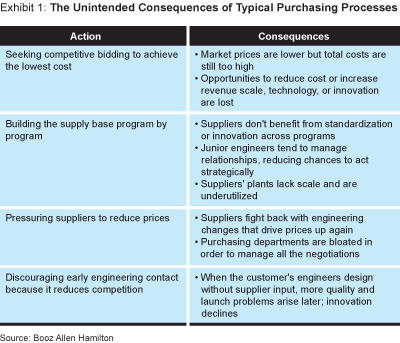
Another criticism: It doesn’t take long for a supply base that has been built program by program to become overgrown, which affects the company in a variety of ways. For example, when a supplier is one among too many, it’s impossible for that supplier to look broadly at its customer’s engineering capabilities, program management, plants, and numerous parts categories to rationalize and improve part design.
Relentless demands by suppliers for engineering changes and price renegotiations also absorb a huge amount of their and the customer’s management, engineering, and purchasing resources. This creates counterproductive tension. Suppliers hide profits and work hard to drive up margins, instead of putting their energy into delivering world-class service for their customers. Customers, on the other hand, may feel exploited by aggressive suppliers, which can lead them to impose outrageous demands (e.g., across-the-board purchase order price reductions after all negotiations are complete, or last-minute part changes that require large capital expenditures). Customers frequently threaten to take away their programs if suppliers don’t comply. As the customer’s workload expands, the number of its purchasing managers swells, too. As a result, suppliers have little or no opportunity to interact with their customer’s senior management — and have no chance of developing a more strategic relationship with that customer.
There’s another major problem in a business environment that encourages companies to look out only for their own interests: disincentives to innovate. For example, suppliers frequently don’t get paid for investments made to generate product and process innovations. Consider the supplier that creates a new design for a specialized application. An OEM may like a supplier’s design, but if it feels the supplier’s price is too high, the OEM may take the innovation, apply it to its own part design, and then solicit competitive bids for the part’s production. In doing so, the OEM is in effect taking the concept and the knowledge from its supplier’s product and transferring the value to other suppliers without paying for the innovation. Although in many cases patents or other agreements protect suppliers from such practices, some innovations are quite subtle. A legal environment that protects all ideas is cumbersome, and suing your customer over intellectual property infringements is hardly an appealing business practice.
A Different Dynamic
The advantaged supply network strategy creates a very different — and we believe more productive — dynamic between the buyer and suppliers. For example, buyers expect their suppliers to earn fair margins for their technologies and to meet best-in-world cost targets.
When buyers and suppliers cooperate — by sharing information about their respective businesses, investing in superior technology to achieve joint business objectives, and learning together about opportunities to improve processes and eliminate inefficiency and waste — they can achieve business benefits that just can’t happen in a transactional model. But making a network function for maximum impact takes a lot of effort. If anything, performance standards are tougher than before. For instance, meeting cost reduction goals is harder for the managers who handle sourcing and procurement because they can’t justify their contributions to cost reduction just by negotiating the lowest piece part price; these managers need to be well versed in product-performance trade-offs and costs before the bidding begins. They must also be proactive in finding ways to help the supplier be better at what it does. And they need to create systems to find the next best practices, sometimes looking outside their current supplier base.
Achieving shared economic advantage is a game-changing model, and the executives and managers involved in designing the network have to be skillful in maintaining some competitive tension with suppliers while getting the right level of buyer–supplier management integration. In the advantaged supply network, buyers and suppliers must understand their specific roles and responsibilities in making the network effective for each member. The buyer that helps its supplier improve its cost structure is more likely, in the long run, to also benefit from the supplier’s economic edge.
A fully developed advantaged supply network tries to account for all elements that influence manufacturing costs, such as plant scale, process technology, location, logistics, wages, and capacity utilization. If “designing a part for manufacturability” is the goal (i.e., faster, easier, less-expensive production), having the right supplier in place to get involved early in the design process is the key to success. (See Exhibit 2.)
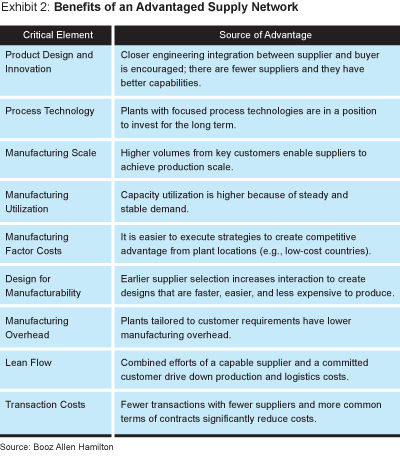
From the supplier’s perspective, greater integration in the buyer’s design process lowers the risks every supplier bears when bidding for a part. Just as important, design integration allows the buyer and its suppliers to work together to achieve the competitive imperatives of shortening time to market and reducing development costs.
The size of a supplier network will vary widely, depending on the individual company and the demands of its industry. Toyota’s advantaged supply network has about 300 preferred suppliers. Frito-Lay’s supplier network for potato chip production has fewer than 100, down from several hundred suppliers it used before its restructuring. Other networks might have fewer than 10 suppliers. The guiding principle is to maintain close relationships with a manageable number of key suppliers so the customer can benefit from a supplier’s more efficient leverage of its process capabilities. For example, one of our clients consolidated its supply base and then developed a process technology with one of its suppliers.
Although it is true that a competitor can eventually copy any or all of the elements of a best-practice manufacturing model, the supplier with a “focused factory” (a factory that makes certain specialized parts as opposed to standard parts, and that has invested in process technology aligned with its focus) has an advantage that is difficult to replicate quickly. But to achieve this position, suppliers often need their customers’ help. A supplier that picks up business one supply program at a time can only invest piecemeal in process technology, and therefore may never achieve competitive scale. Nor is it likely to be capable of building a plant in Michigan, China, or Mexico that can operate at the right scale, sustain high-capacity utilization, and have the best process technology for the particular type of plant.
Moving to an advantaged supply network also eliminates most of the cost of switching suppliers — and reduces the risks of regularly having to enter new relationships with unknown players. Who knows how often a buyer ends up with a supplier that won the contract by “buying” the business with the lowest bid, but didn’t have the resources to fulfill the contract? These days, companies don’t have the extra engineering resources to rescue such under-resourced suppliers; and most have trouble just supporting their own processes.
A supplier that is part of an advantaged supply network may try to co-locate design engineers with its customer’s engineers, and use factories that are near its assembly plants for producing parts that are expensive to ship. Co-locating engineers becomes even more important when the strategy is to move production of certain parts to lower-cost countries.
The Fasteners’ Tale
As an illustration of the impact of going from the transactional price-based model to an advantaged supply network, consider this true — and typical — tale of a company from our own experience in supply base management.
By bidding out every program in an effort to continually shave its supply costs, one multinational automaker found itself burdened with 130 fastener suppliers for its 21 plants in North America. Multiple suppliers were producing nearly the same fasteners. Machinery was underutilized and economies of scale were diminished. Scale advantages were also reduced in the purchase of raw materials. For instance, all the suppliers bought steel in costly separate purchases, instead of buying in bulk at a lower price.
Management inefficiencies were widespread. Hundreds of managers were working the “interface” between the auto company and its suppliers, but none of them had the time, inclination, or familiarity with one another to think about anything other than their immediate problems. The buyer’s purchasing managers had toured only three of the 130 plants in its supply base. When there was a quality flaw in a fastener, the suppliers’ engineers felt compelled to explain why it wasn’t their fault, instead of, for example, considering how the product might be redesigned to use fewer fasteners and thus reduce the opportunity for flaws.
Even if they had wanted to try, suppliers didn’t have enough information to identify design improvements for parts, or opportunities to lower costs through part standardization. The buyer’s engineers didn’t work with the suppliers’ engineers to resolve these problems, because they were too busy designing the next fastener. The buyer and suppliers never talked about investments for the future. With so many suppliers to deal with, it was impossible for the buyer to learn about an individual supplier’s capabilities, much less think about the supplier’s vision. Moreover, since none of its suppliers had plants in countries with lower manufacturing costs, the company launched a separate offshore manufacturing initiative, which further complicated relationships with suppliers.
Frustrated by the cumulative effects of rising costs, inefficient management, and missed opportunity, the auto company decided it had to do a thorough restructuring of its supply base. Often it is the savings from restructuring a bloated supply base that pave the way for a company to transition to an advantaged supply network. Starting with a clean sheet of paper, the automaker’s top management imagined an entirely new structure and composition for its supply base. They asked basic questions: What would the ideal set of suppliers look like if we started over today? How many plants do we need? What should their size be? Where should plants be located? What should different plants be producing? What type of equipment should we have to produce which parts? Where is the waste, and how can we reduce it? How do we keep innovation and competition strong?
Once it had a clear vision for the network it wanted, the automaker approached a set of suppliers it thought had visionary management, strong financial health, manufacturing facilities close to the ideal, and a willingness to invest in the network. As it turned out, self-selection was also important to the process; not all suppliers invited to join the network signed on. In the end, the automaker’s vision of a new supply base reduced its fastener suppliers from 130 to just five.
Each of the suppliers in the new network had a focus for its operations, but each also had capabilities that overlapped with those of the four other suppliers. Having suppliers with overlapping capabilities promotes healthy internal network competition, while suppliers still can sharpen their skills in specific areas. In the perfect network, each supplier has enough latitude to build the capabilities to achieve competitive advantage, while serving the customer that has committed to planning for and sharing economic benefits. Additionally, overlap ensured there was backup manufacturing in case one of the suppliers failed.
Once the suppliers were in place and the network began to operate under new principles of management, positive effects quickly became evident. Interactions among managers became more strategic. People began looking at reducing costs in the total supply system. Engineers and managers from the company finally met with their counterparts from the suppliers now that they had a supply base of an appropriate size.
No matter what the number of suppliers, the benefit of trust in an advantaged supply network comes from better communication and smarter interaction among the participants. For example, when the automaker restructured its supply base, it committed to provide the five suppliers joining its network with a volume of business sufficient to make it worthwhile for the suppliers to participate. In turn, suppliers committed to reducing prices over time.
The buyer plays a central management role in making the network effective. It takes the lead in building the network. Further, since the buyer must know best-in-class practices, it must put in place mechanisms to understand, measure, and drive suppliers’ continuous improvement. When appropriate, the buyer must be able to convince suppliers to invest in new equipment, build new plants, hire new personnel, or move manufacturing to low-cost countries. The buyer also needs to be proactive in balancing the interests of all network participants so that the needs of different suppliers are addressed. As a network grows stronger, the buyer should take the initiative to help suppliers find the root causes of problems — and to help solve them using the buyer’s resources. Finally, even though a buyer may commit to buying a certain volume of product from its network suppliers, it also has to make sure suppliers don’t become complacent. It’s easy for a supplier expecting multiyear guaranteed volume to ignore a customer’s changing requirements.
Guidelines for Success
Our experience in helping a number of large manufacturers restructure their overgrown supply chains suggests several questions a company can ask to determine if it is on the path to building an advantaged supply network. (See “Eight Benchmarks in Building an Advantaged Supply Network,” below.)
|
Eight Benchmarks in Building an Advantaged Supply Network |
|
There are also nine critical management principles buyers should follow, which underlie the success of an advantaged supply network:
1. Have a clear supply network strategy, and ensure everyone supports it. Companies will almost reflexively revert to arm’s-length bidding schemes if all internal managers don’t agree to, and live by, the new strategy. That means not only managers in purchasing, engineering, and manufacturing, but also those in other business functions, such as sales and marketing. There must be consistency in applying new management principles. A supplier that receives the same key messages from all its customer’s managers is more likely to make the long-term investments the network needs to succeed.
2. Commit to building an innovative supply base. Building an advantaged supply network makes it possible to introduce innovations that are two to three years ahead of the competition. With cost models and an information database of best practices available, knowledgeable people at the buyer can determine the costs for a specific best practice in manufacturing a part or component. However, the buyer must also know well the industry standards and technologies for the parts they procure.
3. Choose carefully, then guide suppliers. Not every supplier has the right attitude or aptitude to be a best-in-class company. Over time, a supplier can become one, but only if it has the underlying desire and market position. If a supplier is selected and accepts the invitation to be a part of the network, the buyer and the supplier need to work in tandem to improve operating costs. That is what creates value that exceeds what a one-off pricing relationship can accomplish.
4. Create the right supplier structure. There is no “correct” number of suppliers in an advantaged supply network. But a buyer needs to know what the sufficient number of the right type of suppliers should be to achieve the desired performance in cost, quality, and productivity for the whole network. Having too many suppliers will undermine efforts to create the scale necessary to make substantial improvements in a supplier’s economics or influence its management behavior. Having too few suppliers is equally problematic. We recommend selecting at least two overlapping suppliers per category to ensure internal competition, making sure that each supplier has distinct roles as well. Having suppliers able to stand in for one another adds financial stability and reduces the risk of supplier shutdowns.
5. Develop a new purchasing paradigm. Shifting from a “negotiating” paradigm to a “creating best practices” paradigm requires the buyer to gather knowledge of costs (not just price) from suppliers worldwide. Even pricing models are not enough, since they do not reflect the true costs of operations. A buyer in an advantaged supply network has the ability to give a supplier a price objective for a program knowing that it is world-class — and feeling confident that the supplier will get a good return on capital. Purchasing organizations accustomed to beating up suppliers over price, and interacting only with their suppliers’ junior staff, must change their behavior dramatically when they have to collaborate on setting strategy with a supplier’s senior managers.
6. Determine the pace of the transition. Transitions occur when a buyer replaces one or more existing suppliers or brings on new suppliers. The transition from one supplier to another can be made quickly if the new supplier (or suppliers) can cost-effectively retool and has capacity available, or if there is a second tier of reliable suppliers to cover for the one that is leaving.
But moving too fast in a supplier transition can be risky. Financial and time costs, such as getting approvals for new suppliers or the retooling of machinery, can be substantial. Sometimes it makes sense to keep a program with the current supplier, especially if it is about to expire, or if the production volume is low and the transition costs are expected to be high. A new supplier may require a longer transition period to install appropriate equipment for a focused factory, and to develop the skills to meet the customer’s needs. In some cases, one supplier may merge with another during a supply base restructuring so it is easier to build focused plants.
7. Be open to sharing information and knowledge. Over time, suppliers will share sensitive strategic data and create processes to transmit this data on a timely basis. This is where trust is essential. When problems occur (and they will), they must be handled quickly at the appropriate executive level.
When suppliers and customers share information about their R&D expenditures, it encourages the supplier to invest in a customer’s future needs. This is especially critical in the process technology arena, where suppliers have knowledge about new processes, but really need more information (and sometimes assurances from the customer) to make an investment in a new technology. Even sensitive information, such as volume forecasts, is easier to share with suppliers in a network. For the supplier, such forecasts may enable reduced capital investments and improved capacity utilization. As important as trust is, of course, neither party should ever be lax about protecting its own economic interests.
8. Expect managerial change in the buyer and suppliers. Different managerial capabilities are needed in an advantaged supply network. The most successful purchasing manager in an advantaged supply network is someone who has the interpersonal skills to be a strong relationship manager and the ability to drive down costs. Overall change will happen if senior management commitment exists, but it is also important to reconfigure the purchasing organization as part of a large change management program. Opportunities to make meaningful changes will differ by commodities and components. Focusing on one area at a time also can make the transition easier. Often, when managing specific programs is no longer the only focus, a smaller purchasing department is required to manage the supply base for a particular group of commodities. Building and maintaining world-class pricing tables and cost models also requires new managerial skills and a thorough understanding of how costs change depending on such issues as the type of technology, location, scale, and so on.
Integrated design management means changing the way engineering works with key suppliers. One should expect increased interaction between the engineering groups at the two organizations and less interaction between the supplier and the customer’s quality group. Buyers also need new approaches by which they can involve suppliers earlier in the design process, new skills for conducting joint design reviews, and a better sense of when to provide high-level functional specifications versus detailed designs.
9. Maintain control of the supply network. The network first serves the buyer of parts and materials. That means the buyer must be the most knowledgeable one in the network with regard to manufacturing economics in the industry, its customer relationships, and its future needs.
Making Step Changes
We have shown that creating an advantaged supply network involves far-reaching and difficult changes in organizational structures and systems, and a fundamental modification of the managerial mind-set. For many companies, such change may impose significant short-term cost to achieve savings several years later. Sometimes the challenge seems so daunting, companies would rather stick with market pricing no matter what the costs. We don’t expect companies to impulsively change, but we do think that if the process is carefully handled, the immediate risks and costs of moving to an advantaged supply network can be mitigated, and good results can be achieved in the near term.
We know executives’ concerns about meeting current financial commitments while they are trying to give up the transactional model. We frequently hear senior executives say, “If our company requires x percent savings this year to meet its financial requirements, I have to demand this money from my suppliers today, even if I know this method is not in the company’s best interest long-term. Once a supplier knows I intend to drop it, how can I even get the savings I used to beat out of it? I know this is the direction I want to take the company, but I cannot change the way purchasing and engineering will act overnight.”
These worries should not be taken lightly. But we have seen that taking the first steps to build a better supplier network can save substantial sums immediately. Purchasing managers who can demonstrate that a shift to an advantaged supply network will yield immediate and substantial cost savings (using numbers they can show to financial analysts and shareholders) have a better chance of justifying their strategy. Both sides also need to take a long view. Suppliers will be motivated to take on the challenge of being part of a network if they understand the magnitude and enduring economic advantages. Likewise, the buyer needs to believe that the long-term advantages are worth the near-term dislocation.
Transitioning one business unit, one commodity family, or one component at a time is feasible, and may be advisable. Making incremental changes rather than changing everything at once is both much less difficult and more likely to succeed. But doing nothing is not acceptable.
As competition intensifies, we expect manufacturing companies that stick with the confrontational and transactional pricing model will find it harder and harder to squeeze out costs. Rather than worrying today about giving up a little margin to a supplier in the pricing of a specific part, we believe it is far more cost-effective to develop deeper knowledge of suppliers’ strengths and weaknesses — and help them to improve their business. Ultimately, the proof of our argument is in the outcome. The current bidding model has its merits, but it will not, in the long run, be as beneficial as the advantaged supply network model for managing price and driving innovation.
Reprint No. 04304
Bill Jackson (jackson_bill@bah.com) is a vice president with Booz Allen Hamilton in Chicago. He works on major organizational change programs, including restructurings, post-merger integrations, and growth, for a variety of industrial clients, especially in the global automotive industry.
Conrad Winkler (winkler_conrad@bah.com) is a principal with Booz Allen Hamilton in Chicago. He advises companies across industries on supply chain management improvement and manufacturing strategies, with a focus on the automotive and aerospace sectors.
The authors thank Brian Long, formerly of Booz Allen Hamilton and currently director of supply chain management for International Truck and Engine Corporation, for his contribution to this article.