
Flextronics: Staying Real in a Virtual World
By getting lean, vertical, and global, a Singaporean contract manufacturer became the biggest tech company you’ve never heard of.
 |
|
Photography by John Paul Endress |
Flextronics’ 54-year-old chief executive officer, Michael Marks, is also somewhat obscure — he certainly lacks the name recognition of corporate superstars like Bill Gates, Michael Dell, or Jack Welch. But he has quietly built Flextronics, the largest and most innovative of a new breed of manufacturers that make subassemblies and entire products for brand-name technology companies, into a huge, thriving, global company by following a vision that cuts against the grain of the last decade’s management trends. While many companies have downsized, spun off divisions, or otherwise shrunk, Flextronics has gone in the opposite direction — vertically integrating, globally expanding, and growing by acquisition.
From its modest beginnings in 1990 as a Singapore-based printed circuit board maker, Flextronics has become a global giant of tech manufacturing. With $14.5 billion in annual revenues and 95,000 employees, it is larger than many of its customers. If Singaporean companies qualified for the Fortune 500, Flextronics would be no. 138.
But Mr. Marks prefers to focus on another Fortune magazine list: the ranking of U.S. companies by 10-year returns on equity (ROE). With an ROE of 25.1 percent per annum, Flextronics would rank 31st, ahead of such technology stars as Oracle, Intel, and Texas Instruments. Although profit margins are slender in contract manufacturing — Flextronics’ gross margin is just 6 percent (compared with 36 percent at General Electric) — the overall return on equity can be excellent if a company uses its assets efficiently and grows steadily, two activities at which Flextronics excels.
Flextronics’ successes reveal that in a world where business is increasingly virtual, there are still advantages to being real. Since the 1990s, many technology analysts and management consultants have argued that the future belongs to small, highly focused tech companies, with the classic Silicon Valley venture-backed startup often held up as the organizational role model. Although small may be beautiful in many parts of the technology food chain, Flextronics shows that in the world of manufacturing, scale, global reach, and a deep set of skills and capabilities still matter.
The success of Flextronics also illustrates the importance of vision: In the late 1990s, when technology companies were clamoring for tightly focused best-of-breed component suppliers, Mr. Marks was positioning Flextronics to offer a multitude of services that went beyond manufacturing to include logistics and design — early recognition of a need more and more tech companies are realizing. “Michael Marks’s vision of his changing industry has positioned Flextronics ahead of big market swings,” wrote supply chain management professionals Dave Nelson, Patricia E. Moody, and Jonathan Stegner in The Purchasing Machine: How the Top Ten Companies Use Best Practices to Manage Their Supply Chains (Free Press, 2001).
Consultant and author Richard J. Schonberger says Flextronics’ performance in improving inventory turns is “terrific.” Inventory turns (essentially the ratio of production to inventory), Mr. Schonberger says, is a “catchbasin” reflecting everything a company is doing right or wrong in its manufacturing processes, and Flextronics’ average annual increase of 4 percent puts it near the top of his global database of more than 1,000 companies.
There have been four main elements to Mr. Marks’s strategy over the past decade: First, he built up Flextronics’ core competence in lean manufacturing. Second, he pioneered vertical integration in contract manufacturing, adding capabilities and services as quickly as his customers were divesting theirs. Third, he extended Flextronics’ operations on an ambitious yet carefully designed global footprint. Finally, he has institutionalized his own highly motivational, unassuming, and nonhierarchical management style, enabling Flextronics to execute these strategic decisions with conviction and speed. The strategy has proven to be durable: Although Flextronics suffered during the 2001–03 tech downturn, it outperformed competitors by adapting more swiftly to marketplace changes.
Today, Flextronics seems well positioned to continue to grow as the tech sector recovers. In fact, Mr. Marks is once again pushing the strategic envelope by moving Flextronics into the business of designing his customers’ products as well as manufacturing them.
Lean Growth
The contract manufacturing industry (or EMS — for electronics manufacturing services — as this industry is often called) was born in the 1980s with the introduction of the printed circuit board (PCB). When PCBs became the basic building blocks of most electronic products, computer manufacturers fostered the creation of a new industry to solder or “stuff” circuit boards with components. The board stuffers spared the computer makers from multimillion-dollar investments in complex PCB machinery. Outsourcing circuit board stuffing also furthered the 1980s goal of computer giants like IBM and HP, which wanted to move away from low-skilled, worker-intensive activities and instead focus on product development.
Flextronics began as a board stuffer. After growing rapidly in the 1980s, the company foundered in the recession of the early 1990s. It had slimmed down to just three Asian factories when a buyout team led by Michael Marks purchased control in 1993.
Mr. Marks, a St. Louis–born Harvard MBA, had grown interested in manufacturing operations through his experience at a computer terminal company. In the late 1980s, he moved to Silicon Valley as vice president of operations for Electronic Arts, the computer game maker. He next went to Metcal, a maker of electronic components, where he was CEO when he put together the investor group that bought control of Flextronics. Mr. Marks’s plan was to improve the company’s operations, wait for the tech upturn, and sell the firm to a large contract manufacturer seeking operations in Asia.
When Mr. Marks took over as CEO of Flextronics in January 1994, revenue was running at $300 million a year. In 1996, the company won a bid to take over the manufacturing of Ericsson SpA’s telephone network equipment. As part of the deal, Flextronics also purchased Ericsson’s manufacturing facility in Karlskrona, Sweden. The business was worth some $400 million a year. Suddenly, Flextronics had doubled in size and become one of the world’s top five contract manufacturers. Growing the business now looked more attractive than selling it. All Mr. Marks needed was a growth strategy.
Mr. Marks’s focus on lean manufacturing was inspired by the philosophy of manufacturing initially developed by Toyota and other Japanese automotive companies. Lean manufacturing spread to the West in the 1980s and 1990s and was celebrated in such bestsellers as World Class Manufacturing: The Lessons of Simplicity Applied (Free Press, 1986), by Mr. Schonberger. Mr. Marks describes this book as one of the key inspirations of his career. (He keeps a stack of copies in his office to dole out to visitors.)
Whereas traditional manufacturing relies on high levels of raw materials and inventory as a form of insurance against mishaps, lean manufacturing is based on reducing all inventory levels as much as possible, forcing the entire supply chain to produce to order with minimal waste, minimal stock, and a right-the-first-time focus on quality. “It’s a very elegant system, because if you have a problem, everything stops,” says Mr. Marks. “It’s not a difficult concept to grasp — but it’s very difficult to execute well.”
Toyota’s success proved that the benefits of lean manufacturing could be enormous: It leads not only to lower costs and more efficient use of assets, but also to a more productive work force, because production workers must be motivated and committed to reach the right-the-first-time standards required. Flextronics’ vision of lean production can be seen at Althofen, a relatively small (700 employees) facility tucked away in a quiet village in the Austrian Alps. At Althofen, 12 assembly lines work around the clock stuffing 60 million components onto circuit boards each week for 400 different products as varied as car radios, cell phones, blood analyzers, and fertility testers. Workers manage their own production in teams of 15, meeting weekly to gauge the previous week’s results against approximately two dozen metrics for productivity, yield, waste, and quality. The meetings take place on the factory floor, not in a conference room, says production manager Michael Bergner, “because this company lives for production.” As an example of the efficiency this approach can generate, he notes that between 1999 and 2001, one production team reduced defects from 600 parts per million (ppm) to 30 ppm. Further reductions proved more difficult, but after the team created a special quality program, the rate fell further — to 5 ppm.
Company-wide, Flextronics’ prowess in lean manufacturing is evidenced by its inventory turns. Flextronics’ inventory turns have been higher than those of all major competitors in electronics manufacturing since 2001, and the lead appears to be widening.
Vertical Revisionism
The next element in Mr. Marks’s strategy for Flextronics was vertical integration. In the 1990s, this was a radical departure for EMS companies. In that decade, electronics tech companies aggressively outsourced their production, seeking to buy best-of-breed components and services from a multitude of vendors. Mr. Marks foresaw that the complexity of outsourcing dozens, hundreds, or even thousands of different parts would force customers to seek simplification. Ultimately, he concluded, they would look beyond the best-of-breed model and seek a partner who could work with them one on one to reduce costs throughout their supply chain.
“We figured that if we could be a one-stop shop for the customer, it would be a win-win all around: We could reduce the customer’s costs and it would be less hassle for the customer, while at the same time we would make more margin because those activities were higher margin than just straight assembly,” Mr. Marks explains.
Flextronics’ expansion went both upstream and downstream from the core PCB business. It acquired Multek, a manufacturer of the boards on which printed circuit components are soldered, and also began making enclosures, the plastic or metal “boxes” that house printers, PCs, and cell phones. Thus, instead of merely making a PCB and shipping it elsewhere for final assembly, Flextronics could now put PCBs into its own enclosures and deliver a finished product to the customer. In 2001, Flextronics added its own logistics capability, anchored by a vast warehouse in Memphis, Tenn., purchased from Hewlett-Packard. From this hub, located close to the FedEx SuperHub, Flextronics is capable of delivering to thousands of locations throughout the Americas with less than 24 hours’ notice. Flextronics went on to build similar facilities in Europe and Asia.
Eugene McCabe, senior vice president of worldwide operations at Sun Microsystems, explains the attraction of Flextronics’ integrated model for tech companies. After moving aggressively in recent years to outsource 90 percent of its production, Sun is today a “virtual manufacturer,” taking orders from customers, configuring systems, and then handing the orders off to external manufacturing partners for production and shipping. “The only part of the order we touch directly is the information,” says Mr. McCabe.
Sun uses an assortment of suppliers, 26 in all. Flextronics is a major, but not the only, supplier doing final assembly of Sun systems. For Sun, the appeal of Flextronics is that its integration takes steps out of the manufacturing process. On average, components make up 94 percent of the costs of a part supplied to Sun by an EMS manufacturer. With direct labor accounting for just 6 percent of costs, there is limited potential for savings in the reduction of labor costs. On the other hand, EMS providers typically attach a 2 percent “acquisition charge” for materials they buy. Flextronics doesn’t charge that fee on materials that are made under its own corporate roof — an immediate savings for Sun.
“The fundamental way to bring costs down is to have fewer steps in your supply chain, and that’s what Flextronics is trying to do with vertical integration,” says Mr. McCabe.
Global Industrial Parks
In 1997, Flextronics introduced another major innovation to the EMS industry that was highly beneficial to its customers: global industrial parks. These megacampuses bring together a giant manufacturing facility and several critical suppliers in one place, often an obscure corner of the developing world. By co-locating supplier and manufacturing operations, Flextronics is able to reduce costs further, minimize transportation risks, and drive inventory levels still lower. “It’s not a new idea,” notes Mr. Marks. “At River Rouge, Henry Ford had 145,000 employees making everything he needed to build cars.”
Mr. Marks was seeking the right location for Flextronics’ first industrial park in 1997 when he encountered a contract manufacturing company named Neutronics that had beaten him to the punch. Austria-based Neutronics began as a 1993 management buyout from Dutch electronics giant Philips. It included the smallish facility at Althofen and four large facilities in Hungary. Labor costs for Hungarian production workers were around $3 an hour, compared with $20 or more in high-wage nations like Germany, Austria, and France, so Hungary was an economical place to do high-volume production for the European market. Neutronics had invited several key suppliers to locate at its largest Hungarian site, Sarvar, 50 miles east of the Austrian border.
Mr. Marks met with Neutronics’ CEO Humphrey Porter, and they discovered they had similar ideas about the EMS industry — in particular, their vision of industrial parks. Mr. Porter teased Mr. Marks about Neutronics’ lead in realizing that vision. “We said, ‘You’ve got the PowerPoint slides and we’ve got the real thing,’” Mr. Porter recalls. An acquisition was quickly negotiated. Flextronics paid $150 million in stock to combine Flextronics’ $1 billion revenue with Neutronics’ $300 million. The deal has since earned many times that price for Flextronics, which is now the dominant EMS company in Europe, with more than double the revenue of its nearest competitor.
After acquiring Neutronics, Flextronics went on to establish similar industrial parks in Poland, Brazil, Mexico, and China. The site in Doumen, China, is the largest, with 15,000 employees and 270,000 square feet of space.
What Customers Like
Flextronics’ combination of vertical integration and global footprint was a factor in winning more business from Hewlett-Packard. Mike Fawkes, senior vice president of operations at Hewlett-Packard with global responsibility for HP’s Imaging and Printing division (HP’s most profitable division), says the company made a strategic decision four years ago to reduce the number of EMS companies it dealt with and to globalize the business, so production could be easily transferred from one site to another to cope with sudden shifts in demand or economic change.
Mr. Fawkes cites an example of how Flextronics’ global reach benefited HP: “A couple of years ago Mexico got very expensive for consumer products, and we moved our production to the Flex factory in Shanghai. To be able to do that is a beautiful thing. If I had to build or shut down my own factories, the lead times would be very long.”
Like Hewlett-Packard, Nortel was attracted by the global footprint of Flextronics’ industrial parks — but for a slightly different reason. Nortel does a lot of business with cellular service providers in Europe and Asia. Telephone companies are very demanding customers. Flextronics’ global footprint gives Nortel the ability to service those customers from facilities close to its own networks, allowing Nortel to offer the speed and support of a local company while keeping a tight rein on global overhead costs.
Nortel, which began large-scale outsourcing in 1999, began testing Flextronics’ manufacturing skills in 2003, using it to manufacture some wireless and switching products. Chahram Bolouri, Nortel president for global operations, says the results were excellent, both in quality and in the suggestions for cost reduction that came from the Flextronics team. In early 2004, Nortel made Flextronics its largest supplier, awarding it a long-term EMS contract worth $2 billion per year.
Many of Flextronics’ competitors were skeptical when it embarked upon its ambitious vertical integration and global industrial park initiatives. Flextronics, they thought, would burden itself with costs and — even worse — alienate its customers, who would fear the company would try to “bundle” its services, mixing the good with the bad, and depriving customers of the transparency and choice they craved.
Flextronics’ customers see things differently, however. Extreme Networks, based in Santa Clara, Calif., is a case in point. A medium-sized company with revenue of about $400 million a year, Extreme Networks has a niche selling high-speed, high-intelligence networking switches for corporate networks. The company has refocused its manufacturing strategy to rely on just one EMS company, Flextronics, in two locations (San Jose, Calif., and Guadalajara, Mexico) in place of the three major suppliers in five locations it used previously. The advantages, says Vice President of Operations Diane Pewitt, include greater simplicity, reduced overhead, and the close involvement of the Flextronics team in Extreme Networks’ planning and execution of supply chain strategy.
Flextronics’ vertical integration helps Extreme Networks save money on component costs and avoid delays caused by component shortages. Its production capability in San Jose (close to many U.S. customers and Extreme’s own headquarters) is ideal for customer support and late changes in products, and its Mexican facility provides low-cost volume production.
Most important, the selection of one EMS vendor gives Extreme Networks the opportunity to develop a long-term manufacturing strategy with a partner who has a deep understanding of and interest in the company’s long-term success.
“The most critical element in all this is one that never gets discussed, and that’s the element of trust,” says Ms. Pewitt. “We are working toward a common set of goals. We have a common vision. This business is all about relationships. It’s like building a winning team. It involves trust, getting along, and integrity.”
The Antibureaucrat
Flextronics’ success at building its sprawling global empire is due in no small part to Michael Marks’s creation of an informal, results-oriented corporate culture. He has a passion for the business, a conviction that what Flextronics is doing is different and better than what the competition is doing, and he shares that view enthusiastically and frequently with colleagues at all levels throughout the company.
Gerd Rubeis, director of product design at the Althofen facility, notes that Mr. Marks has visited the plant three times since it was acquired in 1997. “In 24 years that we were part of Philips, we never saw the CEO here once,” says Mr. Rubeis.
Josef Draxler, head of human resources at Althofen, recalls the first time he met Mr. Marks, at the Vienna office. “In most companies, you would expect a CEO to come surrounded with his assistants and his secretaries,” he says. “Michael came in all by himself, pulling his little suitcase on wheels, and just said: ‘Hi guys, I’m here.’”
“I hate bureaucracy,” Mr. Marks declares. He describes his management style in staccato, machine-gun phrases: “I can’t stand large meetings. I answer my own phone. I don’t like lots of rules. The only rule around here is ‘make your own decisions.’” He argues that informality breeds speed, and speed has helped Flextronics in many of its acquisitions. “We’re faster. We’ll meet guys and do a deal in three weeks. Some of the other companies, it takes them that long just to organize a meeting.”
Mr. Marks fosters a flexible, improvisational style. “We’re not fancy people around here,” he says. “Any salesperson can call me anytime. And they do call me, all the time.” Mr. Marks also has an aversion to organization charts. “You’ll never see one in any of my presentations,” he says. “They demotivate people, they put them in boxes. Everybody is part of a team.”
Chief Technology Officer Nick Brathwaite joined Flextronics in 1995 when the company acquired a small startup that specialized in silicon chip design. He wasn’t planning a career in contract manufacturing, a category that traditionally ranked low in the Silicon Valley pecking order, but Mr. Marks’s vision persuaded him to stay. Mr. Brathwaite praises Mr. Marks for growing as a CEO along with the company: “He took a struggling company of $300 million and turned it into a $14 billion multinational in just 10 years. Usually it takes four or five CEOs to take a company through that transition.”
There are many other executives like Mr. Brathwaite inside Flextronics: Engineers with backgrounds in the more glamorous (and usually more lucrative) areas of product development and engineering who moved into the manufacturing side of the business and have elected to remain. This highlights a fundamental shift in the technology industry. Today, product development typically takes place in steady, small improvements to existing designs rather than in revolutionary breakthroughs. Since manufacturers like the EMS companies are by nature more expert at incremental improvement, they now account for a larger share of the added value in technology than ever before.
Michael Marks explains his strategy this way: “If you boil it all down, there’s one principle, and it’s the age-old ‘listen to the customer.’ Each service and each geography we added, we added because that’s what our customers told us to do. And every time we decided to do one of those things, we planned to be aggressive, to do it quickly, and to get really good at it as quickly as we could.”
Flextronics’ most recent strategic expansion involves the original design and manufacture (ODM) of complete products, often before the company has a commitment from any customer. When Flextronics launched its ODM initiative in 2001, competitors questioned whether tech companies would ever agree to outsource product design, which for most of them is a prestigious and profitable core competency.
So far, Flextronics has proved the doubters wrong. In a highly competitive marketplace, cell phone makers are looking for contractors who are ready to help them meet disparate needs and react quickly to market changes. Typically, the ODM contractors design the basic phones that deliver the plain-vanilla voice service at the lowest possible price, and the brand-name cell phone makers focus their energies on designing cutting-edge phones with the latest cameras, music, messaging, video, and other features that appeal to consumers in Japan, Western Europe, and the United States. (Often the basic phones, selling largely in the developing world, show greater sales growth than the trendy models.)
Today, Flextronics designs cell phones for several major manufacturers. Most cell phone makers do not allow ODM contractors to name which manufacturers they are working for, but Mr. Marks does reveal that Motorola is one of the makers for whom Flextronics designs phones. The design contracts bring with them manufacturing contracts. As a result, Flextronics’ ODM initiative is already a $1 billion-plus business.
There are big risks inherent in Mr. Marks’s “big is beautiful” strategy. Flextronics’ giant cost base means that profitability could vaporize in the event of a sudden downturn in business volume. This is precisely what happened when the Internet bubble burst in 2001. According to data from stockbrokers Lehman Brothers, Flextronics’ cash earnings per share fell by more than half between 2000 and 2003. Although earnings are now on a strong upward trend, the PCB fabrication business regained profitability only in mid-2004, and Wall Street has characteristically kept a beady eye on this problem area, even though it is a relatively small part of Flextronics’ revenue.
Leading Change
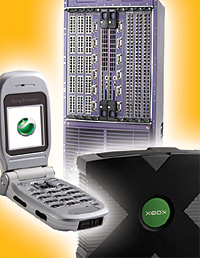
Significantly, though, the drop in profit that followed the collapse of the technology bubble was felt more severely by most of the other major EMS companies. Flextronics was unique among the majors in growing total revenue every year throughout the downturn. Flextronics’ size, scale, and vertical integration enabled it to seize business in consumer electronics from 2001 to 2003 as orders dried up in the telecom and Internet business. Flextronics went from a 51 percent dependence on the data and telecom industries in 2000 to an 18 percent dependence in early 2004, an intensive reconstruction of the customer base. The company’s new powerhouse products were consumer oriented: cell phones, printers, and computer game consoles.
“We ran very hard after the consumer business,” says Mr. Marks, who adds that the restructuring of the last three years was an extremely difficult time for Flextronics: “Our net employment went up, but we had to let 10,000 people go. Our business shifted away from the U.S. and western Europe. The growth was in Asia, eastern Europe, and Mexico.”
Today, Flextronics is reaping the benefits of that restructuring. Its lead over competitors looks likely to grow: 2005 revenue should rise 22 percent, surpassing $20 billion for the first time, while profits could rise 40 percent or more, according to Lehman Brothers, as Flextronics benefits from the continuing technology recovery and the growing efficiency of its lean production model.
But perhaps the ultimate validation of Flextronics’ strategy is the fact that it is provoking a larger transformation of the entire EMS industry. A few years ago, competitors scoffed at Mr. Marks’s unconventional strategic moves. Now most of them are imitating those moves — clambering to make their companies more vertically integrated, to develop their own global footprints, and to move further into product design.
Reprint No. 04408
Jeff Ferry (jferry@highstream.net) was the director of strategic communications for Nortel Networks and vice president of marketing for optical networking startup Yafo Networks. His book, The British Renaissance: How Six British Companies Are Conquering the World (William Heinemann, London, 1993), looked at world-class British manufacturing companies.